
Let me tell you something that makes Paris what it is ,the most beautiful City in the world. I am again lucky to have found a picture in my cd rom vault that made possible for me to tell you about it in my blog. Therefore, let me tell you on the seat house of Yves Saint Laurent in Paris !!! Hope you enjoy the post as I.
First, let me tell you on the street that the building is on, This is the Rue de Bellechasse of the 7éme arrondissement of Paris. It is almost straight, apart from a very slight bend at Rue de Grenelle. 650 meters long, it begins at Rue de Lille and ends at Rue de Varenne. The street is served nearby by metro line 12 at Solférino station, and RER line C at Musée d’Orsay station. The name “Bellechasse” given to this street comes from the fact that in 1636, a Mr. Barbier donated to nuns called Canonesses Regular of the Order of the Sepulchre of Jerusalem, a piece of land called “clos de Bellechasse”, to build a convent called the Religious of Pantemont, whose buildings, sequestered in 1790 during the French revolution, became the Bellechasse barracks, then the Protestant temple of Pentemont in 1802, by decision of Napoleon.
The Rue de Bellechasse was opened in several sections: The oldest section, located between Rue de l’Université and Rue Saint-Dominique, already existed in 1652; The southern section of the street, between Rue de Grenelle and Rue de Varenne, also existed in 1652 under the name “Rue Hillerin Bertin,” named after the owner of the surrounding land, part of which was acquired by Louis XIV at the end of the 17C to build the Hôtel des Invalides; To the north, between Rue de Lille and Rue de l’Université, the street was opened at the end of the 17C under the name “Rue de Belle Chasse.” It owes its name to the former convent of the Dames de Bellechasse; Between Rue Saint-Dominique and Rue de Grenelle, the street was opened in 1805 under the name “Rue Neuve de Bellechasse.” The name Rue de Bellechasse was extended to the entirety of the current street in 1850. Notable buildings here are at No. 27: former studio of Gustave Doré, built around 1865. No. 31: Alphonse Daudet lived here from 1885 to 1897; his wife received Marcel Proust there. In his living room was a double portrait of him and his daughter painted by his friend Eugène Carrière, now kept at the Musée d’Orsay; the politician Gaspard Monge and the physician Jean-Antoine Villemin died here, in 1818 and 1892. At Nos. 37-39: former Penthemont Abbey, Protestant temple of Pentemont since 1802, member of the United Protestant Church of France; seat of Saint Laurent since 2019. (see below) At No. 52: side facade of the Hôtel de Rochechouart, seat of the Ministry of National Education. No. 54: Hôtel de Courteilles, built by Alphonse de Gisors in the 19C,
And of course, let me tell you about No 37 Rue de Bllechasse, The former Penthemont Abbey, once home to the ladies of high society, is now the seat house of Saint Laurent. The high mass of fashion has replaced religious services in this symbolic place. Inspired by the iconic addresses that have forever marked the history of Yves Saint Laurent, their couture edition is a collection of unique fragrances that transcend gender and era. Deep and complex woody notes for the most haute couture scent possible , other stores are at 6 Place Saint Sulpice, and 24 Rue de l’Université. You even had a perfum call 37 Rue de Bellechasse, eau de parfum, a mysterious fragrance ,embossed by a spicy and woody elemi resin !!
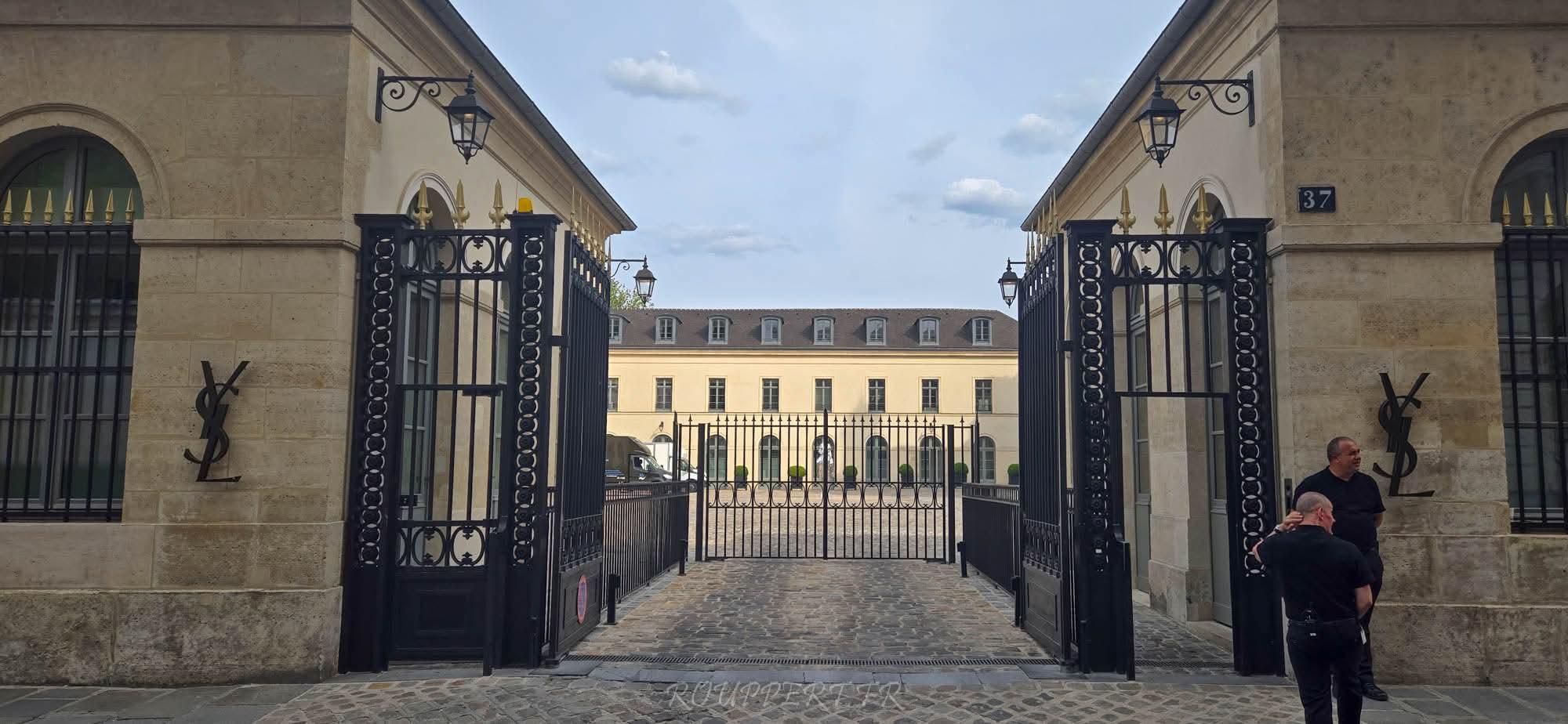
And of course, will tell you about the building where the house of Yves Saint Laurent is base today, The building is the former Bellechasse Convent. The nuns of Pentemont Abbey, located near Beauvais, settled in Paris in 1672. The current building complex was rebuilt starting in 1747 under the leadership of the new abbess, Marie-Catherine de Béthizy de Mézières. They were completed shortly before the French revolution due to a lack of funds. In this convent located in the heart of the very aristocratic Faubourg Saint-Germain, young girls of the nobility received an exemplary education. The establishment also served as a place of retreat for ladies of quality. Under the Empire, the abbey served as barracks. Joséphine de Beauharnais, then separated from Emperor Napoleon I, is said to have stayed there for 15 months. Part of the buildings were destroyed in 1835 during the extension of the rue de Bellechasse. The church was transformed into a Protestant temple in 1844. In 1915, the convent buildings were assigned to the Ministry of War, then to the Ministry of Veterans Affairs. In 2014, this vast architectural complex was sold by the State and acquired by the Foncière des 6e et 7e arrondissements de Paris, a real estate investment company. The ministry remained a tenant until 2016. Pentemont Abbey, the 19C barracks, and the Pentemont Pavilion, arranged around the garden, now house the seat house of the Yves-Saint-Laurent fashion house. The Hôtel du Génie now house a 5-star hotel belonging to the Marriott group.
The abbey church main façade faces Rue de Grenelle. It is distinguished by a central avant-corps. Its portal is framed by Ionic columns supporting a curvilinear pediment, itself topped by a large triangular pediment. Along the main axis of the church, the transept crossing is covered by a beautiful dome on pendentives, lit by four windows. Behind the choir, the church extends into a tower, then the vestibule and stairwell of the abbey residence. Visible from the entrance located at 37 Rue de Bellechasse, the abbey residence is perpendicular to the church. It is based on a large central avant-corps with cut sides, with niches on the ground floor, and topped with a triangular pediment at the attic level. Inside, the grand staircase has unfortunately disappeared; only a few elements of the decor of the abbey apartment remain.
A bit of history I like on the icon Yves Saint Laurent tell us that this fashion house started in 1961 founded by Yves Saint Laurent and Pierre Bergé at 30 bis rue Spontini. Its iconic logo, entwining the initials ‘YSL’, is designed by the French graphic Artist Adolphe Jean-Marie Mouron, known as Cassandre. Its original form is still used as part of the house iconography today. On January 29 1962, the first collection for the house of Saint Laurent is presented, to immediate international acclaim. The first piece created by the ateliers is a little black dress. Saint Laurent launches a boutique to sell a unique ready-to-wear line, the first ever to be given the same attention and creative energy as haute couture. The house , the avant-garde Left Bank of Paris is first named Saint Laurent Rive Gauche. It transforms the fashion industry, and invents designer ready-to-wear. By 1968, again a first Saint Laurent launches a ready-to-wear collection for men, Saint Laurent Rive Gauche pour Hommes, opening a boutique the following year. The house of Saint Laurent moves to 5 avenue Marceau, where the Musée Yves Saint Laurent now stands. (see post) In 1993, the Yves Saint Laurent group was sold to Sanofi. Yves Saint Laurent and Pierre Bergé, however, retained control of the fashion house, excluding perfumes and cosmetics. By 1997 in an exceptional move indicating his intention for the house of Saint Laurent to continue after he himself retired, and to cement his creative legacy , Yves Saint Laurent appoints the designers Alber Elbaz and Hedi Slimane to head the Saint Laurent Rive Gauche womens and mens lines respectively, while he continues to design the haute couture. In 1998, Saint Laurent stopped designing the Rive Gauche ready-to-wear collections. Alber Elbaz replaced him as artistic director of women’s ready-to-wear and Hedi Slimane of men’s ready-to-wear. Both designed very few collections under the Saint Laurent Rive Gauche label. By 1999 ,the Gucci Group purchases the house of Saint Laurent in December. In January 2000, François Pinault (PPR) imposed his brand by appointing the American Tom Ford as artistic director of ready-to-wear. Haute couture was separated and became the property of François Pinault through his holding company Artemis. In January 2002, Yves Saint Laurent retires from the house of Saint Laurent following a spectacular retrospective haute couture show at the Centre Pompidou ,the haute couture house closed its doors. No other couturier would replace him. Tom Ford was replaced by Stefano Pilati in 2004, followed by Hedi Slimane in 2012. In 2016, Anthony Vaccarello was appointed artistic director.The Pierre Bergé – Yves Saint Laurent Foundation, created that same year, opened its doors in 2004 in the former private mansion on Avenue Marceau occupied by the haute couture house. Its goal is to promote the work of Yves Saint Laurent in France and abroad. The label is rebranded to simply read ‘Saint Laurent’, referencing the ready-to-wear logo design and name originally conceived in 1966. In 2008, the Gucci group sold the perfume and cosmetics division to L’Oréal, retaining only the ready-to-wear division. In 2015, the house of Saint Laurent moves its creative operation to 24 Rue De L’Université , an address that emphasizes the ties of the house to this inspirational district or arrondissement of the city. Finally, in 2017 the operations of the house of Saint Laurent move to 37 rue de Bellechasse, once again on the Left Bank of Paris.
The official YSL stores in Paris : https://www.ysl.com/fr-fr/stores
The Paris tourist office on the 7éme arrondissement de Paris : https://parisjetaime.com/eng/article/explore-paris-s-7th-arrondissement-a825
There you go folks, a dandy place to visit at the Yves Saint Laurent house, another wonderful spot in my eternal Paris. Again, hope you enjoy this post on the seat house of Yves Saint Laurent in Paris !!! as I.
And remember, happy travels, good health, and many cheers to all !!!

 Paris1972-Versailles2003