
I am inspire again on writing about this memorable spot of many passing walking driving and just plain memories of always in my eternal Paris. I have found me pictures in my cd rom vault that should be in my blog for you and me, This is a sublime, beautiful, architecturally stunning and full of wonderful history area to walk until ends needs. Therefore, here is my take on the Jardin du Trocadéro of Paris !!! Hope you enjoy the post as I.
The place du Trocadéro-et-du-11-Novembre is located in the 16éme arrondissement of Paris with access by Metro Trocadéro lines 6 and 9 ; metro Boissière and Passy on line 6 as well as Bus lines 22,30,32 , 63, 72 and 82 arrêt/stop Trocadéro, It is at the crossroads of Avenue du Président-Wilson, Avenue Kléber, Avenue Raymond-Poincaré, Avenue d’Eylau, Avenue Georges-Mandel and Avenue Paul-Doumer. It opens onto the Human Rights Square and the Palais de Chaillot, which houses in its west wing (Passy) the Musée de l’Homme and the Musée de la Marine and in its east wing the Cité de l’architecture et du patrimoine and the Musée des Monuments français. On the heights of Chaillot, its diameter is 164 meters. It is planted with trees and decorated in its center with an equestrian statue of Marshal Foch, surrounded by a lawn that is difficult for pedestrians to access. The square opens onto the Palais de Chaillot and its forecourt overlooking the Seine and offering a clear view of the Eiffel Tower. The square is one of the capital’s top tourist spots. Along with various newsstands, it is mainly home to cafés and brasseries, such as the Café du Trocadéro, Le Malakoff, Pâtisserie Carette (my fav), Café Kléber, and Le Coq.
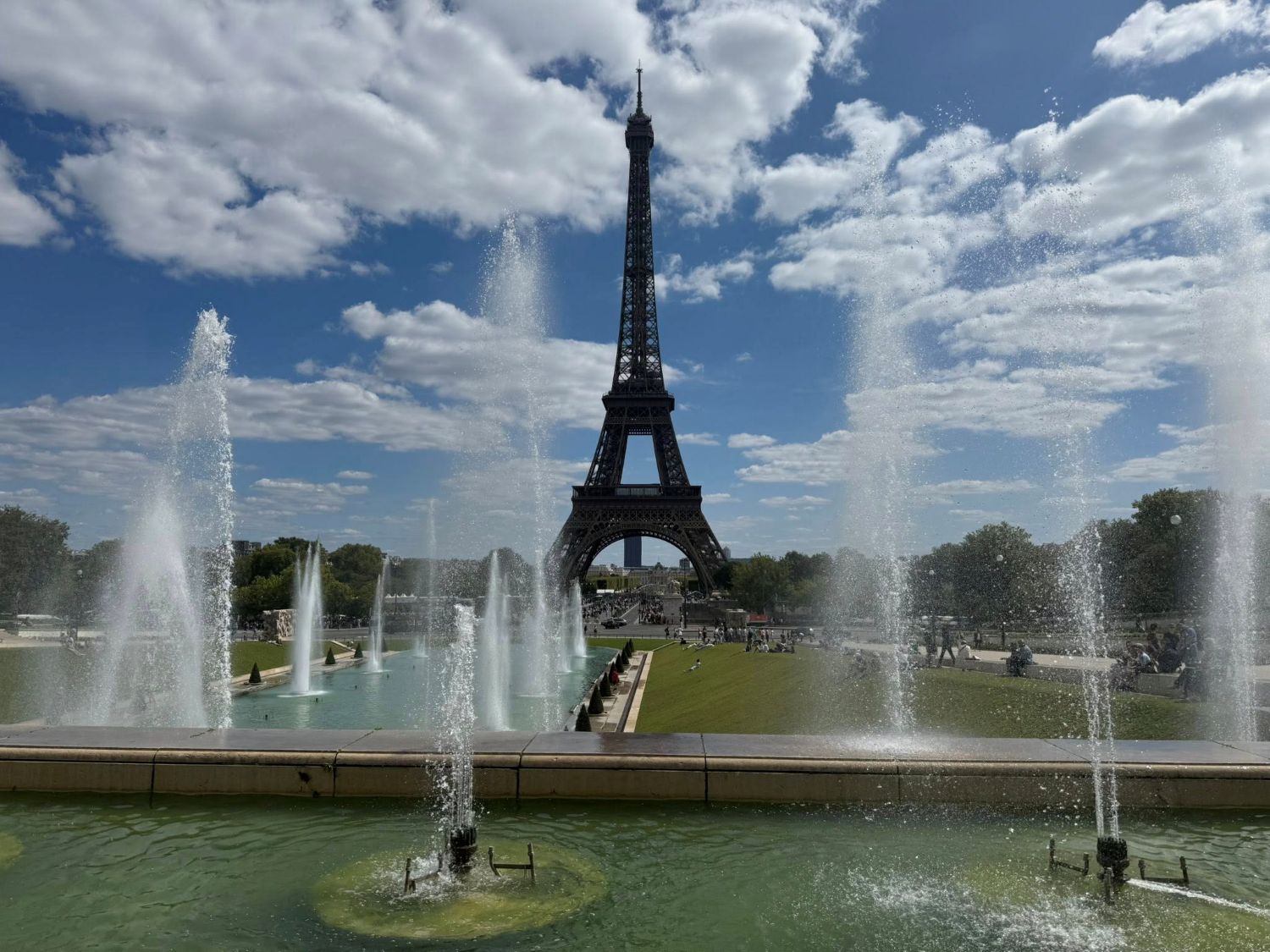
On the hill was built Palais Chaillot and below you can stroll in the Jardin du Trocadéro gardens. You can admire many monuments and sculptures there: equestrian statue of General Foch, statue of Apollo Musagete, A true symbol of the city of Paris, it is an essential spot for souvenir photos in Paris, with a breathtaking view of the Eiffel Tower, the Champs de Mars and the Seine.
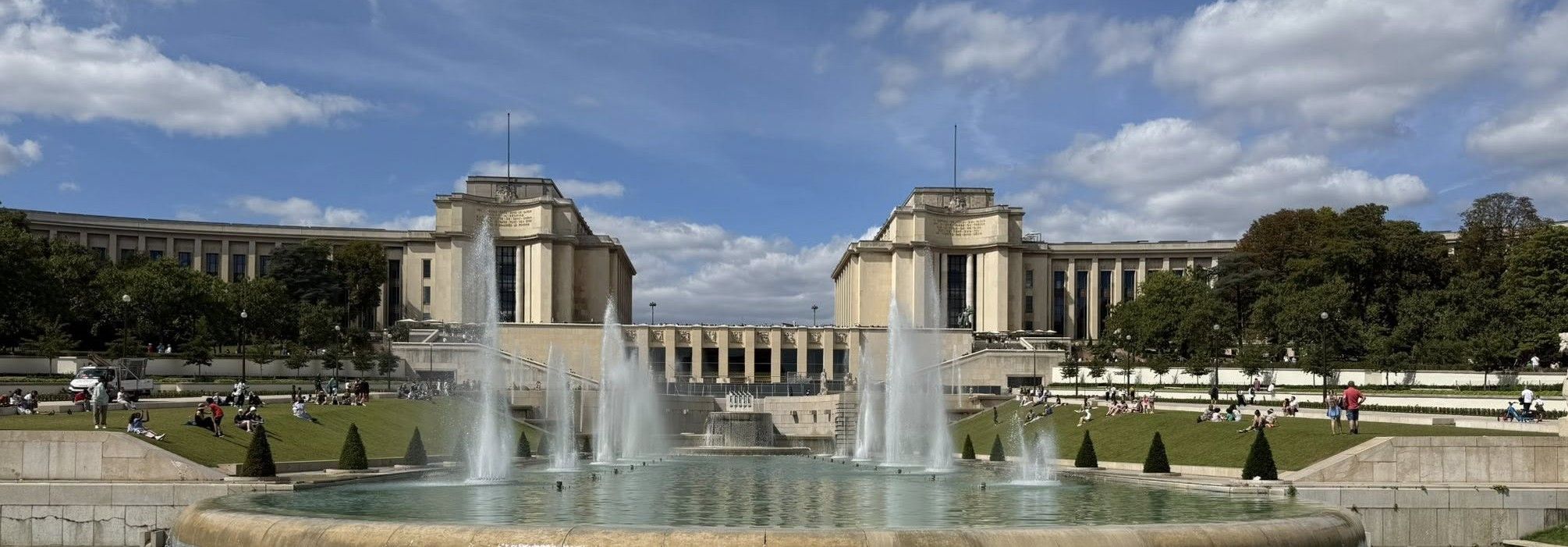
The Jardin du Trocadéro bear the imprint of the two World Fairs that shaped them. From the 1878 Exposition, we remember the large trees shading the winding paths, the waterfalls and the rocks in the pure tradition of Haussmannian gardens designed by the engineer Adolphe Alphand, head of the Promenades and Plantations of Paris under the Second Empire. The 1937 Exposition redesigned the central axis, magnifying the brand new Palais de Chaillot: the so-called Warsaw fountain and its 20 oblique cannons with a range of 50 meters is lined with sculptures and cone-shaped yew trees. Today, the Trocadéro Gardens are a must-see for admiring the Eiffel Tower, and the famous Warsaw Fountain (1937). The large waters of the central basin are highlighted by a play of light that animates the gilded bull-headed and horse-headed statues in the evening. The Trocadéro Gardens are punctuated by a multitude of sculptures, some dating from the 1930s, such as “Man in Traverse” and “The Woman” by Bacqué, which overlook the basins. Two English-style gardens unfold on either side of the Palais de Chaillot. A small artificial river follows their path alongside beeches, horse chestnuts, lime trees, and blue Atlas cedars, as well as a red oak, a Byzantine hazel, and one of the largest plane trees in Paris. This lush vegetation meets a disciplined row of paulownias below, which mark the entrance to the mineral and aquatic world of the Warsaw fountains. The gardens provide access to the Paris Aquarium. An anecdote ,not known to many is that there is indeed a secret tunnel under the Trocadéro. The Victor Tunnel connects the Trocadéro esplanade to the Palais de Chaillot. The latter served as a hideout and headquarters for all French resistance fighters during WWII.
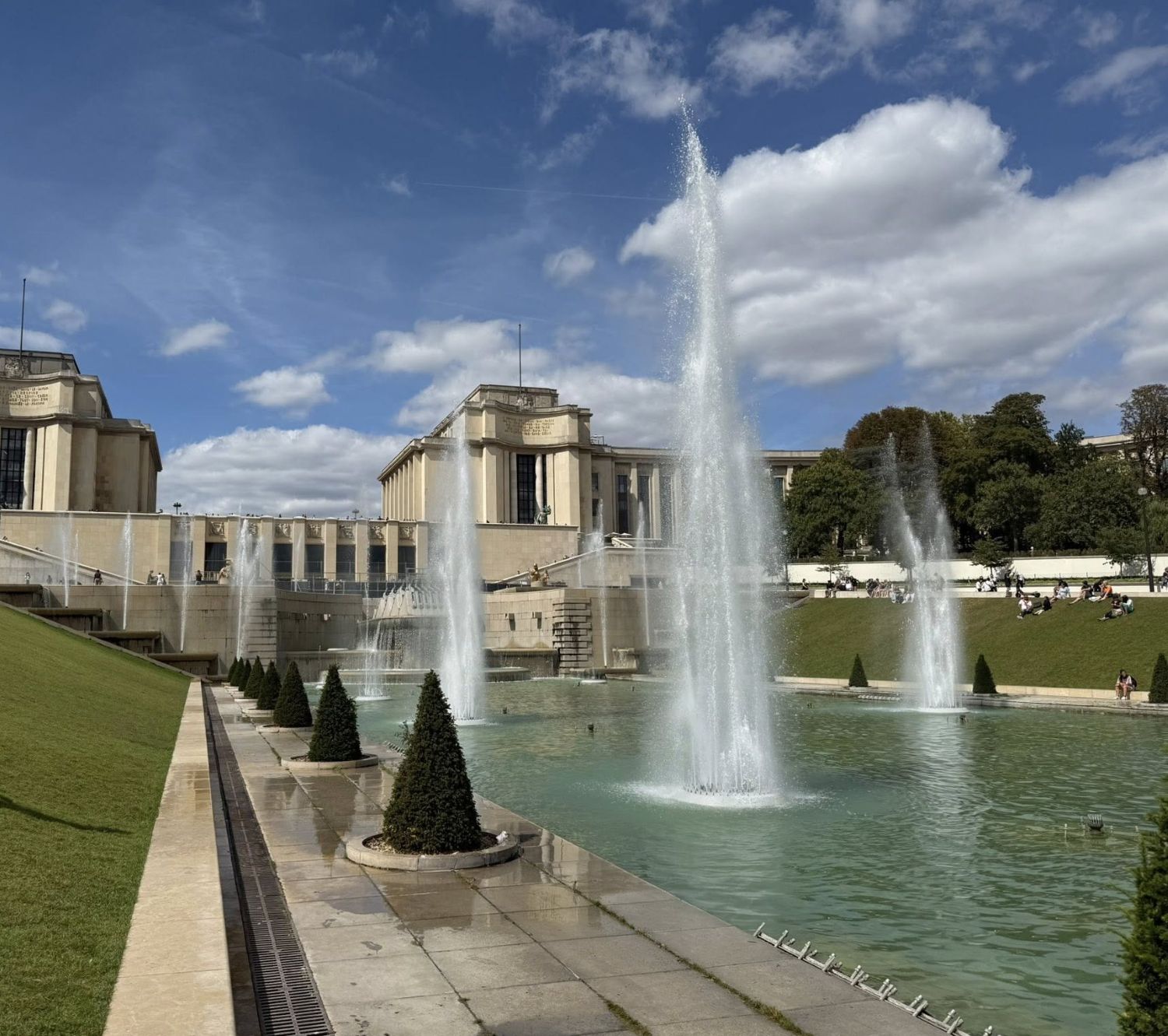
The Place du Trocadéro whose name resonates in the four corners of the world, will be transformed: at its heart, 4000 m2 of vegetation will be available to pedestrians. The rest of the square will be developed to offer more space for bicycles, buses and emergency vehicles. Cars will no longer have a place in this area. The center of the bridge will host a pedestrian zone, with a view of the Eiffel Tower. On each side of this pedestrianized space, in a symmetrical configuration, a traffic lane for buses, bicycles and emergency vehicles will be installed. The Avenue des Nations Unies (towards Avenue d’Iéna) will be dedicated to emergency and health vehicles as well as public transport and bicycles. While the west side of the avenue and the perimeter of the fountain will be dedicated to pedestrians, while remaining accessible to emergency and health vehicles and bicycles. For the Trocadéro-Iéna sector, enhancing and preserving heritage is not limited to reducing pollution. The area around the Warsaw Fountain has already been restored, as have the statues on the Pont d’ Iéna bridge.
A bit of history I like tell us that the square is located on the upper part of the former grounds of the Visitandine Convent of Chaillot, previously the park and Château de Chaillot. In 1869 under the name “Place du Roi-de-Rome,”in homage to Charles Joseph Bonaparte, son of Emperor Napoleon I, it was renamed in 1877 in memory of the Battle of Trocadéro, which took place on August 31, 1823, during which a French expeditionary force captured Fort Louis, which defended the port of Cadiz in Spain, from the hands of the Spanish liberal revolutionaries and restored the authority of King Fernando VII. November 11 corresponds to the armistice of November 11, 1918, which marked the end of the fighting in the Great War or WWI. In everyday language, however, it remains called “Place du Trocadéro” or is abbreviated to “Troca.” It took the current name Place du Trocadéro in 1877.
The former Palais du Trocadéro Palace was built for the 1878 World’s Fair. The palace was also used for the 1889 World’s Fair and the 1900 World’s Fair. Criticized for its architectural style and the poor acoustics of the main hall, it was dismantled in 1935. It was replaced by the current Palais de Chaillot for the 1937 International Exhibition of Arts and Technology. The central building was destroyed and the wings reused for the new palace. The fountain in front of the Trocadéro Palace was in the form of a cascade. Bronze mascarons were incorporated into it, believed to be by Auguste Rodin, a young sculptor who was working for Eugène Legrain, who was more famous than him at the time. Seven of them were recovered and reinstalled on the edge of the waterfalls in the Parc de Sceaux; others were installed on the retaining wall of the terrace of the Jardin des Serres d’Auteuil, and plaster models of two of them are kept at the Musée des Arts Décoratifs in Paris. The fountain was remodeled in the 1890s and the mascarons dismantled. The fountain was destroyed in 1935 and replaced by a new fountain at the foot of the Palais de Chaillot , the fontaine de Varsovie or Warsaw’s fountain. The six allegorical statues representing the continents (North America, South America, Oceania, Africa, Asia and Europe) around the ballroom are currently located in front of the entrance to the Musée d’Orsay.
The Paris tourist office on the quartiers or neighborhoods of Trocadéro and Passy : https://parisjetaime.com/eng/article/trocadero-and-passy-a911
The Paris tourit office on Trocadéro and its esplanade : https://parisjetaime.com/eng/transport/le-trocadero-et-son-esplanade-p1900
The Paris tourist office on the 16éme arrondissement de Paris : https://parisjetaime.com/eng/article/a-la-decouverte-du-16e-arrondissement-de-paris-a830
There you go folks, another dandy in my eternal Paris, once bitten, the virus of love stays with you. This is an area to walk your shoes off, wonderful magical , we love it in the 16 ! Again, hope you enjoy the post on the Jardin du Trocadéro of Paris !!! as I.
And remember, happy travels, good health, and many cheers to all !!!

 Paris1972-Versailles2003