
I bring you back to my eternal Paris and so glad found me more pictures in my cd rom vault that should be in my blog for you and me, I have, also told you that there is so many things to see here that you will need a lifetime. Passed by it as it is in a popular area, and finally went in a while back. There is always time to indulge in Paris and there is always new things to see . Therefore, let me tell you a bit on the Church Sainte Elizabeth de Hongrie of Paris !!! Hope you enjoy the post as I.
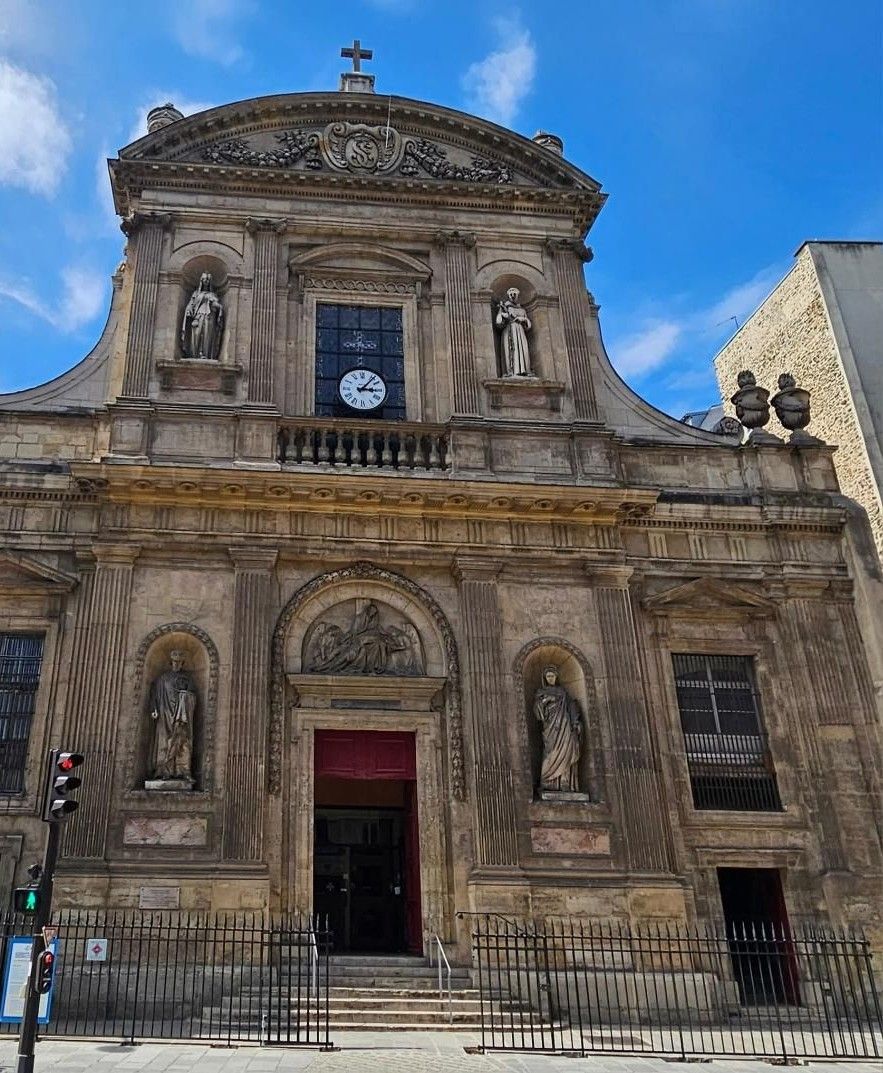
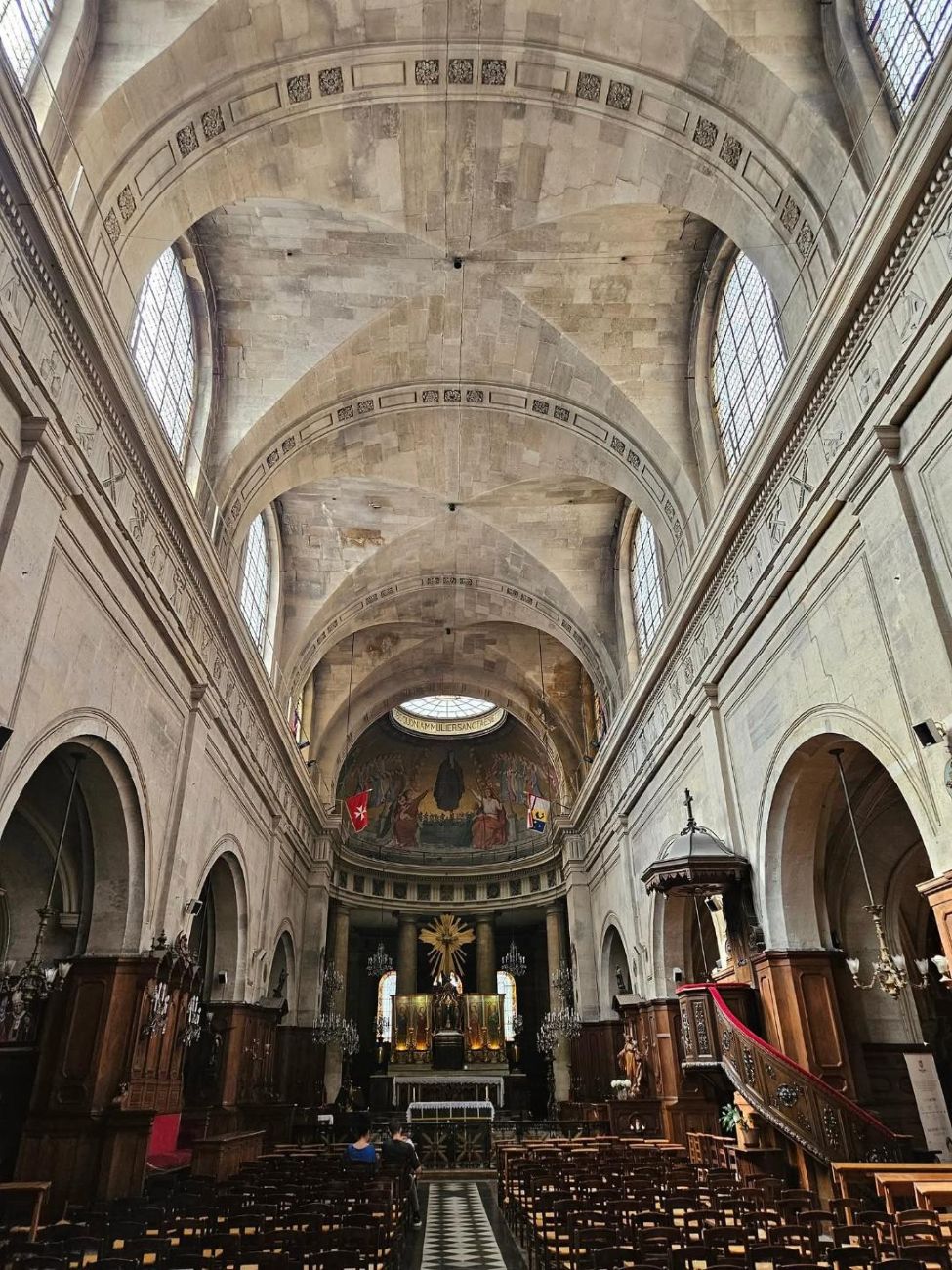
The Church Sainte Elizabeth de Hongrie is located in the 3éme arrondissement of Paris, dating from the 17C and 19C. It is located at 195 rue du Temple, bordered on one side by the Passage Sainte-Élisabeth. It is served by the Temple line 3 , and République lines 3, 5, 8, 9 and 11, metro stations. The parish’s perimeter extends over part of the 3éme and 11éme arrondissements around the Cirque d’Hiver.
Externally, the Church Sainte Elizabeth de Hongrie is notable primarily for its original façade, in the classical style and inspired by the Jesuits. A Pietà sits on the tympanum. Four statues date from the Second Empire: below: Saint Louis and Saint Eugenie (patron saint of the wife of Napoleon III); above: Saint Elizabeth and Saint Francis of Assisi. The current church consists of a nave and an adjoining chapel, aisles, an ambulatory and a bell tower, a sacristy and various rooms.
Inside is gorgeous, it has in the nave a cornice accompanied by a frieze decorated with liturgical symbols and the instruments of the Passion. a carved wooden pulpit, a bench decorated with cherubs. in the choir: a half-dome decorated with a fresco representing “The Glorification of Saint Elizabeth of Hungary welcomed by the angels in heaven”. Elizabeth wore the Franciscan habit. She is greeted by the three theological virtues and by the archangels Saint Michael and Saint Gabriel. four round columns in classical style 19C; a high altar decorated with paintings of adoring angels and a bronze bas-relief of the Resurrection 19C, a wooden altar 21C, stalls, a wooden Virgin, two stained-glass windows: “The Miracle of the Roses” and “The Canonization of Saint Elizabeth by Pope Gregory” of 1891.
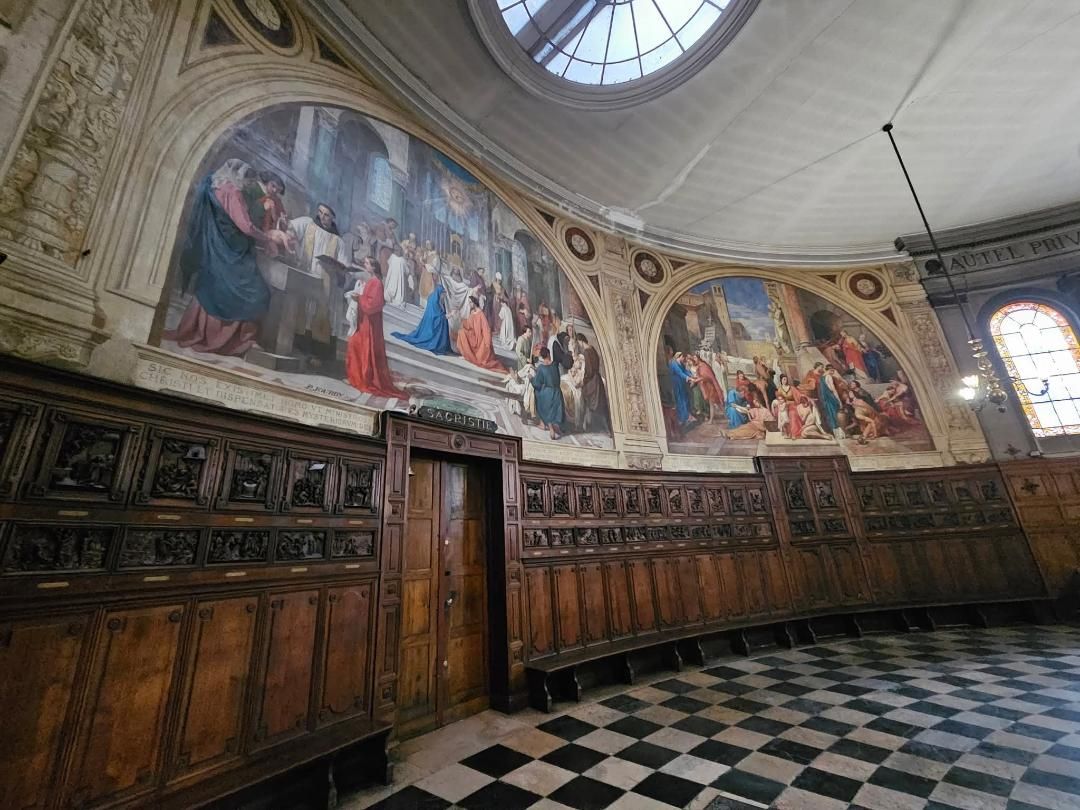
In the ambulatory: a series of 100 wood carvings in medium relief from the beginning of the 17C, installed around 1845 and coming from the Abbey of Saint-Vaast in Arras, where they decorated the stalls. They represent scenes from the Old and New Testaments. They bear the mark of the reform resulting from the Council of Trent and reflect the theological trend of the period 1623. Deposited in the 18C and then forgotten, they reappear in the 19C Christ on the cross surrounded by the Virgin and Saint John, a 17C wooden triptych in the Louis XIII style; four frescoes from the middle of the 19C; including The Beatitudes , The Seven Sacraments , The Last Judgment , and The Seven Works of Mercy. Another work ,Let the Little Children Come to Me, can be admired there. the altar of the Sacred Heart,
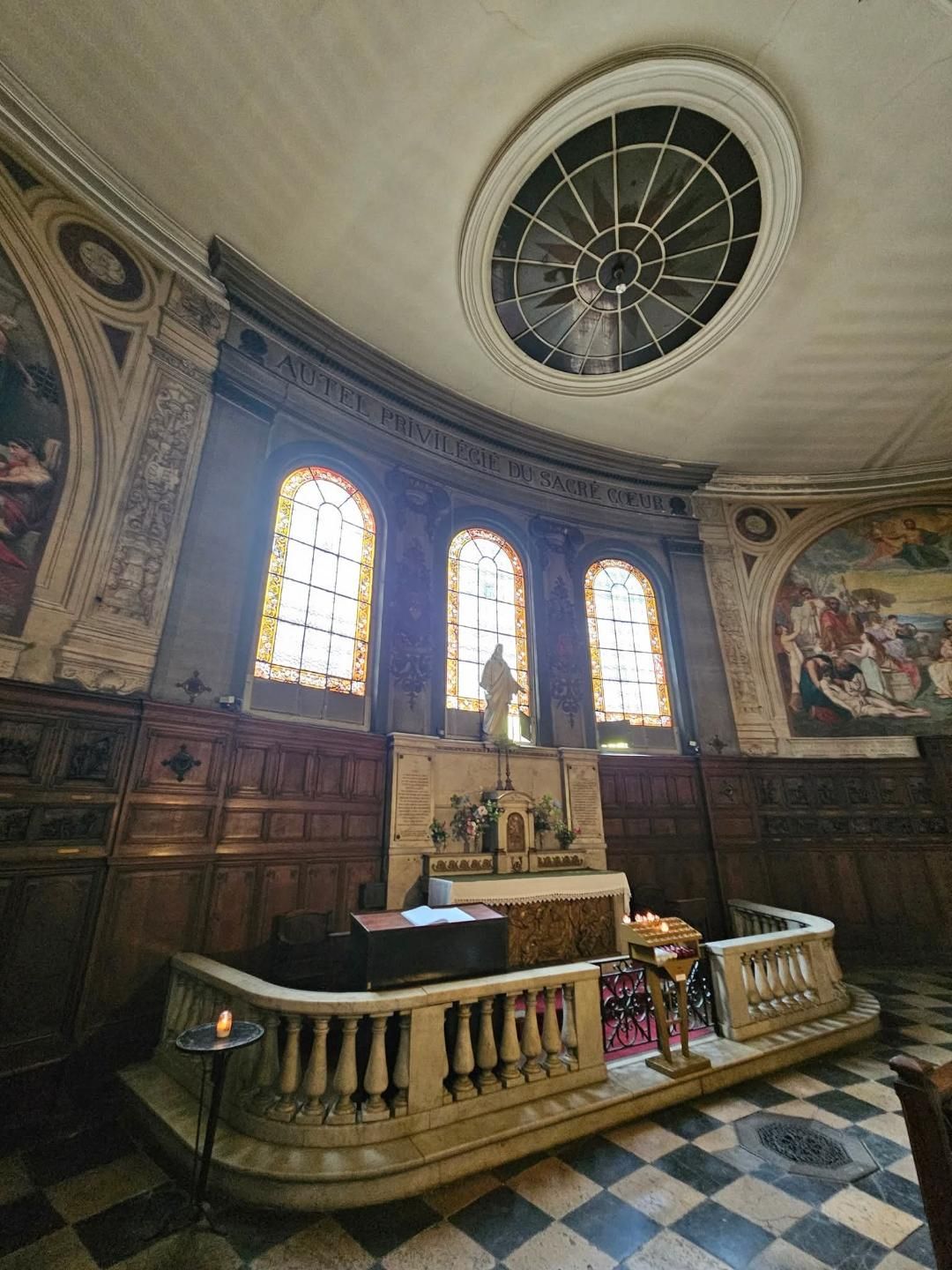
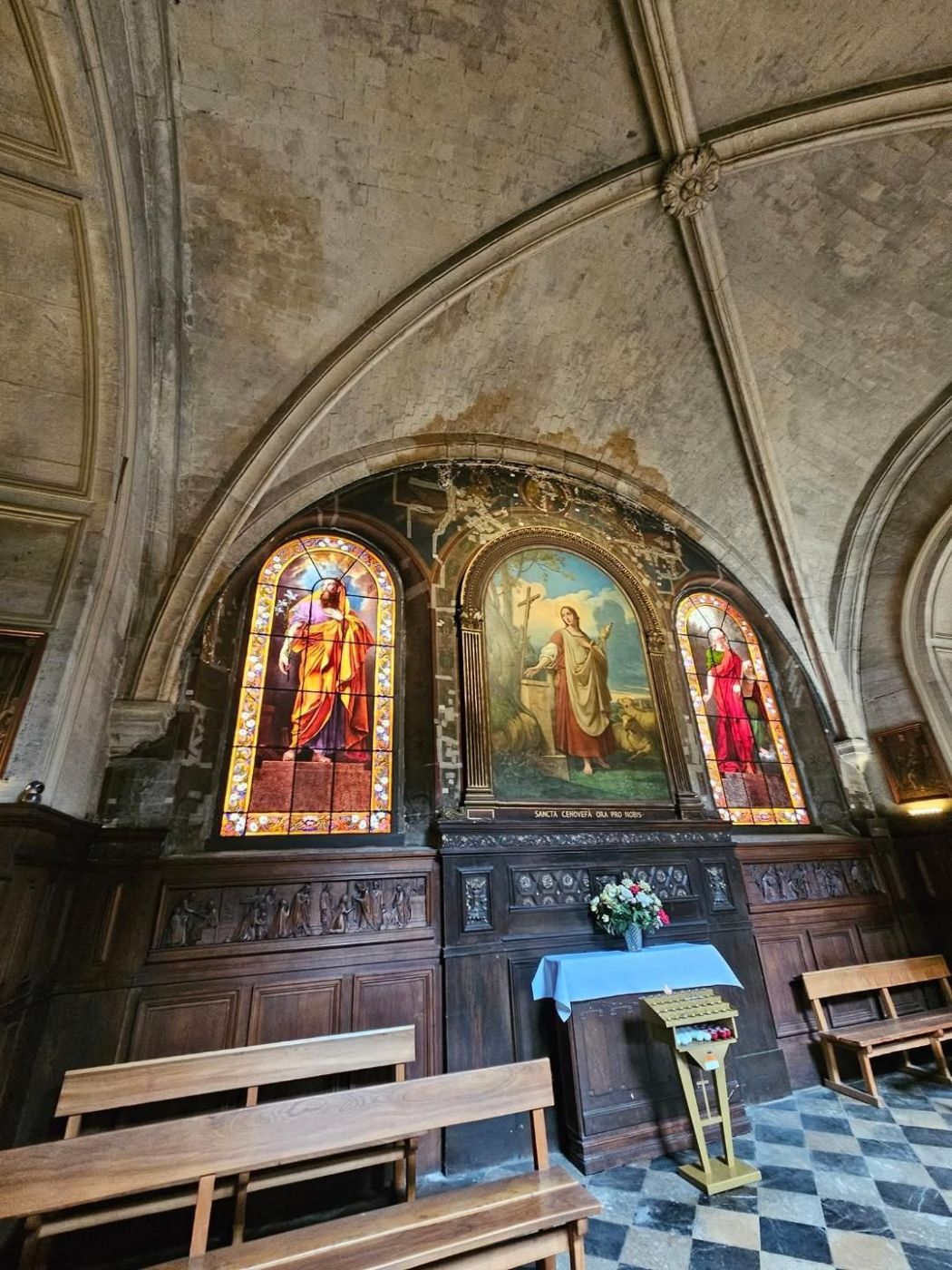
In the side aisles: to the left of the entrance, at the height of the great organ, a statue of the Virgin Mary in the chapel dedicated to Our Lady of Peace. A statue of Saint Therese of the Child Jesus at the entrance to the Catechism Chapel (Gospel Room). A statue of the Virgin and Child. A statue of Saint Joseph and Saint Anthony of Padua. Baptismal fonts from 1654, from the Saint-Sauveur Church. They are still in use today. Confessionals. remarkable stained-glass windows from the 1820s. They depict Saint John the Evangelist, Saint John the Baptist, and Saint Joseph, and were created by the glass painting workshop of the Manufacture de Sèvres based on cartoons by Abel de Pujol. a 16C Pieta, attributed to the Master of Chaource; two statues of Saint Elizabeth; a painting on wood depicting, among others, Abbé Girault (author unknown); a painting of Saint Genevieve (the patron saint of Paris) watching over her sheep. a Stations of the Cross (2009); 19C wooden panels illustrating the life of Saint Genevieve. in the Chapel of the Virgin: an altar decorated with the three theological virtues; a large painting “Elizabeth laying her crown at the feet of the image of our Lord”; a plaster statue of Saint Elizabeth (1845); an anonymous painting “Mary of Bethany in prayer” with, in the background, a rare scene: a woman quarreling with Christ, Martha of Bethany, Mary’s sister. in the Chapel of Catechisms (Gospel Room): four semi-circular canvases mounted on a 19C frame.
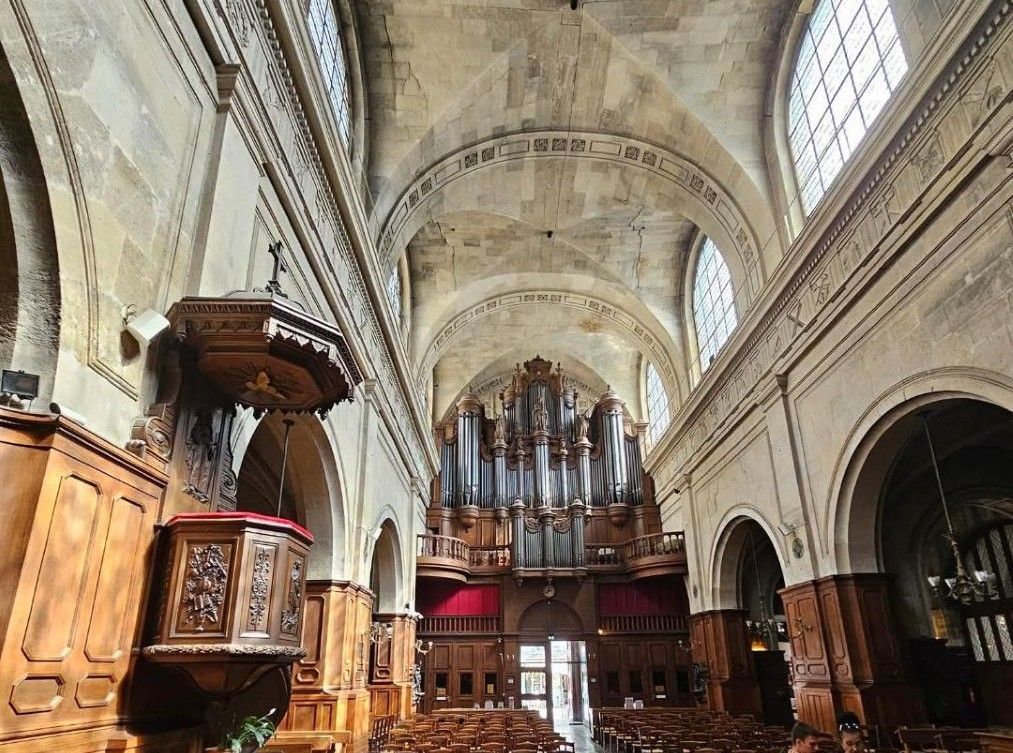
The choir organ, located behind the high altar, installed around 1925 and transformed at the end of the 1950s. The great organ is placed on a large gallery at the end of the nave. It is the largest instrument by Marie Antoine Louis Suret, inaugurated in 1853, Due to its wonderful acoustics, many classical music concerts have taken place there.
A bit of history I like tell us construction of the church began in 1628 , and Queen Marie de Medici laid the foundation stone on May 14, 1628. In 1643, work was resumed that had been stopped in 1631, completing it around 1646. The church was consecrated on July 14, 1646, under the presidency of Queen Anne of Austria, by Jean-François Paul de Gondi, future Cardinal de Retz, and coadjutor of the Archbishop of Paris. It was then dedicated to Saint Elizabeth of Hungary and Our Lady of Pity. The godfather and godmother of the bell were the Duke of Angoulême, Grand Prior of the Order of Saint John of Jerusalem, and Charlotte de Montmorency. First the chapel of the monastery of the nuns of the Third Order of Saint Francis (from 1646 to 1792), then the parish church (since 1802) of the Temple district, it regularly hosts since 1938 religious celebrations of the Sovereign Order of Malta in Paris.
Originally, the church was the chapel of the monastery of the cloistered Franciscan sisters of the Third Order Regular of the Strict Observance. They were responsible for the education of young girls as well as the elderly. Among them was probably Esprit Madeleine Poquelin, daughter of Molière. During the French revolution, on August 29, 1792, the nuns were expelled by the municipal authorities of the Paris Commune. The confessor of the Ladies of Saint Elizabeth, Father Georges Girault (in religion Father Séverin de Saint Jean) was arrested and imprisoned in the Discalced Carmelite convent. Assassinated on September 2, 1792, he became the first martyr of the Carmelites and was declared blessed in 1926. The convent chapel then became a flour depot called “the Élisabeth Store,” open until 1802. The bell tower was destroyed during the Terror. The royal family was imprisoned a few meters from the church, in the Temple Tower. A painting by Gustave François, visible in the church to the left of the main door, depicts Louis XVI’s farewell to his family on January 20, 1793. The church was returned to worship at the beginning of the 19C. It was at this time that it became the parish church of the Temple district. The parish church, Sainte-Marie-du-Temple, which was located in the Temple enclosure, near Rue Perrée, had been razed in 1796 or 1797. In 1815, a Mass for Louis XVI was celebrated there by Hyacinthe-Louis de Quélen, at the request of the bailiffs, commanders, and knights of the Sovereign Order of Malta.
It was enlarged during the Restoration. A choir, an ambulatory, and two large chapels were added to the left aisle. In the ambulatory, a small axial chapel dedicated to the Virgin built, but it was destroyed in 1858 when Rue Turbigo was opened. In 1845, the priest Éloi Jousselin purchased and installed in the ambulatory the carved woodwork from the stalls of the Abbey of Saint-Vaast in Arras. He also installed the great organ and the woodwork of the nave and side aisles. In 1853, the great Suret organ, winner of the first medal at the 1855 World’s Fair, was inaugurated. From 1923 to 1947, the priest of Sainte Élisabeth was the canon and art collector Albert Marcadé. During his term of office, a new sacristy and a new bell tower were built, an organ was installed in the choir, and it became, without ceasing to be a parish church, the church of the Sovereign Order of Malta in France. In November 2007, the 8th centenary of the birth of Saint Elizabeth of Hungary was celebrated there, including a pontifical mass presided over by Cardinal Tauran, the veneration of the mantle of Saint Francis, a procession to Notre-Dame de Paris with the relic of the heart of Saint Elizabeth and a pontifical Mass at the cathedral. On May 21, 2016, it was the starting point of a procession for the 1700th anniversary of the birth of Saint Martin, in the presence of Father Paul Préaux, General Moderator of the Saint-Martin Community and H.E. György Károlyi, Hungarian Ambassador to Paris. The procession ended in the Church of Saint-Germain-l’Auxerrois.
The official Church Sainte Elizabeth de Hongrie : https://sainteelisabethdehongrie.fr/
The Paris tourist office on the Church Sainte Elizabeth de Hongrie : https://parisjetaime.com/eng/culture/eglise-sainte-elisabeth-de-hongrie-p1245
There you go folks, a masterpiece church often overlook and totally bypassed by yours truly until now. Paris is always amazing and so is my belle France. Again, hope you enjoy this post on the Church Sainte Elizabeth de Hongrie of Paris as I.
And remember, happy travels, good health, and many cheers to all !!!

 Paris1972-Versailles2003