
This is one of those towns we came in my local road warrior trails while living in Versailles, the choices are endless just here alone. It is worth the detour for the quant pretty real towns and villages of my belle France, I am glad to have found me these pictures in my cd rom vault that made me do it for you and me. Therefore, here is my take on curiosities of Richebourg !!! Hope you enjoy the post as I.
The village of Richebourg is located in the Yvelines department no 78 in the Île-de-France region of my belle France. It is located at 23 km from Mantes-la-Jolie, 41 km from Versailles, 6 km from Houdan, 455 km from my current city, The village is served mainly by the D983 road which links Gisors and Mantes-la-Jolie to Houdan and Nogent-le-Roi. I came from Versailles on rue de la Paroisse, right onto Rue du Maréchal Foch, continue to Avenue de l’Europe ,continue on Avenue du Général de Gaulle (D10) continue to Rue Royale turning right on Rue Albert Samain, then left on Rue du Maréchal Joffre (D91) continue same road on Avenue Clément Ader to connect with the N12 highway at exit/sortie 4 then continue until exit/sorte D983 dir Bazainville go around village of Maulette and continue on the D983 which is also Route de Houdan bear right just entering the village by the cementery on your right hand side and bear right onto Rue Saint Georges and the church.
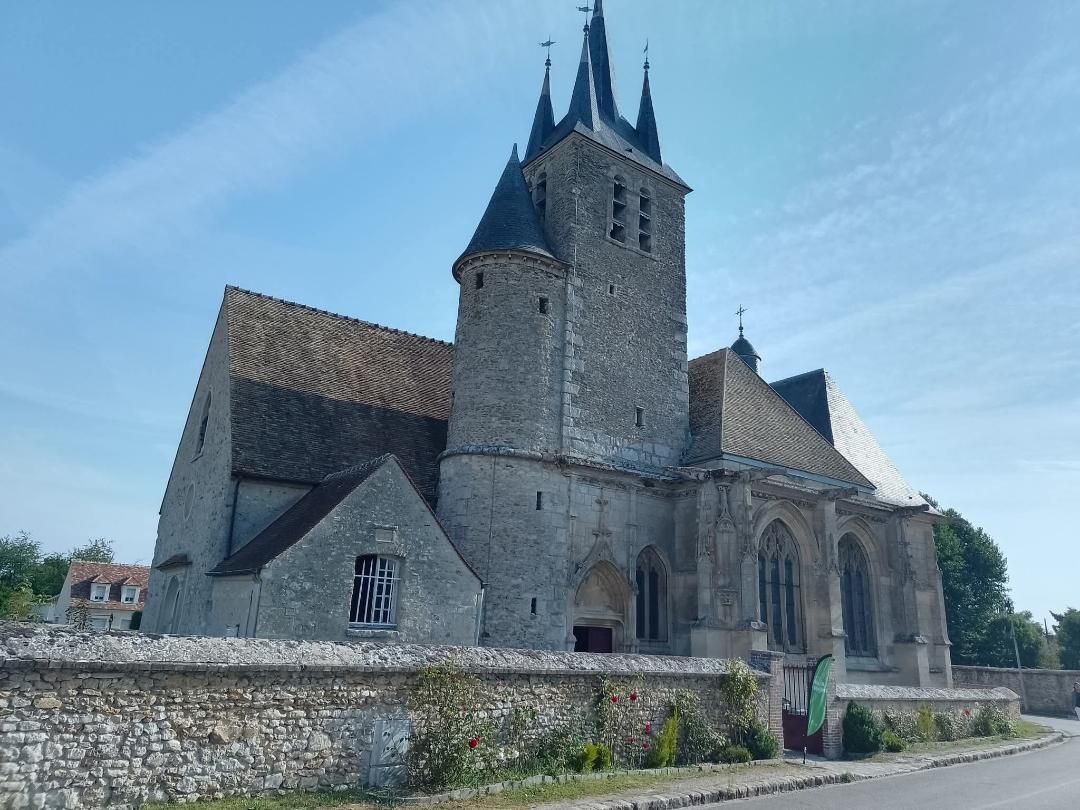
The Church Saint-Georges was built in Flamboyant Gothic style in the 16C and 18C. The church is dedicated to Saint-Georges, probably because its builders, veterans of Italy fighting alongside the Kings of France, wanted to pay homage to the patron saint of knights. Legend has it that Saint-Georges, a knight in the Middle Ages, defeated a dragon during a fierce battle.
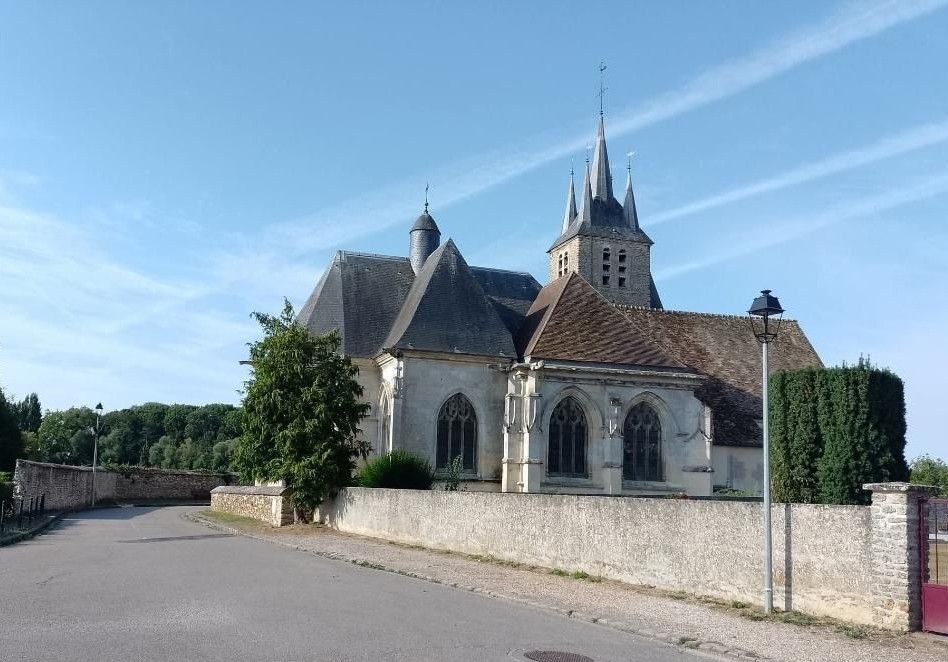
The five-bay covered nave, paneled with sculpted beams, consists of a central vessel accompanied by side aisles. The nave, which is the oldest part of the church, dates back to the 12C. The reconstruction of the church, undertaken throughout the 16C in flamboyant Gothic style, is inextricably linked to the Sabrevois family. Outside the church, one can see 13 gargoyles of imposing size compared to the size of the church. Monstrous animals such as dragons, lizards, chimeras, grimacing human heads, etc. can be seen. The tower was added in the 17C and the sacristy in the 18C. The bell tower was built in 1603 ,and has a central spire, flanked by four pinnacles. The bell tower with a quadrangular base has a turret staircase. It is entered through a pointed arch door. This tower is covered with a pepperpot roof surrounded by four smaller pepperpots, all made of slate. While the transept and the choir are in flamboyant Gothic style, the high walls with few openings are more Romanesque in style, The square choir of a bay with three aisles, vaulted with ribs, is extended by a polygonal apse decorated with sculpted keystones. The south of the nave is flanked by a quadrangular chapel and the bell tower. The windows are in the Flamboyant Gothic style.
The Church Saint Georges contains works from several periods such as a 15C stone Madonna known as Our Lady of Richebourg; a 16C stained-glass window depicting the Tree of Jesse; two sculptures, a 16C Saint Catherine and an 18C Saint Nicholas; and two 19C paintings on either side of the choir, depicting Christ’s Visit to Martha and Mary and Jesus and the Samaritan Woman.
Other things to see here are The aqueduc de l’Avre crosses the village, passing very close to the center. It is one of the works that supplies the city of Paris with drinking water. Inaugurated in 1893, The Château de Richebourg: built between 1522 and 1537 on the site of a feudal castle. In 1709 it was extended with two wings. In 1976 it was acquired by the Mallet Foundation, which transformed it into a medical center and accommodation for people with disabilities. The castle park can be visited during the European Heritage Days. The Villa de la Pièce du Fient remains of a Roman villa of a Gallic nobleman dating from the 1C BC and abandoned in the 3C.
A bit of history I like tell us that hstorically, the name Richebourg only appears in the 11C as Rich-borg = stronghold. Before that, there was only “saulx,” a village (where the church above is located) built along the Saulceron river, built on numerous Gallo-Roman remains and located at the crossroads of two important Roman roads. The Richebourg family was the most powerful vassal of the Counts of Montfort from 1100 to 1468 , then passed through the hands of various noble families. The village was called Saulx-et-Richebourg until 1800.
The village of Richebourg on its history/heritage : https://richebourg78.fr/decouvrir/richebourg-en-chiffres/
The village of Richebourg on the Church Saint Georges : https://richebourg78.fr/leglise-et-le-cimetiere/
The local Pays Houdanais tourist office on Richebourg : https://en.tourisme-pays-houdanais.fr/?recherche=richebourg
There you go folks, enjoy this wonderful ride into the French soul, and the countryside of the Yvelines dept 78 at quant nice off the beaten path village of Richebourg, there is a lot more to see around here ! Again ,hope you enjoy this post on curiosities of Richebourg !!! as I.
And remember, happy travels, good health, and many cheers to all !!!

 Paris1972-Versailles2003