
This is one of those towns we came in my local road warrior trails while living in Versailles, the choices are endless just here alone. It is worth the detour for the quant pretty real towns and villages of my belle France, I am glad to have found me these pictures in my cd rom vault that made me do it for you and me. Therefore, here is my take on this is Senlisse !!! Hope you enjoy the post as I.
The village of Senlisse is located in the Yvelines department no, 78 in the Île-de-France region of my belle France. The village is 3 km from Dampierre-en-Yvelines, 4 km from Choisel, 2 km from Cernay-la-Ville, 7 km from Chevreuse, 22 km from Versailles, and 444 km from my current home, I came here from Versailles, on rue de la Paroisse right on rue du Maréchal Foch, continue onto Avenue de l’Europe, continue onto avenue du Général de Gaulle, (D10) continue onto Rue Royale and turn right on Rue Albert Samain, then left onto Rue du Maréchal Joffre (D91) continue same road to Avenue Clément Ader to connect with the N12 highway by exit/sortie 4 but get off at exit/sortie 6 dir Montigny le Bretonneux on Route de Guyancourt take a quick right into the D36 road and then a quick left back to D91 road by Voisins le Bretonneux continue on the D91 road dir Dampierre en Yvelines continue until turning left onto D149 road or Rue de Cernay la Ville just before centre ville of Senlisse turn left onto rue du Couvent to church of Senlisse.
The Church Saint-Denis dates from the 13C, and a Virgin and Child adorns the tympanum of the entrance porch. The church is roofed with brown tiles. Its plan is simple: a flat chevet closes the nave, and the two side aisles each have four vaulted bays. On the north aisle stands the bell tower: a square tower pierced with walled ogival bays and an octagonal timber-framed spire, all covered with slate.
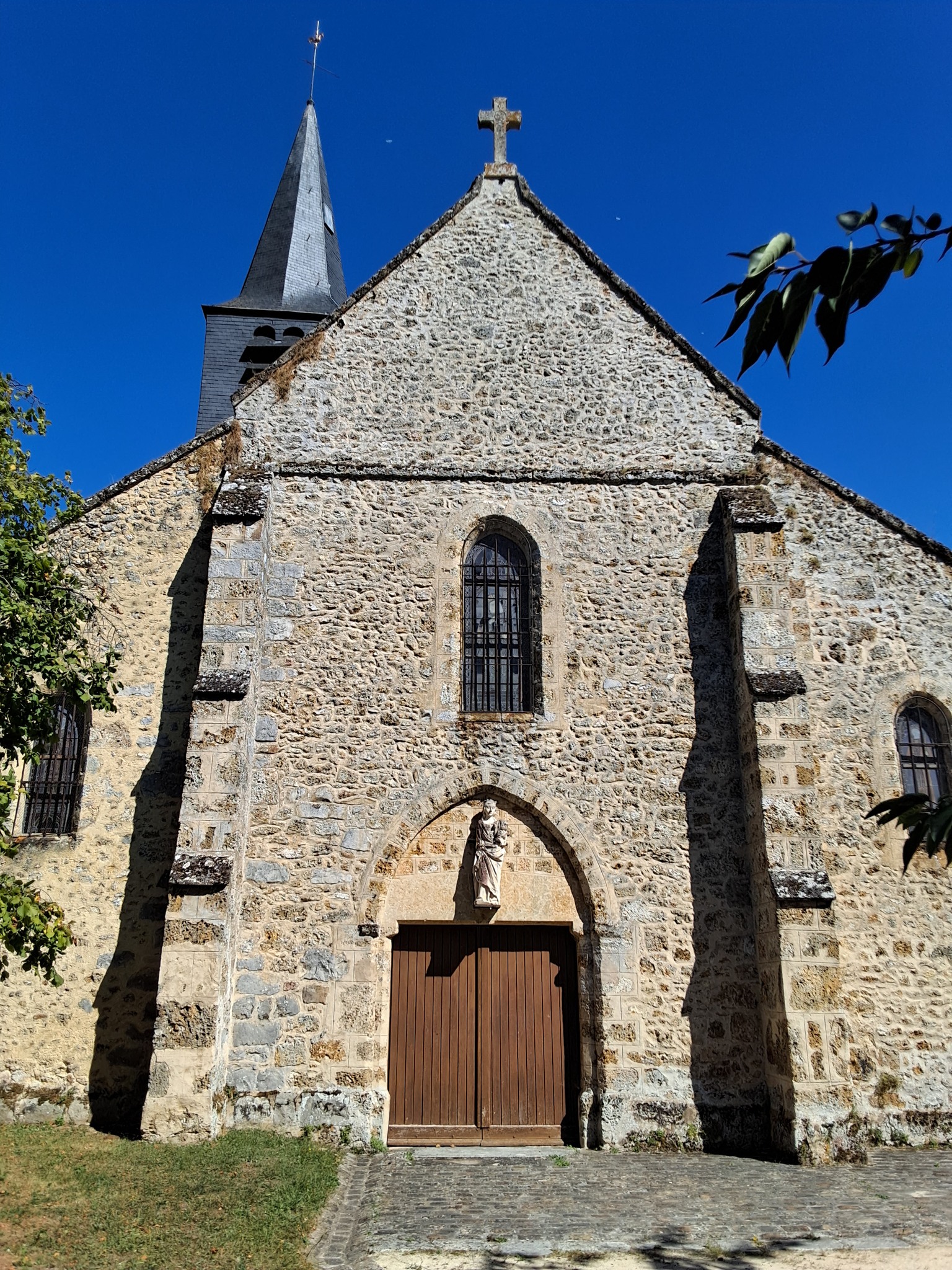
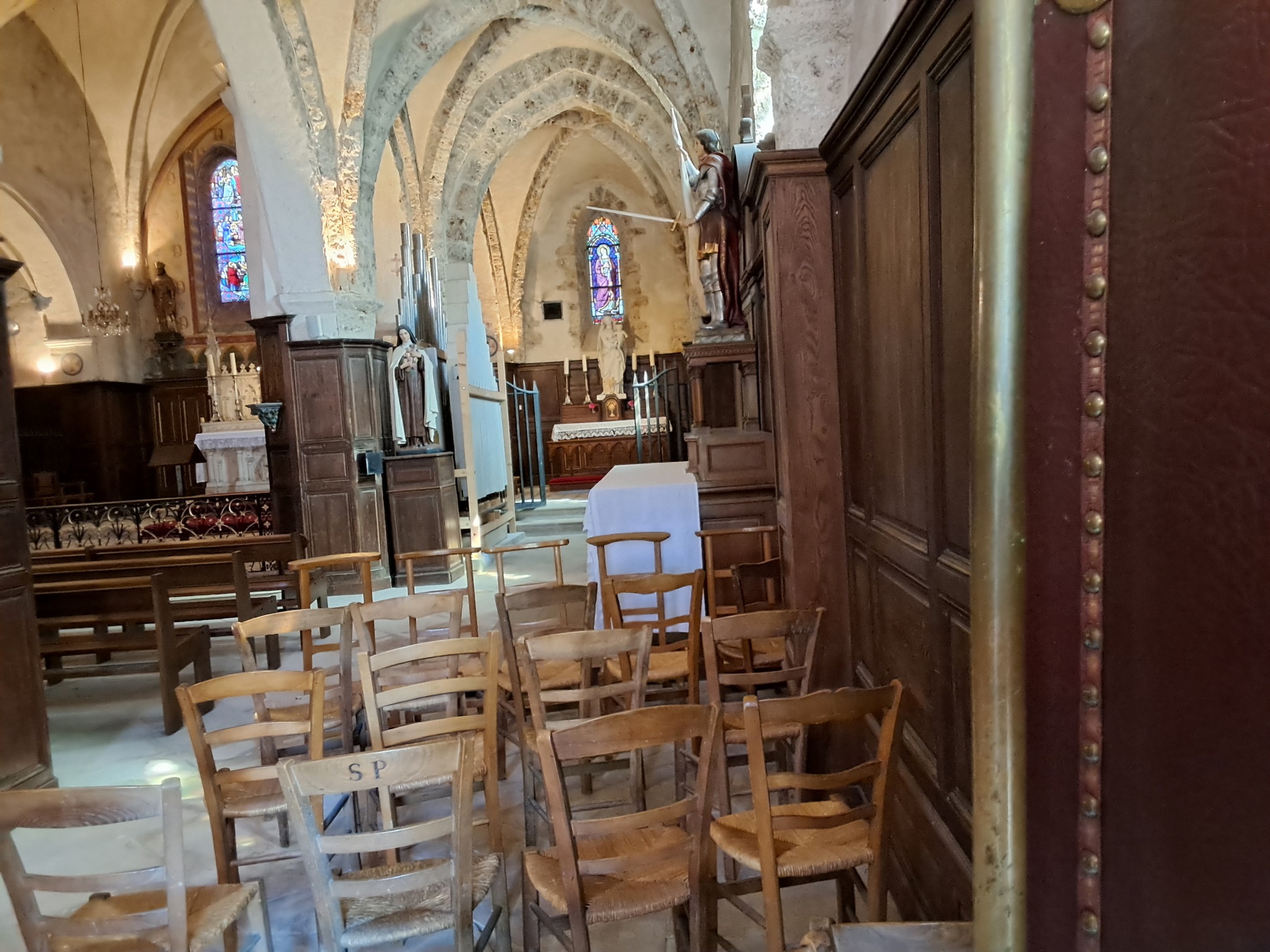
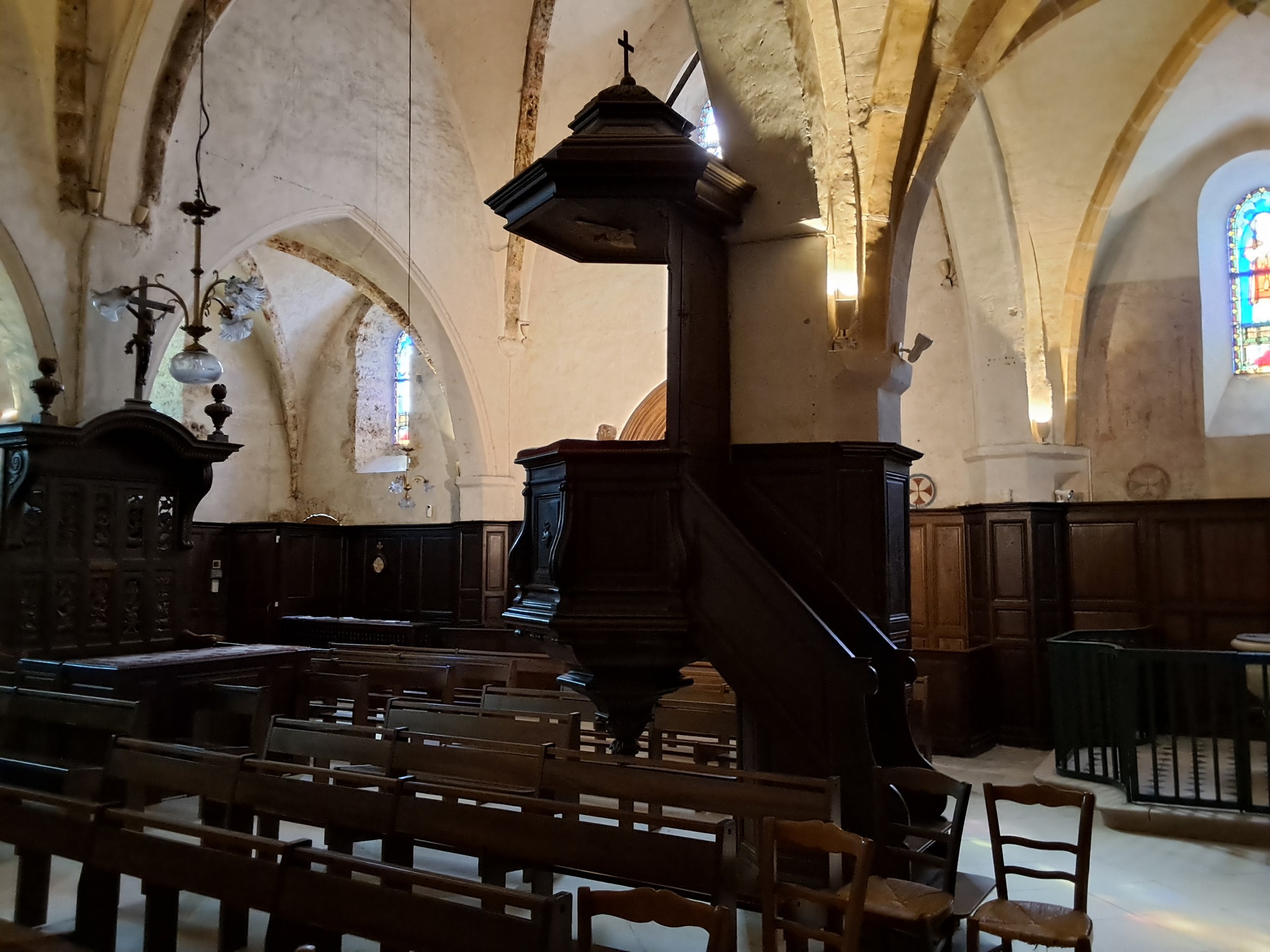
The Church Saint Denis has been mentioned since 862; it was rebuilt in the 14C, then renovated in the 15C ,and 18C. It features a beautiful vault, a 15C statue of the Virgin, a 17C pulpit, and beautiful 19C decor. Enter through the small door near the gate. To your right, you will find an 18C baptismal font made of white marble. Next to it, a 16C wooden statue: Saint John the Baptist depicted wearing a skin, his hand reaching out to a lamb on a book. The clock installed in 1770 which controlled two exterior dials, one of which indicated the phases of the moon.
The current altar is made of wood. It recalls the old high altar, neo-Gothic, made of limestone. Its altar table rests against a low wall that serves as a support for the winged tabernacle. The tabernacle is surmounted by a canopy, the wings flanked by pinnacles. Beneath the altar, a stone bas-relief depicts the Supper at Emmaus. Behind the altar, three 19C stained-glass windows depict, around the crucifixion, the lives of Saint Denis and his companions, the deacon Rustique and the priest Eleutherius.
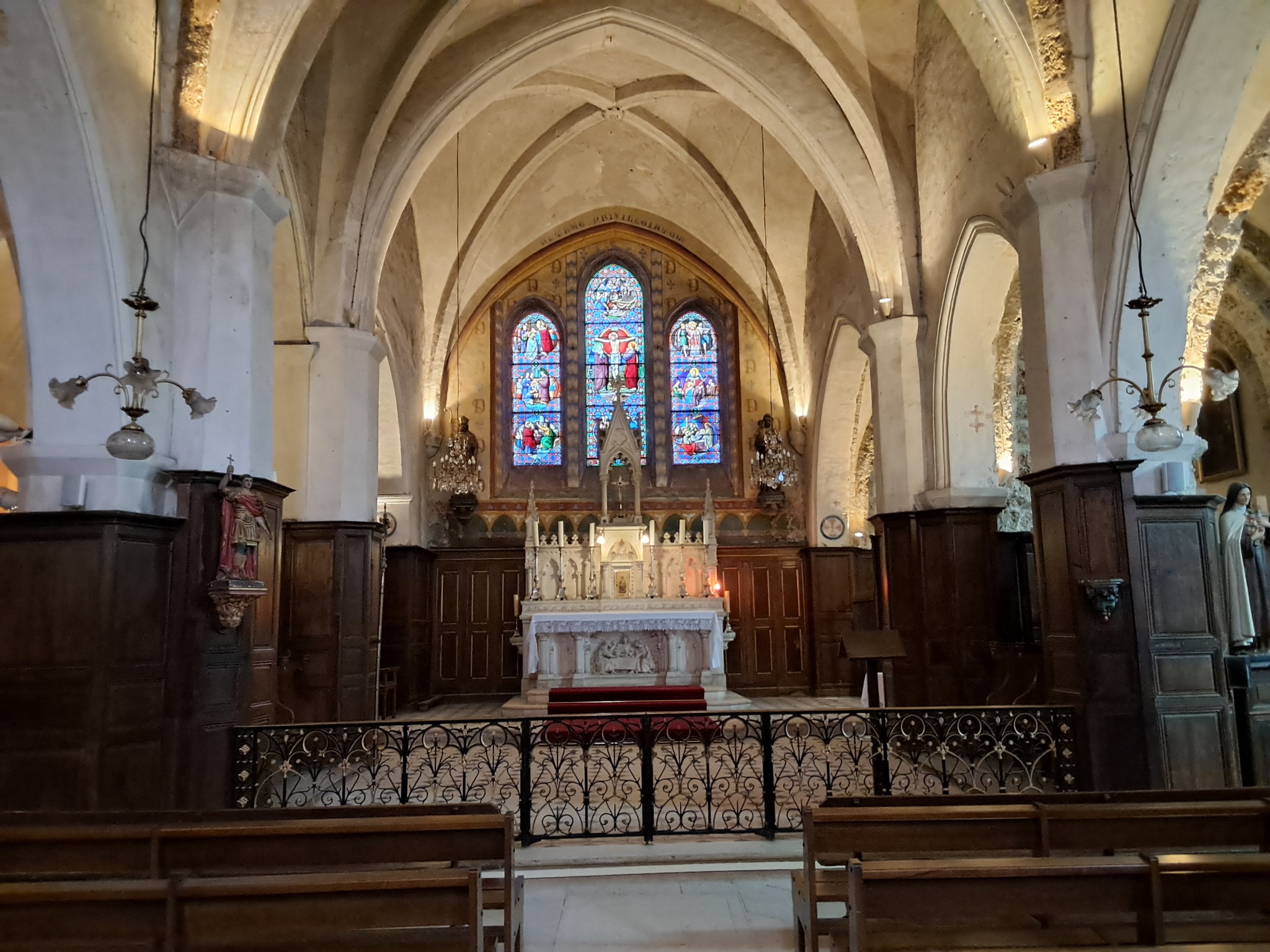
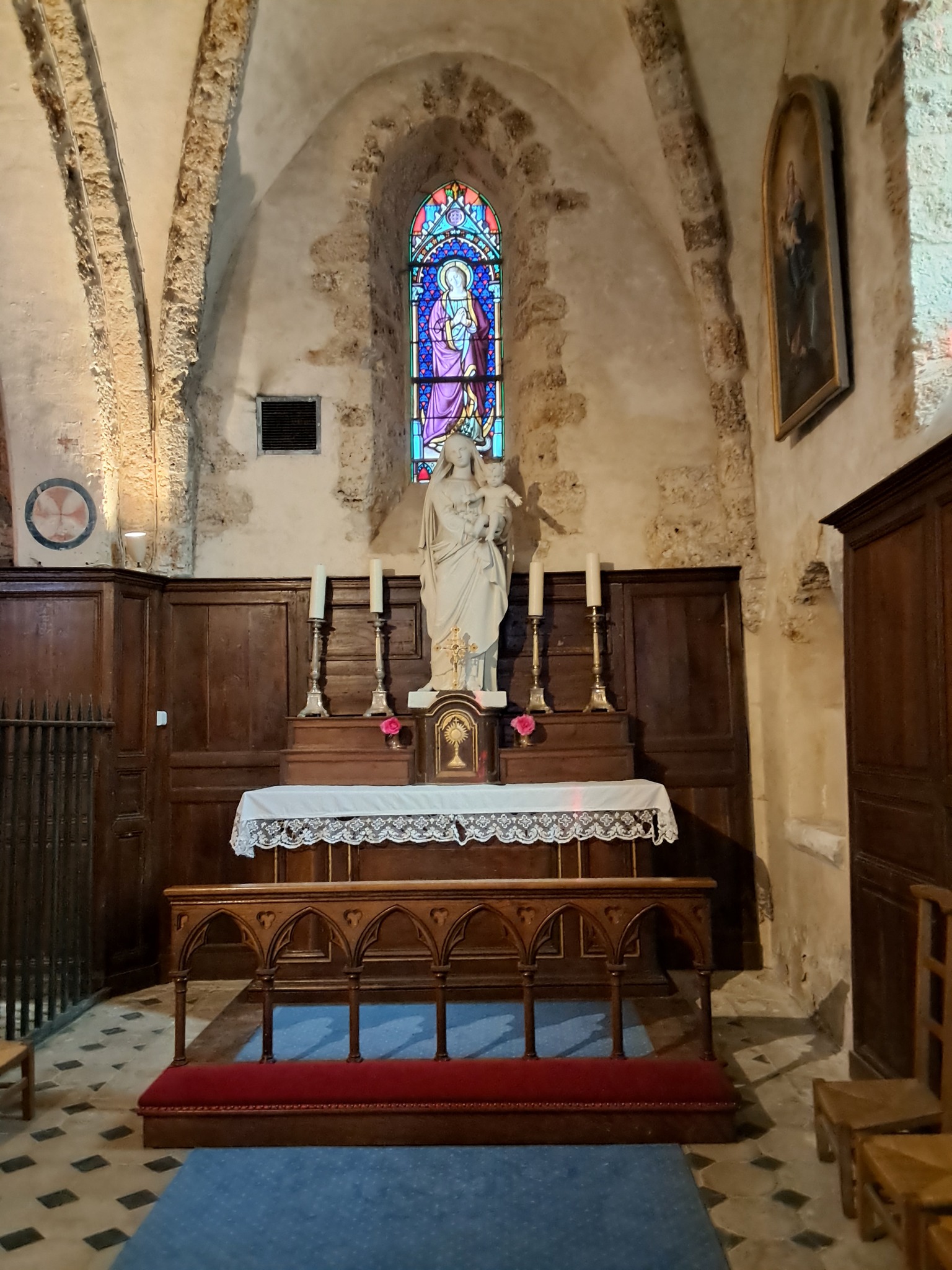
The nave in the choir. The altar is the central part, for the Eucharist is celebrated there, according to Jesus’ words: “Do this in memory of me.” And behind the altar, the stained-glass window depicts the crucifixion: Jesus, at Golgotha, on the cross, before the walls of Jerusalem, with Mary and Saint John the Evangelist. On either side are two 18C wooden altars. The one on the left is surmounted by a statue of the Sacred Heart of Jesus, a symbol of divine love. Behind it, a stained-glass window depicting Saint John the Baptist. The altar on the right is dedicated to Mary, with a statue of the Virgin and Child. The two nearby early 19C paintings depict a Virgin and Child and Saint Genevieve.
On the south wall, another altar, dedicated to Joan of Arc. Beside it, is a statue of Saint Theresa, in Carmelite habit, holding a crucifix and roses. You will see an Adoration of the Magi, an old 16C copy; further on, a mural from 1877 depicting the donation of the church of Senlisse by Charles the Bald (grandson of Charlemagne) to the Abbey of Saint Denis in 862. Beside it, the painting of Saint Denis (1850) celebrating Mass in the catacombs evokes evangelization. In the middle of the nave, a 17C pew, the back of which reuses 16C openwork panels, was used by churchwardens. Those in charge of helping the poor in a parish. The 17C pulpit is decorated with hearts and a dove. The hearts represent the Sacred Heart of Jesus. The dove symbolizes the Holy Spirit. Christians believe in the Trinity: one God who is Father, Son, and Holy Spirit; the third person of the Trinity, the Holy Spirit, is the spirit of Jesus that the Father communicates to us, the breath. A 354-pipe organ, built in Utrecht in 1874, was installed in the church thanks to the Senlisse Organ Association, which aims to ensure its artistic activity. The association organizes several concerts a year around this organ.
A bit on Saint Denis tell us that around 250, the Pope sent Dionysius to Gaul with six other missionary bishops. He settled in Paris, where he became its first bishop and suffered martyrdom by the sword. He is sometimes depicted with his head decapitated, a sign that the head of Christ cannot be separated from his body, the Church. Saint Denis died a martyr around 260 and was buried where Saint Genevieve had a church built in 475 which would become the Basilica of Saint Denis (see posts).
Other things to see here are the Château de la Cour dates from the 17C. The largest of these towers is also the oldest and may date from the mid-15C. The residential buildings were rebuilt or remodeled in the 17C. It is now privately owned. The existence of the Malvoisine manor is attested in 1235. The buildings were rebuilt at the end of the 15C, the moats and walls were restored in 1652, and the entire complex was rebuilt at the beginning of the last century. The manor currently houses the Malvoisine stud farm.
A bit of history tell us that Senlisse made its mark on history in the second half of the 9C.
During a stay in Compiègne, King Charles II the Bald donated the village of Senlisse to the Abbey of Saint-Denis in 862 due to its great devotion to the holy martyr. In the late 16C and early 17C, there are records of a fief and a lord of Cour-Senlisse, dependent on the castellany of Beaurain, which included the lordships under the Abbey of Saint-Denis. The estate was then acquired by Claude de Lorraine, Duke of Chevreuse, during the reign of Louis XIII, and in 1739 became the property of Charles Louis d’Albert, Duke of Luynes. In 1842, the Duke of Luynes Honoré Théodoric d’Albert provided the town with a city hall and a school, two adjoining buildings followed by a canteen.
The village of Senlisse on its history/heritage : https://www.senlisse.fr/vivre-%C3%A0-senlisse/histoire-et-architecture/
The Parish of the Valley of Chevreuse on its churches see Saint Denis: https://paroissevalleedechevreuse.fr/notre-paroisse/decouvrir-nos-9-clochers/
There you go folks, enjoy this wonderful ride into the French soul, and the countryside of the Yvelines dept 78 at quant nice off the beaten path village of Senlisse, there is a lot more to see around here ! Again ,hope you enjoy this post on this is Senlisse !!! as I.
And remember, happy travels, good health, and many cheers to all !!!

 Paris1972-Versailles2003