
I am again to tell you about more streets of my eternal Paris. I have many many posts on Paris and several on the streets of the most beautiful city in the world. I have come up with pictures from cd rom vault that should be here for you and me. As always thank you for following my blog some since Nov 26, 2010. Therefore, here is my take on the streets of Paris, part XXVIII !!! Hope you enjoy it as I.
The Rue des Francs-Bourgeois is located in the Marais quartier or neighborhood, marking the boundary between the 3éme and 4éme arrondissements or districts of Paris. It runs from Place des Vosges to the intersection of Rue Rambuteau and Rue des Archives. Its name comes from “alms houses” opened on this street for poor people who were exempt from taxes due to their indigence. This site is served by the metro line 8 at the Chemin Vert station, by metro line 1 at Saint-Paul station, and by lines 1 and 11 at Hôtel de Ville station. This street, which is attested from the 14C, is cited under the name of “rue des Francz bourgeois” in a manuscript of 1636. This old street, which partly ran along the wall of Philippe Auguste, was first called “rue des Poulies”, “rue des Viez Poulies” or “rue des Vieilles Poulies”, “rue Richard des Poulies”, “rue Ferri des Poulies”, because of its weavers’ trades. It took its current name after the foundation, in 1334, of “alms houses” whose occupants, exempt from taxes due to their low resources, were called “francs-bourgeois”, and one of which, which was called “maison des Francs-Bourgeois”, was a hospital for poor bourgeois.
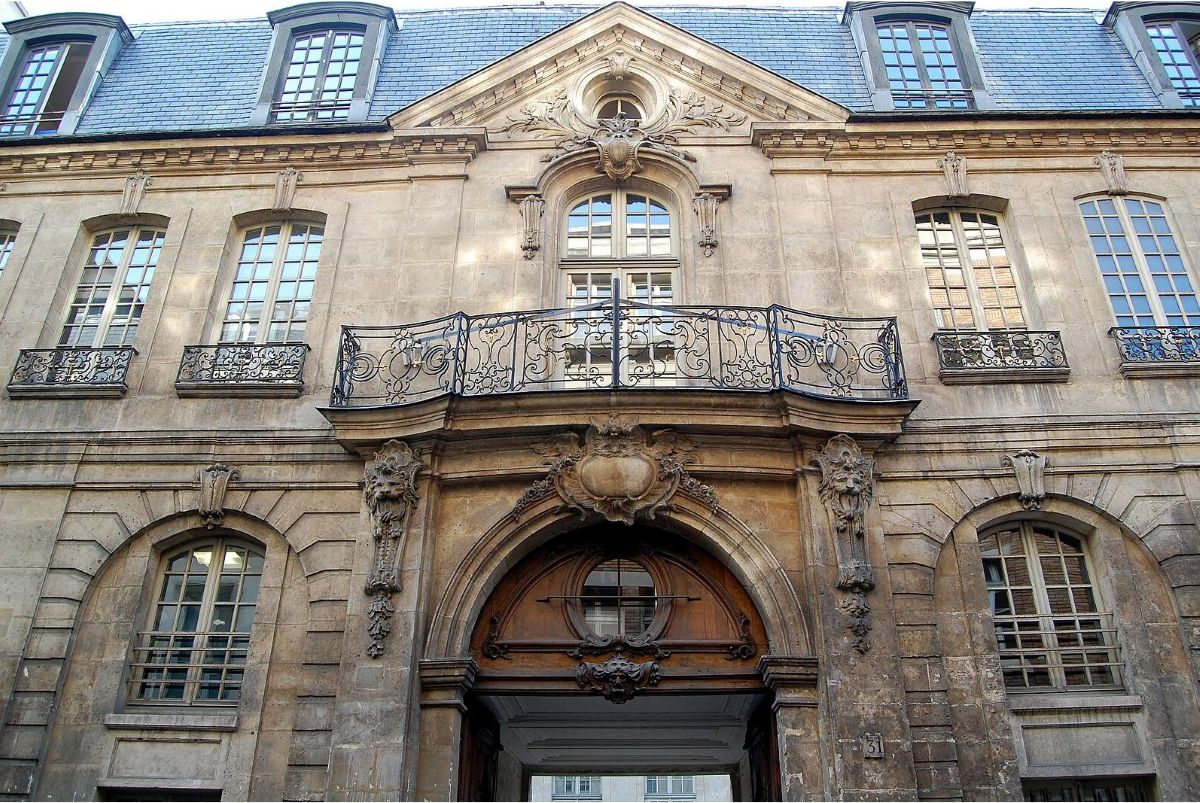
Notable buildings in Rue des Francs-Bourgeois are at Nos. 3 to 19 (odd-numbered side): 17C houses. No. 14 the street runs along the side facade of the Hôtel Carnavalet (even-numbered side) and that of the Hôtel d’Angoulême Lamoignon (odd-numbered side). The entrance to the former is located on Rue Sévigné, that of the latter on Rue Pavée. The garden of the Hôtel-Lamoignon – Mark Ashton, accessible via Rue des Francs-Bourgeois, is open to the public. No. 16: gate formed by the Arc de Nazareth, formerly in the Île de la Cité and reassembled here in 1886. It is now a secondary entrance to the Carnavalet Museum towards the drapers’ courtyard and the gardens. Nos. 20 (and 1 and 3, rue Payenne: site occupied from 1632 to 1687 by one of the buildings of the convent of the Petites-Cordelières or nuns of Sainte-Claire de la Nativité-de-Jésus, an outbuilding of the Cordelières convent in the Faubourg Saint-Marcel. The porch opened onto the rue Pavée No. 26: Hôtel Mortier de Sandreville, also called “Hôtel Mortier”, “Hôtel de Sandreville” or “Hôtel Le Meyrat”: built in 1585, then remodeled in 1767, Nos. 29 bis and 31: Hôtel d’Albret. The first stone of this building was laid by Constable Anne de Montmorency around 1550. In 1700, the facade was rebuilt in its current state . At the end of the 18C, the hotel was transformed into a lighting workshop. It was bought by the city of Paris in 1989. After restoration, it became the headquarters of the cultural affairs department of the city of Paris. No. 30: Hôtel d’Alméras. No. 33: Hôtel Barbes, formerly Hôtel de Seré, dating from the 17C. The building on the street was destroyed in 1868 and replaced by a set-back building corresponding to the street alignment decided at that time. This hotel housed, from 1701 to 1713, François-Joseph de Seré, known today as Jean de Serré de Rieux, advisor to the Parliament of Paris, poet (Les Dons des enfans de Latone, 1734), great lover, especially of Italian music, and protector of the composer Jean-Baptiste Morin, creator of the “cantata françoise”. From their collaboration was born, in October 1707, the Divertissement or little opera, entitled La Chasse du cerf. Nos. 34 and 36: Hôtel de Poussepin, Swiss Cultural Center. In 1895, first workshop of the leather goods brand Offenthal. Nos. 35 and 37: Hôtel de Coulanges and Maison de l’Europe in Paris. The Jardin des Rosiers – Joseph-Migneret is accessible via the lobby of the Maison de l’Europe at these numbers. No. 38: entrance to the Impasse des Arbalétriers with a historical marker recalling the murder of Louis d’Orléans in 1407 On November 23, 1407, leaving the Hôtel Barbette, the Duke of Orléans was assassinated by a group of killers led by Raoul d’Anquetonville in front of the current Hôtel Amelot de Bisseuil , This event marked the beginning of the civil war between the Armagnacs and the Burgundians.. No. 44: Hôtel Hérouet on the corner of Rue Vieille-du-Temple, which belonged to Jean Hérouet., No. 53: north entrance to the Church of Notre-Dame-des-Blancs-Manteaux. No. 54: Hôtel de Jaucourt, now occupied by the Interministerial Service of the Archives of France. Nos. 55 and 57: pawnshop (Crédit Municipal de Paris), installed on part of the Convent des Blancs-Manteaux, on the site of part of the former enclosure of Philippe Auguste. A tower, the so-called “Pierre-Alvart” tower, is visible from the door of No. 57 bis. No. 56 Maison Claustrier, built to the plans of Mansart de Sagonne, and Hôtel de Fontenay, occupied by the Interministerial Service of the Archives of France. No. 58: Hôtel Le Tonnelier de Breteuil, dating from 1626, annexed to the Hôtel de Soubise in 1862. No. 58 bis: Hôtel d’Assy, formerly Hôtel Marin de la Châtaigneraie, from 1643 with a garden wing from 1729, acquired by the State in 1845 for the archives of the kingdom, also annexed to the Hôtel de Soubise. No. 60: Hôtel de Soubise (National Archives) ,No. 61: 17C house raised with facade redone in 1900.
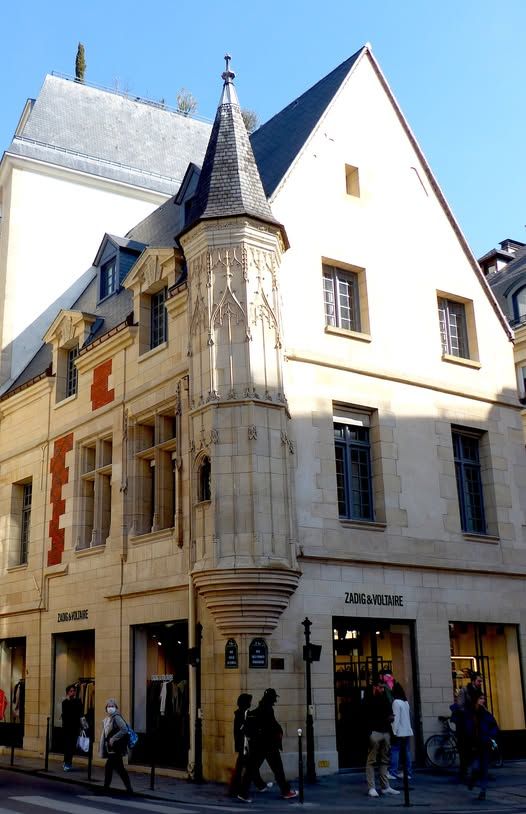
The Hôtel Hérouet,(see pic above) a small hotel on the corner of 54 rue Vieille du Temple 3éme and 42-44 rue des Francs-Bourgeois 4éme. Nearest metro Rambuteau line 11 ,and Hôtel de Ville lines 1 and 11, The Hôtel Hérouet was built around 1510-1520 in the Renaissance style for Jean Hérouet, secretary to the Duke of Orléans (the future King Louis XII) and treasurer of France. It then passed to his widow, Marie Malingre, who remarried Jean Balue, nephew of Cardinal Balue. The successive owners under the ancien régime were not distinguished, and were many. By the 19C, its ground floor had been defaced by commerce. In 1582, the hotel was acquired by Nicolas Pelloquin, secretary to the king’s chamber. Following his bankruptcy, the hotel was seized in 1621 and split into two lots during the sale. Occupying the left side, the Turret House was owned by Jean-Baptiste Brunet de Chailly, advisor to the king, who also owned the Hôtel d’Albret, In 1908, the City of Paris became the owner and modified the alignment along Rue Vieille-du-Temple to preserve the turret. Originally, the facades were clad in bricks decorated with red and black diamonds, while stone was used for the base, the chainwork, and the mullioned windows. The corbelled corner turret lends the house a great deal of charm. Resting on a console, it is sculpted with flamboyant Gothic decoration. Restored at the end of the 19C in the troubadour style, the building was unfortunately badly damaged by the bombings that took place in Paris from 26 to 27 August 1944. It was almost entirely rebuilt in the 1970s, with the exception of its turret, which remained intact.
The Rue Vieille-du-Temple is a street bordering the 3éme and 4éme arrondissements or districts of Paris , located in the heart of the Marais quartier or neighborhood, The Rue Vieille-du-Temple is the path that led, from the 13C, to the Maison du Temple and its tower. The street is 855 meters long, bordering the Archives, Saint-Gervais and Enfants-Rouges quartiers or neighborhoods. It begins at 36, rue de Rivoli and ends at 1, rue de Bretagne. This site is served by the metro lines 1 and 11 Hôtel de Ville station, and metro line 8 Filles du Calvaire station. This road was partly open in 1250, and was cut in two by the wall of Philippe Auguste in which the Barbette gate was pierced. The part then located outside Paris was successively called “rue de la Culture-du-Temple”, “rue de la Couture-du-Temple”, “rue de la Clôture-du-Temple” because it led to “culture”, that is to say to the gardens and the enclosure of the Temple. On some maps of Paris, this part is also referred to as “rue de l’Égout” and “rue de l’Égout-du-Temple” because of the sewer that passed through it. The intra-muros part, between the Place Baudoyer and the Philippe Auguste enclosure, was designated under the names of “rue de la Porte-Barbette”, “rue de la Poterne-Barbette”, “rue Barbette” and “rue Vieille-Barbette” because it led to the Barbette hotel and the Barbette gate, located near the rue de Paradis. After the construction of the Charles V enclosure, the two parts, intra-muros and extra-muros, of the street were united under the name of rue-Vieille du-Temple.
Notable buildings in rue Vieille du Temple are at No. 15: Hôtel de Vibraye ,No. 20: entrance to the impasse de l’Hôtel-d’Argenson. Nos. 26-28: site of the former Hôtel d’Effiat (or Hôtel Le Peletier), demolished in 1882 to create the Rue du Trésor. In 1882, between Nos. 26 and 28, a passage was created during the demolition of the Hôtel d’Effiat, named after its first owner, Marshal d’Effiat. On this occasion, a copper vase containing gold coins from the 14-15C was discovered. In all, a total of 7,822 coins from John II the Good, Charles V and some feudal coins. This treasure was put up for sale and the Carnavalet Museum acquired the vase and some samples. The road that was cut through, which remained a dead end, took the name of Rue du Trésor. No. 47: Hôtel Amelot de Bisseuil, known as the “Hôtel des Ambassadeurs de Hollande”, where Beaumarchais lived for several years. Nos. 46 and 48: site of the convent of the Hospitalières-Saint-Gervais, closed in 1795. No. 48: Espace des Blancs-Manteaux, formerly the “Marché des Blancs-Manteaux”. No. 50: site of the former Hôtel de Noirat demolished in 1939. No. 52: site, in the 18C, of the Au-Chat-qui-pâlotte cabaret, a gambling den then a hotbed of political agitation during the French revolution and which was frequented by Momoro, Tréchard and Carbon, No. 54: Hôtel Hérouet (see pic above),and its corbelled turret , At the level of the current No. 61 was the Barbette postern, pierced in the enclosure of Philippe Auguste. No. 87: Hôtel de Rohan (National Archives). No. 90: site of the “des Maretz” tennis court, built around 1603, then, from 1634, of the Théâtre du Marais. In this theater, for the first time, no spectators were seated on the stage. Corneille’s Le Cid was created there in 1637. Nos. 100 to 104: Hôtel de Lauzon, No. 106: Hôtel Mégret de Sérilly, built in 1620-1621, was acquired in 1686 by Charles du Tillet, Marquis de La Bussière, Master of Requests. The du Tillet family modified the hotel. A remarkable boudoir was fitted out there in 1778 with paneling by Jules-Antoine Rousseau, a fireplace sculpted by Philippe-Laurent Roland, and a ceiling painted by Jean-Jacques Lagrenée. This decor is now in the Victoria and Albert Museum in London (see post). Jewelry designer Line Vautrin lived there with her husband, the painter Jacques-Armand Bonnaud: they renovated the place and set up their workshops there, their furniture being designed by Gilbert Poillerat, the tapestries being made from cartoons by Jean Lurçat and the fireplace andirons being designed by Diego Giacometti At No. 110: Hôtel d’Hozier, built from 1623 for Robert Josselin, Lord of Marigny. The hotel has a remarkable portal sculpted by Antoine Fauquière. The sculptor Sandrine Follère had her studio there from 1996 to 2005.
The Paris tourist office on walks in the Marais : https://parisjetaime.com/eng/article/exploring-the-marais-a1070
The Paris tourist office on Paris Centre (arrond 1-4) : https://parisjetaime.com/eng/article/explore-the-centre-of-paris-a846
The Paris tourist office on the rue Francs-Bourgeois : https://parisjetaime.com/eng/transport/rue-des-francs-bourgeois-p2039
The Rue du Louvre was created in 1853 and located in the 1er and 2éme arrondissements of Paris. About 20 meters wide, it stretches for approximately 700 meters; and it begins at 154 Rue de Rivoli and ends at 30 Rue du Mail and 67 Rue Montmartre. It takes its name from its proximity to the Palais du Louvre, and the metro station, Louvre-Rivoli since 1989 on Line 1. The street was built as part of the transformations of Paris under the Second Empire (Napoléon III). The construction was carried out in three stages: in 1888, between Rue Saint-Honoré and Rue Coquillière; in 1880, between Rue Coquillière and Rue d’Argout; and in 1906, between Rue d’Argout and Rue Montmartre. The Rue du Louvre was not fully completed until 1934 with the construction of the building housing the daily newspaper Paris-Soir. In 1972, the southern part of Rue du Louvre was renamed “Rue de l’Amiral-de-Coligny.”
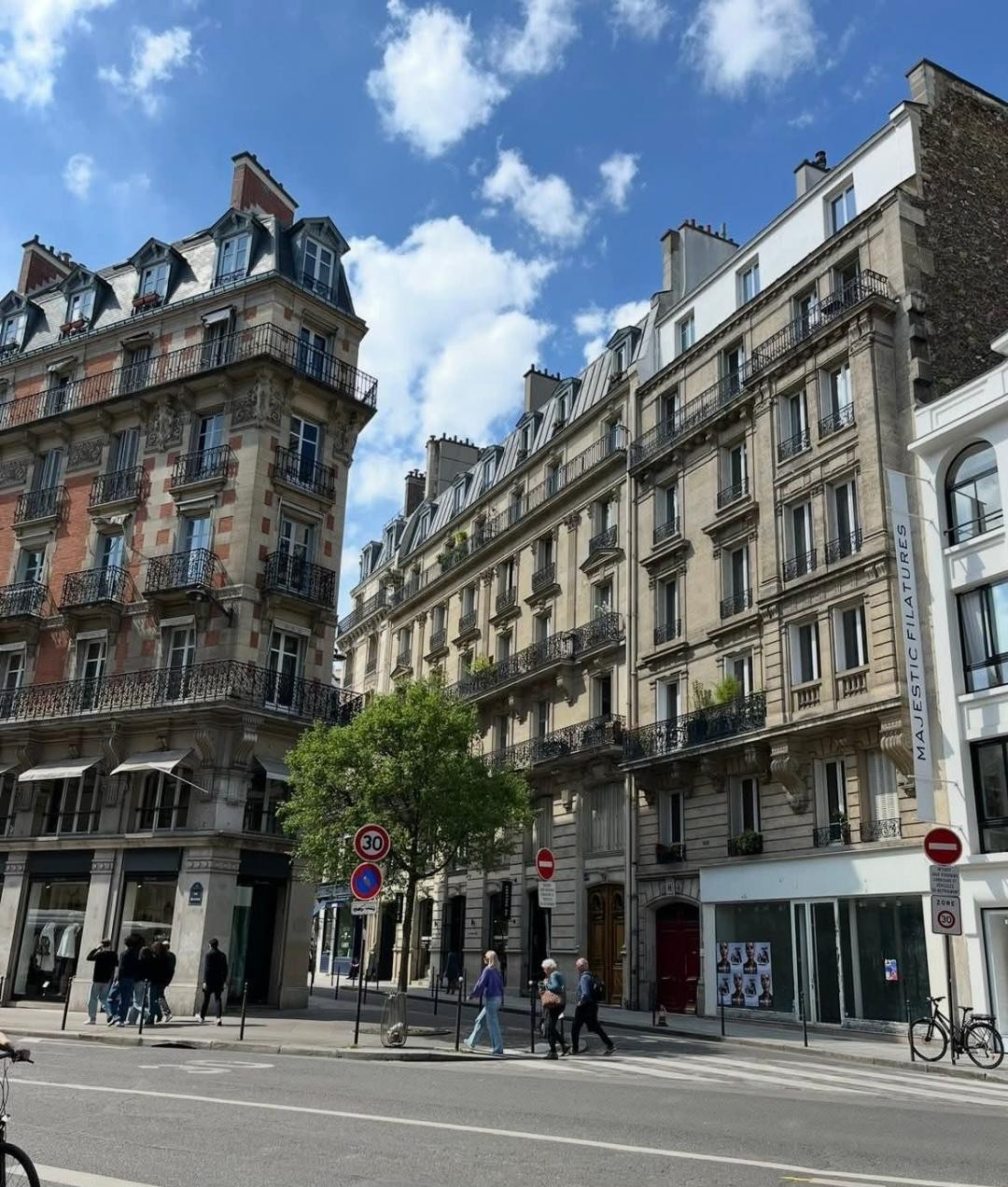
Notable buildings here me think are at Nos. 11 and 13: Remains of a tower from the Philippe Auguste wall. No. 15: Building facade (1892) with the Cour-des-Fermes passage. No. 19: Former Hôtel d’Olonne, headquarters of the caisse d’épargne or savings bank, No. 37: former headquarters of Le Figaro newspaper until August 2005. Previously the joint headquarters of L’Humanité and Ce soir ,No. 40: former Hôtel Central, No. 46 bis: Central Gutenberg telephone office, building from 1891 with two towers, all built in blue-tinted bricks. Nos. 48-52: central post office of the Louvre. A bit of history of this venerable street many time walked and drove on it is that the section between Rue d’Argout and Rue d’Aboukir was opened in 1909. This opening removed numbers 51 and 53 from Rue d’Argout, which dated back to the 18C. The southern section of the street was formed by the former Rue du Petit-Bourbon, and the section between Place du Louvre and Rue Saint-Honoré by Rue des Poulies. Both sections existed at the beginning of the 13C. In 1888, the Rue du Louvre included what remained of the rue d’Orléans, formerly the rue de Nesle, which ran from the rue Saint-Honoré to the rue des Deux-Écu. The rue du Louvre also caused the disappearance of the small rue Mercier (1762) which ran from the Halle aux Blés (Bourse du Commerce) to the rue de Grenelle-Saint-Honoré (today Rue Jean-Jacques-Rousseau). The southern part of the street was called rue de la Colonnade for a while and rue d’Iéna in 1806. The rue du Petit-Bourbon and the rue des Poulies once ran alongside, on the left side starting from the Seine, several large hotels which were demolished to clear the Louvre. The Hotel du Petit-Bourbon was located along the Seine, between the Vieux Louvre and Saint-Germain-l’Auxerrois. It was built in 1370 for L. de Bourbon, Count of Clermont. In the great hall of the Petit-Bourbon the Estates General of 1614 were held; this hall served as a court theatre under Louis XIII and Louis XIV. Corneille’s Andromède was performed there in 1630 and Molière’s troupe gave performances there until 1660. The Hôtel du Petit-Bourbon, after having served as the Queen’s Stables and as a furniture store, was completely demolished in 1758 ( today site of the garden). Adjacent to the Hôtel du Petit-Bourbon was in 1600 the Hôtel de Combault, sold to the king in 1666 for the enlargement of the Louvre. The entrance to the square courtyard of the Louvre, under the colonnade, occupies the site of the chapel of the Petit-Bourbon. To the right of the great gate of the Louvre, before 1764, stood the Hôtel des Postes, which was separated from the Petit-Bourbon by the Post Office stables, which occupied an old building once used for a short time as the Mint. The northern part of the Jardin de la Colonnade is on the site of the Hôtel de Choisy, which was located on Rue du Petit-Bourbon at the corner of Rue des Poulies. This hotel was the Petit Alençon in 1470. In 1578, it was the Hôtel of Marshal Gondi de Retz, and of Choisy in the 17C. It was demolished in 1664. Higher up stood the Hôtel de Longueville, which had been built by the brother of Saint Louis and enlarged by Enguerrand de Marigny. In 1421, it was the Hôtel d’Alençon, the Hôtel de Villeroi (1470), the Hôtel de la Duchesse de Longueville (1581), the Hôtel de la Marquis d’Antin (1709), and the Hôtel des Postes (1738). This hôtel, which occupied the northern site of the Jardin de la Colonnade and the northeast corner of the Louvre on Rue des Poulies, was demolished in 1758 to clear the way for the Louvre.
To the north of the Hôtel de Longueville, and still opening onto Rue des Poulies, stood the Hôtel de Villequier d’Aumont. In the 14C, it was the Hôtel de Garancière, the Hôtel de Nevers (1567), the Hôtel de Villequier (1577), the Hôtel d’Aumont (1655), and the Hôtel de Rouillé (1732). Purchased by the King and destroyed in 1761 (see the pave floor of the Rue de Rivoli). In the Rue des Poulies there was still the Hôtel d’Angiviller which had been the Hôtel d’Argenson, de Conti, de Tresmes and which, started in 1780 by the Rue d’Angiviller, disappeared completely in 1854 by the opening of the Rue de Rivoli.
The Paris tourist office on Paris Centre (arrond 1-4) : https://parisjetaime.com/eng/article/explore-the-centre-of-paris-a846
There you go folks, another dandy beautiful set of glorious streets of my eternal Paris. I have criss cross them many and have many in my blog already, Again, hope you enjoy this post on the streets of Paris, part XXVIII !!! as I.
And remember happy travels, good health, and many cheers to all !!!

 Paris1972-Versailles2003