
This is a nice town and a wonderful off the beaten path visit of Montfort L’Amaury. I am glad to have found me this picture in my cd rom vault that should be in my blog for you and me. When I was in Versailles, I came often to his town and walked all over it, and much else including lunches. The town of Montfort L’Amaury is in the Yvelines dept 78 of the Île de France region , and in my belle France. Therefore, here is my take on the Château de Groussay of Montfort L’Amaury !!! Hope you enjoy the post as I.
The town is 47 km from Paris, 20 km from Houdan, 21 km from Rambouillet, 36 km from Saint Germain en Laye, 29 km from Versailles, and 447 km from my current home, The roads connecting Montfort-l’Amaury to other towns in the department are the RD 76 towards the train station in Méré, the RN 12 and the direction of Thoiry; the RD 13 towards Maurepas, the RN 10 and beyond to Chevreuse; the RD 155 towards Les Mesnuls; the RD 138 towards Saint-Léger-en-Yvelines; the RD 112 towards Gambais and beyond to Gressey; the RD 172 towards Grosrouvre; and the RD 155 towards Galluis. We came here from Versailles along the Rue de la Paroisse to Rue du Maréchal Foch to Ave de l’Europe to Avenue du Général de Gaulle to Rue Royale (D10) right on Rue du Général Leclerc, left on Rue du Maréchal Joffre, (D91) continue on Ave Clément Ader by exit/sortie 4 connect with the N12 road continue until bearing right into the exit/sortie D76 dir Montfort l’Amaury in town bear right into Route de Rambouillet or D138 at next round point take left onto Rue de Mantes or D155 road ,continue until roundpoint onto Rue de Versailles or D13 road until the Château de Groussay on your right hand side, As popular with Parisians, will tell you from Paris get on the A13 autoroute de Normandie dir Rouen, then the A12 towards Dreux , then the N12 towards Dreux, go under the Pontchartrain tunnel, take the first exit: Méré/Montfort l’Amaury. In Montfort, at the first large cobbled intersection, turn left. Go down to the stop sign. At the stop sign on the left, follow the castle wall. The entrance is on the right, after the wall.
The Château de Groussay , a country house dating from the 1820s was transformed into a real castle by Charles de Beistegui, who acquired it in 1938, at the dawn of WWII, he extended it with two wings, a theater and a ballroom called the Dutch Hall and created an original but ephemeral aesthetic work. Some elements of the interior decoration chosen by him have been preserved: they can be found in the theater (inaugurated in 1957 with Impromptu, by Marcel Achard, performed by the Comédie-Française with Annie Girardot and Jean-Claude Brialy, and in the following rooms: the Goya Gallery, the Grand Salon, the Russian Salon, the billiard room, the Dutch Gallery, the Grand Dutch Salon and the dining room. The library has two spiral staircases; Beistegui had a ceiling and two rooms removed to give it more height; The trumeau of its fireplace surmounted by a painting identical to The Wedding Masquerade by José Conrado Roza (1778) acquired in 1985 for the Musée du Nouveau Monde in La Rochelle where it is exhibited. Several mahogany chairs decorated with his gilded monogram are kept in the vestibule of the castle.The Château de Groussay is especially famous for its factories, inspired by 18C parks and so-called Anglo-Chinese gardens, and built during the time of Charles de Beistegui, between 1950 and 1970. The ceramic vases in the park are by Jean Luneau: the Tartar Tent (1960); the Temple of the Labyrinth (1967); the Palladian Bridge (1960); the Pyramid (1968); the Temple of Love (1949); the Chinese Pagoda (1963) and the Observatory Column (1962). The stables date back to the creation of the first castle. The park covers 30 hectares. This park, through its “factories,” offers a true journey around the world. Charles de Beistegui, accompanied by Emilio Terry and Alexandre Serebriakoff, had several unusual and extraordinary works built in the Groussay park between 1950 and 1970. You can discover the Chinese pagoda built in 1963, which required digging a small pond to provide a setting for it to be placed on a reflecting pool, as well as the observatory tower, the Palladian bridge, the pyramid, the Tartar tent, and the open-air theater. And there are still others to be discovered… There are also pleasure gardens in the park. The garden – before the English one – was initially regular, with a flowerbed overlooking a large rectangular pond, in the center of which was an island. From 2012, the park hosted the filming of Le Meilleur Pâtissier, broadcast on M6 for several seasons. Yes !!!, Christian Lacroix launched a new collection in 2017, “Au Théâtre Ce Soir,” staged entirely at the castle. Similarly, the Spring/Summer 2017 men’s collection highlights this location.
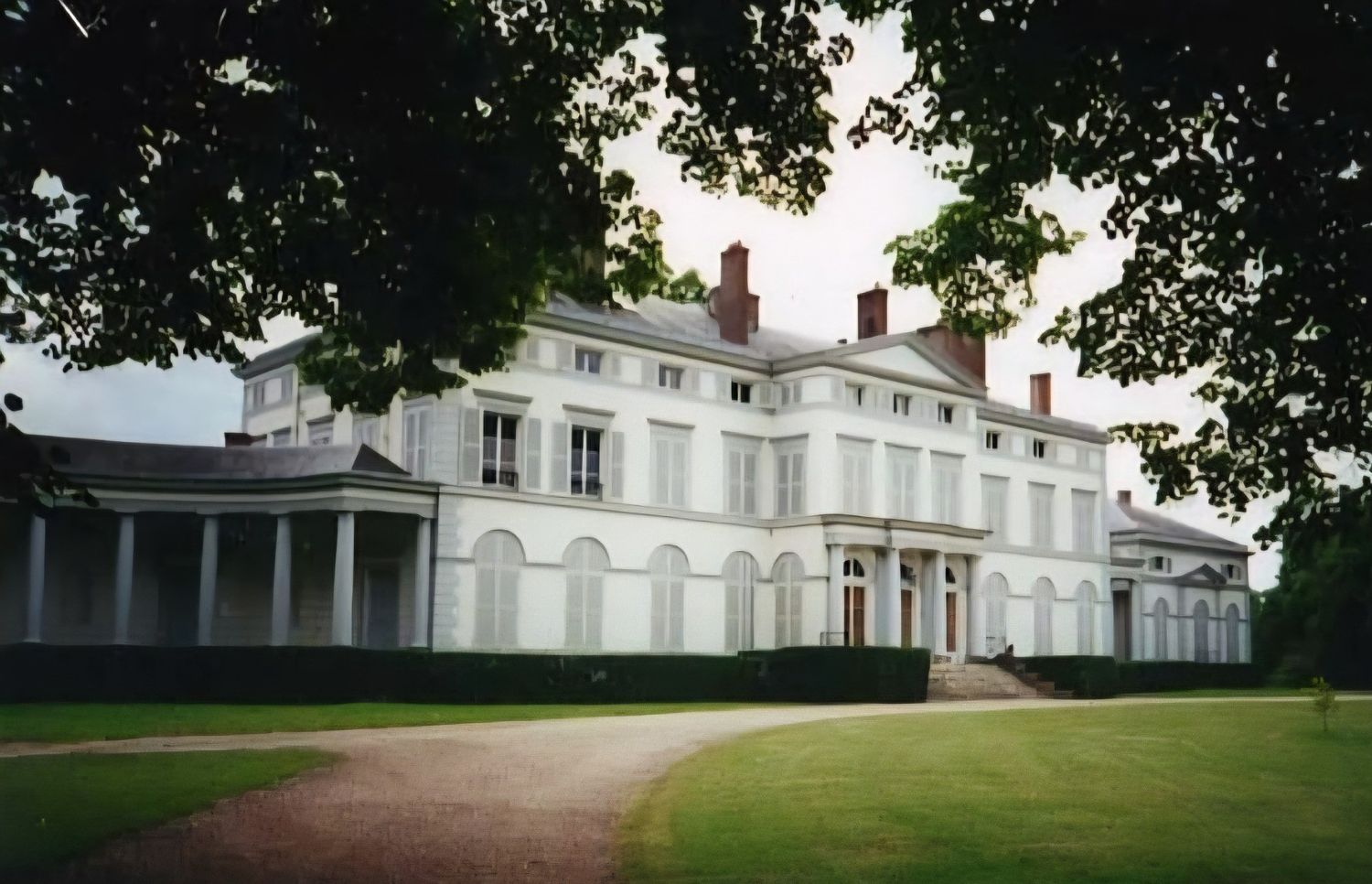
A bit of history I like tell us that Henriette Adélaïde du Bouchet de Sourches de Tourzel, Duchess of Charost, widow and heiress of the Mayor of Paris, Armand Joseph de Béthune, Duke of Chârost, daughter of Madame de Tourzel, governess to the children of King Louis XVI and Queen Marie-Antoinette, had the château built in 1815. Construction was practically completed in 1823. Having accompanied the royal family during the attempted escape, imprisoned but having escaped the scaffold, Henriette’s mother, returning from London, came to settle in Groussay, where she received the daughter of Louis XVI, the Duchess of Angoulême. A few months later, in 1832, she died at the château at the age of 82. In 1843, the Russian Countess Julie de Pahlen acquired the estate after the death of her husband, which occurred the same year. She received the Emperor and Empress there. In 1873, she sold to Henriette Dufour d’Hargeville, wife of Prince Soltikoff. In 1938, Charles de Beistegui, of Mexican and Spanish nationality and an inspired aesthete, bought Groussay; He is the nephew of the great Mexican collector and generous patron of French museums and cultural institutions Carlos de Beistegui. He created at the château an Italian-style theatre, trompe-l’oeil, sphinxes at the bottom of the stairs, a ballroom, a mahogany library lounge with a double spiral staircase, follies in the 30-hectare park. Upon Charles’s death in 1970, his nephew Juan de Beistegui, known as “Johnny”, inherited it and worked to preserve it for thirty years, but in 1999 the castle was sold to the television producer Jean-Louis Remilleux and its contents, except for certain decorative elements, were finally dispersed into 2,000 lots described in a four-volume catalogue at the first public auction organised in France by Sotheby’s, during a four-day house sale, an event in the art market. In 2012, the property was sold to Rubis International, managed by businessman Rustam Madumarov. The property then passed into the hands of Gulnora Karimova, daughter of the Uzbek dictator; however, her assets were seized after she was charged with laundering embezzlement of public funds, and the castle put back up for sale, Since 2015, an association, Patrimoine aventure, has set itself the goal of “bringing the castle to life”, in particular by opening it to the public during certain events.
The official Château de Groussay : https://www.chateaudegroussay.com/
The town of Montfort l’Amaury on the castle : https://www.montfortlamaury.fr/chateau-et-parc-de-groussay/
The local cœur d’Yvelines heritage site on Montfort l’Amaury : https://www.coeur-yvelines.fr/patrimoine/nos-communes/montfort-l-amaury/
The Yvelines dept 78 tourist office on Montfort l’Amaury : https://www.destination-yvelines.fr/visiter-montfort-lamaury/
There you go folks, enjoy this wonderful ride into the French soul, and the countryside of the Yvelines dept 78 at quant nice off the beaten path Montfort l’Amaury, there is a lot more in my belle France. Again ,hope you enjoy this post on the Château de Groussay of Montfort l’Amaury !!! as I.
And remember, happy travels, good health, and many cheers to all !!!

 Paris1972-Versailles2003