
I am again to tell you about more streets of my eternal Paris. I have many many posts on Paris and several on the streets of the most beautiful city in the world. I have come up with pictures from cd rom vault that should be here for you and me. As always thank you for following my blog some since Nov 26, 2010. Therefore, here is my take on the streets of Paris, part XXIX !!! Hope you enjoy it as I.
The Place des Petits-Pères is located in the 2éme arrondissement of Paris. The name of the square commemorates the Augustinian convent that extended all around it and whose footprint corresponds to the old courtyard. The Augustinians were called the “Petits-Pères” or small fathers. The square, formed in 1805, was formerly the courtyard of the convent of the Augustinian Monks, known as the Petits-Pères, whose church was the Notre-Dame-des-Victoires basilica. This convent was abolished during the French revolution, and part of its buildings became the town hall of the former 3éme arrondissement of Paris until 1849. From 1850 onward, it housed the Petits-Pères barracks, also known as the “Bank barracks,” which opened onto Rue de la Banque and Rue Notre-Dame-des-Victoires.
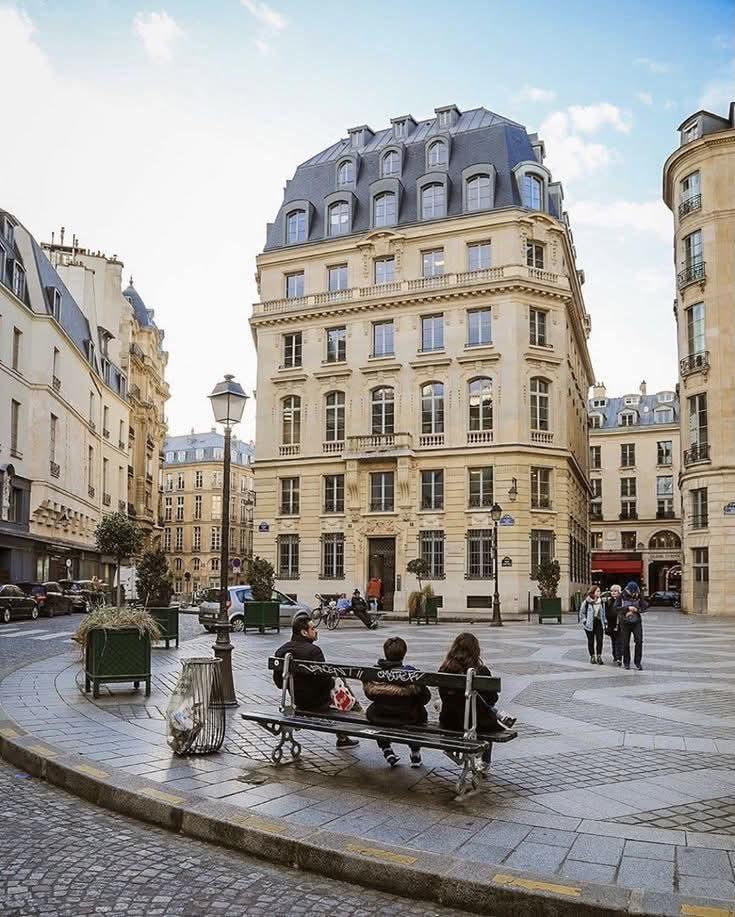
Notable buildings here are on its southern side, the square is bordered by Rue des Petits-Pères, the only commercial facade on the square, where shops selling religious objects were once located. Only one remains, at no 8. Nos. 4 and 6 still have statues of Virgins and Children overhanging the windows, vestiges of their past activity. High-end shops now occupy the windows. The west side has at nos. 1-3 the Léopold Louis-Dreyfus bank building (a forerunner of the Louis-Dreyfus Group). The premises were occupied by the General Commission for Jewish Affairs under the Vichy regime. The Passage des Petits-Pères leads to the square. No. 5 is a building belonging to the City/town hall of the 2éme arrondissement, which houses the Charlotte-Delbo library. On the north side see at no. 7 the Notre-Dame-des-Victoires Basilica (former church of the Petits-Pères convent). Rue Notre-Dame-des-Victoires leads to the square. The east side the only building is no 9. In the 1880s a wholesale linen merchant was established there and on the ground floor a pharmacy: the Charles Tarin pharmacy, supplier of the Mexican Flour of Doctor Fernando of Rio de Mexico (food for convalescents, and the Barberin café, “health hygiene, stomatic and fortifying”). Rue du Mail opens onto the square. Rue Vide-Gousset ,which connects it to Place des Victoires opens onto the square.
The Paris tourist office on Paris Centre (former arrond 1-4) : https://parisjetaime.com/eng/article/explore-the-centre-of-paris-a846
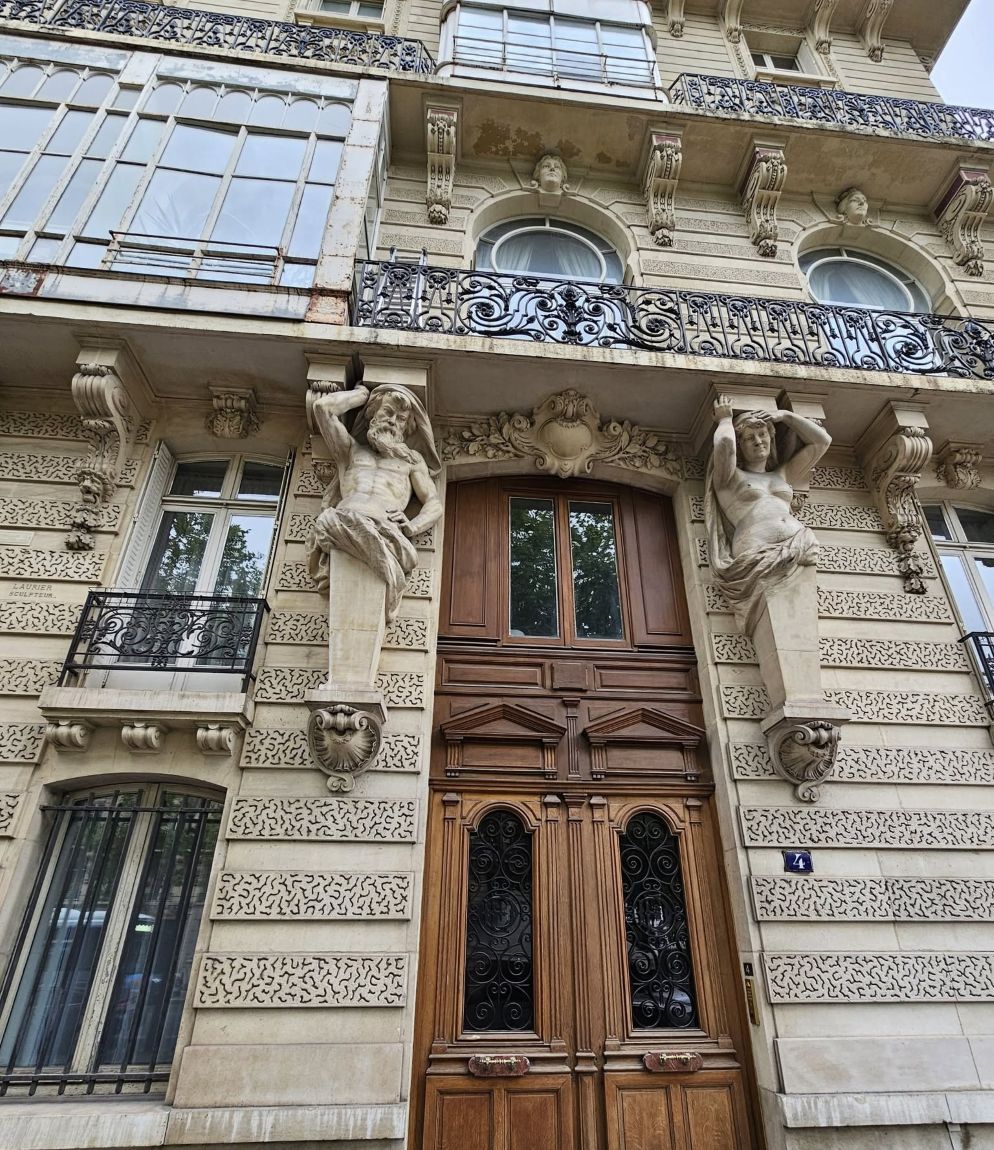
The Avenue de Tourville is located in the 7éme arrondissement of Paris. It is 550 meters long, and begins at 8 Boulevard des Invalides and ends at 3 Place de l’École-Militaire and Avenue Duquesne. It is served by metro line 8, at the École Militaire station. The avenue pays homage to Anne Hilarion de Costentin, Count of Tourville, Vice-Admiral, Marshal of France. The section along the Invalides existed in 1680; the remainder was traced around 1780 on the site of an old road. This avenue formerly ended at Avenue de La Motte-Picquet. The street was ceded by the State to the city under the law of March 19, 1838. A decree of July 16, 1912, united the junction of Avenue de Tourville with Avenue de La Motte-Picquet at the Place de l’École-Militaire. Notable buildings here are at No. 1: the painter and designer Jacques Thiout lived here. No. 4 (see pic): building constructed by the architect Eugène Dutarque in 1891. Entrance door framed by an atlante and a caryatid. No. 23: building where the writer Charles Bourcier was born. His name is inscribed in the Pantheon in the list of 560 writers who died for France. (WWI),
The Paris tourist office on the 7éme arrondissement de Paris : https://parisjetaime.com/eng/article/explore-paris-s-7th-arrondissement-a825
The Boulevard Saint-Germain is located on the Left Bank of Paris, named in honor of Bishop Germain of Paris, and because of the proximity of the Saint-Germain-des-Prés Church, which is dedicated to him. It is 3,150 meters long and about 30 meters wide, It starts from the Seine at the corner of Quai Saint-Bernard and facing the Île Saint-Louis, in the 5éme arrondissement, runs along the river a few hundred meters at the foot of the Sainte-Geneviève mountain, then crosses the 6éme arrondissement and rejoins the Seine at Quai d’Orsay, in the 7éme arrondissement. This is one of the projects personally designed by Baron Haussmann during the transformation of Paris under the Second Empire (Napoléon III). The construction of Boulevard Saint-Germain led to the demolition of a large number of old mansions in the Faubourg Saint-Germain. The boulevard has long housed publishing houses and bookstores, for example, medical publishing near the Faculty of Medicine. Over the years, they have tended to be replaced by fashion stores and restaurants.
Notable buildings here only in the section of the 6éme arrondissement: from Boulevard Saint-Michel to Rue des Saints-Pères:; you have at No. 79: Hachette bookstore, founded in 1826 by Louis Hachette, replaced by a bank since 1994. On the wall of the bookstore itself, there was a plaque recalling the location of the Hôtel d’Aligre where Charles Baudelaire was born in 1821; the trophy of the first French Football Cup was displayed there for several weeks to the public, before the final played on May 5, 1918 At No. 99: UGC Danton cinema. No. 112: Pierre-Charles Pathé’s apartment, and headquarters of the Committee of Intellectuals for a Europe of Freedoms ,No. 113: MK2 Odéon cinema (Saint-Germain side). No. 114: rental house and last Parisian home of Yves Montand, where a tribute was paid to him upon his death on November 9, 1991. No. 117, at the corner of rue Grégoire-de-Tours: building constructed in 1877-1879 by Charles Garnier for the Cercle de la librairie, a professional association of book trades. The building on rue Grégoire-de-Tours was extended at the end of the 19C. It now houses the School of Journalism and the Urban School of the Paris Institute of Political Studies., No. 124: UGC Odéon cinema. No. 139: on the ground floor of the building at this address, located at a corner of a small tree-lined square, a now-defunct café, Le Saint-Claude, was a meeting place for Greek intellectuals and artists exiled in France during the seven-year period (1967-1974) of the colonels’ dictatorship. The Saint-Claude and its attendance at that time later inspired a book by one of these former exiles, the writer Vassílis Vassilikós: Καφενείον Εμιγκρέκ Ο Άγιος Κλαύδιος (Cafeion Emigrek O Agios Claudios), work published in 1998.No. 143: The Madison Hotel. André Malraux spent the winter there in 1937, No. 145: Monument to Diderot by Jean Gautherin (1886), recalling the place where he lived, then rue Taranne; Steph Simon gallery in the 1950s. No. 145: Lipp Brewery.
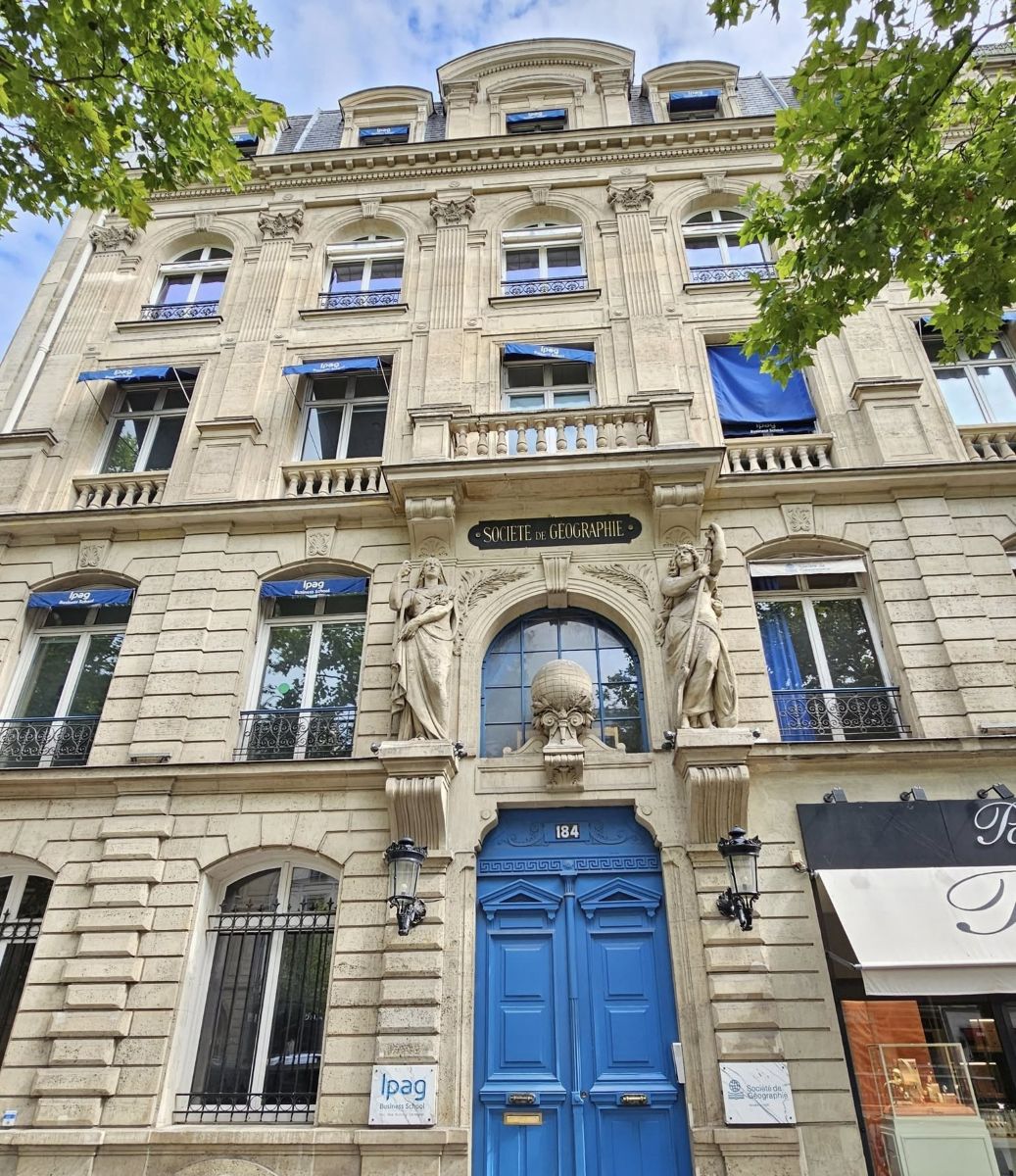
No. 149: on the corner of rue de Rennes, former Publicis drugstore, opened in 1965, the second launched by the group in France. In 1995, too small for public taste, the closure of the drugstore was announced, leaving room two years later for an Armani boutique. No. 168: former Franco-Spanish-American bookstore, and headquarters of Louis-Michaud editions taken over by Valdemar Rasmussen; the bookstore, continued by René Rasmussen, closed in 1960. Opposite number 168 on the current boulevard, immediately west of the current passage de la Petite-Boucherie): site of the Abbaye prison (demolished), No. 172: the Café de Flore, one of the most famous literary cafés in Paris, where winners of the Prix Goncourt, poets of all eras met, and where some ideologues of the Russian or Chinese revolutions and great literary figures have passed through. No. 175: Sonia Rykiel’s boutique inaugurated No. 184 (see pic): building constructed in 1878 for the Geographical Society. The two caryatids, representing The Earth and The Sea, and the terrestrial globe on the facade. The initial distribution of the premises included on the ground floor, the large meeting room (preserved), a room lost steps, a cloakroom, a caretaker’s quarters; on the 1st floor, a committee room and the president’s office; on the 2nd and 3rd floors, the library and a committee room; on the 4th, the apartment of the Company’s agent. Also home to the IPAG Business School. in 2008.
The Paris tourist office on the 6éme arrondissement de Paris : https://parisjetaime.com/eng/article/explore-paris-s-6th-arrondissement-a823
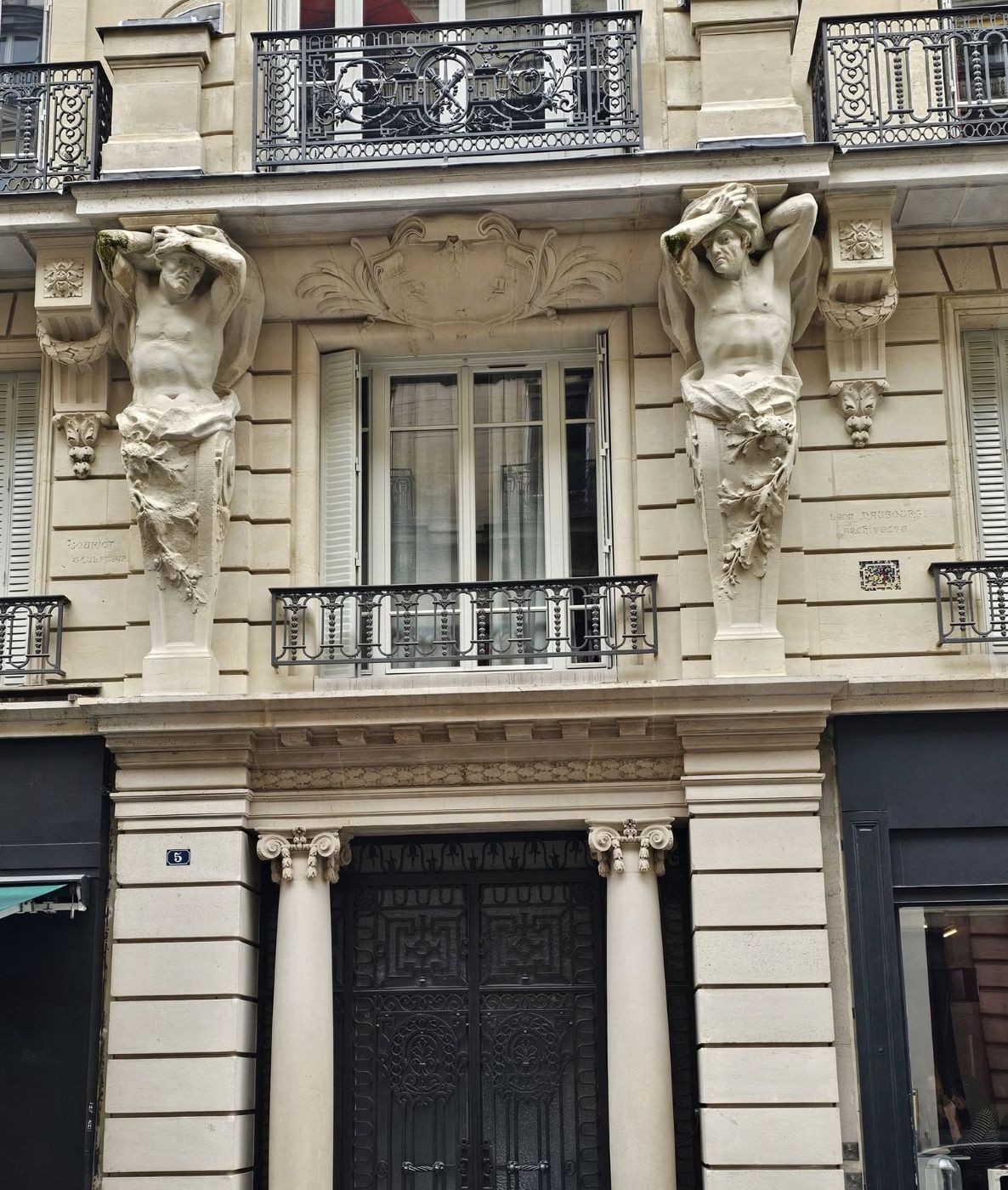
The Rue Dante is located in the 5éme arrondissement of Paris in the Sorbone quartier or neighborhood. It is approximately 120 meters long and 16 meters wide, this street connects Rue Galande to Boulevard Saint-Germain. Its relatively homogeneous architecture is Haussmannian in style. It is accessible by metro line 10 at the Maubert – Mutualité station. It owes its name to the great Italian poet Dante Alighieri, who is said to have lived nearby during his time at the University of Paris, then located on the current site of Square René-Viviani before the construction of the Sorbonne. Formerly part of Rue du Fouarre, the road was opened in several stages from 1855 to 1897, the section to Boulevard Saint-Germain being the last to be developed. Formerly called “rue du Fouarre” along its entire length, the southern part was renamed in homage to the poet who mentions it in The Divine Comedy, in song X of Paradise as the place where the philosopher Siger de Brabant taught in Paris Remarkable buildings here is at No. 5 (see pic) at the end of his seven-year term, President Émile Loubet lived in this building in a large apartment on the first floor. This apartment was later occupied by the politician Ernest Pezet. then Antonin Dubost, President of the Senate throughout the Great War or WWI, lived in this building in the 1910s. It is an apartment building built in 1905.
The Paris tourist office on the 5éme arrondissement de Paris : https://parisjetaime.com/eng/article/explore-paris-s-5th-arrondissement-a820
The Rue de la Paix is located in the 1er and 2éme arrondissements of Paris. It connects Place Vendôme and the Opéra Garnier of many glorious walks by it ! Located in a prestigious and affluent area of the City, indeed, it mainly houses fine jewelry houses , luxury stores, and grand hotels and palaces . This site is served by metro lines 3, 7, and 8 at the Opéra station. It bears this name in memory of the signing of the 1814 peace treaty between France and the major European powers after the first abdication of Napoleon I. The Order of the Capuchin Poor Clares was introduced in France by Queen Louise of Lorraine. Finally, on June 8 1602, Henri IV authorized the widow of the Duke of Mercœur, Marie of Luxembourg, Duchess of Étampes and Penthièvre, to build a Capuchin convent, but in Paris and not in Bourges. By a bull of September 1603, Pope Paul V accredited the creation of the convent in Paris, under the name “the Daughters of the Passion”. Construction work on the convent began on June 29, 1604, and the chapel was inaugurated in June 1606. The Capuchin convent then occupied half of the current Place Vendôme ! The nuns moved in on July 2, 1688. The new church was consecrated and dedicated to Saint Louis on August 27, 1689. During the French revolution, the municipal officers were tasked with expelling the nuns, and on June 14, 1790, the sisters left the convent. By decree of September 7, 1792, the convent became the mint where assignats were printed. Signed by Napoleon, a decree of February 19, 1806 stipulates the opening of the future rue de la Paix, between the place Vendôme and the boulevard des Capucines, on the occasion of the creation of the rue Daunou (then “rue Neuve-Saint-Augustin”), which is perpendicular. First named “rue Napoléon” after a decision of the Ministry of the Interior of June 30, 1806, the artery changed its name to rue de la Paix on May 30, 1814, to celebrate the new peace negotiated in Europe. The street was opened after the destruction of the Capucines convent, following the confiscations of ecclesiastical property by the French revolution. However, some famous people had been buried if sometimes parts of it in the convent church following a will, a mass foundation or a legacy. Among these dignitaries were François Michel Le Tellier de Louvois, Gilbert Colbert de Saint-Pouange, the Marquise de Pompadour or the Duke of Créquy, elder brother of Marshal François de Créquy. The bones unearthed in the cloister and the Capucines church during the construction of the rue de la Paix were transferred on March 29, 1804 to the catacombs of Paris, in their private ossuary. Queen Louise of Lorraine, founder of the convent, was moved to the Père-Lachaise cemetery in 1806, then to the Basilica of Saint-Denis in 1817. In 1864, during the construction of a Haussmannian sewer, three coffins were discovered and saved: those of Henriette Catherine de Joyeuse, the Duchess of Mercœur and Louvois. But that of Madame de Pompadour was not exhumed. The writer Michel de Decker evokes the fate of the Marquise in his work: « This is how Jeanne-Antoinette, remaining in her tomb, still sleeps today under the paving stones of the old rue Napoléon , which became rue de la Paix in 1814 , and probably in front of the building bearing No 3..
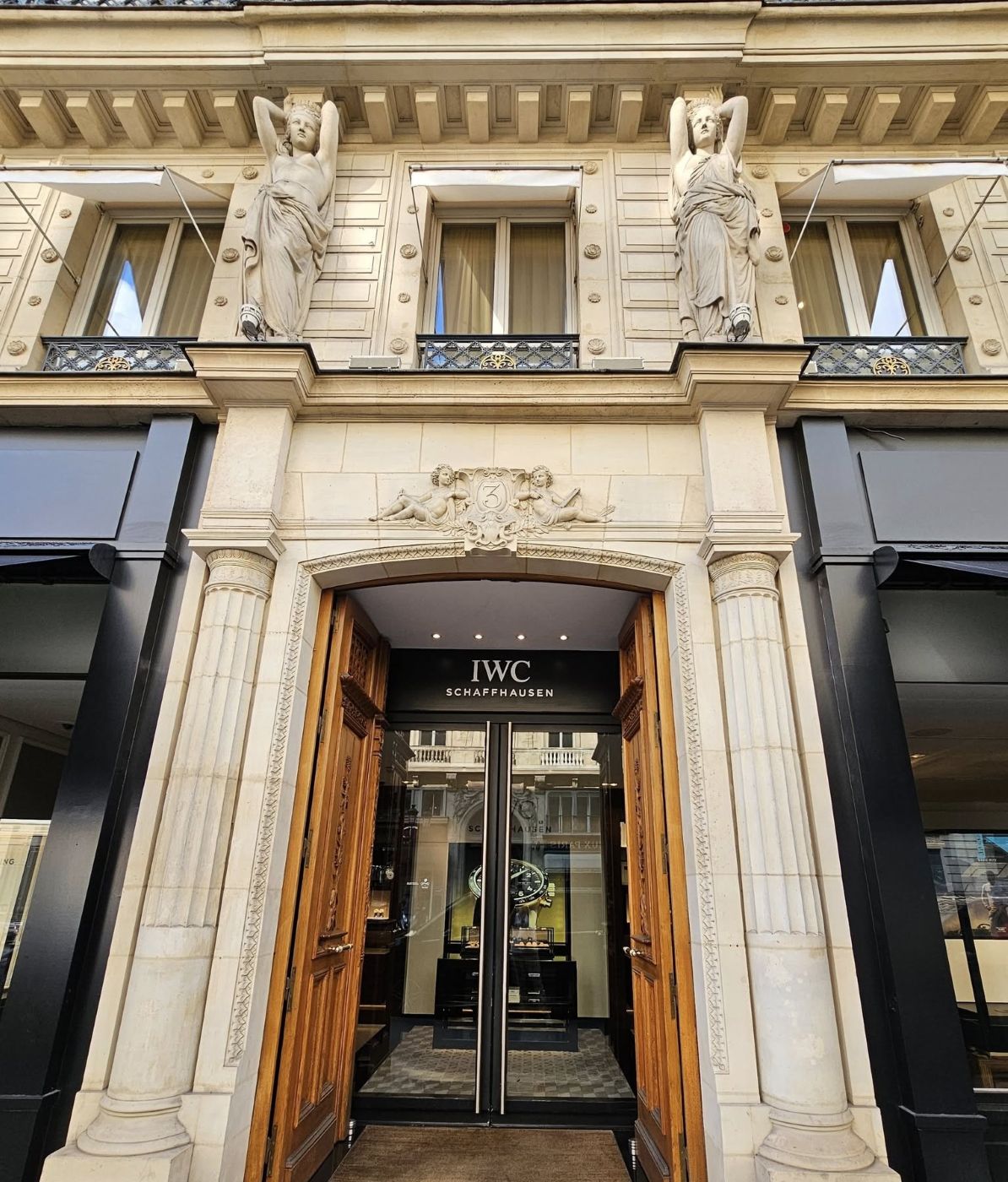
Notable buildings here are at No. 3: building from 1854. The haute couture house Paquin was established at 3, rue de la Paix in 1891, before closing its doors for good in 1956 due to serious financial difficulties. No. 4: Robert Linzeler’s jewelry and goldsmith shop in 1923. (see pic ) It is now one branch of the Boutique IWC Schaffhausen, the Engineer of Watchmaking™. The International Watch Company (IWC) was founded in 1868 by the American Florentine Ariosto Jones. With over 85 years of Pilot’s Watch heritage, the house has become the leader in aeronautical timekeeping. At No. 6: Goldsmith Louis Aucoc opened his boutique on Rue de la Paix in 1821. It is mentioned in the first chapter of “La Dame aux camélias”. It was with his descendants André Aucoc and Louis Aucoc that René Lalique apprenticed from 1874 to 1876. No. 7: In 1858, the couturier Charles Frederick Worth and the Swede Otto Gustav Bobergh created the haute couture house Worth & Bobergh here. At the start of the Great War or WWI, the store was transformed into an auxiliary military hospital. The Worth house has since been replaced by the watchmaker and jeweler Piaget , No. 8: during the reign of Louis-Philippe and the Second Empire, site of the Hôtel meublé Mirabeau and the store of the publisher Amyot. The current building dates from 1867, when it was rebuilt. In 1927, the perfumer Roger & Gallet had the front of his shop made here. Nos. 11 and 13: site of the Cartier jewelry store (at 13 since 1899, at 11 since 1912). No. 13: site of the Hôtel Westminster Paris. No. 19: here was the jeweler Gustave Baugrand, protector of the actress Marie Delaporte and supplier to Napoleon III. Also the location of the luxury perfumery Grenoville, from 1902. No. 24: location of the leather goods house Offenthal from 1935 to 1995 (shop looted during the Nazis Occupation).
The Paris tourist office on Paris Centre (former arrond 1-4) : https://parisjetaime.com/eng/article/explore-the-centre-of-paris-a846
The Rue de Sèvres is located in the 6éme, 7éme and 15éme arrondissements of Paris. It is 1500 meters long and about 20 meters wide. It is served by metro lines 10 and 12 at the Sèvres – Babylone station, by metro line 10 at the Vaneau station, by metro lines 10 and 13 at the Duroc station and by metro line 6 at the Sèvres – Lecourbe station. This street owes its name to the town of Sèvres to which it leads. In the 13C, this street was called “chemin de la Maladrerie” because of a leper hospital that it ran alongside, a place occupied today by Square Boucicaut and Allée Pierre-Herbart. In 1355, it was indicated under the name of “voie de Sèvres”, then successively took the names “grand chemin de Sèvres”, “chemin de Meudon”, “chemin des Charbonniers”, “chemin du Boullouer” before becoming “rue du Boullouer”, then “rue du Boullaier”, “rue du Boulloy” and “rue du Bouloir-Saint-Germain” from 1568. In 1624, it took the name of “rue des Petites-Maisons” then “rue de l’Hôpital-des-Petites-Maisons”, the leper hospital having been transformed into an asylum for the insane under the name of Hôpital des Petites-Maisons or Hôpital des Petits-Ménages. The hospice was transferred to Issy-les-Moulineaux in 1863 and Boulevard Raspail was traced on its site.
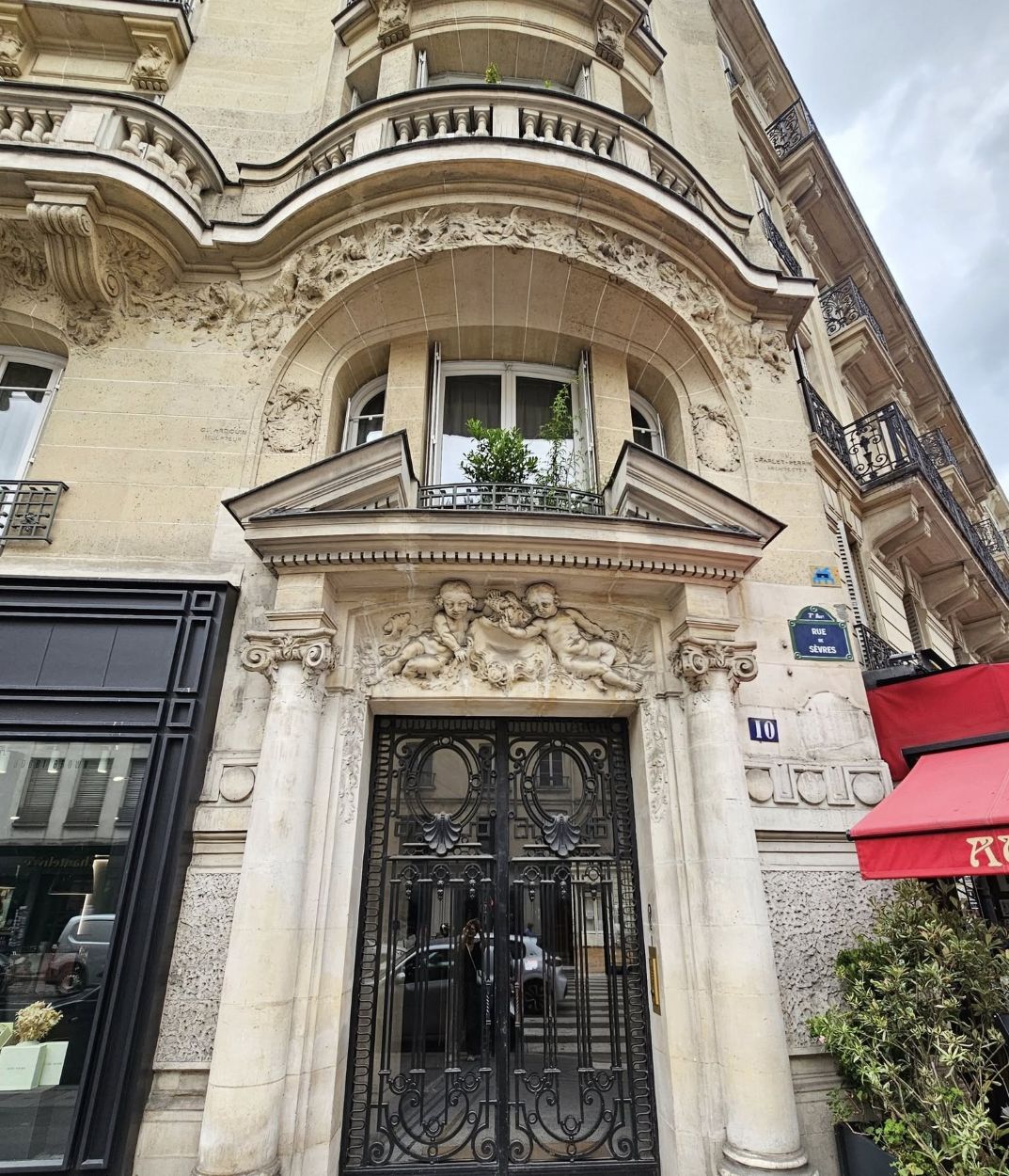
Notable buildings here are at Nos. 1 and 10: tenement houses built in 1722 for the Premonstratensian Convent of the Blessed Sacrament, extensively remodeled. No. 11: Site of an entrance to the Premonstratensian-Reformed Convent, founded in 1661 and sold as national property in 1797. The writer Joris-Karl Huysmans lived at this address for most of his life, in an apartment on the first floor overlooking the courtyard, set up in the buildings of the former Premonstratensian Convent. He visited the painter Émile Bouneau there in 1920, who lived on the top floor, under the roof of Pierre Seghers, poet, publisher and French resistance fighter. He is one of the most famous French poetry publishers of the 20C, setting up his young publishing house there after the Liberation of Paris in 1944. No. 16: former Abbaye-aux-Bois, current location of Rue Juliette-Récamier and Square Roger-Stéphane. No. 23: Hôtel Lutetia. Nos. 23 and 27: crossing Boulevard Raspail. No. 22: Square Boucicaut, named after Marguerite Boucicaut and Aristide Boucicaut, founders of the Le Bon Marché department stores, and access to Allée Pierre-Herbart, in memory of the writer and WWII resistance fighter Pierre Herbart, who lived in the area. No. 24: Le Bon Marché department stores. Nos. 25 and 27: site of the former mother house of the Sisters of Saint Thomas of Villeneuve, demolished in 1908 after the nuns were expropriated for the purpose of opening a section of Boulevard Raspail. They set up their new mother house at the Château de Neuilly (Neuilly-sur-Seine 92), acquired for this purpose in 1907. No. 33: Church of Saint-Ignace . No. 35: Allan Kardec opened a private course there in 1824. Le Corbusier’s last Parisian residence, where his studio was located. No. 35 bis: Sèvres Jesuit Center. No. 38: La Grande Épicerie. No. 42: Fellah Fountain. No. 51: The English painter Thomas William Marshall had his studio here in 1905. No. 59 forming a corner with No. 2, rue Saint-Placide: house (18C) with a corner niche housing a Virgin and Child. In 1838, the wine merchant and caterer named Guignet occupied this site. No. 79: Aristide Maillol had his studio here where he welcomed the painter Achille Laugé. No. 84: site of the former Couvent des Oiseaux, “Bird Prison” during the Frenc revolution. No. 90: private mansion occupied by the congregation of the Daughters of the Cross, known as the Sisters of Saint Andrew. Nos. 93 to 97 (and 88 to 92, rue du Cherche-Midi: chapel of the mother house of the Congregation of the Mission (Lazarists). Also at 93, Paris campus of Saint John’s University (New York). No. 111: at the corner of rue Saint-Romain, the Hôtel de Choiseul-Praslin, headquarters of La Banque Postale. No. 135 (or 155?): in 1888, home of the painter Henri Rousseau, known as Le Douanier Rousseau. His first wife, Clémence Boitard, died there on May 7, 1888 at the age of 37. Nos. 149 and 151: Necker-Enfants Malades Hospital.
The Paris tourist office on the 6éme arrondissement de Paris : https://parisjetaime.com/eng/article/explore-paris-s-6th-arrondissement-a823
The Paris tourist office on the 7éme arrondissement de Paris : https://parisjetaime.com/eng/article/explore-paris-s-7th-arrondissement-a825
The Paris tourist office on the 15éme arrondissement de Paris : https://parisjetaime.com/eng/article/explore-paris-s-15th-arrondissement-a827
The rue Royale is in the Quartier Madeleine or neighborhood of the 8éme arrondissement or district of Paris with 282 meters long, the street begins at Place de la Concorde and ends at Place de la Madeleine. It measures 22.80 meters wide between Place de la Concorde and Rue du Faubourg-Saint-Honoré and 43 meters elsewhere. Its name comes from the fact that this route was opened to give access to Place Louis-XV, current Place de la Concorde. This rue Royale replaced the Saint-Honoré gate, which was at the corner of the rue Saint-Honoré , built under Louis XIII and destroyed in 1733, and the rampart which extended to the jardin des Tuileries. The rue Royale des Tuileries was built from 1758 on a uniform facade drawing given by Ange-Jacques Gabriel. Around 1792, during the French revolution,rue Royale was renamed “rue de la Révolution”. It then became “rue Royale Saint-Honoré” then, in 1795, “rue de la Concorde”. It resumed its name by prefectural decree of April 27, 1814. After the Restoration, the rue Royale gradually lost its residential character and became one of the high places of the Parisian luxury trade, particularly from the end of the 19C.
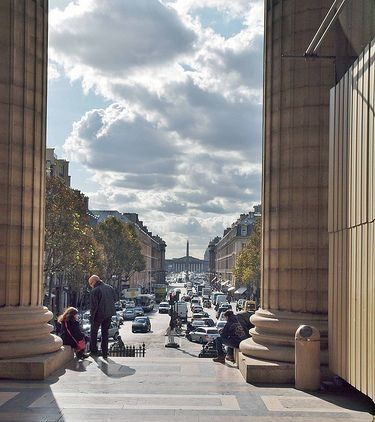
Notable buildings here are well see pic from the Madeleine Church towards rue Royale, and then at No 1: Hôtel de Coislin on the corner of Place de la Concorde where, on February 6, 1778, Conrad Alexandre Gérard in the name of King Louis XVI, Benjamin Franklin, Silas Deane, Arthur Lee signed the treaties by which France was the first country to recognize the independence of the United States of America. Yeah! Between Place de la Concorde and Maxim’s restaurant, on the south pilaster of the entrance to No. 1, you can see the facsimile of a poster of the French mobilization of 1914. The original poster having been forgotten long after the start of hostilities, the city of Paris decided to perpetuate this oversight, by replacing the poster that had become illegible by a new one, protected by a glass framework. At No 2: Hôtel de la Marine, also known as the Garde-Meuble hotel. No 3: Hôtel Richelieu. Maxim’s restaurant established at this address since 1893 is remarkable for its storefront and its Art Nouveau interior decor of 1899. At No 9: hotel built after 1781. François Alexandre Frédéric de La Rochefoucauld-Liancourt died there on March 27, 1827. At No 11: hotel built after 1781. The large cut-out living room was reassembled in Paris at the Musée Nissim-de-Camondo museum and the bedroom at the Museum of Decorative Arts in Buenos Aires Argentina. Queen Nathalie of Serbia lived there, and was later call the Brunner Exhibition Hall in 1910. At No 13: hotel built after 1781. The writer Jean Baptiste Antoine Suard, perpetual secretary of the French Academy, died in this building on July 20, 1817. A living room of the apartment on the street was reassembled at the Philadelphia Museum of Art in Philadelphia, Pennsylvania. At No 16: Boulangerie Ladurée bakery founded in 1862. At No 21: the famous Brasserie Weber was installed in this building from 1899 to 1961. Before 1914, it was the meeting place for writers, journalists and artists, frequented by the designers Forain and Caran d’Ache, the writers Paul- Jean Toulet, Léon Daudet, Marcel Proust, the editorial offices of Le Temps and Le Figaro, actors like Marguerite Deval. After the riots of February 6, 1934, the wounded were transported to Weber’s home while waiting for first aid. It was from 1905 the property of the hotelier Arthur Millon then of his son-in-law René Kieffer. A chic address with wonderful high fashion stores is the Village Royale at no 25 rue Royale , for your shopping pleasure in style. At No 24: home of humorist Alphonse Allais. And finally, at No 27 and no 3 place de la Madeleine: building which housed the Brasserie Autrichienne or austrian brewery, badly damaged by projectiles fired during the Commune, in the second half of May 1871; the Larue restaurant, opened at the same location in 1886, hosted Proust in the early 1900s, and from 1924 the monthly meeting called “Bixio Dinner” made to host men of letters, writers and journalists, and men of influence in political, economic and cultural circles.
The Paris tourist office on the Madeleine neighborhood/Quartier: https://parisjetaime.com/eng/article/madeleine-a901
The Paris tourist office on the 8éme arrondissement de Paris : https://parisjetaime.com/eng/article/explore-paris-s-8th-arrondissement-a826
There you go folks, another dandy beautiful set of glorious streets of my eternal Paris. I have criss cross them many and have many in my blog already, Again, hope you enjoy this post on the streets of Paris, part XXIX !!! as I.
And remember happy travels, good health, and many cheers to all !!!

 Paris1972-Versailles2003