
Well I am amazed always of the many wonderful monuments in my eternal Paris. I have to say better and more than anywhere else, one reason is call the most beautiful city in the world, and I agree. Here we have a wonderful building call the Petit Palais a wonderful expression of architecture and history. Glad to find me more pictures in my cd rom vaults that should be in my blog for you and me, Therefore, here is my take again on the Petit Palais of Paris, part II !!! Hope you enjoy the post as I,
The Petit Palais, was built on the occasion of the Universal Exhibition of 1900, houses the Museum of Fine Arts (Beaux-Arts) of the city of Paris. It is located in the 8éme arrondissement or district of Paris, Avenue Winston-Churchill, facing the Grand Palais. The Petit Palais is served close by the Metro lines 1 and 13 at the station Champs-Elysées-Clemenceau and Metro line 9, station Franklin-Roosevelt , as well as by the bus lines RATP 28,42,72,73,80,83 and 93. The Petit Palais, an architectural gem of the Belle Époque, is beginning an ambitious restoration of its peristyle and fresco, which are showing worrying signs of deterioration. This large-scale project, which will run from April 2025 to March 2026, will restore the splendor of this masterpiece, a symbol of the revival of fresco painting in France at the beginning of the 20C. It will remain open.
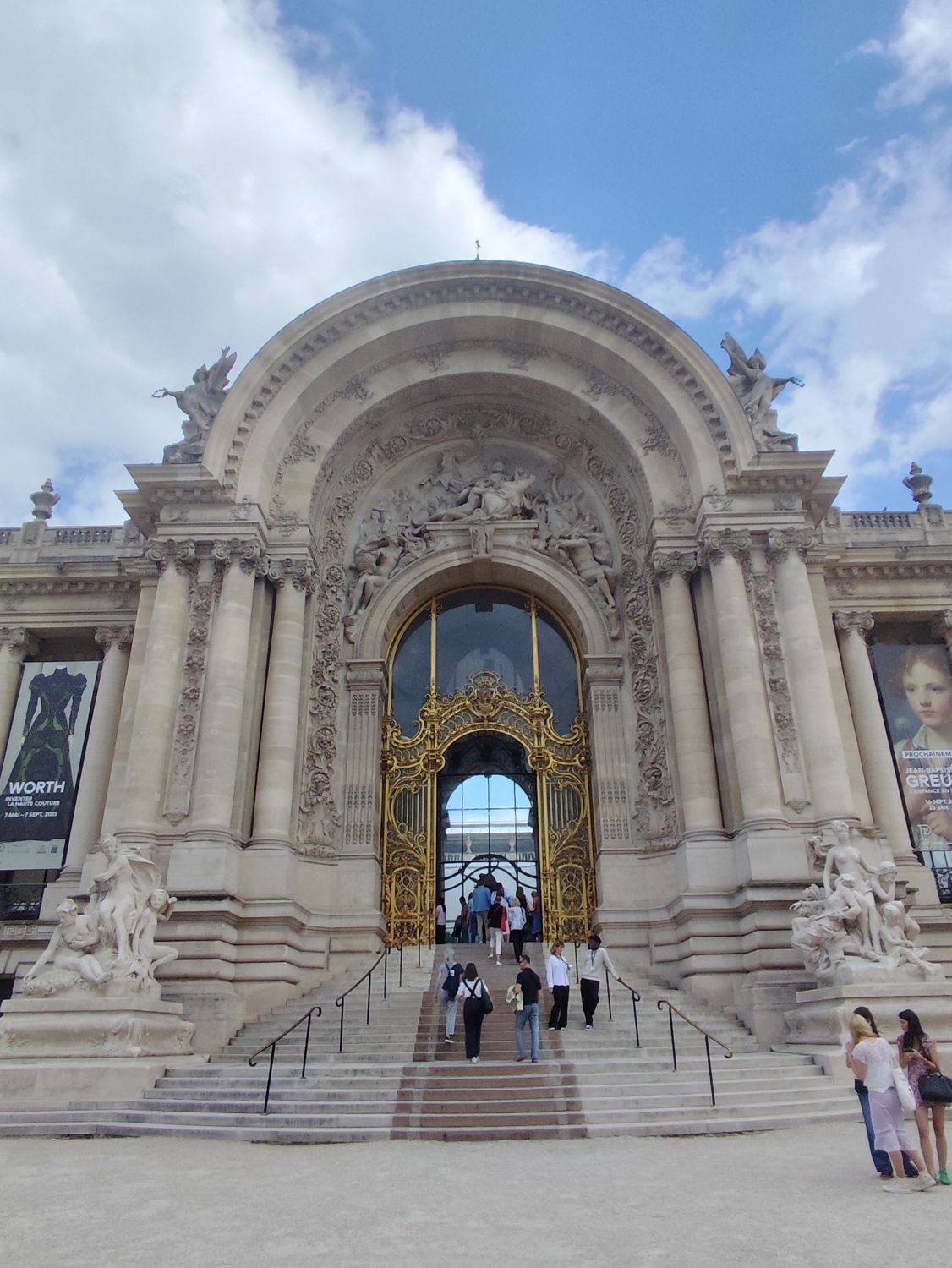
From the moment it was installed, the entrance gate designed by Charles Girault was praised for its elegance and virtuosity of its execution. The entrance vestibule were executed between 1903 and 1910, with four Symbolist-inspired panels for the museum’s entrance vestibule: Mysticism, Plastic Art, Thought, and Matter. The entrance rotunda is the only space in the Petit Palais lit by stained glass. At the base of the roof are four oculi closed by stained glass windows decorated with interlocking patterns, made of white and opal glass.
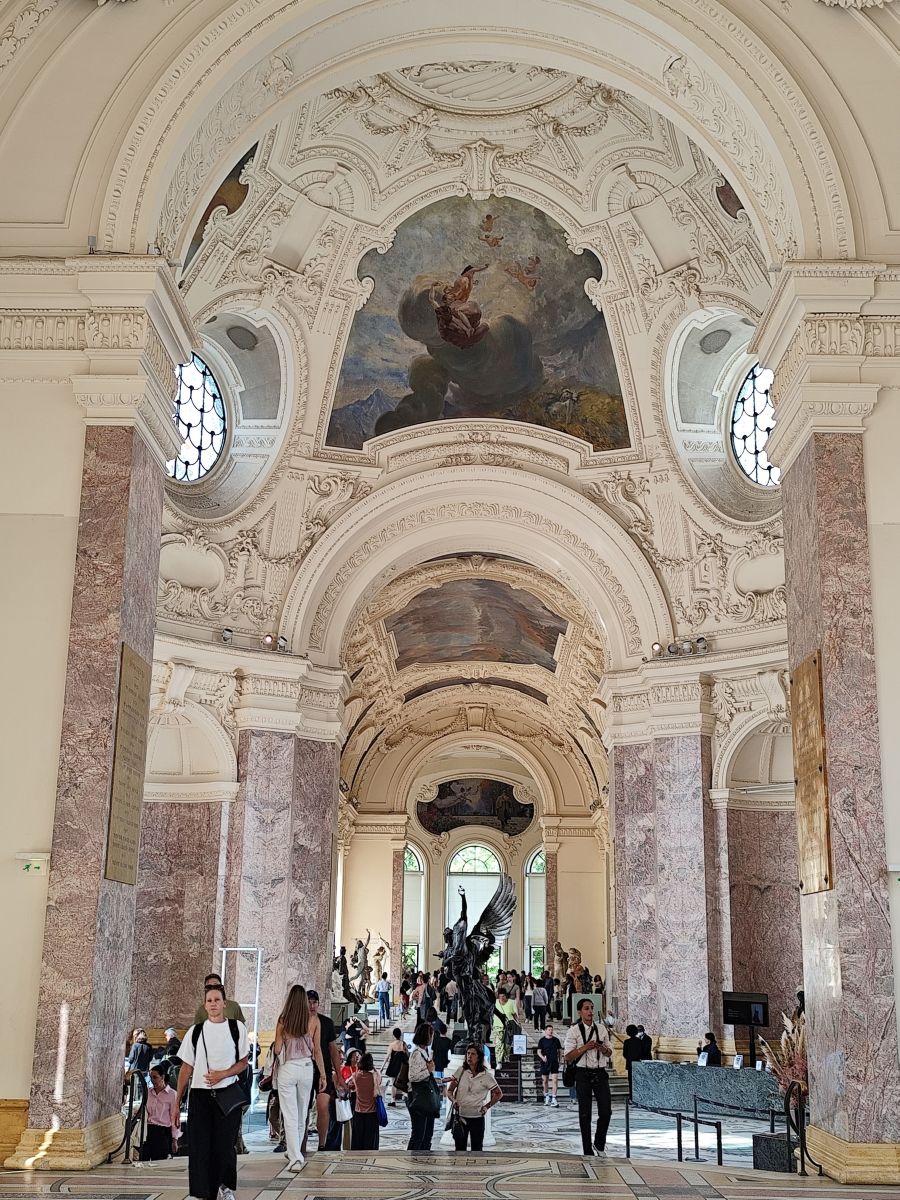
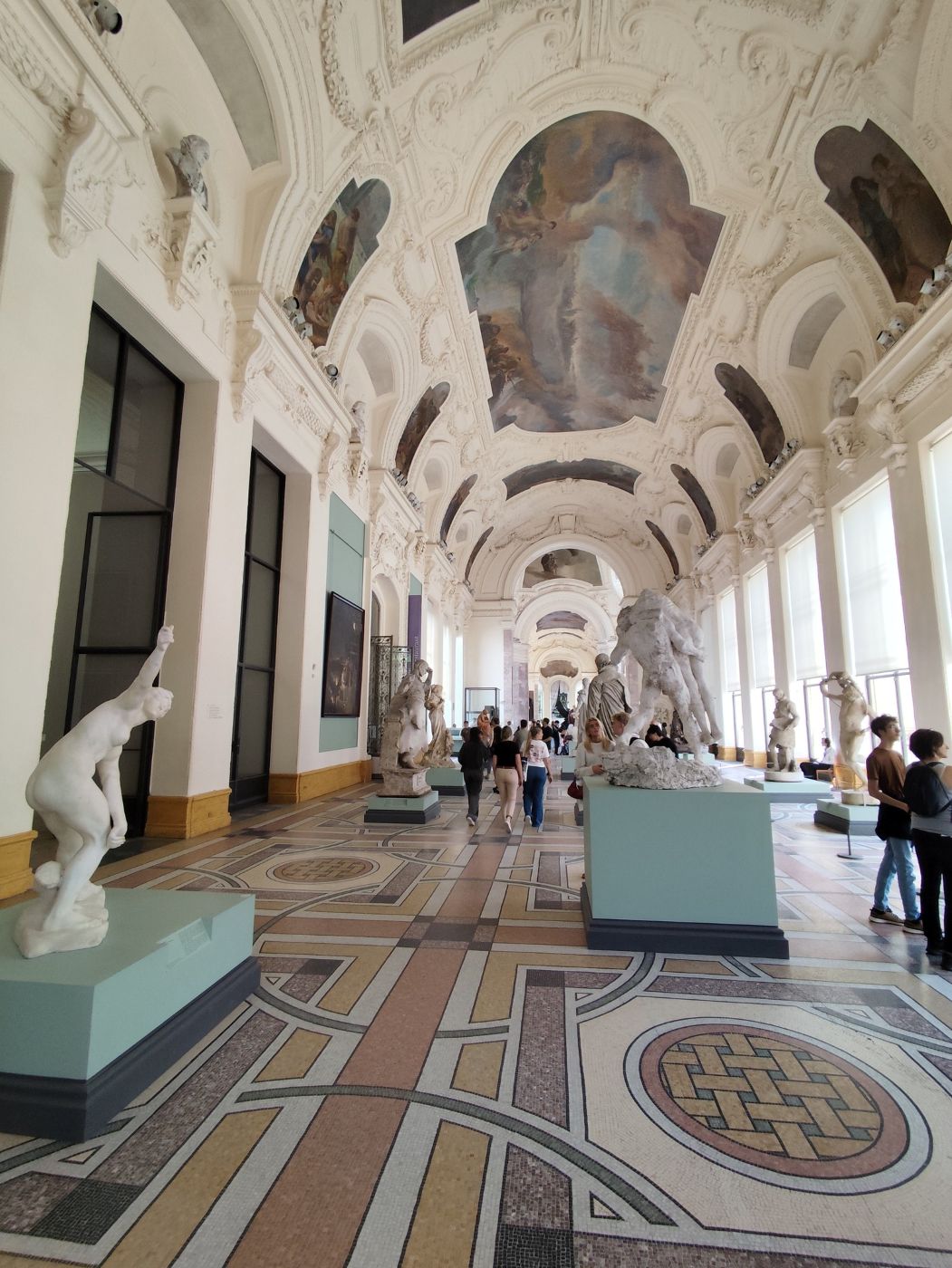
The large galleries were each tasked with decorating the vaults of the two galleries. From 1906 to 1911, Cormon retraced the history of old Paris, from the Battle of Lutetia to the French revolution (North Gallery). Roll, meanwhile, was responsible for illustrating modern Paris (South Gallery). Above the galleries are sixteen plaster busts representing famous artists, such as Eugène Delacroix, Pierre Lescot, and François Mansart.
The pavilions to the north, Ferdinand Humbert painted two ceilings celebrating The Intellectual Triumph of Paris between 1909 and 1924. Humbert introduced into his composition a contemporary figure, an ordinary stroller wearing a hat and an overcoat, descending the steps of a staircase. To the south, Georges Picard depicted The Triumph of Woman. The garden peristyle with cover the vaults of the garden portico, reinvented the art of fresco painting and rediscovered a decorative technique forgotten since the Renaissance, punctuated by medallions depicting the Months alternating with the hours of day and night. The three large sections of the vault are punctuated by the female figures of the Seasons. The final phase of work was carried out after WWI. The decoration of this dome, above the southeast rotunda, was entrusted to Maurice Denis, who retraced the history of French art using portraits of the greatest artists accompanied by their most famous works.
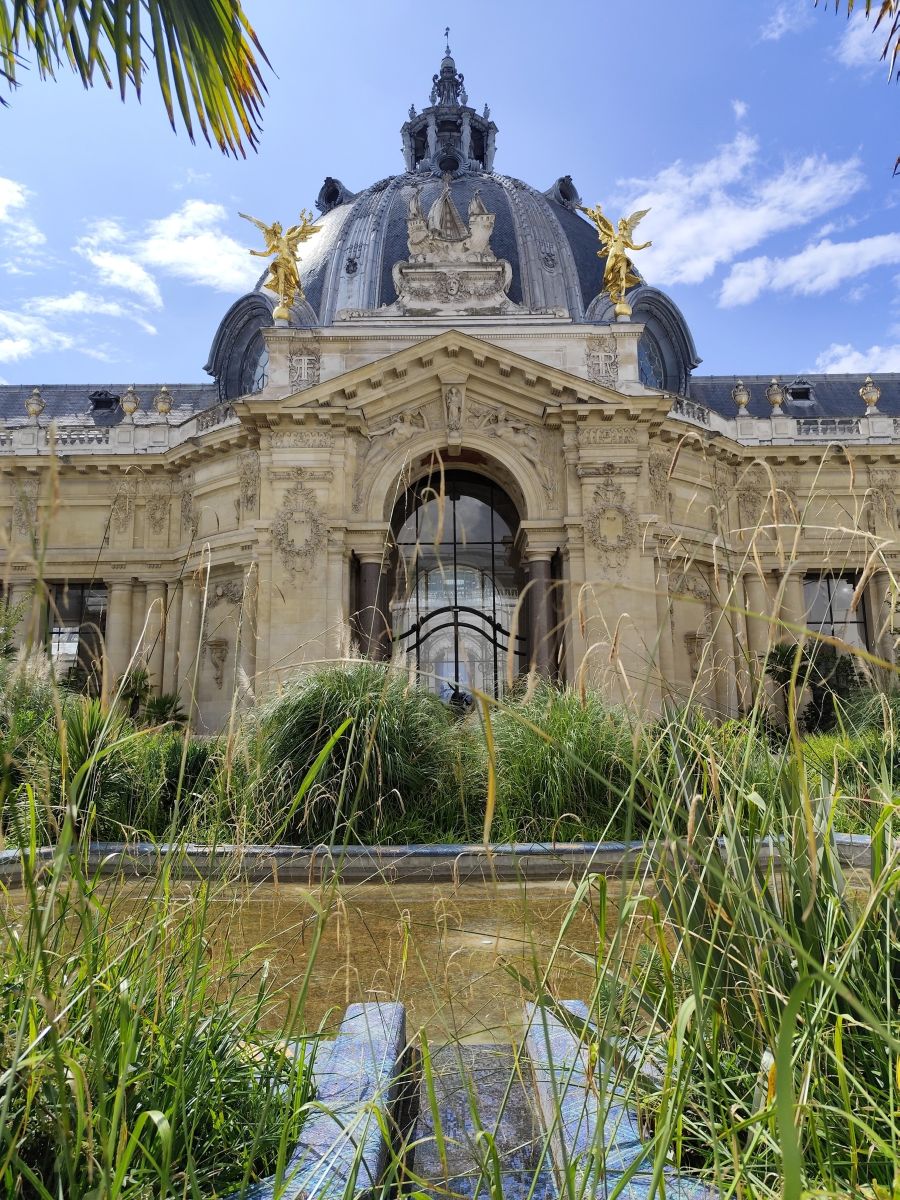
The Petit Palais is organized around a semi-circular garden. The exhibition sites are located on the first floor (2nd US), the ground floor (1st US) being originally dedicated to offices and reserves. The façade is about 150 meters long, centered by a monumental porch topped by a dome. Ionic columns with diagonal scrolls adorn the main facade as well as the semi-circular peristyle of the inner courtyard. The décor is complemented by numerous bas-reliefs. The sculptures on the façade are, the city of Paris protecting the Arts with a woman seated holding in her left arm a ship symbolizing Paris and surrounded by the Muses; on the right, a group with the Seine river and its tributaries. On the left, the Four Seasons group with young women carrying sheafs of wheat and fruit. Donations made by the Dutuits and Tucks in particular enrich the collection of works: precious antique, medieval, French and Italian Renaissance pieces, as well as famous Flemish and Dutch cabinets and paintings. Paintings and sculptures, tapestries and objets d’art from the 18C. The museum also has a collection of 19c works, the result of commissions and purchases made by the City of Paris (Dalou workshop) as well as bequests and donations, of the greatest interest (Carpeaux, Carriès, Cézanne, Chassériau, Courbet, Delacroix, Ingres). The works on display reflect the main pictorial movements of the 19C. The 1900s period is illustrated by art nouveau style objects such as glassware by Emile Gallé or a dining room by Hector Guimard.
I need to tell you this our favorite spots and main reasons to come here other than an unusual exhibition like that of the Incas, The bookstore-boutique is located on the ground floor of the Petit Palais and is accessible free of charge through the museum’s main entrance. The Café 1902 is located in the garden and is accessible free of charge through the museum’s main entrance. During garden renovations, access to the Café is via the permanent collections. This is a must to sit sip and enjoy just been in Paris.
The Official Petit Palais webpage: https://www.petitpalais.paris.fr/en
The Paris tourist office on the Petit Palais: https://parisjetaime.com/eng/culture/petit-palais-musee-des-beaux-arts-de-la-ville-de-paris-p3490
The City of Paris on the Petit Palais : https://www.paris.fr/lieux/petit-palais-musee-des-beaux-arts-de-la-ville-de-paris-1526
There you go folks, another dandy monument of my eternal Paris, this is a must to see. I have written so much on Paris ,the city I worked for almost 10 years and very glad I did,in fact proud of it. The area around this monument is superbe and fully enjoyable by all. Again, hope you enjoy this post on the Petit Palais of Paris, part II !!! as I
And remember , happy travels, good health,and many cheers to all !!!

 Paris1972-Versailles2003
Another of my fave spots, thank you
LikeLiked by 1 person
Indeed wonderful and the salon de thé in the garden is glorious. Thanks for stopping by Cheers
LikeLike