
I told you how much I have walked all over Paris and that I worked in it for 9 + years while living just next door in Versailles! Well, I have, also told you that there is so many things to see here that you will need a lifetime. This is another wonderful monument on the off the beaten path and glad to have it in my blog for you and me ; after finding me a picture in my cd rom vault, There is always time to indulge in Paris. Therefore, let me tell you a bit on the Christuskirche of Paris !!! Hope you enjoy the post as I.
The Christuskirche or the German Protestant Church is located at 25 rue Blanche in the 9éme arrondissement of Paris. It has existed for over 100 years. It belongs to a religious association under French law according to the law of 1905. It is run by a presbyteral council composed of a president, a treasurer and eight other members, as well as pastors. It is a German Protestant church bound by contract to the central organization of the Protestant Church in Germany (EKD). The EKD was founded in 1945, its current organization dates from 1948 ,with pastors ,often a couple, coming from Germany. It represents a base for all German-speaking Protestant Christians. It constitutes a Franco/German link with the French Protestant churches through its membership in the Protestant Federation of France (FPF) with the status of associate member. You can get to it on Metro line 13 stop Liège or line 12 stop Trinité – d’Estienne d’Orves ;also, on bus lines 68, 74 and 81 stop/arrêt La Bruyère.
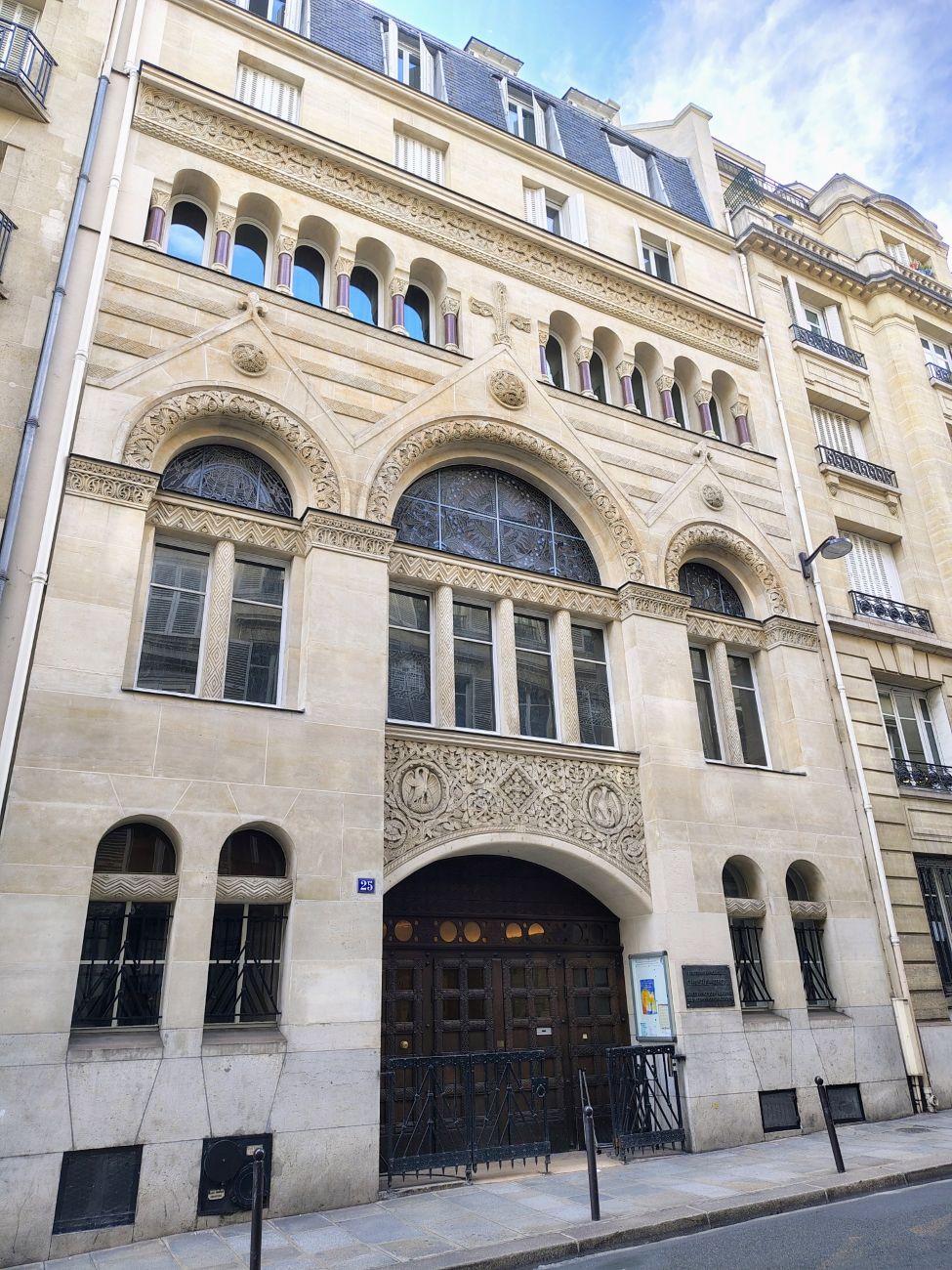
Its facade, in a Romanesque-Byzantine style, is richly decorated. Two symbols of Christ in particular are worth mentioning: a phoenix and a pelican. Aisles run along the five-bay nave. The semi-circular choir has no ornamental sculptures. The stained-glass windows represent The Last Supper, Christ in Glory and Jesus walking on water. It façade) displays the so-called Romanesque style, as it developed from the 10C to the 13C and was used at that time in all Christian countries. Above the ground floor and the 6.30 meters high hall, enclosed on the outside by five small columns, are rooms specifically intended for the Christian association of young men. Above this, on two floors, is the rectory. Inaugurated on December 9, 1894, the church boasts one of the best acoustics in Paris. The installation of its first organ was the starting point of an intense musical life. On November 20, 1962, the contract was signed with Detlef Kleuker of Brackwede (Westphalia), who installed the current instrument shortly after the renovation and modernization of the church. Inspired by North German Baroque construction, the new organ has mechanical action. On May 17, 1964, Pentecost Day, Jost Harro Schmidt, organist of Celle, devoted the inaugural concert entirely to the works of J. S. Bach.
The church’s operations include German-language services, the organization of reflection and prayer circles, cultural activities, au pair groups, and, above all, moral support for Germans, which makes the Christuskirche so important to many. Unlike German churches, churches in France are associations that must finance themselves. The Christuskirche is no exception, but receives a grant from the Protestant Church in Germany (EKD), which covers a small part of its expenses. The main sources of funding are membership fees, donations, and the rental of church premises for music recordings, concerts, and choir rehearsals.
A bit of history tell us the beginnings of the German church in Paris took place at the Swedish embassy, because even after the promulgation of the Edict of Nantes by King Henry IV in 1598, Protestant services could only take place in certain authorized places, and they were forbidden in Paris. In 1679, the parish obtained official status, still under the protection of the Swedish embassy, shortly before the Edict of Nantes was revoked in 1685 by King Louis XIV with the Edict of Fontainebleau. With the expulsion and emigration of the Huguenots , the social structure of the German parish changed profoundly. After the death of Louis XIV in 1715, many Protestant artisans and skilled workers came to Paris from abroad to replace the Huguenots who had been expelled or murdered. In 1711, the King of Sweden granted the parish the status of an official parish. In addition to the parish of the Swedish embassy, a second German-speaking parish was soon to be found in the Danish embassy, where mainly Protestant workers and domestic staff in Paris would gather. The Swedish branch of the church would have difficulties during the French revolution because it would be considered allied with the royalists, while the Danish chapel would not be disturbed. But ultimately the revolution would facilitate the integration of foreigners and legalize Protestantism. The annexation of Montbéliard ,which until then belonged to the Duchy of Württemberg in 1793 by revolutionary troops increased the number of Lutheran Protestants in France, particularly French-speaking ones, since the main French Lutheran center had until then been in Alsace and was dialect-speaking. Through the “organic articles”, Napoleon guaranteed freedom of religious choice in 1806; the Lutheran Church became a church recognized by the French State in the same way as the Catholic, Reformed and Jewish faiths; the pastors would have the status of civil servants and the Lutheran Church of Paris obtained the use of the former abbey church of Billettes (see post) in the Marais neighborhood, which is still a Lutheran church ,and which has the oldest cloister in Paris. The 19C saw the slow separation of the German part from the French part of this Lutheran Church.
Under Louis-Philippe, whose daughter-in-law and thus potential queen, Helen of Mecklenburg-Schwerin, was a German Lutheran princess, the Lutheran Church reached its peak. In 1843, the Church of the Redemption was inaugurated on Rue Chauchat in the 9éme arrondissement; it is now the seat of the Lutheran Church in France. Baron Haussmann, who, as prefect of the Seine, radically transformed the city of Paris into its current face, was a member of this parish. The revolution of 1848 brought this prosperous period for Parisian Lutheranism to an end. From 1858 to 1864, the great organizer of mutual aid, Friedrich von Bodelschwingh, was a pastor in Paris. He cared for workers who had fallen into poverty, especially their children, and built schools and social institutions for poor immigrants in the northeast of Paris, including the Hügelkirche ,now the Institut Saint-Serge, and the Lutheran Church of the Ascension in Batignolles, which was inaugurated in 1866. The war between France and Prussia in 1870/71 accelerated the separation of the German branch of the Lutheran Church from the French branch. The defeat of France in 1871 led to the definitive break. From 1888 onwards, the new German Emperor William II pursued a more active foreign policy. Following disputes over worship times in the churches of the Redemption and Billettes, the construction of a new church, the Christuskirche, on Rue Blanche, was undertaken, inaugurated almost without any French participation in 1894. Until following the complete separation of state and church in 1905, the parish formally remained part of the French Lutheran Consistory Church. From 1905 onward, like all churches in France, it was a “religious association.”
Following the principle of the unity of “Throne and Altar” as the German Emperor was also the chief bishop of the Protestant Church, and also inspired by the patriotism of the time, the parish during this period was more German than Protestant-Lutheran. Consequently, the beginning of the Great War o WWI in 1914 meant the end of the parish. The period from 1933 to 1945 represented an extremely ambivalent and difficult phase for the Christuskirche. In 1945, it was again the collapse: the Nazis left the city, the buildings were requisitioned again. But three institutions of the Protestant Church would occupy the building on rue Blanche: CIMADE, the French Protestant Church’s refugee aid organization, the Swedish mission for Israel and the Chaplaincy for Protestant foreigners in France. Rue Blanche had become an international Protestant center. It was on September 1, 1954, that the parish officially resumed its activity with the arrival of Pastor Dahlkötter. The parish was contractually bound to the central organization of German Protestant Churches (Evangelische Kirche in Deutschland – EKD), and no longer to a regional Lutheran church. It became the home of all German-speaking Christians of all Protestant denominations. With the improvement of Franco-German relations, the work was greatly facilitated; the parish became a link between French and German people, and it became an associate member of the Protestant Federation of France. In 1984, it regained ownership of the church’s building.
The official Christuskirche: https://www.christuskirche.fr/
The official l’Église protestante en Allemagne (EKD) : https://www.ekmd.de/
The official Fédération Protestante de France; see bottom the church : https://www.protestants.org/les-eglises-et-union-deglises-de-la-federation-protestante-de-france/
The Paris tourist office on the 9éme arrondissement de Paris : https://parisjetaime.com/eng/article/explore-paris-s-9th-arrondissement-a828
There you go folks, another nice find in my eternal Paris, often overlook and totally bypassed by visitors is always amazing to find these gems. Glad to have it in my blog for you and me, Again, hope you enjoy this post on the Christuskirche of Paris !!! as I.
And remember, happy travels, good health, and many cheers to all !!!

 Paris1972-Versailles2003