
We have driven and walked in my eternal Paris, and would like to have an imprint in my blog on the wonderful family times we had there, There is so much to see , doing my best, and glad found me these pictures in my cd rom vault ,which now transposing in my blog for you and me, This was my former worked city, so glad to post more memorable spots on it, I thank you for your readership over the years and to bear with my rants! After all, Paris is to rant, shout and yelled about, me think. Therefore, here is my take on curiosities of Paris, part LXXII !!! Hope you enjoy the post as I.
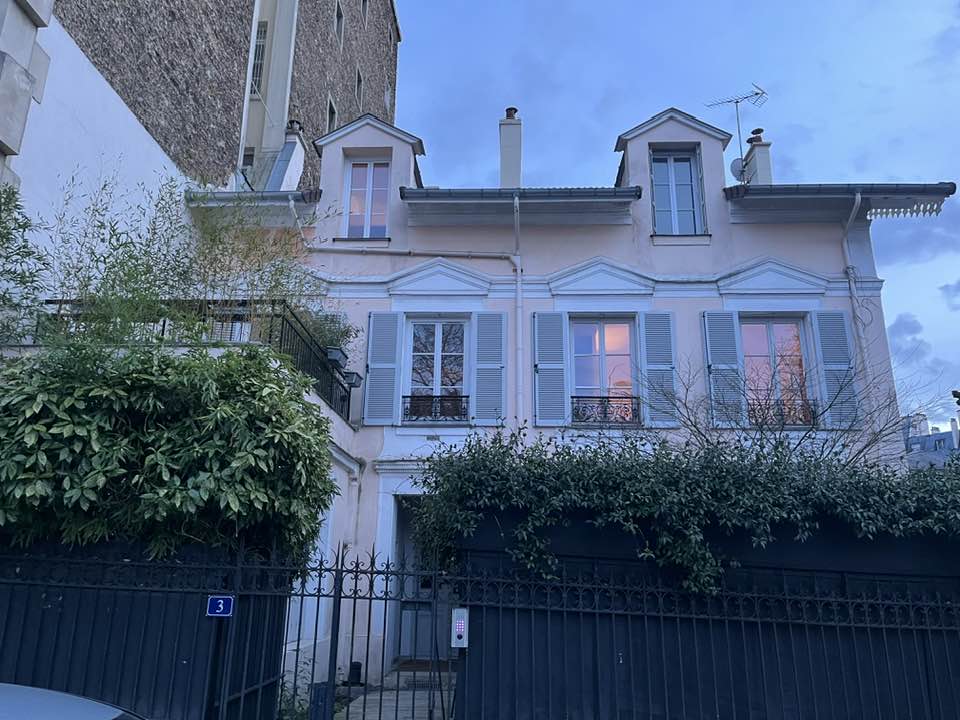
The Boulevard de Beauséjour is located in the 16éme arrondissement of Paris. It begins at the intersection of Chaussée de la Muette, Boulevard Émile-Augier, and Rue d’Andigné, and ends at 102 Rue de l’Assomption, where it continues as Boulevard de Montmorency. At no 7, Boulevard de Beauséjour provides access to the Villa de Beauséjour. It is situated near the metro line à La Muette station,(many time on it). This thoroughfare takes its name from the former Parc de Beauséjour, which it bordered. The Jardin du Ranelagh (see post) is a remnant of this park. The Parc de Beauséjour park featured country pavilions built on the site of former royal stables, surrounded by trees. This road in the former village of Passy was opened in 1853 by the City of Paris and the Paris-Saint-Germain Railway Company during the construction of the Auteuil railway. Bordering the park, it was laid out on the site of a perimeter path in the Bois de Boulogne, mentioned as the “Auteuil perimeter path” in 1847. The opening of Avenue Mozart in 1867 divided this park in two. Notable buildings here are at the Ranelagh Garden extends on the other side of the former railway. At the intersection with the Chaussée de la Muette: Passy-la-Muette station. Nos. 5-7: Villa de Beauséjour. (see post) Inside: four dachas from the 1867 Exposition, one of which actually came, in pieces, from Saint Petersburg. The writer Paul Margueritte lived here. At No 3 the architect Adolphe Alphand lived here and died here in 1891 (see pic). No. 19: former President of the French Republic Albert Lebrun lived here from 1945 until his death in 1950, in an apartment with about ten rooms. No. 47: the philosopher Henri Bergson lived here until his death in 1941. In the 1920s, he had lived in the same neighborhood, at 32 rue Vital. The painter Wifredo Lam, a Cuban painter, promoted a hybrid style of painting combining Western modernism with African and Caribbean symbols, thus creating a unique and contemporary language. Close to Pablo Picasso, and recognized as one of their own by the Surrealists, he lived there until his death in 1982. No. 61 (and 141, rue du Ranelagh): a corner building dating from 1900-1901 with ornamental motifs evoking the Middle Ages and the Renaissance.
The Paris tourist office on the 16éme arrondissement de Paris : https://parisjetaime.com/eng/article/a-la-decouverte-du-16e-arrondissement-de-paris-a830
The Place de l’Odéon is located in the 6th arrondissement of Paris. It is shaped like a semicircle, with its base situated alongside the Odéon Theatre (see post). On its circular side, the square provides access to five streets, arranged symmetrically: Rue Regnard, Rue Crébillon, Rue de l’Odéon, Rue Casimir-Delavigne, and Rue Racine. On either side of the theatre, two parallel streets extend perpendicularly from the square: Rue Rotrou and Rue Corneille. This square is so named because it is located near the Odéon Theatre. The square was officially opened by letters patent on August 10, 1779, on the site of the Hôtel de Condé, under the name “Place du Théâtre-Français.” It later became known as “Place de la Comédie-Française” before adopting its current name in 1807. Notable building here are the Odéon Theatre. No. 1: Here, in 1834, stood Madame Vergne’s bookshop. The Café Voltaire was located on this site. No. 2: La Méditerranée restaurant. Louis Aragon frequented it, and Eugène Ionesco corrected his proofs there. Jean Cocteau designed the plates and the establishment’s logo. Christian Bérard and Marcel Vertès created the wall decorations. The Prix Médicis is awarded here. Camille Desmoulins’ apartment overlooked the square at No. 2 (access via No. 22 rue de l’Odéon). He was arrested here on March 31, 1794, and then guillotined the following April 5 in the Place de la Révolution. No. 7: Headquarters of the publishing house Le Dilettante.
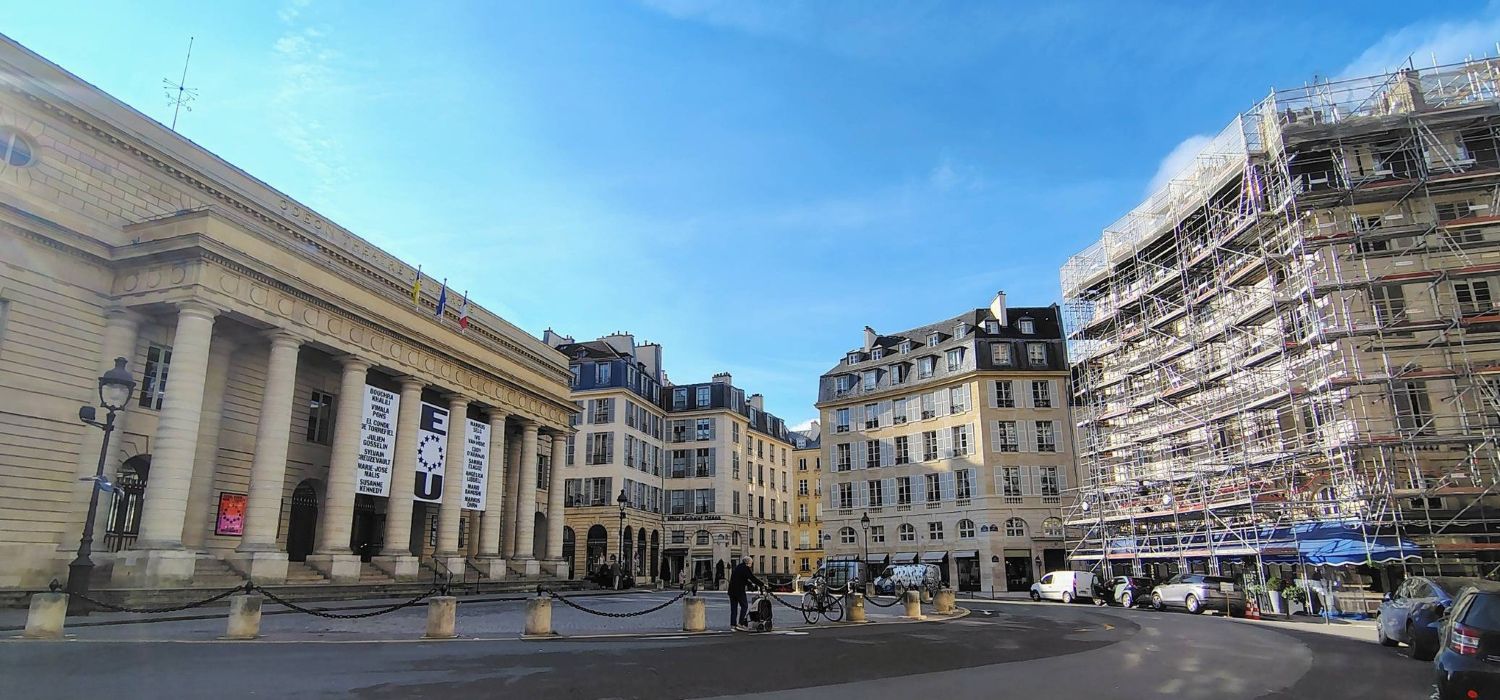
The Rue de l’Odéon is located in the Odéon quartier of the 6th arrondissement of Paris. It is served by metro lines 4 and 10 at the Odéon station. The street is named after the Théâtre de l’Odéon, to which it leads. It was created by letters patent dated August 10, 1779, on the site of the Hôtel de Condé, under the name “Rue du Théâtre-Français” because it led to the Théâtre-Français, the original name of the Théâtre de l’Odéon. It appears on the 1830 map as Rue de l’Odéon. It was one of the first streets in France to have sidewalks, around 1781. These were raised benches accessed by two steps. They were paved and protected by bollards that narrow the roadway. Notable buildings (the pic starts from about no 6) here are at No. 7: Adrienne Monnier founded her bookshop, La Maison des amis des livres (The House of Friends of Books), at this address in 1915; she sold it in 1951. No. 10: Thomas Paine, a British, American, and French philosopher, pamphleteer, and revolutionary, was a major figure in the American Revolution in support of the independence of the thirteen British colonies in North America. He also distinguished himself in the revolutionary movement in France, leaving a significant legacy as a political activist and theorist. A supporter of the Girondins, he lived in this building from 1797 to 1802. No. 12: Sylvia Beach founded her bookshop, Shakespeare and Company, at 8 rue Dupuytren in 1919, moving to this address two years later; she published James Joyce’s Ulysses here in 1922. The bookshop remained on the street until 1941, when it closed. Number 21: a private mansion opening onto the Odéon Theatre. This is the former 17 rue du Théâtre-Français, where Constance-Marie Charpentier, a painter and sister-in-law of Danton, lived from 1793, the year of her marriage. The painter Louis Lafitte had lived in this building since 1795. Constance Charpentier painted in his company, as well as in the company of François Gérard and Pierre Bouillon, who lived on the same street. The writer Cioran lived at this address for many years, until his death in 1995, in a 50 m2 apartment on the 5th floor, consisting of three adjoining attic rooms. No. 22: Camille Desmoulins, his wife Lucile Desmoulins, and Fabre d’Églantine lived in the house at the current number, on the corner of the Place de l’Odéon, when they were arrested and executed on April 5, 1794. No. 35: Constance-Marie Charpentier, a painter, lived at this address in 1806.
The Paris tourist office on the quartier or neighborhood of Odéon : https://parisjetaime.com/eng/transport/quartier-de-l-odeon-p1993
The Paris tourist office on the 6éme arrondissement de Paris : https://parisjetaime.com/eng/article/explore-paris-s-6th-arrondissement-a823
The Rue Valette is in the 5éme arrondissement of Paris, in the Sorbonne quartier. It is an extension of Rue des Carmes, which it continues from Rue de l’École-Polytechnique to Place du Panthéon. The street is accessible via metro line 10 at the Maubert-Mutualité station. The street is named after the jurist Auguste Valette, a French jurist and politician, and professor of law at the University of Paris. The street is believed to be of Gallo-Roman origin. Its layout follows that of a cardo of Lutetia, parallel to the Rue Saint-Jacques, a major north-south axis of Lutetia. In 1185, it was called “Rue des Sept-Voies” (Street of the Seven Ways), because seven roads intersected in a vineyard located there. It is mentioned as “Rue des Sept-Voies” in a manuscript from 1636. It was renamed around 1880. For centuries, this street was home to educational institutions, including the Collège Fortet (1394), the Collège de Reims (1412), the Collège Sainte-Barbe (1460), the Collège de la Merci (1515), the Collège des Grassins (1569), and the Collège de Montaigu (destroyed in 1844). Notable buildings here are at No. 2: site of the Church of Saint-Hilaire. From 1948 until the late 1950s, this address housed the Kentucky Club, where many jazz musicians performed. No. 4: Collége Sainte-Barbe (middle school), founded in 1460, now an inter-university library. (see below), No. 6: Nordic Library of the Sainte-Geneviève Library. No. 7: Former Royal Music Printing House. No. 9: Former Collège de la Merci, which ceased to house students in the 17th century and was converted into apartments in 1791. Nos. 19-21: Remains of the Fortet College, with the Jean Calvin Tower.
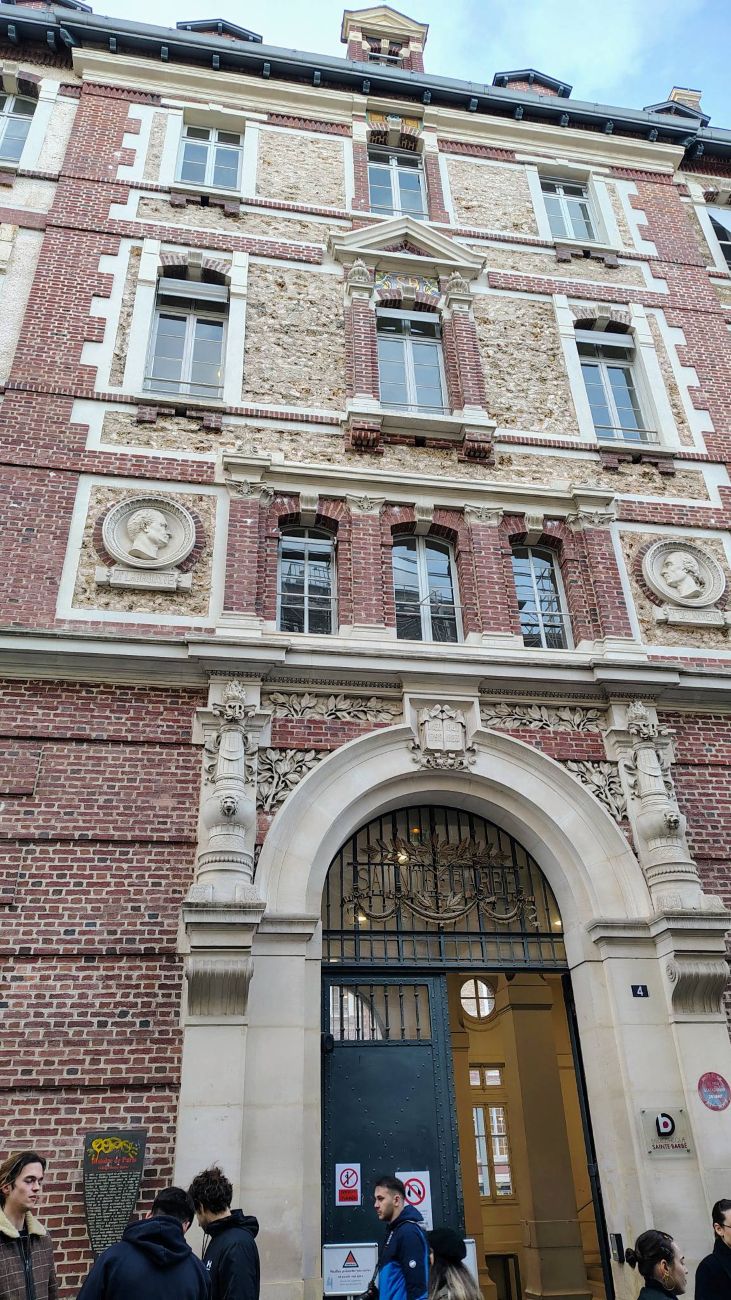
The Collège Sainte-Barbe was founded in 1460 on the Montagne Sainte-Geneviève and located on Rue Valette (see above). Until its closure in June 1999, it was the oldest college in Paris. Its buildings now house the Bibliothèque Sainte-Barbe, an inter-university library, as well as one of the university centers of Panthéon-Assas University. It is the only medieval college whose name still existed until a few years ago and which has remained in its original location. The identity of the college’s founder remains a subject of debate
The Paris tourist office on the 5éme arrondissement de Paris : https://parisjetaime.com/eng/article/explore-paris-s-5th-arrondissement-a820
The Charlemagne and his Leudes (see below) is a monumental statuary group located in the parvis de Notre-Dame Cathedral , Place Jean-Paul-II, above the Maurice-Carême promenade and the Seine river in the 4éme arrondissement of Paris. The bronze statue depicts an elderly Charlemagne on horseback, wearing the imperial crown and holding the long scepter of Charles V in his right hand. Before him, on either side of the horse’s neck and holding its bridle, stand two of his closest Leudes: Roland and Olivier, both armed, helmeted, and wearing chainmail. Roland, looking to the right, carries the sword Durandal and an oliphant, and holds a labrys in his hand. Olivier, looking to the left, carries a dagger and holds a spear. The statue rests on a stone pedestal on one side of which is engraved Charlemagne and his Leudes. Louis Rochet, a French sculptor and Mongolian, undertook this creation after having completed the Statue of William the Conqueror in Falaise and the equestrian statue of Pedro I, Emperor of Brazil, in Rio de Janeiro. The project was presented to Emperor Napoleon III in 1853, and the statue was exhibited in a plaster version at the 1867 Universal Exhibition and in bronze at the 1878 Universal Exhibition on the stand of the Thiébaut Frères foundry. That same year, Louis Rochet died, and the plaster cast was displayed in front of Notre-Dame Cathedral. But with the fall of the Second Empire, the defeat against Prussia, and the loss of Alsace-Lorraine, the figure of Charlemagne, emperor and Franco-German unifier, was no longer welcome in the new Third Republic.The old Hôtel-Dieu buildings along the Seine having just been demolished, enlarging the forecourt (parvis), they were replaced by a square, where the statue was installed in 1882. It was inaugurated on July 14 of that same year and finally acquired by the city of Paris in 1896
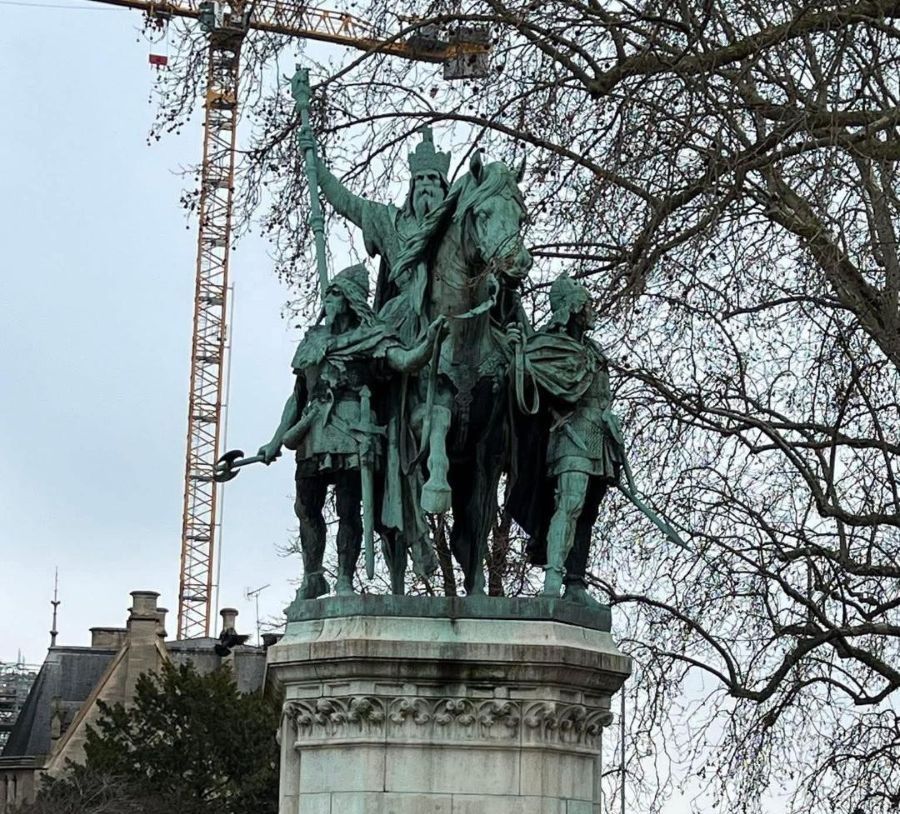
The Parvis Notre-Dame – Place Jean-Paul-II is located in front of Notre-Dame Cathedral, on its forecourt, which was named after Pope and Saint John Paul II in 2006. An archaeological crypt is also located there, as well as several statues, including one of Charlemagne and his Leudes . The square pays homage to Pope John Paul II. Until the 12C, the forecourt was occupied by Saint-Étienne cathedral. To the north of the cathedral was a small square between the apse of the Church of Saint-Christophe and the Church of Saint-Jean-le-Rond. To the west, between Rue Saint-Christophe and Rue Neuve-Notre-Dame, lies Rue de la Huchette. In 1160, the decision was made to demolish Saint-Étienne cathedral in order to enlarge Notre-Dame Cathedral. The parvis Notre-Dame forecourt is first mentioned in a text from 1163-1164. It was enlarged during the Middle Ages, due to the prestige acquired by Notre Dame Cathedral, which had become the capital of the Kingdom of France. The first expansion of the square, linked to major development projects and the decision to build a new Foundling Hospital, took place in the mid-18th century. From 1746 to 1749, houses located between Rue Saint-Christophe, Rue de Venise, Rue Neuve Notre-Dame, and Impasse de Jérusalem were purchased and then demolished to make way for the hospital. Between 1745 and 1757, the buildings within the block bounded by Rue Saint-Christophe, Rue de la Huchette, Rue Neuve-Notre-Dame, and Rue de Venise, including the Church of Saint-Christophe, were razed to clear the hospital and enlarge the square. In 1802, the square was enlarged again, this time to the southeast. The Hôtel-Dieu chapel was demolished, and Clavareau rebuilt a new entrance in the form of a portico with Doric columns. The hospital, extended westward in the 1780s, was occupied after the French Revolution by the Public Assistance administration. Two fountains were added to the building in 1806. The square took on its current appearance in the 1860s and 1870s as part of the transformations of Paris under the Second Empire. On May 22, 1865, the reconstruction of the Hôtel-Dieu on its current site (north of the square, rather than south) was declared to be in the public interest. The group of streets located north of the square, between the Seine, the Rue de la Cité, and the Rue d’Arcole, was razed between 1865 and 1867, and the new Hôtel-Dieu buildings were erected on the site. The Public Assistance building, located between the square, Rue de la Cité, Rue Saint-Christophe, and Rue Neuve-Notre-Dame, was demolished in May 1874. The former Hôtel-Dieu buildings, situated along the Seine, were demolished in 1877–1878 and replaced by a square, where the statue of Charlemagne and his Leudes (see above) was installed in 1882.
In June 1914, during construction work to build a central platform on the square, the foundations of the former Saint-Pierre-aux-Bœufs church were unearthed. Presented as a “refuge,” this central median was intended to provide pedestrian safety from the risk of car accidents, as traffic increased traffic lights and pedestrian crossings only began to be developed in the 1920s. In 2000, a Millennium Fountain was installed at the intersection of the square and Rue d’Arcole. Since September 3, 2006, the square has been called “Parvis Notre-Dame – Place Jean-Paul-II” in homage to Pope John Paul II, who died on April 2, 2005. In front of the cathedral’s main portal stood a gallows ladder, used to raise those condemned to hanging. This symbol of the high justice of the Bishop of Paris was replaced in 1767 by a pillory, which disappeared in 1792. It was from this post that distances throughout France were measured. In 1924, a medallion was installed there to mark the “zero point of French roads,” the reference point from which distances between Paris and other cities are measured.
The Paris tourist office on the parvis Notre Dame see about statue: https://parisjetaime.com/eng/transport/parvis-de-notre-dame-p1967
The Paris tourist office on Paris Centre (arrond 1-4) of Paris : https://parisjetaime.com/eng/article/explore-the-centre-of-paris-a846
There you go folks, a dandy city to explore and enjoy with the family, Memorable moments in my eternal Paris, driving and walking all over in my road warrior trails brings out sublime awesome spots with nice memorable family visits of yesteryear always remember and always looking forward to be back, eventually. Again hope you enjoy the post on curiosities of Paris , part LXXII !!! as I.
And remember, happy travels, good health, and many cheers to all !!!

 Paris1972-Versailles2003