
We have driven and walked in my eternal Paris, and would like to have an imprint in my blog on the wonderful family times we had there, There is so much to see , doing my best, and glad found me these pictures in my cd rom vault ,which now transposing in my blog for you and me, This was my former worked city, so glad to post more memorable spots on it, I thank you for your readership over the years and to bear with my rants! After all, Paris is to rant, shout and yelled about, me think. Therefore, here is my take on curiosities of Paris, part LXVIII !!! Hope you enjoy the post as I.
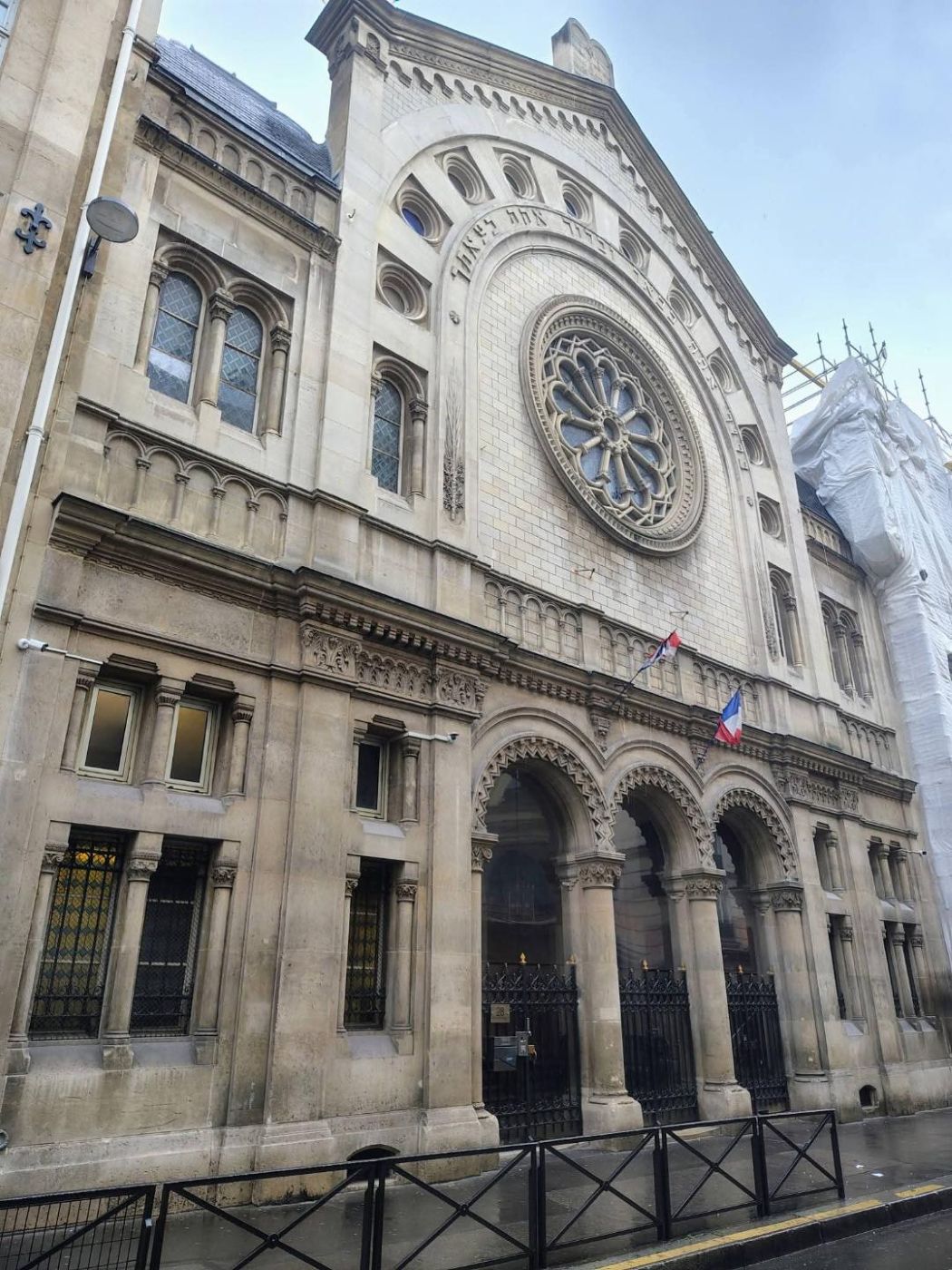
The Buffault Synagogue, located at 28 rue Buffault in the 9éme arrondissement of Paris, was built by Sephardic Jews in conflict with the Ashkenazi community, which had just built the synagogue on rue de la Victoire, later to become the Great Synagogue of Paris. In the 19C, Paris had two Jewish communities: one of German rite, primarily from Alsace and the Rhineland, and another of Sephardic rite, originating from Portugal and the Ottoman Empire. The idea arose to merge the two rites and replace them with a French rite, the Sharifath. The synagogue on rue de la Victoire, then under construction, was intended to adopt this new rite. However, many disagreements could not be resolved, such as the placement of the Bimah (the platform on which the cantor stands) in relation to the Holy Ark. The Portuguese congregants refused certain constraints. The synagogue on rue de la Victoire would therefore follow the German rite. In 1875, Jews from Bordeaux, Bayonne, the Comtat Venaissin, and the Ottoman Empire decided to build their own synagogue and created the “Civil Society of the Israelite Temple following the Spanish-Portuguese Sephardic rite.” They purchased land on Rue Buffault, not far from Rue de la Victoire. The synagogue was built in 1877 in the Romano-Byzantine style, then very fashionable in Parisian synagogue architecture.The upper part of the facade is formed by two large concentric arches, supporting a pediment crowned by the Tablets of the Law. The large Gothic rose window is located in the center of a semicircular arch. The total height of the façade from the ground to the top of the Tablets of the Law is 22.50 meters
The official temple Buffault : https://www.buffault.net/
The Paris tourist office on the 9éme arrondissement de Paris : https://parisjetaime.com/eng/article/explore-paris-s-9th-arrondissement-a828
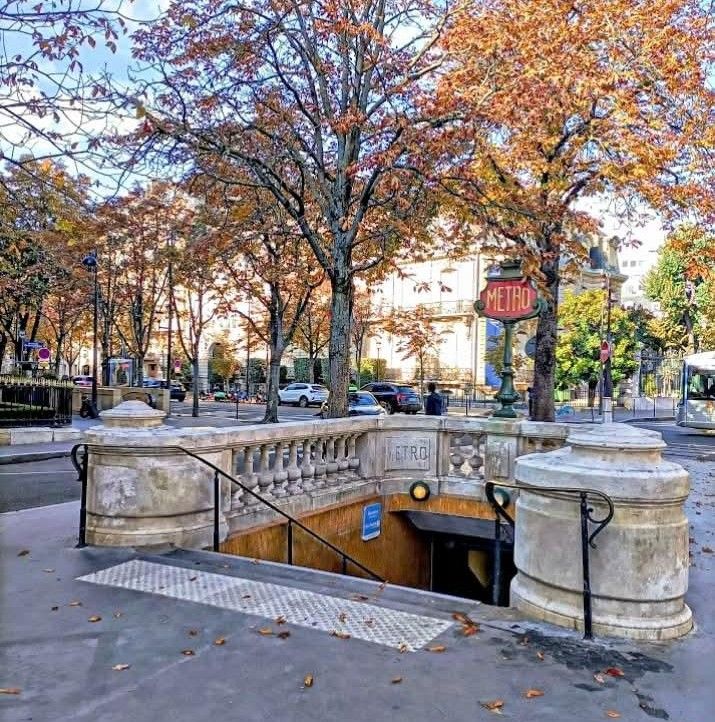
The metro Franklin D. Roosevelt is on lines 1 and 9 , located in the 8éme arrondissement of Paris. The station is underground, on the border between the Champs-Élysées and Faubourg-du-Roule quartiers or neighborhoods, near the Champs-Élysées roundabout. The stops for the two lines, approximately 200 meters apart, are located: on line 1, under the Avenue des Champs-Élysées, at the Rue Marbeuf intersection ,and on line 9, under Avenue Montaigne, (see pic) at the end of the roundabout. The station has five entrances, the first two of which are only accessible from the platforms of line 1, as its stop was originally independent of that of line 9. Entrance no. 1 “Champs-Élysées”; Entrance no. 2 “Rue de Marignan”; Entrance No. 3 “Avenue Montaigne”; Entrance No. 4 “Rond-Point”; Entrance No. 5 “Avenue Franklin D. Roosevelt – Palais de la Découverte”. The lower section of the Champs-Élysées shopping district, its shops and restaurants. The upper section of the Champs-Élysées gardens, including: the Carré Marigny, with the stamp market , the Théâtre Marigny, the Théâtre Vrai Guignolet, and the Carré du Rond-Point, with the Théâtre du Rond-Point.The Grand Palais, its national galleries, and the Palais de la Découverte.The Petit Palais. The headquarters and studios of the radio stations: Europe 1, RFM, and Virgin Radio, at 26 bis and 28, rue François-Ier. The station opened on July 19, 1900, with the commissioning of the first section of metro line 1 between Porte de Vincennes and Porte Maillot. It owes its initial name of Marbeuf to its proximity to Rue Marbeuf. On May 27, 1923, the Line 9 station opened with the inauguration of its section between Trocadéro and Saint-Augustin; it was then named Rond-Point des Champs-Élysées in reference to the eponymous intersection it served. A connecting corridor was built and opened on October 6, 1942; on this occasion, the new station took the name Marbeuf – Rond-Point des Champs-Élysées aka Champs-Élysées – Marbeuf. Then the station was renamed Franklin D. Roosevelt on October 30, 1946, following the renaming of Victor Emmanuel III Avenue to Franklin D. Roosevelt Avenue, in homage to Franklin Delano Roosevelt, head of state of an allied country during WWWII, replacing that of an enemy country (Italy) although allied during WWI.
The RATP Paris transport on metro line 1 : https://www.ratp.fr/plans-lignes/metro/1
The RATP Paris transports on metro line 9 : https://www.ratp.fr/plans-lignes/metro/9
The Paris tourist office on the 8éme arrondissement de Paris : https://parisjetaime.com/eng/article/explore-paris-s-8th-arrondissement-a826
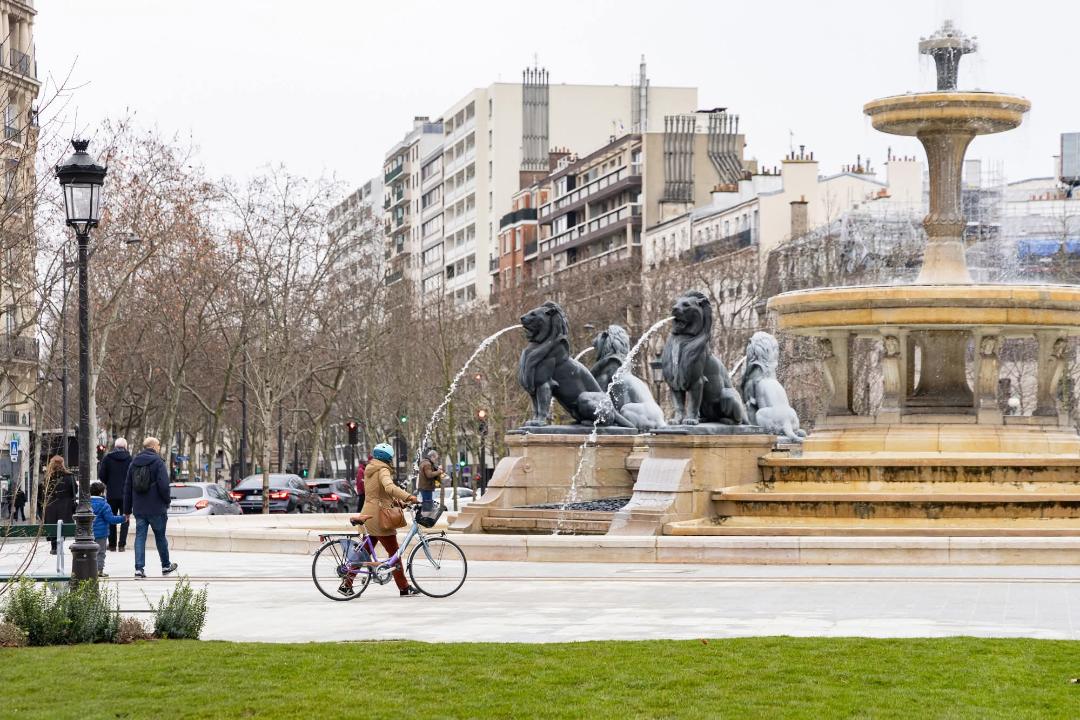
The Place Félix-Éboué, previously called Place Daumesnil, is located in the Picpus neighborhood or quartier of the 12éme arrondissement of Paris. The Place Félix-Éboué forms a crossroads with Avenue Daumesnil, Boulevard de Reuilly, Rue de Reuilly, Rue Claude-Decaen and Rue Lamblardie. It is served by metro lines 6 and 8 at the Daumesnil station. It has borne its current name since 1947. The name of the square is a tribute to the colonial administrator and French politician Félix Éboué who was one of the very first to rally to Free France from General de Gaulle in August 1940. The square is set up on the site of the Barrière de Reuilly on the wall of the Farmers General, was first called place de la Barrière-de-Reuilly, then, in 1864, place Daumesnil. The center of the square is adorned with the fontaine du Château d’eau fountain aka fontaine aux lions or Lions Fountain, a work by Gabriel Davioud, commissioned by Haussmann. The fountain was originally located in the Place du Château d’Eau (now Place de la République) before being moved to its current location in 1880, when the Monument to the Republic by the brothers Léopold and Charles Morice was installed.
The City of Paris on the Place Félix Eboué : https://www.paris.fr/pages/felix-eboue-une-place-apaisee-et-conviviale-a-imaginer-ensemble-22016
The Paris tourist office on the 12éme arrondissement de Paris : https://parisjetaime.com/eng/article/explore-paris-s-12th-arrondissement-a824
The Rue Saint-Lazare is located in the 8éme and 9éme arrondissements of Paris. It begins at 9 Rue Bourdaloue and 1 Rue Notre-Dame-de-Lorette and ends at Place Gabriel-Péri and Rue de Rome. Glad to found me a picture as this street was walked so many times ! Its current name dates back to 1770 and comes from the Saint-Lazare house to which it led. The Saint-Lazare prison was a former leper colony, converted into a prison in 1793, located at the present-day site of 117 Rue du Faubourg-Saint-Denis, in the 10éme arrondissement. This street already existed in 1700 under the name “Rue des Porcherons” because it connected the villages of Le Roule and La Ville-l’Évêque to the village of Les Porcherons. It later took the name “Rue d’Argenteuil” because of its direction towards the village of Argenteuil. In 1734, it was still lined with only a few scattered buildings and took its current name in 1770. The crossroads formerly formed by the junction of Rue Saint-Lazare, Rue du Rocher, Rue de la Pépinière, and Rue de l’Arcade was called “Little Poland” or more simply “Poland.” The gare Saint-Lazare train station (my first work entry to Paris) was built in 1837. A narrow alley, known as Impasse Bony, created in 1826 and located on the site of the Hôtel Terminus, was used for unloading luggage. The Cour de Rome, located in front of the train station, incorporated the former Impasse d’Argenteuil, which opened onto Rue du Rocher.
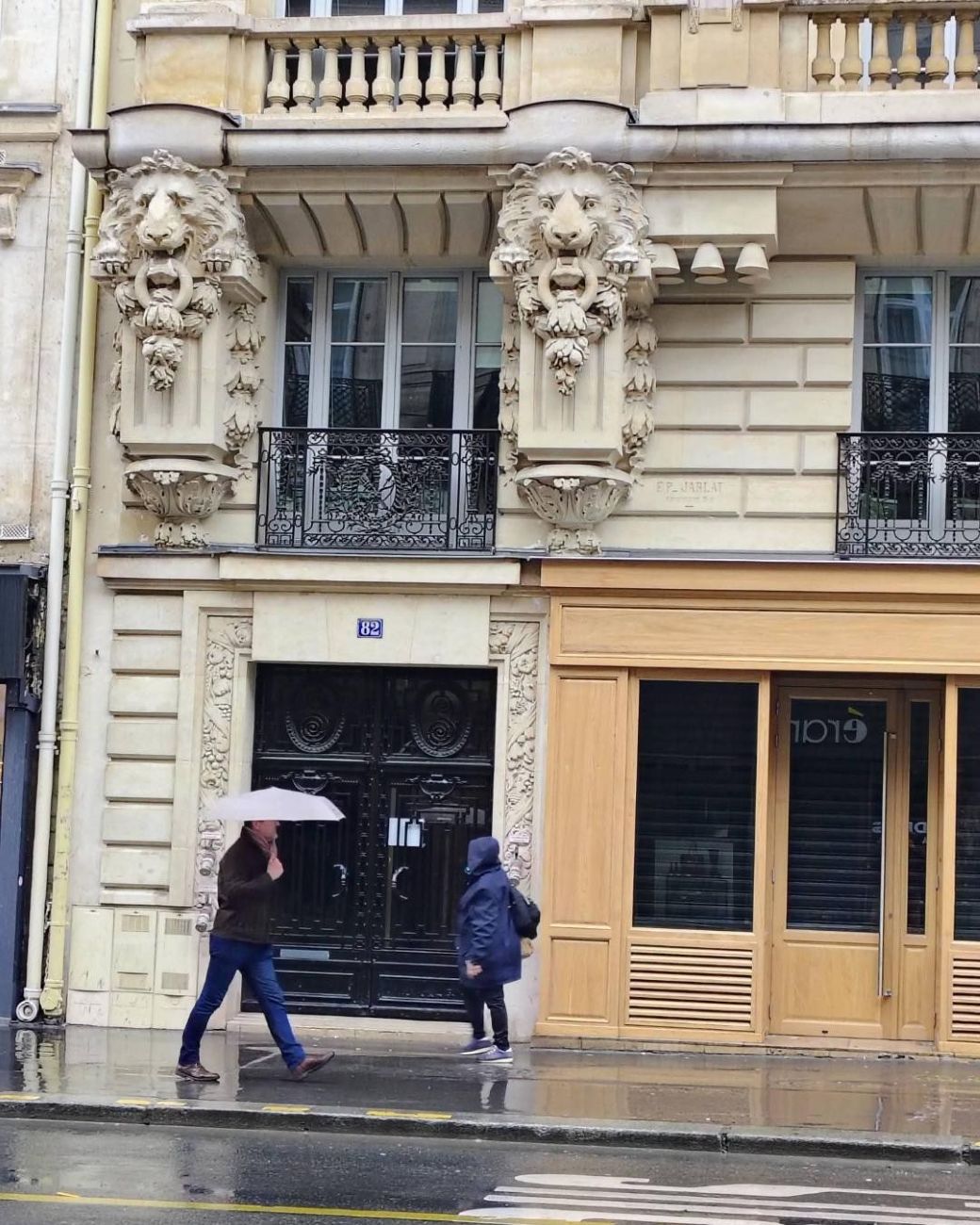
Notable buildings here are at Nos. 3: Aircraft manufacturer Armand Deperdussin committed suicide here in 1924. Nos. 18: The Théâtre d’Application, or La Bodinière (1888-1909), was located at this level. Nos. 27-29 (and 32-34, rue de Châteaudun): Two remarkable buildings, decorated in the style of 16C French architecture, around 1840. Probably one of the most important groups of buildings in this style. The rear facades are visible from rue de Châteaudun, the extension of which in 1862 appears to have deprived these buildings of their garden. The artist Paul Gavarni resided at no 27 on the street in 1829. No 52: the beginning of Rue Catherine-de-La-Rochefoucauld, named after the former Abbess of Montmartre, which provides access to the Gustave Moreau Museum, near Rue Saint-Lazare. No 58: Hôtel Delaroche, built in 1829 in the Tuscan style for the painter Paul Delaroche, who lived there for ten years. The polychromy of the recent restoration is intended to reproduce the original polychromy. No 60: the Parisian residence of the Duke of Bassano, where he and his wife died; the residence of J. Minot, printer, publisher, and lithographer, where he died. No 66: Émile Zola bought an apartment where he installed his mistress, Jeanne Rozerot. Dr. David Gruby, a mycologist who treated many prominent figures, lived here for several decades. The intersection of Rue Saint-Lazare (now Place d’Estienne-d’Orves) and 2-4 Rue de la Chaussée-d’Antin marks the site of the Mont-Blanc barracks, also known as the “Clichy barracks,” “Lazare barracks,” or “Saint-Lazare barracks,” one of the barracks of the French Guards. No. 78: the gate of the former Tivoli garden. No. 79: the home of the painter François Léon Benouville, who died here in February 1859. An apartment in this building later belonged to the Gallimard family. Gaston Gallimard was born here in 1881. No. 82: (see pic) building constructed in 1908 by Émile Jarlat, which won an award in the City of Paris Façade Competition in 1909. It has housed the headquarters of Flammarion publishers since July 2022. No. 87: Avenue du Coq, site of the former Porcheron family château (13C), which gave its name to the neighborhood. Later, it became the property of the Le Cocq family and gave its name to the cul-de-sac that was created in its place. No. 88: hotel built for the PLM railway company in 1869 on the site of the former headquarters of the Bridges and Roads Department, built in 1788. The entrance was originally the entrance to the Tivoli Gardens. From 1938 to 1999, it housed the headquarters of the SNCF . No. 108: Concorde Opéra Paris Hotel, (went to meetings here ! ) formerly the Grand Hôtel Terminus of the Saint-Lazare train station, built to accommodate visitors to the 1889 Universal Exhibition. Nos. 113-115: Brasserie Mollard (yes awesome). The interior decor dates from 1894. No. 119: A McDonald’s fast-food restaurant replaced a Bavarian tavern called “Le Roi de la Bière” (The King of Beer), which was recorded as early as 1910 and whose original facade has been preserved. No. 121: Formerly The Criterion Fouquet’s Bar, an establishment founded by Louis Fouquet before he created Fouquet’s on the Champs-Élysées.
The Paris tourist office on the 8éme arrondissement de Paris : https://parisjetaime.com/eng/article/explore-paris-s-8th-arrondissement-a826
The Paris tourist office on the 9éme arrondissement de Paris : https://parisjetaime.com/eng/article/explore-paris-s-9th-arrondissement-a828
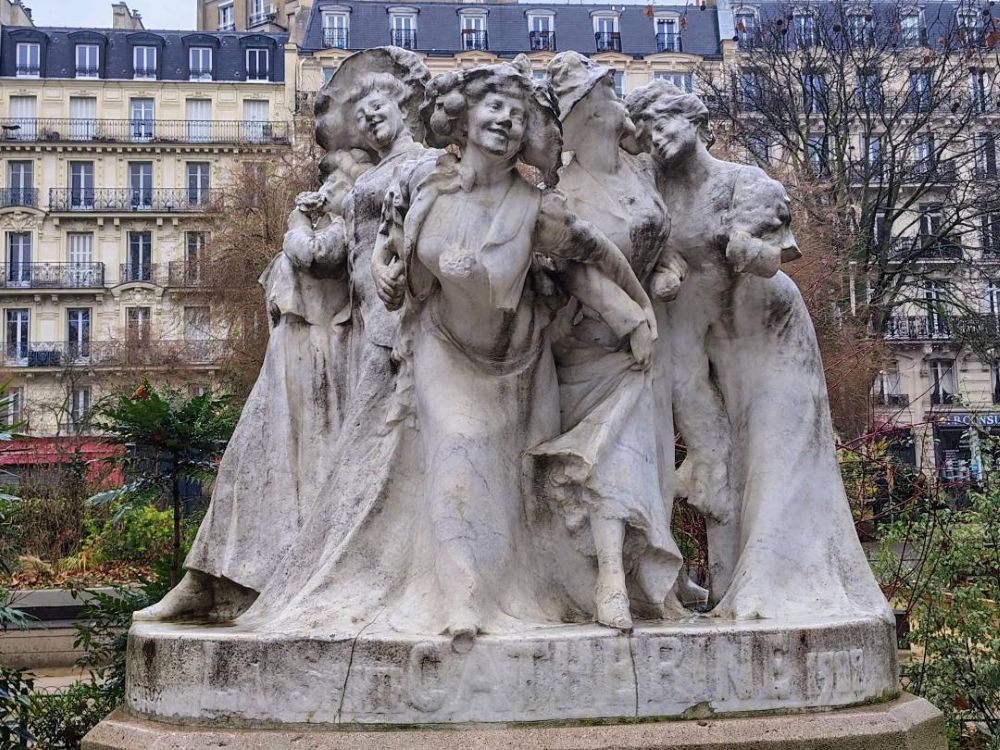
The Square Montholon is a green space in the 9éme arrondissement of Paris. It is accessible via 2 rue Mayran and served by metro line 7 at the Cadet and Poissonnière stations. It takes its name from its proximity to rue de Montholon. Covering an area of 4,571 square meters, it is enclosed by railings designed by Gabriel Davioud and includes two terraces. Two century-old Oriental plane trees, each approximately 30 meters tall, stand in the central lawn. The larger of the two, 32 meters tall and 4.32 meters in circumference, was planted in 1872. Other tree species include alders, catalpas, ginkgo trees, linden trees, paulownia trees, a weeping beech, a black locust, a goldenrain tree, and a black cherry. The square also features shrubs and flowerbeds. During excavations on the site of the future square, a complete mammoth skeleton was discovered. Construction of the square began in 1862, at the same time as the construction of Rue La Fayette. The square opened in 1863. It was part of the gardens of the private mansion of Charles Sanson, the second executioner of Paris, at a time when this quartier or neighborhood was still called “Nouvelle-France” (New France). Notable buildings here are per se statues such as between 1879 and 1884, the square housed the statue Gloria Victis, now kept at the Petit Palais. A marble group, entitled Saint Catherine of 1908 (see pic), was installed there and acquired by the City of Paris in 1925. It pays tribute to the working women of the district. The square also housed the sculpture Eagle and Vulture Fighting Over a Dead Bear, installed in 1895 and melted down during the Nazis occupation in 1942.
The City of Paris on the square Montholon : https://www.paris.fr/lieux/square-montholon-2469
The Paris tourist office on the 9éme arrondissement de Paris : https://parisjetaime.com/eng/article/explore-paris-s-9th-arrondissement-a828
There you go folks, a dandy city to explore and enjoy with the family, Memorable moments in my eternal Paris, driving and walking all over in my road warrior trails brings out sublime awesome spots with nice memorable family visits of yesteryear always remember and always looking forward to be back, eventually. Again hope you enjoy the post on curiosities of Paris , part LXVIII !!! as I.
And remember, happy travels, good health, and many cheers to all !!!

 Paris1972-Versailles2003