
We have driven and walked in my eternal Paris, and would like to have an imprint in my blog on the wonderful family times we had there, There is so much to see , doing my best, and glad found me these pictures in my cd rom vault ,which now transposing in my blog for you and me, This was my former worked city, so glad to post more memorable spots on it, I thank you for your readership over the years and to bear with my rants! After all, Paris is to rant, shout and yelled about, me think. Therefore, here is my take on curiosities of Paris, part LXIX !!! Hope you enjoy the post as I.
The Place Henri-Mondor is bordered by Boulevard Saint-Germain and the Carrefour de l’Odéon intersection. It lies within the Odéon and Monnaie quartiers or neighborhoods of the 6éme arrondissement of Paris. This square was initially named Place Broca, after the French physician Paul Broca, due to its proximity to the Paris Faculty of Medicine. It was later renamed after the French surgeon and writer Henri Mondor. As there are no buildings within its cadastral boundaries, the square has no official numbering. The central section, the median strip corresponding to the Boulevard Saint-Germain metro station, was renamed in 1968. Notable buildings: The Monument to Danton, commissioned by the City of Paris and erected in 1889 represents Danton standing, in the pose of a tribune, delivering a speech. Two young conscripts, armed, stand beside him, watching him. commemorate the centenary of the French revolution, stands on this square near the site of the famous revolutionary’s former home, which was demolished during Haussmann’s urban renewal projects. His home was located opposite no 95 Boulevard Saint-Germain, above the arch marking the entrance to the Cour du Commerce-Saint-André, then in the Rue de l’École-de-Médecine. It is here the access to the Odéon metro station. The Danton Monument (see pic) is a bronze sculpture group created in 1891. The monument depicts Georges-Jacques Danton, a member of the National Convention and revolutionary, group represents Danton standing, in the pose of a tribune, delivering a speech. Two young conscripts, armed, stand beside him, watching him.haranguing the people. The statue was commissioned by the City of Paris in 1887 for the centenary commemorations of the French revolution of 1789. The monument is located at Place Henri-Mondor, and 97 Boulevard Saint-Germain. Also, literally across the street is a cinema we have been, The UGC Danton cinema (see pic) with 4 screens is located at 99 boulevard Saint Germain;just steps from the Luxembourg Gardens and the vibrant Saint-Germain-des-Prés nieghborhood. More than just a cinema, the UGC Danton is a true testament to Parisian cultural history. Inaugurated in the 1930s, it has stood the test of time, preserving its soul and Art Deco charm. It can be reach by Metro lines 4 et 10 Odéon at about1 min on foot; line 10 Mabillon at 4 min on foot, line 4 Saint-Michel ,5 min on foot, and Saint-Germain-des-Prés at 6 min on foot, and RER C Saint-Michel at 7 min on foot, Times are by locals,
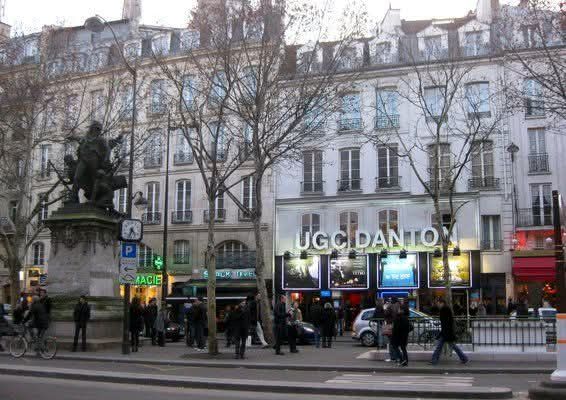
The official UGC Danton: https://www.ugc.fr/cinema.html?id=4
The Paris tourist office on the 6éme arrondissement de Paris: https://parisjetaime.com/eng/article/explore-paris-s-6th-arrondissement-a823
The Pont Notre-Dame spans the main branch of the Seine river, connecting the Quai de Gesvres to the Quai de la Corse on the Île de la Cité. It is located near the Hôtel-Dieu hospital and the flower and bird market, which it links to the Right Bank. In line with the bridge, south of the Rue de la Cité, the Petit-Pont connects the island to the Left Bank. This area is served by the line 4 Cité station, and lines 1 and 11 Hôtel de Ville station. The Notre Dame bridge, built in 1853 during Haussmann’s urban renewal projects, is 105 meters long and 20 meters wide. Its original five arches were reduced to three in 1912, including a 60-meter-long central metal arch. It was on this site that one of the first two Parisian bridges stood, allowing the axis of the cardo maximus to cross the Seine on its main branch, the Grand Pont, as an extension of the Petit Pont. This bridge was later replaced by the “Milbray planks,” then by two replicas of the Notre-Dame Bridge, one in wood, the other in stone. This bridge became the triumphal avenue for Francis I, Henry II, Charles IX, Henry III, Louis XIV, and the Infanta of Spain; it was also the most fashionable and festive bridge. The houses were demolished in 1787, and the bridge was made passable for carriages, It is mentioned as the Pont Notre-Dame in a manuscript from 1636. In 1659, the bridge was restored and redecorated to honor the arrival in Paris of Marie-Thérèse of Austria, daughter of King Philip IV of Spain, who then became Queen of France and Navarre upon marrying Louis XIV, in accordance with the Treaty of the Pyrenees. It was rebuilt in 1913. During the French revolution, as part of the dechristianization campaign, the bridge was renamed the “Bridge of Reason.” The bridge was inaugurated in 1919 by Raymond Poincaré, President of the Republic. In Victor Hugo’s *Les Misérables*, Inspector Javert commits suicide by jumping from this bridge; a precise description of the Seine’s eddies at this point can be found in Part 5, “Jean Valjean,” Book 4, Chapter 1: “Javert Derailed.”
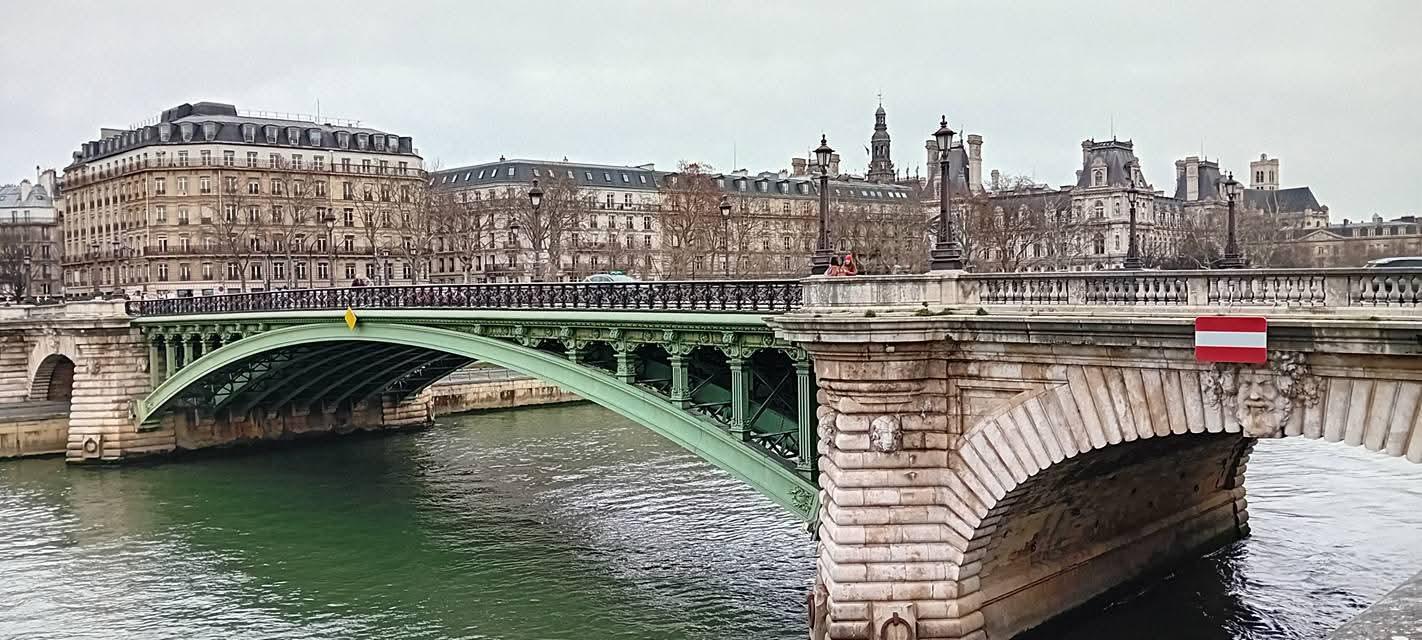
The Paris tourist office on other bridges : https://parisjetaime.com/eng/article/paris-the-Seine-with-its-bridges-and-footbridges-a025
The City of Paris on its other bridges : https://www.paris.fr/pages/paris-et-ses-ponts-toute-une-histoire-7466
In 1907, the Port of Paris requested a design for industrial warehouses, constructed on the banks of the Seine, the Magasins Généraux stored merchandise in transit from river barges to the Gare d’Austerlitz. A first in France, this raw concrete structure signaled the creation of the first modern Parisian docks of the 20C. The conversion of the Magasins Généraux into the Cité de la Mode et du Design; the Cité was reborn, transfigured, in 2009. With a usable area of 36,000 m², In 2005, the project to convert it into the Cité de la Mode et du Design (City of Fashion and Design) was entrusted to Dominique Jakob and Brendan MarcFarlane. The program includes the Institut Français de la Mode (French Fashion Institute), the Wanderlust club, an exhibition and event space, a bookstore, a restaurant Café Oz opened on the rooftop of the Cité in 2017, a rooftop solarium, shops and services, as well as a brasserie and a restaurant on the ground floor. Inaugurated in 2012, the building is designed as a space open day and night, offering both indoor and outdoor walkways. At the top, a green roof terrace offers a spectacular view of the Seine and the urban landscape. On the Seine side, an apple-green metal footbridge, shaped like a lizard, connects the different levels via staircases. Organic and colorful, it contrasts with the orthogonality of the original building. The French Fashion Institute moved in in 2008. From November 16, 2013, the site housed Art Ludique – Le Musée, a museum dedicated to entertainment (animation, cinema, video games, comics, etc.). The museum left the Docks in 2018. It can be access by Metro: Gare d’Austerlitz (lines 5 and 10), Gare de Lyon (lines 1 and 14), Quai de la Gare (line 6), RER: Gare de Lyon (lines A and D), Gare d’Austerlitz (line C), Train: Gare d’Austerlitz, and Gare de Lyon Bus: Lines 24, 57, 61, 63, 89, and 91,
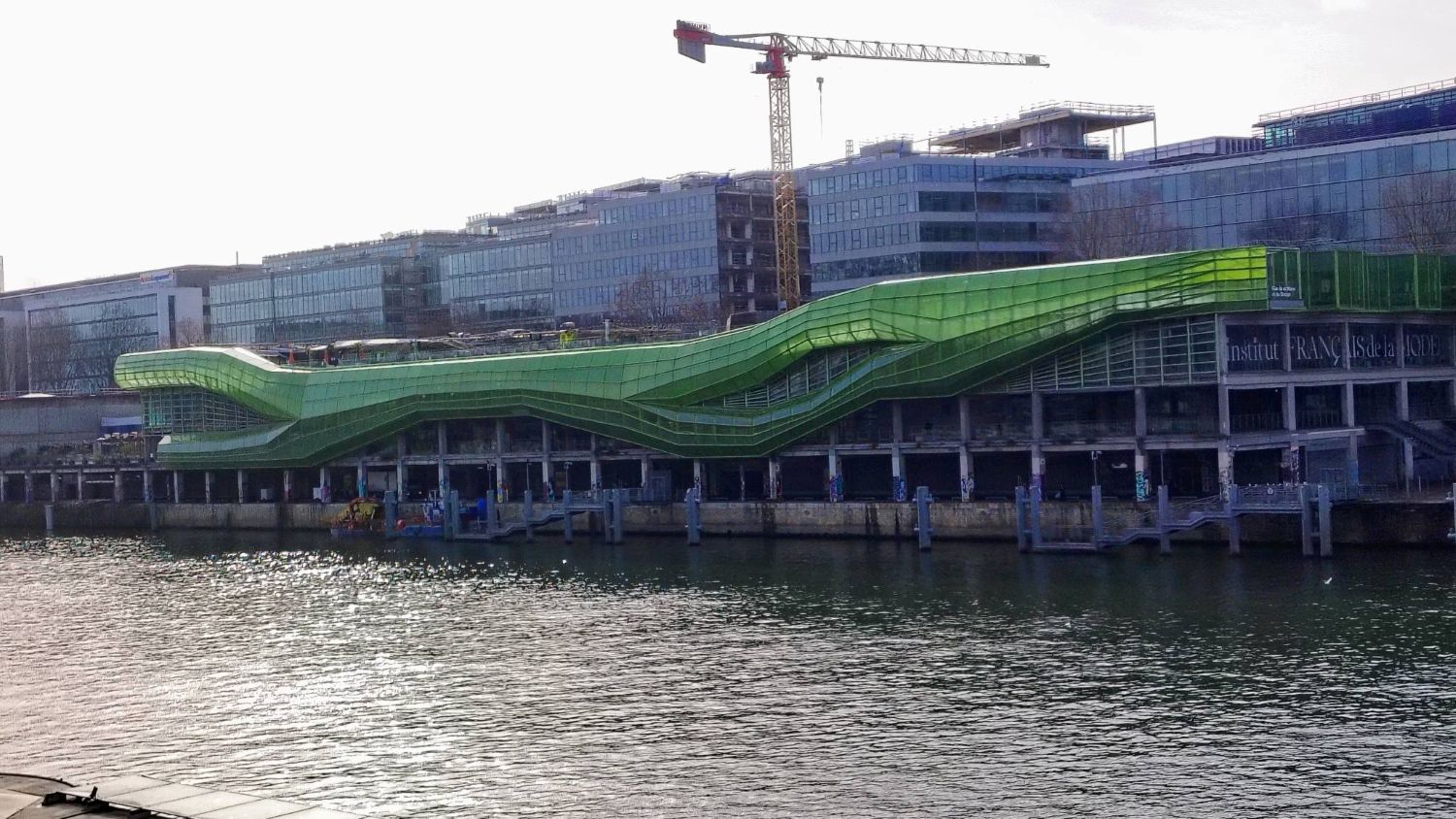
The official Cité de la Mode et du Design : https://www.citemodedesign.fr/en/
The Paris tourist office on the Cite de la Mode et du Design : https://parisjetaime.com/culture/la-cite-de-la-mode-et-du-design-p1137
There you go folks, a dandy city to explore and enjoy with the family, Memorable moments in my eternal Paris, driving and walking all over in my road warrior trails brings out sublime awesome spots with nice memorable family visits of yesteryear always remember and always looking forward to be back, eventually. Again hope you enjoy the post on curiosities of Paris , part LXIX !!! as I.
And remember, happy travels, good health, and many cheers to all !!!

 Paris1972-Versailles2003