
I am again to tell you about more streets of my eternal Paris. I have many many posts on Paris and several on the streets of the most beautiful city in the world. I have come up with pictures from cd rom vault that should be here for you and me. As always thank you for following my blog some since Nov 26, 2010. Therefore, here is my take on the streets of Paris, part XXXIX !!! Hope you enjoy it as I.
The Rue du Roi-Doré is located in the 3éme arrondissement of Paris, in the quartier Marais neighborhood. It is a very short street, less than 60 meters long, connecting Rue de Thorigny to Rue de Turenne near the Church of Saint-Denis-du-Saint-Sacrement. It is narrow, and its buildings, though old, predate the early 19C. The street is served by the metro line 8 Saint-Sébastien – Froissart. The street’s name originates from a sign depicting a gilded bust of King Louis XIII. This street was opened in 1620 as part of the development of the Saint-Gervais Hospitaller Sisters’ estate, known as the Saint-Gervais seamstresses. It is mentioned as “rue Françoise” in a 1636 manuscript. It has borne the names “rue Françoise,” “rue Saint-François,” “rue Sainte-Françoise,” and “rue Française” before taking its current name. During the French revolution, it was called “rue Dorée.” Notable buildings here are at No 7 Honoré de Balzac lived from 1822 to 1825. No 11 Histoires de Parfums store (see pic).
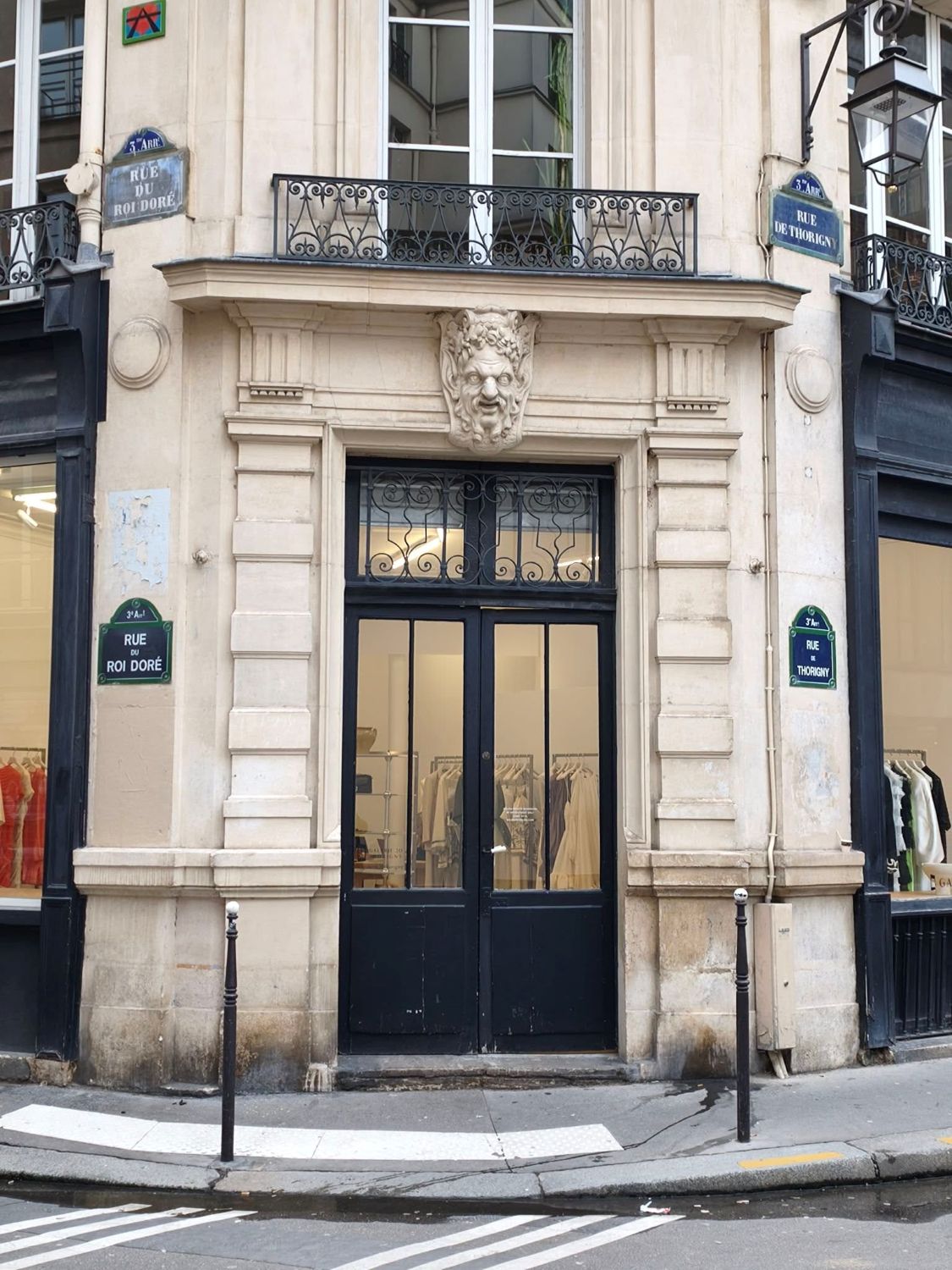
The Rue de Thorigny is locatedin the 3éme arrondissement of Paris. It is located in the heart of the Marais quartier/neighborhood. This area is served by the metro line 1 Saint-Paul and line 8 Saint-Sébastien – Froissart stations. This street is named after Jean-Baptiste Claude Lambert de Thorigny, who was president of the 2nd Chamber of Requests of the Parliament of Paris from 1713 to 1727, and provost of the merchants of Paris from 1726 to 1729. In 1539, this street was a dead end, extended in 1620 during the subdivision of gardens belonging to the Hospitaller nuns of Saint-Gervais. It is mentioned as “rue Neufve Saint Gervais” in a manuscript from 1636. Two streets were created on this land, which, at the beginning of the 18C, took the names “rue de Thorigny” and “rue de la Perle.” Notable buildings here are at No 5 stands the remarkable Hôtel Salé, built between 1656 and 1659 for Pierre Aubert de Fontenay and his wife, Implicated by accusations of embezzlement brought by Nicolas Fouquet, Aubert de Fontenay was dispossessed of his property; the name Hôtel Salé or Dirty hotel popularly arose from this event. It was rented to the Embassy of the Republic of Venice from 1668 to 1684, then to the Duke of Villeroy from 1684 to 1688. In 1728, the new owner, Nicolas Le Camus, President of the Court of Aids, commissioned the renowned painters Coypel, Oudry, and Desportes to redecorate the woodwork and overdoors. The family of the Marquis de Juigné occupied it from 1771; it became the Hôtel Juigné, owned by Monsignor Leclerc de Juigné, Bishop of Châlons, then Archbishop of Paris, and a member of the Constituent Assembly. Pillaged and requisitioned during the French revolution, the hôtel was sold in 1797 and then leased to the École Centrale des Arts et Manufactures. In the 19C, the hôtel suffered from its occupation by various educational institutions. In 1964, the City of Paris purchased the Hôtel Salé and restored its original dimensions. Meanwhile, the heirs of the painter Pablo Picasso made a substantial donation to the State to settle inheritance taxes: 203 paintings, 158 sculptures, 29 relief paintings, 81 ceramics, 1,500 drawings, 1,600 engravings, manuscripts, and more. It was then decided to convert the mansion into a museum dedicated to Pablo Picasso (see post), considered one of the greatest painters of the 20C. At the corner of Rue des Coutures-Saint-Gervais, the mark of the Saint-Gervais fashion estate remains. Madame de Sévigné lived at No 8 from 1669 to 1672, before moving to Rue de Montmorency. This mansion burned down twice, in 1818 and then in 1919. Nothing remains of it. At No 9 lived Honoré de Balzac when he studied at Abbé Ganser’s institution in 1815. No 22 Citizen Concept Store, vintage & luxury consignment shop in Paris (see pic)
The Paris tourist office on Paris Centre (arrond 1-4) of Paris : https://parisjetaime.com/eng/article/explore-the-centre-of-paris-a846
The Passage du Chantier is a passageway in the 12éme arrondissement of Paris, located in the Quinze-Vingts quartier or neighborhood. It begins at 53 rue de Charenton and ends at 66 rue du Faubourg-Saint-Antoine. The passage’s name refers to a former wood-burning yard located there. Inheriting the traditions of the Faubourg, this passage still houses many furniture dealers. Opened in 1842, it was officially designated a Parisian thoroughfare by municipal decree on February 9, 1995. Narrow and sometimes dark, the Passage du Chantier is nonetheless very colorful, with numerous shop signs. Tiny back courtyards serve as showrooms for furniture makers, upholstery workshops, and workshops specializing in replicating period furniture or restoring pieces.
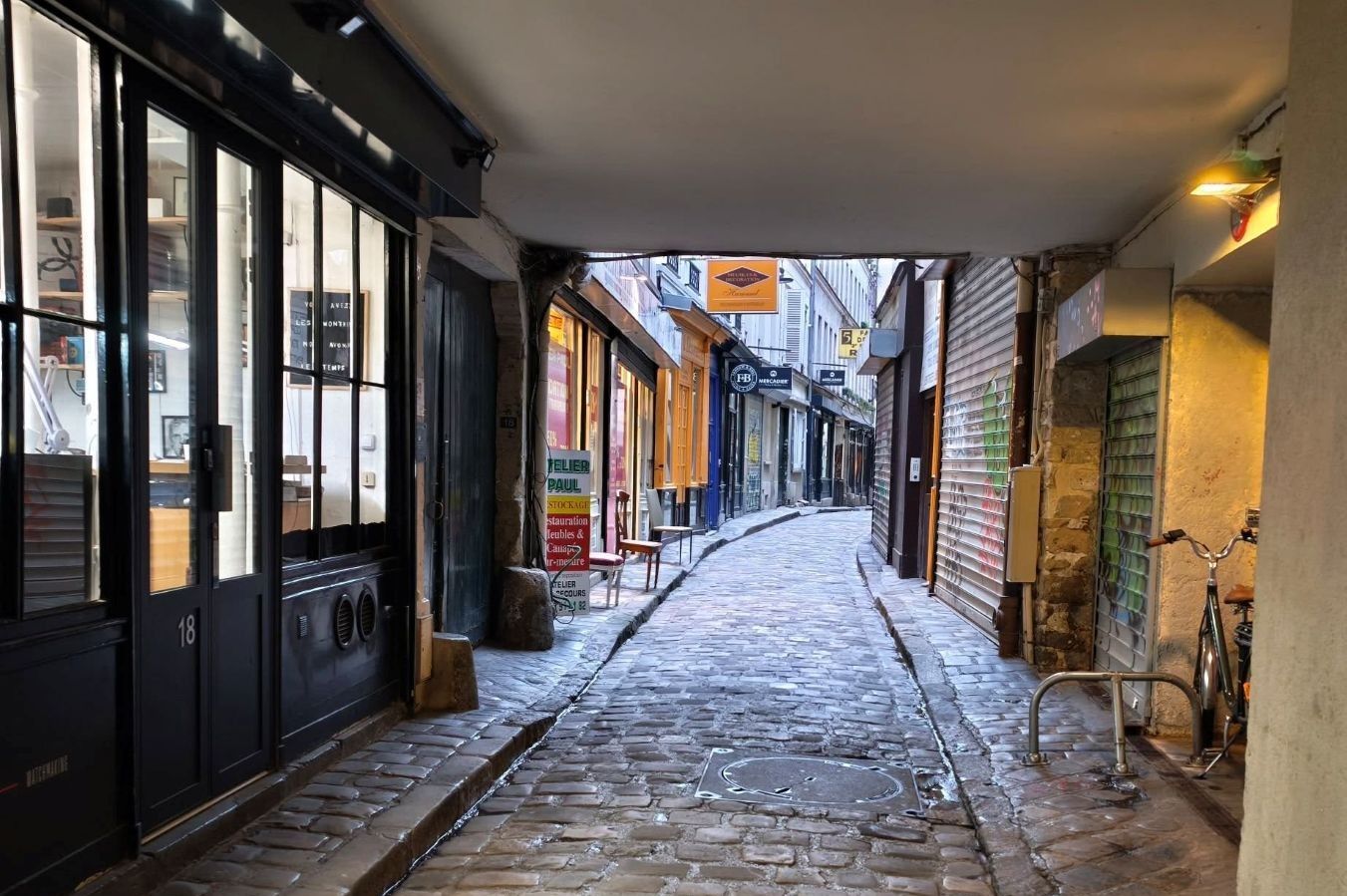
The Paris tourist office on exploring the 12éme arrondissement de Paris : https://parisjetaime.com/eng/article/explore-paris-s-12th-arrondissement-a824
The Rue des Rosiers running 303 meters through part of the 4éme arrondissement, in the Saint-Gervais quartier or neighborhood, in the southern part of the Marais. It begins at 13 Rue Mahler and ends at 40 Rue Vieille-du-Temple. This street is served by metro line 1 at the Saint-Paul station. It already bore this name in 1230, due to the rose bushes that grew in the neighboring gardens. A second source confirms that it bore this name in 1233. In 1230, the street was almost entirely built along the ramparts of Philippe Auguste, some stones of which can still be seen, particularly in the Jardin des Rosiers – Joseph-Migneret, accessible via no 10. It starts from the Rue du Roi-de-Sicile, continues in what is now the Rue Ferdinand-Duval, then turns at a right angle to the Rue Vieille-du-Temple. The easternmost section of what is now Rue des Rosiers, between Rue Ferdinand-Duval and Rue Pavée, was then a dead end, whose name changed frequently: “Rue de la Quoquerée” (1292), “Cul-de-sac de la Lamproie” (1400), “Rue Coquerée” (1415), “Rue Coquerrie” (1540), “Cul-de-sac Coquerelle,” or “Impasse Coquerelle.” In the late 19C and early 20C, between 1881 and 1914, the neighborhood experienced a significant influx of immigrants settled there after fleeing persecution in Romania, Austria-Hungary, and Russia. The Ashkenazi, Yiddish-speaking community is thus strongly represented, explaining the Pletzl’s prominent image in the 20C, but recent research shows that the Sephardic community is also present. It is mentioned as “rue des Roziers” in a 1636 manuscript. From 1848 to 1850, the street was extended to rue Malher. Its central section, dark, narrow, and slightly winding, escaped the realignment of Parisian streets carried out under Baron Haussmann. The current Rue Ferdinand-Duval separated from Rue des Rosiers in the 15C and was initially called “Rue des Juifs” (Street of the Jews) before being renamed Rue Ferdinand-Duval in 1900 during the Dreyfus Affair. In the 19C, Rue des Rosiers, 171 meters long, was located in the Marché-Saint-Jean quartier or neighborhood, formerly the 7éme arrondissement. It began at 21 Rue des Juifs and ended at 50-52 Rue Vieille-du-Temple. The street numbers were red. The last odd number was 35 and the last even number was 48. Finally, another Rue des Rosiers existed in the former village of Montmartre, which was not yet part of Paris. To avoid confusion, it became Rue du Chevalier-de-la-Barre.
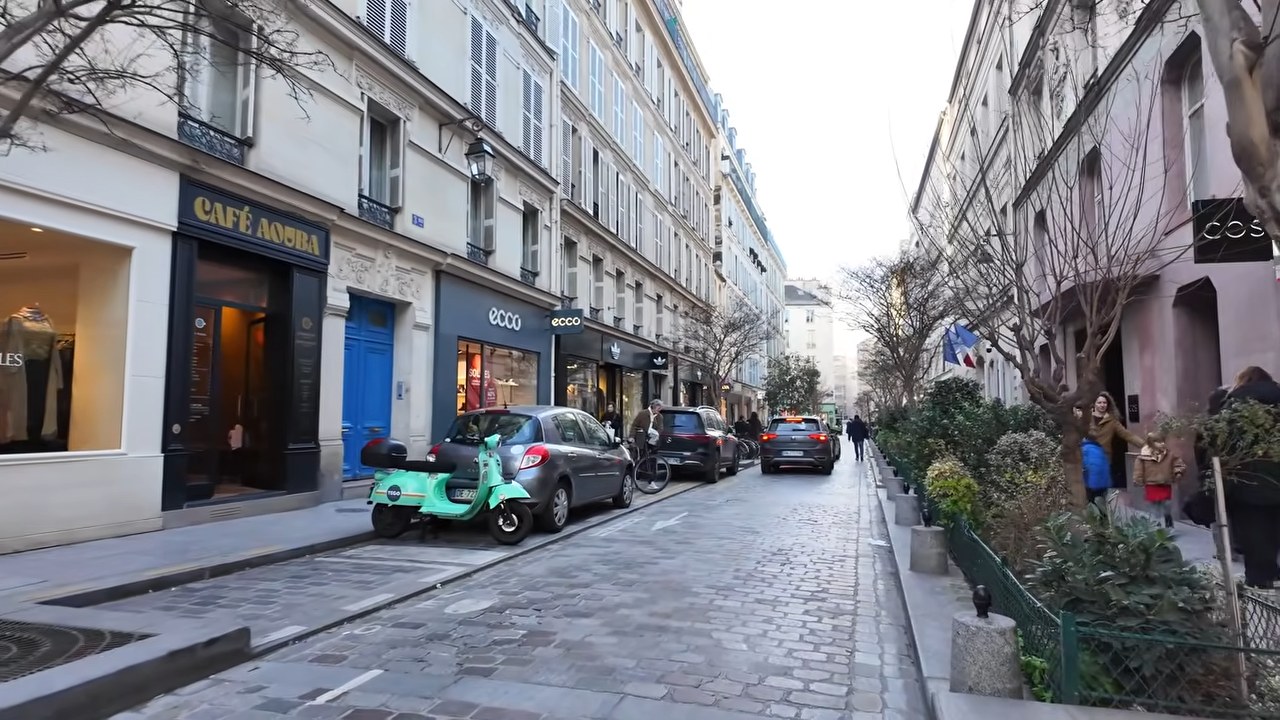
Notable buildings here are at no 4 stood a renowned hammam, the Hammam-Sauna Saint-Paul, built in 1863. Sold in 1990, it became a shop, of which only the façade, which still bears the inscription “Hammam Saint Paul -Sauna-Pool” recalls its former purpose. Furniture and clothing stores have successively occupied the premises. At no 7 was a well-known restaurant, run by Jo Goldenberg. Closed in 2006 due to hygiene issues and debt, it was known for its traditional Jewish cuisine. From 2010 to 2017, a clothing store occupied the premises, retaining the storefront, but it could not survive with rent exceeding half a million euros annually. At no 10, the passageway provides access to the Jardin des Rosiers – Joseph-Migneret, where sections of the Philippe Auguste rampart are still visible. The tower, partially destroyed, was used as a water tower to supply a washhouse. At no 17 is the Synagogue , one of two synagogues on the street, the other being at no 25. Both are non-consistorial Orthodox synagogues. One can be identified at no 17 by the red light of its eternal lamp on the first floor, the other at no 25 by a sign on the first floor with the inscription “Schule,” which means “synagogue” in Yiddish and Judeo-Alsatian. This Lubavitch synagogue is, according to members of this community, the oldest Jewish place of worship in Paris (some date it to the 18C, others to the 19C). At no 26 lived Yvette Feuillet, a member of the French Forces of the Interior (FFI) with the rank of sergeant, who was deported and murdered at Auschwitz, and posthumously awarded the “Order of the Resistance.” At no 27, since 1865, stands a bakery and pastry shop specializing in Ashkenazi treats, run first by the Haarscher family of Alsatian origin, then by the Birman family, and finally by the Finkelsztajn family since 1946. At no 34 lived Louis Shapiro, a resistance fighter and commander in the FTPF (French Forces of the Interior), who was executed at Mont Valérien (dept 92). A plaque above the building’s entrance commemorates him. At no 40, in 1925, there was a modern butcher shop, Maison Choikhit, run by Zelman Choikhit, who was later deported and died at Birkenau-Auschwitz in April 1942. Since 2006, it has been a clothing boutique.
Some anecdotes here tell us that a scene from Gérard Oury’s 1973 film *The Mad Adventures of Rabbi Jacob* takes place on an unrecognizable Rue des Rosiers: although the camera lingers on the street sign, the film was actually shot on a street in the city of Saint-Denis dept 93 for the exterior scenes; the interior scenes, particularly the synagogue, were filmed in a studio. Rue des Rosiers is emblematic of the Jewish community and boasts numerous shops, food stores, bookstores, and traditional restaurants. Since the 1980s, luxury boutiques (clothing, perfumes, accessories) have opened and are slowly changing the street’s appearance. Since 1979, the year the L’As du Fallafel restaurant that claims to have introduced falafel to France opened, the street has been associated with the sale and consumption of falafel, vegetarian sandwiches made from fried chickpea puree: several restaurants compete fiercely there.
The Paris tourist office on Paris Centre (arrond 1-4) of Paris : https://parisjetaime.com/eng/article/explore-the-centre-of-paris-a846
The Rue Crémieux is located in the Quinze-Vingts quartier or neighborhood of the 12éme district or arrondissement of Paris. It begins at 228 Rue de Bercy and ends at 19 Rue de Lyon. It is 144 meters long and 7.5 meters wide. It is easily accessible by metro line 5 at the Quai de la Rapée station or by metro lines 1 and 14 at the Gare de Lyon station as well as RER lines A and D, from which the street can be reached on foot in a few minutes. In 1897, the avenue was renamed Rue Crémieux in honor of Adolphe Crémieux, a lawyer and politician, a member of the Government of National Defense, author of a famous 1870 decree that granted French citizenship to the Jews of Algeria. Opened in 1865 by developer Moïse Polydore Millaud, on the site of the former National Arena, the street was known as “Avenue Millaud” until 1897. It has been a pedestrian street since 1993. Notable buildings here are the the fact located near the Gare de Lyon train station, it is lined with small, similar-looking, two-story houses with colorful facades. A housing development of 35 identical houses has been built there. The street also bears the marks of the 1910 flood. The street and its colorful facades, found nowhere else in Paris, are victims of their own success. In addition to the usual tourist traffic, since 2016 it has been occupied by influencers seeking to recreate the images circulated on social media.
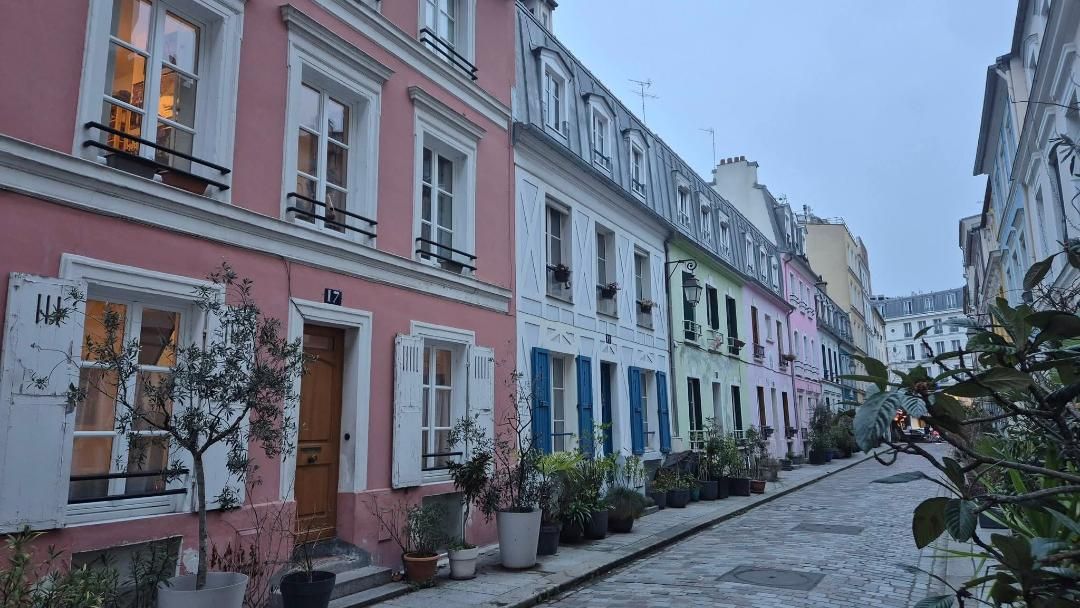
The Paris tourist office on exploring the 12éme arrondissement de Paris : https://parisjetaime.com/eng/article/explore-paris-s-12th-arrondissement-a824
There you go folks, another dandy beautiful set of glorious streets of my eternal Paris. I have criss cross them many and have many in my blog already, Again, hope you enjoy this post on the streets of Paris, part XXXIX !!! as I.
And remember happy travels, good health, and many cheers to all !!!

 Paris1972-Versailles2003