
I am again to tell you about more streets of my eternal Paris. I have many many posts on Paris and several on the streets of the most beautiful city in the world. I have come up with pictures from cd rom vault that should be here for you and me. As always thank you for following my blog some since Nov 26, 2010. Therefore, here is my take on the streets of Paris, part XXVI !!! Hope you enjoy it as I.
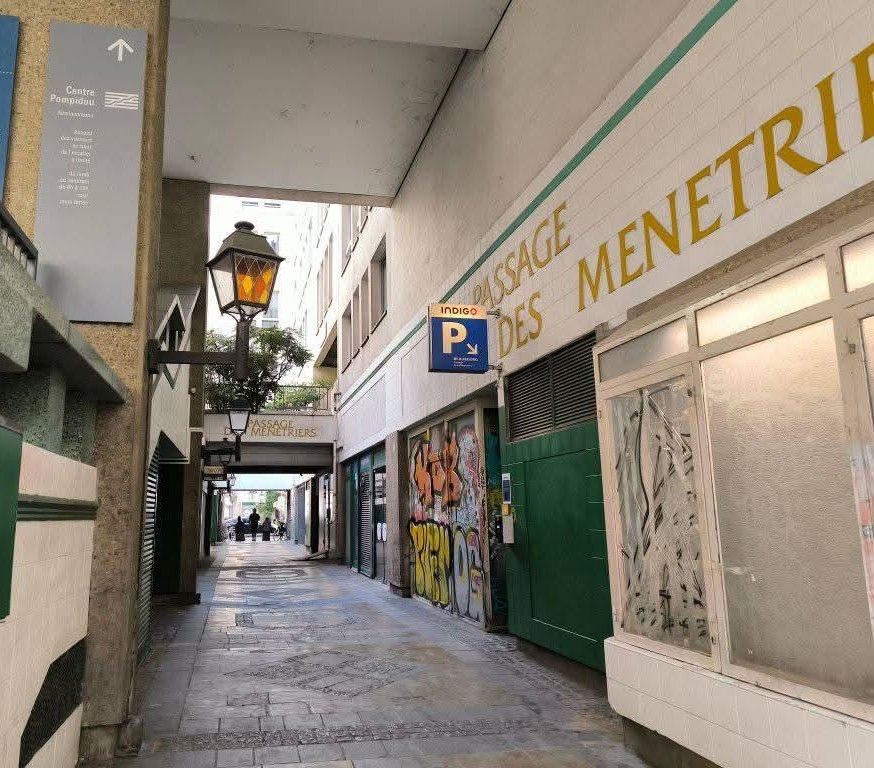
The Passage des Ménétriers is located in the 3éme arrondissement or district of Paris. It begins on rue Rambuteau and ends on rue Brantôme. It belongs to the Horloge quartier or neighborhood. It was created in 1979 and opened to public traffic by municipal decree of March 27, 1981. Name taken from the name of the Chapelle Saint-Julien des Ménétriers which was built in the neighborhood at the former no, 170 rue Saint-Martin from the 14C to the 18C. It is near the Centre Georges Pompidou, with the rue des Ménétriers that was an essential place for Parisian music and festivals. Like other professions in the Middle Ages, the fiddlers were organized into a corporation, with its statutes and rules. From the 14C onwards, the profession organised the distribution of singers for weddings and celebrations. It was impossible to call on the services of these musicians without going to the Place des Ménétriers. Also called the Rue des Jongleurs, one could find all the specialities of the show there: jugglers, but also trumpeters, drummers, violinists, organists, flautists, etc. From the 1330s onwards, the Ménétriers set up a hospital. It was an establishment intended to accommodate the poorest among them. They then built their own church for their brotherhood. Indeed, along with the goldsmiths, the musicians were one of the rare corporations to have their own church. It was in front of the porch of this church, Saint Julien des Ménétriers, that the musicians organised their activity. From the 17C onwards, the authorities took a dim view of this monarch’s prerogatives. Thus, reforms to the profession and the establishment of academies reduced its freedoms. At the same time, the Church sought to regain control of Saint Julien des Ménétriers. The services of archers had to be called upon to combat the musicians’ resistance.
The Paris tourist office on the 3éme arrondissement de Paris of Paris Centre (1-4): https://parisjetaime.com/eng/article/explore-the-centre-of-paris-a846
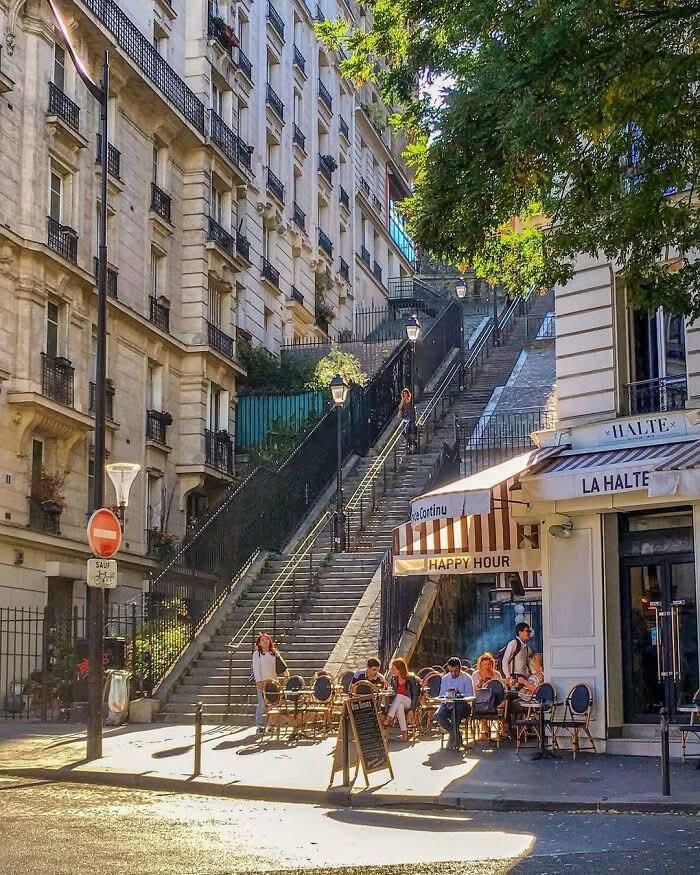
The Rue Custine is located in the 18éme arrondissement or district of Paris. It begins at 35, boulevard Barbès and ends at 34-36, rue du Mont-Cenis. It is served some distance away by line 12 at the Lamarck – Caulaincourt and Jules Joffrin metro stations and by line 4 at the Château Rouge metro station. The street honors General Adam Philippe de Custine, a major general of the French revolution. He died by guillotine on August 28, 1793, and participated in the Seven Years’ War and then in the American War of Independence as part of Rochambeau’s expedition sent to help the insurgents. After the victories won during the Virginia campaign and the Battle of Yorktown, he returned to France and resumed his place in his original unit. This street was opened by a decree of May 23, 1863 between Boulevard Barbès and Rue de Clignancourt. Part of the old Rue Dejean, opened in 1843, was also added to it, the current segment between Rue Ramey and Rue de Clignancourt. It took its current name by a decree of March 2, 1867. It was the last street laid out on the Château Rouge estate, thus leading to its definitive disappearance. It was extended between Rue Ramey and Rue du Mont-Cenis by a decree of August 11, 1867. This section, which also took the name of Rue Custine by a decree of September 3, 1869, was mainly divided up after 1900. Notable buildings here are at the corner with rue de Clignancourt (at no, 63 of this street) is the Roland-Dorgelès college. Built in 1875, the building originally housed a boys’ school where the future president of the Republic Paul Doumer was a pupil. At nos. 7 to 13 bis are built on the northern edge of the former Château Rouge park. Anecdote: Rue Custine is mentioned in the song Valentine, composed by Albert Willemetz and Henri Christiné in 1925, and successfully performed by Maurice Chevalier. FYI La Halte gives a great breakfast!
The Paris tourist office on the 18éme arrondissement de Paris: https://parisjetaime.com/eng/article/explore-paris-s-18th-arrondissement-a832
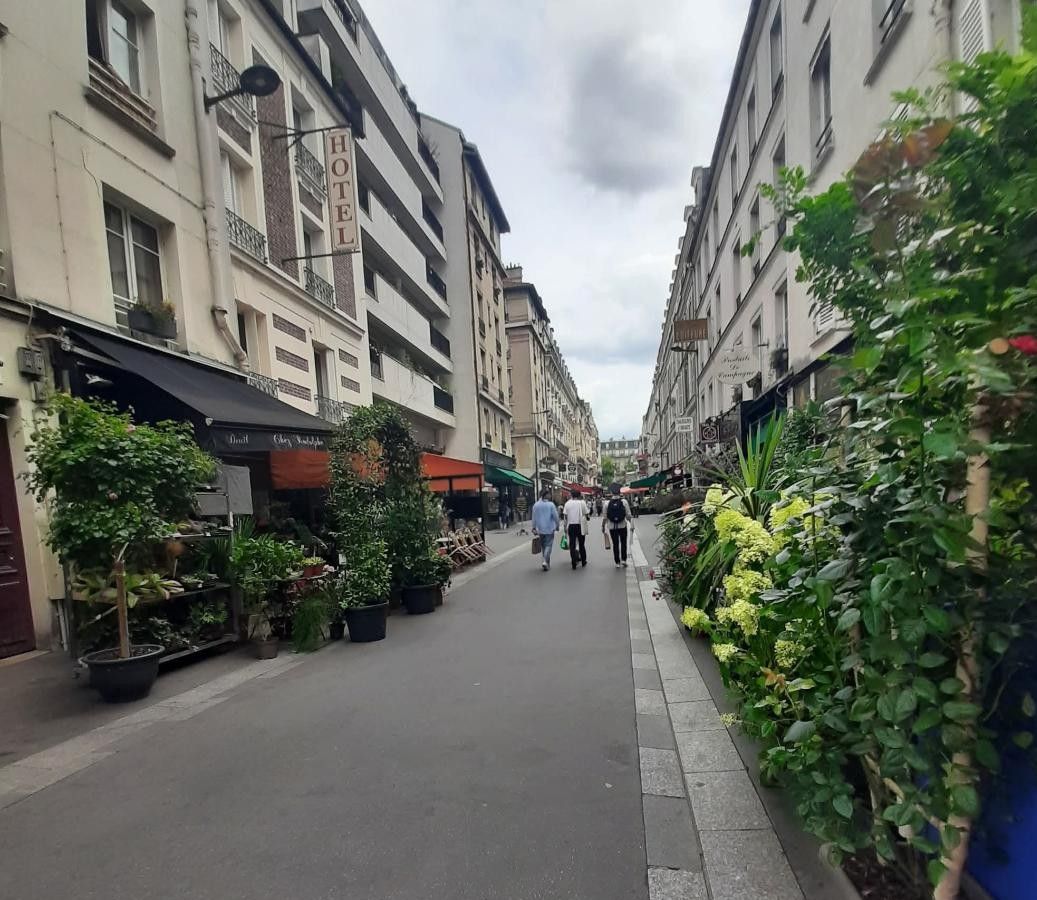
The Rue Daguerre is located in the 14éme arrondissement or district of Paris. It is 630 meters long, and begins between nos, 4 and 8 Avenue du Général-Leclerc and ends at no, 109 Avenue du Maine. It has been pedestrianized between its beginning and Rue Boulard. It is a very lively street, both during the day for its many local shops and in the evening for its cafés and restaurants. Since 1867, its name has perpetuated the memory of Louis Daguerre, the inventor of the daguerreotype, the ancestor of the camera. This road, which existed as a path in 1730 in the former village of Montrouge, more precisely in its northern part, was incorporated to Paris in 1863. In 1840, it was known as “Rue de la Pépinière,” and later “Rue de la Pépinière-Montrouge” due to the important horticultural operation of the Cels Frères establishment, owned by two grandsons of the botanist Jacques Philippe Martin Cels. At that time, it extended along the western part of the street, from Rue Neuve de la Pépinière (Rue Fermat since 1864) to Rue du Champ-d’Asile (Rue Froidevaux since 1896). It is shared between three Parisian quartiers or neighborhoods ; currently the Petit-Montrouge, Plaisance, and Montparnasse . Rue Daguerre took its current name by decree of February 27, 1867. Notable buildings here are No. 22: A small three-story tourist hotel, currently “Le Lionceau,” built of brick, dating from the second half of the 19C or the beginning of the 20C. It is a former inexpensive “hôtel garni” whose owners welcomed, between the two wars, young people who came to Paris to frequent the artistic hotspots of Montparnasse. The Japanese painter Toshio Bando lived there in 1925, protected by the owner, Madame Mongeot, who posed for him. The American sculptor Alexander Calder, enrolled at the Académie de la Grande-Chaumière upon his arrival in Paris in 1926, rented a room in this hotel during the winter of the same year, when he created his first wire silhouette, inspired by Josephine Baker. no. 44: The painter Henri Rousseau, known as “le Douanier Rousseau”, lived there from 1905 to 1906. no. 63: The craft city present in this place since the first half of the 19C, is a long paved cul-de-sac lined with workshops exclusively devoted to craft and artistic work. The French photographer and illustrator Roger Parry worked there from the end of 1932 until 1935, the year of his marriage to Madeleine Montigny; the Greek sculptor Takis had his studio there from 1967 to 1992, and the painter and visual artist Armand Langlois his from 1972 to 1976; in 1999, a guide listed “printers, cabinetmakers, decorators, architects, graphic designers, etc.”; more recently, a conservation-restoration workshop for works of art authorized by the direction of the Museums of France and a creative leatherwork workshop offering courses were established there. no. 66: at the end of 1862, while this house still retained its old address (no. 62 rue de la Pépinière, the young Émile Zola, recently hired as a bookseller’s clerk at Hachette, moved with his mother to the first floor, in a three-room apartment overlooking the Montparnasse cemetery. At no. 83: Editing room-shop for the Ciné-Tamaris productions of the filmmaker Agnès Varda. A resident since the 1950s, Agnès Varda filmed the street and its shopkeepers on several occasions. The geometric abstract painter Jean Legros lived at No. 83. At no. 86: Agnès Varda’s former home, from 1951 until her death in 2019. She is buried in the Montparnasse cemetery, located near the street and her home.
The Paris tourist office on the Rue Daguerre historical sites : https://parisjetaime.com/eng/transport/rue-daguerre-p2022
The Paris tourist office on the 14éme arrondissement de Paris : https://parisjetaime.com/eng/article/explore-paris-s-14th-arrondissement-a836
The Rue de Rennes is located in the 6éme arrondissement or district of Paris. It begins at Place du Québec and ends at Place du 18-Juin-1940. It measures over a kilometer in length and 20 meters in width. Opened in the mid-19C ; its buildings, of a fairly uniform size, consist exclusively of buildings dating from after 1850. The street is served by metro line 4 at the Saint-Germain-des-Prés, Saint-Sulpice, and Saint-Placide stations, metro line 12 at Rennes station, and metro lines 4, 6, 12, and 13 at Montparnasse – Bienvenüe station. The street is named after the city of Rennes because in 1853, the street ended at the “Gare de Rennes,” now known as Paris-Montparnasse train station, from which lines serving Brittany depart. The Rue de Rennes was built during the Second Empire (Napoléon III) . It was originally intended to connect to the Seine. This is why the numbering begins at 41, the previous numbers having been reserved for the part of the street which was to be opened to the north of Boulevard Saint-Germain. Its opening was made following the decree of March 9, 1853 from the Notre-Dame-des-Champs and de Vaugirard streets to Place du 18-Juin-1940. The second section follows the decree of July 28, 1866 from Boulevard Saint-Germain to the Vaugirard and du Regard streets. In 1880, the outlet of Rue de Rennes onto Boulevard du Montparnasse took the name of “Place de Rennes” today Place du 18-Juin-1940. Notable buildings here are: François Hollande and Ségolène Royal lived at an unknown number in the 1980s. No. 44: On March 22, 1895, the Lumière brothers gave their first public cinema screening here, in front of the Société d’encouragement pour l’industrie nationale. No. 71: In 1919, Simone de Beauvoir, still a child and who had lived until then in the beautiful apartment where she was born in 1908, at 103, boulevard du Montparnasse, her family having suffered setbacks, moved to this new address in a less opulent apartment on the sixth floor, without an elevator to access it, nor running water; she lived there until 1929, Nos. 136-138: former building of the Grand Bazaar, inaugurated on September 29, 1906. In 1910, it became the Grands Magasins , which in the 1920s became the property of Magasins Réunis. In 1974, the building became a Fnac store, the first store of the brand in Montparnasse to sell books. No. 140-140 bis: building of the former Félix Potin store, opened in 1904, a large six-story food store richly decorated in Art Nouveau style which notably offered a “kitchen service for the city” with its delicatessen section. This building was then taken over by Tati. The terrorist attack on rue de Rennes took place there on September 17, 1986. The commercial area is now occupied by Zara. No. 153: location of the first church of the Notre-Dame-des-Champs parish, created in 1858 and which covers part of this district. The building was made of wood. It has since been replaced by the new Church Notre-Dame-des-Champs (see post, built from 1867 to 1876 at the corner of Boulevard du Montparnasse and the street of the same name.
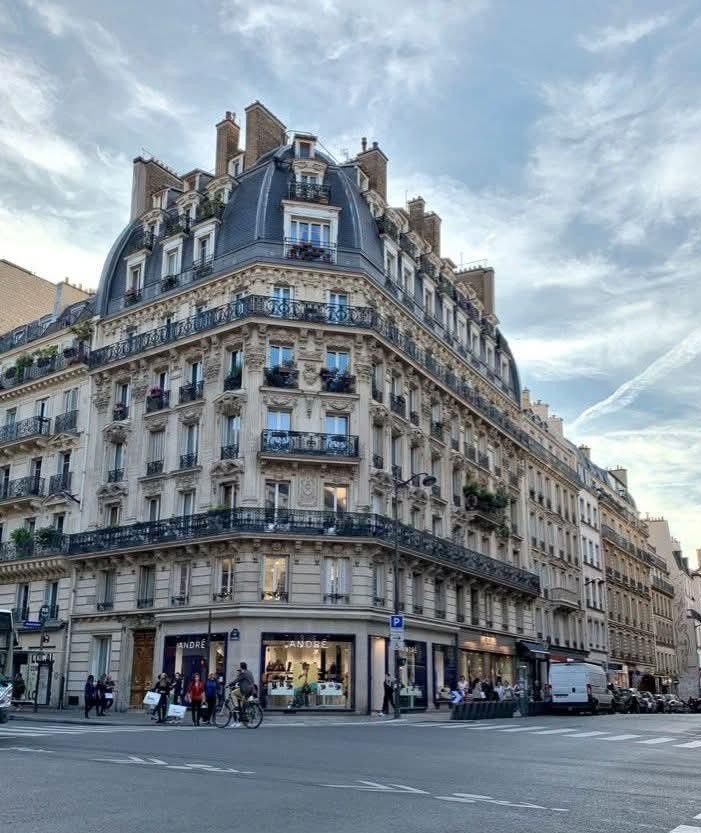
On the picture above, you see the right side onto the rue du Vieux-Colombier so on the same 6éme arrondissement or district of Paris. The street is 220 meters long, and it begins at 72 bis, rue Bonaparte and ends at rue du Cherche-Midi and carrefour de la Croix-Rouge. Its name comes from the dovecote of the Abbey of Saint-Germain-des-Prés, located at 2 rue de Furstemberg. This site is served by metro line 4 at the Saint-Sulpice station. Originally “rue du Colombier”, it took the name rue du Vieux-Colombier in the 17C. It is mentioned under the name “rue du Viel colombier” in a manuscript from 1636. It also bore the names “rue du Puys” (1360), “chemin de Cassel” or “rue Cassel dite du Colombier” (1411-1453), “rue de la Maladerie” (1414), “rue du Puys Mauconseil” (1506-1514), “grant rue Saint-Sulpice” (1509-1524), “rue Saint-Sulpice” (1521), “rue des Champs” (1509-1520-1524) and “rue de la Pelleterie” (1615), Notable buildings here are at No. 15: location of the Congregation of the Mother of God for poor orphaned children of the parish of Saint-Sulpice, which was transformed into a barracks under the name of “barracks of the rue du Vieux-Colombier”. No. 21: home of the painter Joseph-Félix Bouchor in 1900. In 1902, the painter Blanche Odin opened a studio there. Jacques Copeau opened the Théâtre du Vieux-Colombier in October 1913, in the former Athénée-Saint-Germain. Formerly a jazz club Le Vieux Colombier, then a nightclub Kathmandu. Also home to the painter and engraver Jean Cluseau-Lanauve, From 1661 to 1683, Boileau occupied an apartment here where Molière, La Fontaine, and Chapelle met three times a week to read their works and dine cheerfully, each paying their own way. When a guest was fined, they were made to read verses from Chapelain’s La Pucelle. This book, much criticized by Boileau, was permanently on the table, and reading an entire page was considered a death sentence. The painters Antoine and Louis Le Nain lived on this street, where they died in 1648, two days apart. The playwright Alain-René Lesage, the astronomer Jean-Dominique Cassini, and Jean-Paul Marat also lived here. The address of the king’s engraver Gilles Demarteau was rue de la Pelleterie, at the Cloche.
The Paris tourist office on the 6éme arrondissement de Paris : https://parisjetaime.com/eng/article/explore-paris-s-6th-arrondissement-a823
There you go folks, another dandy beautiful set of glorious streets of my eternal Paris. I have criss cross them many and have many in my blog already, Again, hope you enjoy this post on the streets of Paris, part XXVI !!! as I.
And remember happy travels, good health, and many cheers to all !!!

 Paris1972-Versailles2003