
We have driven and walked in my eternal Paris, and would like to have an imprint in my blog on the wonderful family times we had there, There is so much to see , doing my best, and glad found me these pictures in my cd rom vault ,which now transposing in my blog for you and me, This was my former worked city, so glad to post more memorable spots on it, I thank you for your readership over the years and to bear with my rants! After Paris is to rant, shout and yelled about, me think. Therefore, here is my take on curiosities of Paris, part XLVI !!! Hope you enjoy the post as I.
The Avenue du Trône is a short street in the 11éme and 12éme arrondissements of Paris. This street connects Cours de Vincennes to Place de la Nation. The odd-numbered side is located in the 11éme arrondissement, and the even-numbered side is located in the 12éme arrondissement. It owes its name to the throne erected on the square upon the return of Louis XIV and Maria Theresa of Austria after their marriage in 1659. The Philippe-Auguste to the south, and Saint-Louis to the north pavilions and columns of the former Barrière du Trône are also visible. The Avenue du Trône is served by metro lines 1, 2, and 6 at Nation station and by RER line A at Nation station.

A bit of history tell us that it was laid out in 1728, this avenue, wider than it is long, was formerly an integral part of the Place du Trône, which became the Place de la Nation (see post) during the French revolution, which owed its original name to the throne erected in 1660 on the occasion of the solemn entry of Louis XIV and Marie-Thérèse into Paris, after their marriage. During this period, the avenue was called “Avenue Santerre” before returning to the name of the old, renamed square. During the construction of the Mur des Fermiers Généraux, it was the exact site of the Barrière du Trône, where two imposing columns were erected framing it. These columns are still present today and mark the north and south sides of the square. The Barrière du Trône was built in 1787, and included two sentry boxes framing a gate approximately 60 meters long and serving as a pedestal for two 28-meter-high columns. In 1845, the columns were topped with two 3.8-meter-high statues: Philippe Auguste, to the south, and Saint Louis, to the north. As well as bas-reliefs: Abundance (1843), Justice (1843) ,Victory (1843), and Peace (1843),
The Paris tourist office on place de la Nation (see towers back) : https://parisjetaime.com/eng/transport/place-de-la-nation-p1978
The Théâtre des Bouffes-Parisiens is a performance hall located at 4 rue Monsigny in the 2éme arrondissement of Paris. The history of it tell us that in 1826, the magician and ventriloquist Louis Comte had to leave the Passage des Panoramas where he had set up his Théâtre des Jeunes-Élèves. He then commissioned the architects Allard and Brunneton to build a new hall in the quartier Choiseul or neighborhood, which was currently being redeveloped. With a double entrance from the Passage Choiseul and Rue Neuve-Ventadour (now Rue Monsigny), it was inaugurated on January 23, 1827. In 1855, Jacques Offenbach ,who had just inaugurated his Bouffes-Parisiens theater in the Salle Lacaze in the Marigny Square, on the Champs-Élysées was looking for a venue that could accommodate it for the winter. He bought the lease, and on December 29, 1855, opened at the Carré Marigny, the Bouffes d’hiver (in reference to the hall on the Champs-Élysées which became the Bouffes d’été). When Offenbach abandoned the Salle Lacaze in 1859, the hall in the Passage Choiseul definitively took the name of the Bouffes-Parisiens theater. Offenbach premiered Orphée aux enfers there, before selling his theater in 1862, He had the hall demolished to build another, with 1,100 seats. Specializing in lyrical shows, mainly operettas, the Bouffes Parisiens presented works by Emmanuel Chabrier, Louis Viarney (Les Mousquetaires au couvent), Robert de Flers, and Claude Terrasse. From 1958, operetta gave way to theater with the creation of plays by Henry Bernstein and Sacha Guitry (Faisons un rêve), before returning to the light genre that made its fame Phi-Phi, by Albert Willemetz and Henri Christiné ,Willemetz took over the management of the venue and achieved enormous success with Dédé, played by Maurice Chevalier. Dranem, Guitry, Michel Simon, Arletty, Pauline Carton, Elvire Popesco, then Yves Robert, Danièle Delorme were the big stars of the Bouffes Parisiens in the decades that followed. The Bouffes-Parisiens theater moved more towards boulevard plays performed by renowned artists: Maria Pacôme, Sophie Desmarets, Jean Poiret, Robert Hirsch, Pierre Mondy, Jean Le Poulain, Marthe Mercadier, and Jacqueline Maillan, In 2010, fifty private theatres in Paris, united within the Association for the Support of Private Theatre (ASTP) and the National Union of Directors and Tour Managers of Private Theatre (SNDTP), of which the Bouffes-Parisiens are a part, decided to join forces under a new banner: the “Associated Parisian Theatres”.
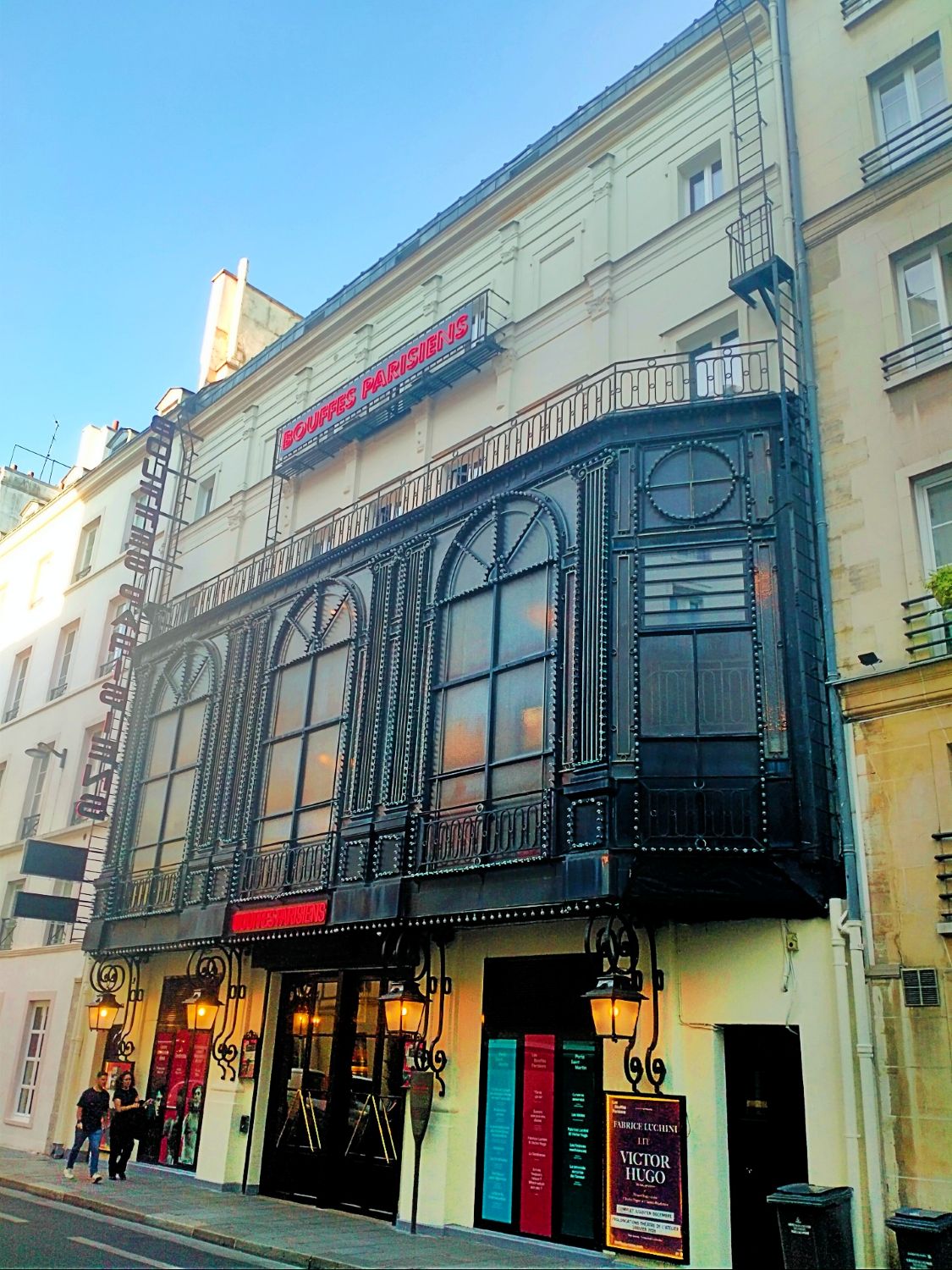
The Porte St Martin theaters on the Théâtre des Bouffes Parisiens: https://www.portestmartin.com/bouffes-parisiens-histoire
The Paris tourist office on the Théâtre des Bouffes Parisiens : https://parisjetaime.com/eng/culture/theatre-des-bouffes-parisiens-p1215
The official l’Association pour le soutien du théâtre privé (ASTP)see theater : https://astp.asso.fr/nos-adherents/#liste-des-adherents-2024
The official Syndicat national des directeurs et tourneurs du théâtre privé (SNDTP),see theater : https://www.theatresprives.com/adherent/bouffes-parisiens/
The official Associated Parisian theaters on the Bouffes Parisiens : https://tpa.fr/salles-theatre-paris/bouffes-parisiens-73.html
The Pont du Carrousel crosses the Seine river between the Quai des Tuileries (1er arrondissement) and the Quai Voltaire (7éme arrondissement). It was also called the “Pont des Saints-Pères” because its axis almost extended that of the Rue des Saints-Pères. It was also sometimes called the “Pont du Louvre” because it ended opposite the Palais du Louvre, on the right bank. The bridge was opened to traffic on October 30, 1834. It has a total length of 169.5 meters and a width between railings of 11.85 meters and includes three arches with a 47.67 meters opening. This site is served by the metro Palais Royal – Musée du Louvre lines 1 and 7. It took a great sense of innovation to create an arched bridge while the trend was towards suspension bridges. The complex structure of cast iron and wood is also very daring, which earned it some criticism. Thus, the iron circles that decorate the metal structure are ironically called “napkin rings”. At each corner of the bridge rise sculptures by Louis Petitot representing Abundance, Industry, the Seine and the City of Paris. They date from 1845. Under the Second Empire (Napoléon III) , the bridge, which is located on an axis linking the Montparnasse and Saint-Lazare train stations, saw its traffic increase. In 1930, it was also deemed to be of insufficient height for river navigation, and it was decided to completely destroy it and replace it with a new structure, a little further downstream, opposite the ticket offices of the Louvre. It was demolished in 1937. The new bridge was designed by the Paris Bridges Department. It followed the general shape of the original bridge with its three arches, but was now made of reinforced concrete. It was rebuilt from 1939 to 1943. Raymond Subes designed an ingenious system of telescopic streetlights to illuminate the bridge, installed in 1946 (the lamps rising from 13 meters during the day to 20 meters at night). The telescopic mechanism, which broke down shortly after its commissioning, was restored in 1999. As anecdotes, the Neo-Impressionist painter Maximilien Luce created an oil on canvas in 1890 entitled “The Louvre and the Pont du Carrousel. Effect of Night.” Georges Stein painted a painting entitled “Paris. The Pont du Carrousel,” depicting figures walking on the bridge in front of the ticket offices of the Louvre. The American Edward Hopper depicts the first bridge in his painting Pont du Carrousel and Gare d’Orléans (1907).

The Paris tourist office on the Centre or arrond 1-4 de Paris : https://parisjetaime.com/eng/article/explore-the-centre-of-paris-a846
The Paris tourist office on the 7éme arrondissement de Paris : https://parisjetaime.com/eng/article/explore-paris-s-7th-arrondissement-a825
There you go folks, a dandy city to explore and enjoy with the family, Memorable moments in my eternal Paris, driving and walking all over in my road warrior trails brings out sublime awesome spots with nice memorable family visits of yesteryear always remember and always looking forward to be back, eventually. Again hope you enjoy the post on curiosities of Paris , part XLVI !!! as I.
And remember, happy travels, good health, and many cheers to all !!!

 Paris1972-Versailles2003