
I am going to tackle another familiar territory in more ways than one, My dear late wife Martine’s step father is from nearby Clermont-Ferrand where it has a second home, This made it several years back many family trips took us here, The wonderful towns of my belle France, There is so much to see , doing my best, I just found me more pictures in my cd rom vaults that should be in my blog for you and me. Another dot in my world map ; therefore, here is my take on curiosities of Clermont-Ferrand !!! Hope you enjoy the post as I.
The City of Clermont-Ferrand is in the Puy de Dôme department no 63 of the Auvergne-Rhône-Alpes region of my belle France, It is 174 km from Limoges, 164 km from Lyon ,190 km from Bourges, 408 km from Versailles, and 669 km from my current home, I came here from Versailles,going pass the potager du roi on my way to connect with the N12 road to exit/sortie 6 taking avenue des Garennes dir Voisins le Bretonneux taking the D91 road dir Dampierre en Yvelines and by Senlisse taking the D149 road dir Bullion to Rochefort en Yvelines here taking the D988 road same as D149 to connect with the A10 autoroute de l’Aquitaine dir Orléans and here it becomes the A71 autoroute de l’Arvene dir Trellay and continue on the A71 dir Vierzon continue on A71 past Bourges dir Montmarault and continue on the A71 dir Combronde passing it becomes the A89 autoroute la Transeuropéenne it change numbers again to the A71 until exti/sortie 15 changing again to the N89 avenue Fernand Forest to left turn Bd Maurice Pourchon at trafic circle take Bd Gordon Bennett then right on Bd Lavoisier turn left to Rue Paul Dioméde ,then right turn on Rue Pierre Besset continue on Rue Amadéo the left on Rue Antoine Menat righton Rue Gabriel Péri continue becomes Rue Bonnabaud, left on Rue de Salles ,then turn quick right and then left on Rue Julien to Place de la Jaude.
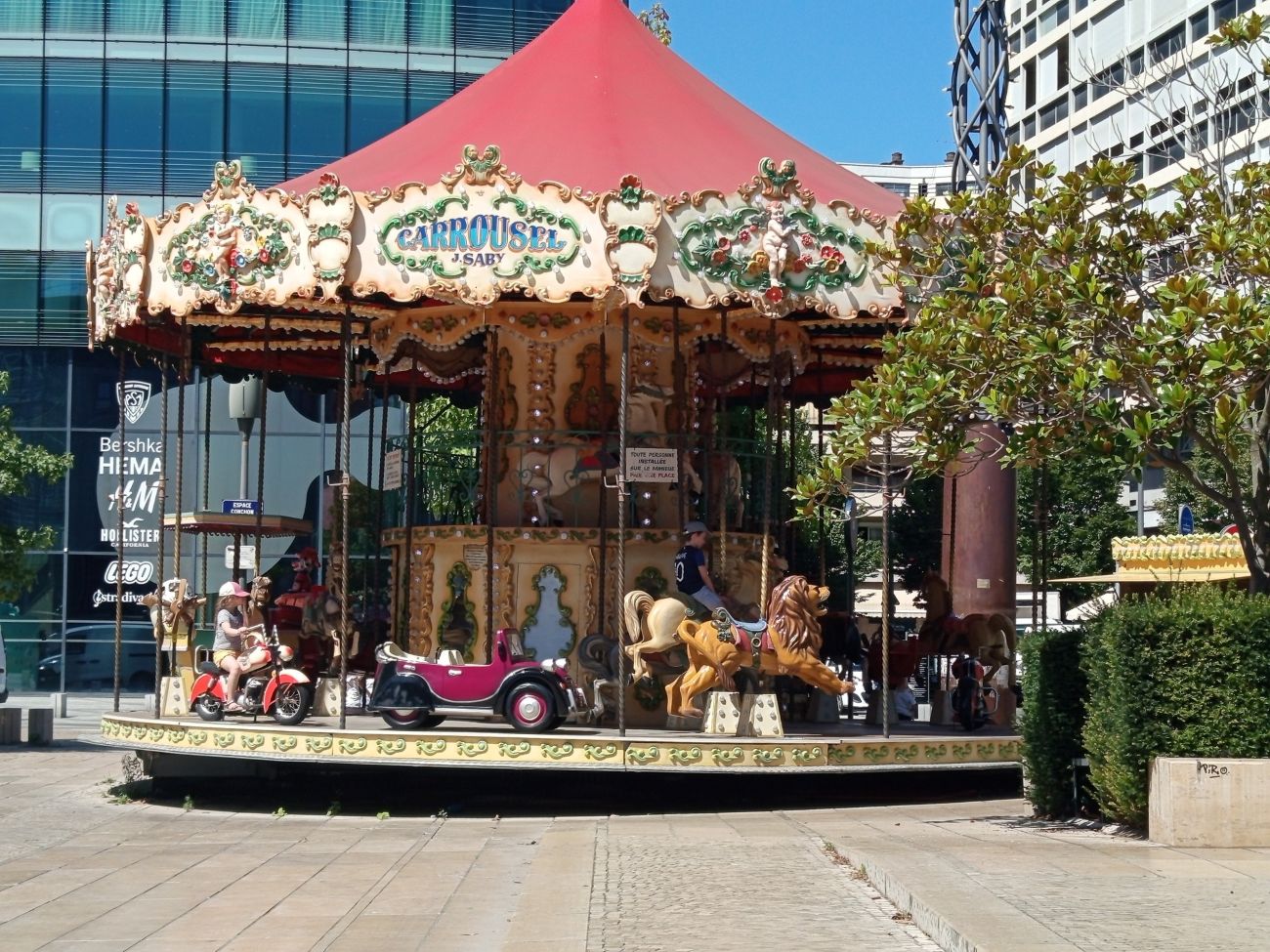
The Place de Jaude is the most important and best-known square in Clermont-Ferrand. Now mainly pedestrianized, it can be crossed by car in its center by Rue Blatin ,and Boulevard Desaix , and Avenue Julien. The square opens onto Avenue des États-Unis, which has become pedestrianized with a tramway track in its center, and to Rue du Maréchal-Foch, pedestrianized in its part adjacent to the square but a one way street. See the bronze equestrian statue of Vercingetorix,done in 1903 (see pic), sculpted by Auguste Bartholdi, and representing Vercingetorix, king of the Arverni and victor of the Siege of Gergovia which took place nearby. The horse jumps over the Roman opponent who is on the ground. Wanting to evoke an intense and violent movement, Bartholdi depicted the horse in a movement between a jump and a gallop, none of its hooves touching the ground. The face of Vercingetorix is inspired by the face of the young Napoleon III and expresses resignation after defeat. Also, there is a nice garden area to rest and see all and the merry go around or carrousel Joël Saby with its forty seats, its horses, a lion, a pig, 1900s-style planes carried by golden crankshafts that make them go up and down, a wooden carriage, two vintage motorcycles, old cars, all turning in a majestic setting adorned with sculptures, mirrors, paintings and lights, the carousel makes children and even adults dream. (see pics).
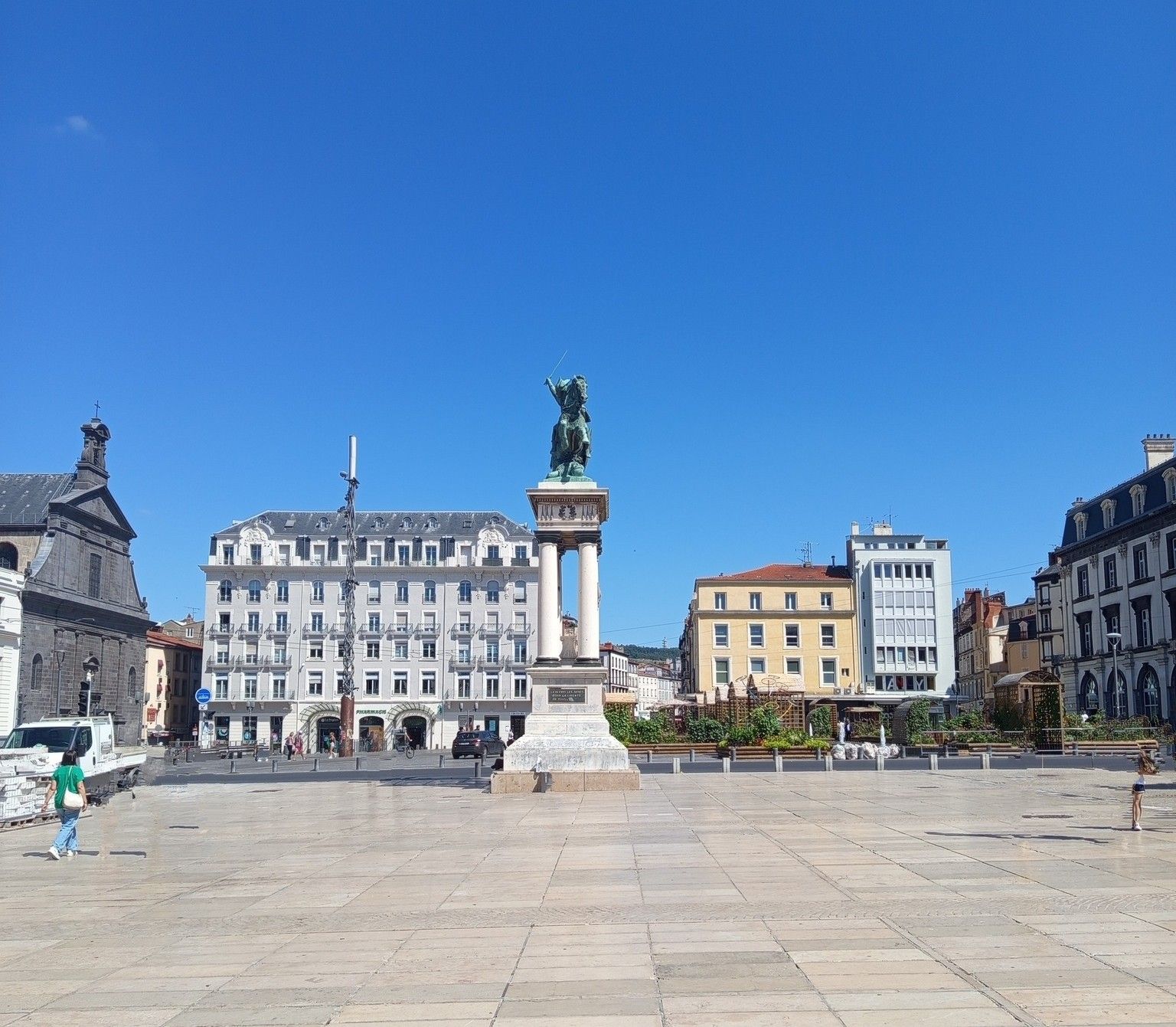
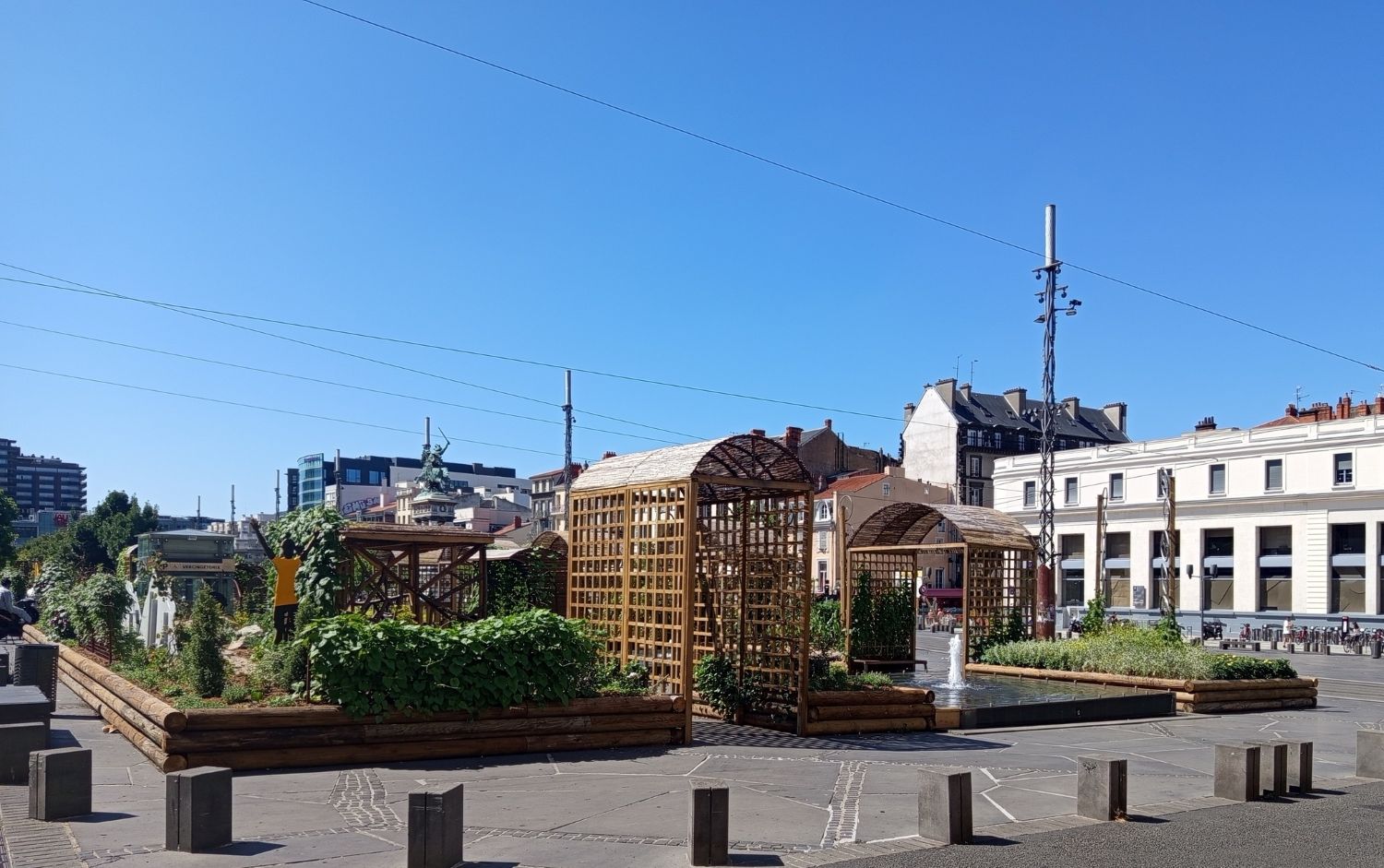
Its name is of very ancient origin. The square is built on the eastern part of the Jaude maar to which the square gave its name, an ancient phreato-magmatic volcano about 156,000 years old, about 1.5 km in diameter, extending as far as the town of Chamalières. In the Middle Ages, the square was a vast, unsuitable marshy area ,it was in fact an old crater lake, bordered by the branch of the Tiretaine du Sud, developed to supply tanneries and mills, and by the boundary of the urbanized sector. A fountain and a pond were installed in 1663. In 1750, the square was transformed into a fairground to sell horses and firewood. In the 19C, the square became a popular place for locals to stroll. On the east side of the square, the halle aux toiles or cloth hall, built in 1812, was converted to house a large theater in 1894. There is a statue of General Desaix, in 1848,A parking lot is dug under the square. Above, a bus station and a T2C tram shop are located. Near the Centre Jaude, a square is decorated with a fountain. The square is bordered by the Opéra-Théâtre, the Galeries de Jaude, which became the Galeries Lafayette, the Paris-Clermont stores now occupied by HSBC; the Centre Jaude shopping center and the Saint-Pierre-des-Minimes Church (1630).
The Cathédrale Notre-Dame-de-l’Assomption , Gothic, built from 1248 See the wonderful tripartite facade in width with the two towers pierced by twin bays composed of two lancets topped with quatrefoils, hexalobes and octalobes.The crypt discovered in 1885 is particularly mutilated with destroyed vaults, excavations to install sarcophagi and the foundations of the Gothic cathedral. The center of the crypt is organized from three confessions opening onto a square room made up of three naves covered with groin vaults resting on columns. This space is extended by a slightly narrower choir. This choir includes two semicircular niches and a square one containing the altar with a loophole open in the axis. The predominantly blue rose window placed above the north portal dates from the 14C as does the orange-toned one overlooking the south portal. Both are inscribed in a square of 8.50 meters on each side.
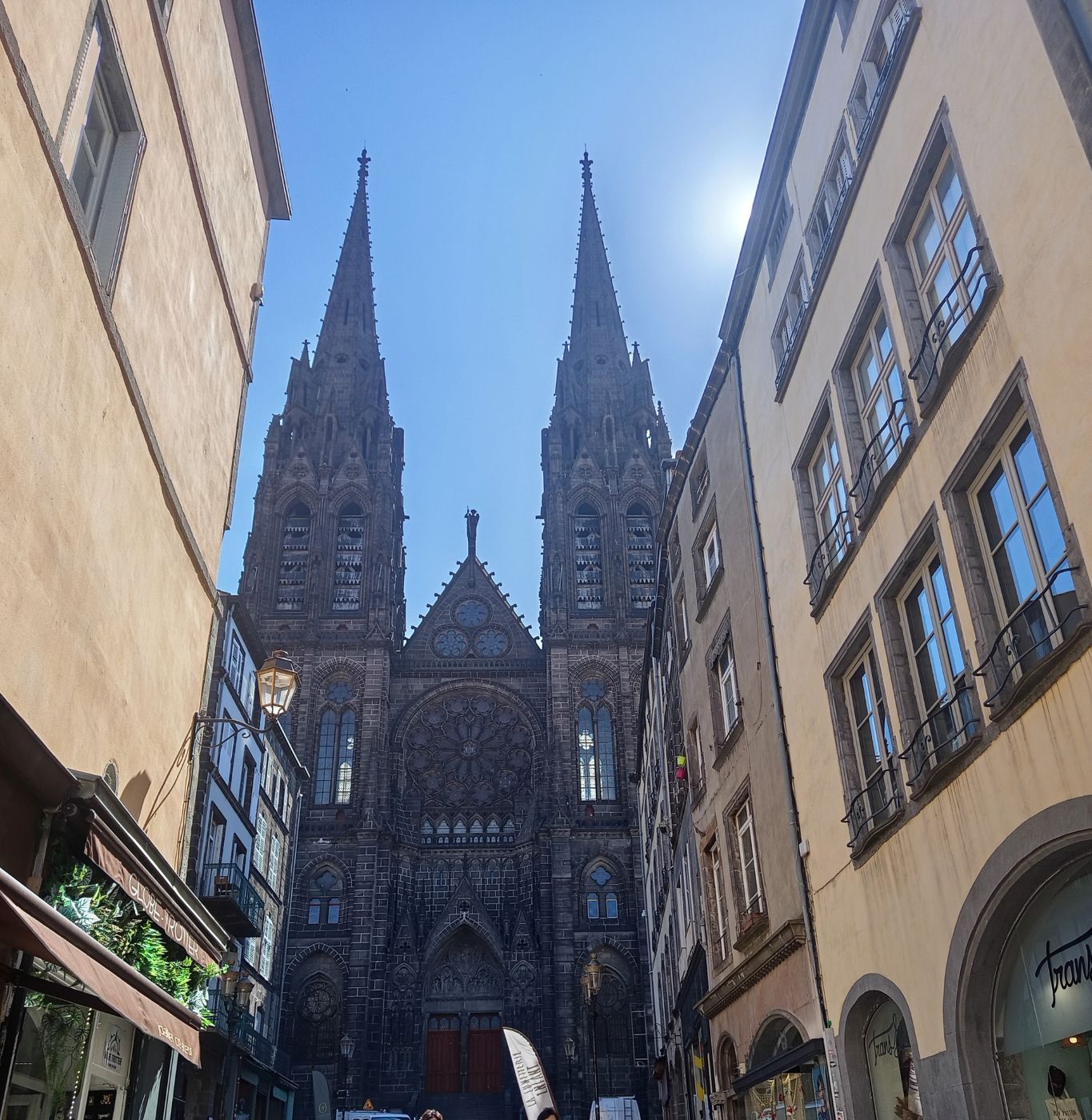
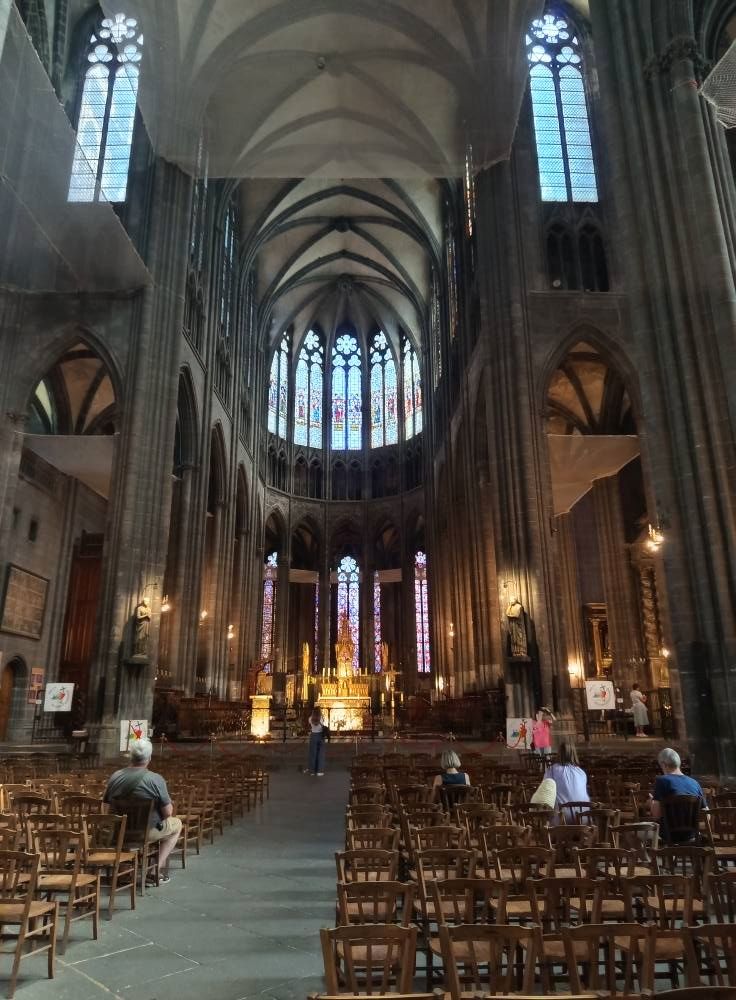
A bit of history tell us that it replaced a Romanesque cathedral located on the same site, which itself had been preceded by two other Christian sanctuaries. Its initial patronage was that of Saint Vital and Saint Agricol. Most of the current construction dates from the second half of the 13C; it is the first example of the use of Volvic stone in architecture. The western facade and other renovations were carried out by Eugène Viollet-le-Duc during the second half of the 19C. It is located at the crossroads of various streets and squares from the medieval period, following the layout of the 3C fortified town. The southern forecourt overlooks the Place de la Victoire, in the center of which is the statue of Pope Urban II who launched the first crusade at the Council of 1095. On May 28, 1262, Clermont experienced one of the most prestigious events in its history: the marriage of the future Philip the Bold, eldest son of Saint Louis, with Isabelle of Aragon, daughter of James I, King of Aragon, in the presence of the monarchs, almost all the nobility of the kingdom and numerous prelates. Charles II of Bourbon ,son of Charles I of Bourbon and Agnes of Burgundy, he pursued a political career as a courtier to King Louis XI as ambassador, then as papal legate in Avignon. At the heart of a conflict between the Pope and the King, he lost his position and received the bishopric of Clermont, with the title of cardinal. The bishopric of Clermont having become vacant, at the end of 1504, Louis XII appointed Jacques d’Amboise there. François de la Rochefoucauld began his career as a great prelate at the age of 27, after having studied at the college of Clermont with the Jesuits, and having been abbot of Tournus. On September 10, 1607, François de la Rochefoucauld was raise to cardinal. To have his advisor closer to him, Henry IV had the Bishop of Clermont transferred to the seat of Senlis in 1610. Jean-Baptiste Massillon became Bishop of Clermont in 1717, until his death in 1742. He was elected a member of the French Academy in 1718, replacing the Abbot of Louvois. In 1718, he preached the sermons of the Little Lent before Louis XV, then aged 8. In the 18C, he was often compared to Bourdaloue and Bossuet.
The Clermont Auvergne Volcans tourist office on the place de la Jaude : https://www.clermontauvergnevolcans.com/en/pages/place-de-jaude/
The Clermont Auvergne Volcans tourist office on the Cathedral Notre Dame de l’Assomption : https://www.clermontauvergnevolcans.com/en/pages/notre-dame-de-lassomption-cathedral/
The City of Clermont-Ferrand on a visual look of the Cathedral : https://clermont-ferrand.fr/visite-virtuelle-de-la-cathedrale
The official Cathédrale Notre Dame de l’Assomption : https://www.cathedrale-catholique-clermont.fr/
There you go folks, a dandy area to explore and enjoy with the family, Memorable moments in my belle France, driving all over in my road warrior trails brings out sublime awesome spots with nice memorable family visits of yesteryear always remember and always looking forward to be back, eventually. This is a historical town with nice architecture to see and even more with more time. Again hope you enjoy the post on curiosities of Clermont-Ferrand !!! as I.
And remember, happy travels, good health, and many cheers to all !!!


Beautiful place, wow you know the autoroutes!!
LikeLiked by 1 person
🤣 yes i am the road warrior ! Thanks for stopping by Cheers
LikeLiked by 1 person
I lived in the neighboring Lyon region for two years, yet never came around to visiting Clermont-Ferrand. Looks lovely, and I’ll have to visit some day!
LikeLiked by 1 person
It happenned many times on things we have so near yet further away. There is still a lot to see. Thanks for stopping by. Cheers
LikeLiked by 1 person