
As usual lately, digging into my cd rom vault of memories found me new pictures that should be in my blog for you and me. The town of Les Clayes sous Bois passed by several times but as always not enough pictures!! worth the detour to see more, me think, Therefore, this is my take on this is Les Clayes sous Bois !!! Hope you enjoy the post as I.
The town of Les Clayes-sous-Bois is located in the Yvelines department 78 in the Île-de-France region of my belle France. It is 21 km from Versailles, 6 km from Chavenay, 3 km from Villepreux, 9 km from Bois-d’Arcy, 11 km from Trappes and 3 km from Plaisir as well as 459 km from my current home, The town is served by the D11 road which connects Versailles, and Plaisir. The D98 road allows, from the D11, to reach Saint-Nom-la-Bretèche and Saint-Germain-en-Laye. From Paris you would take the Porte de Saint-Cloud on the autoroute de Normandie A13 dir St-Quentin-en-Yvelines, exit: Bois d’Arcy ; then take the direction: Fontenay-le-Fleury then Les Clayes-sous-Bois, We came here by Avenue de Sceaux to right on Rue Royale (D10) ,right on Rue Albert Samain, left on Avenue Maréchal Joffre (D91) continue same road Avenue Clément Ader to connect with the N12 road dir Houdan/Dreux to exit by Satory exit 5 get on Bd Henri Barbussa (D129) right on Avenue Raymond Falaize to connect right with the D127 road to roundabout D11 to Les Clayes sous Bois entered on Rue du Stade left to right Rue du Roseaux and parc de Diane.
As an introduction to the town passing by saw the City hall and took a picture, this is the Mairie of Clayes sous Bois !

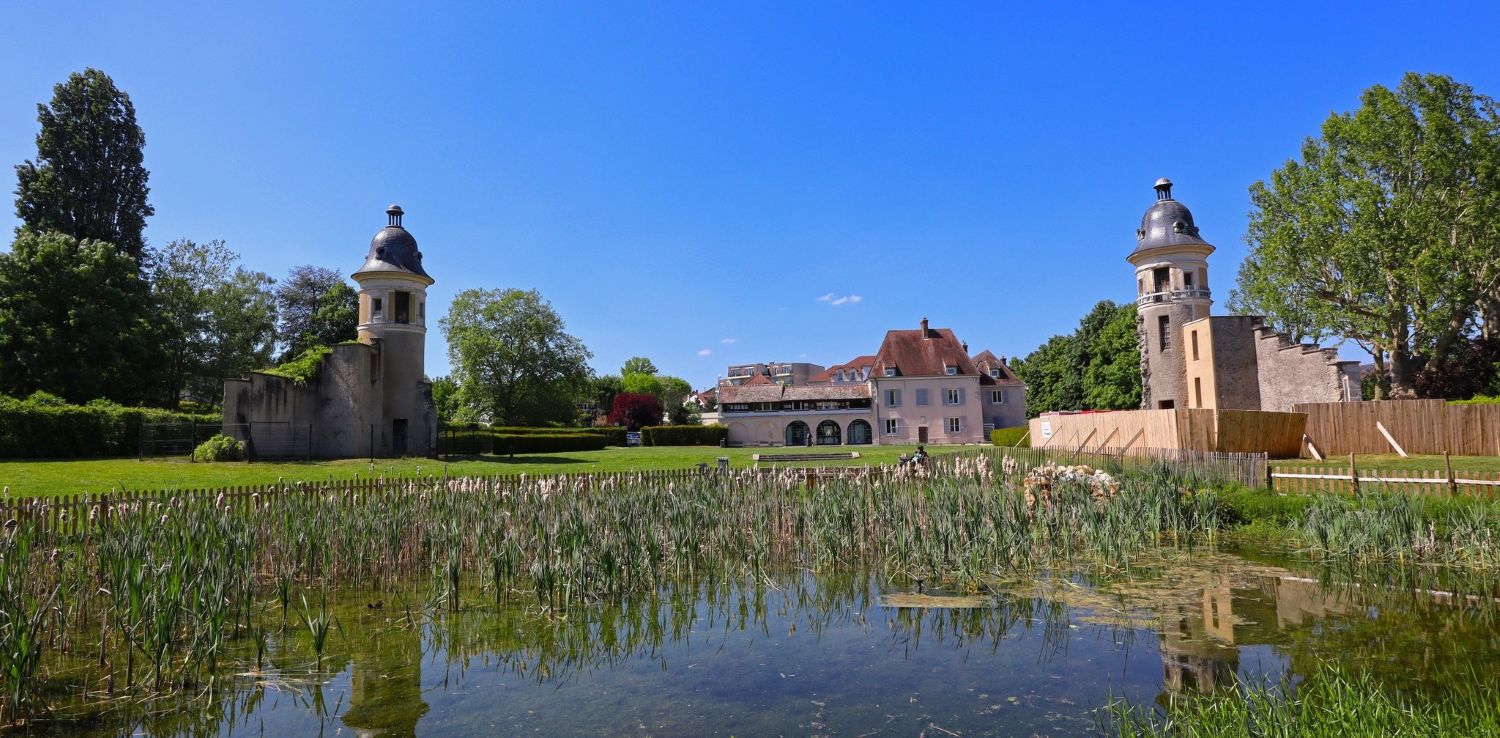
Opposite the remains of the old hunting lodge, a new neo-classical style castle was built between 1800 and 1816. Made of stone and brick, the facade of the building is rectangular, framed by two circular towers with lanterns and roofs pierced with four bull’s-eye windows. A belfry decorated with a clock is installed in the middle of the roof, showing the symbolic power of the castle. The presence of five chimney stacks indicates that each room had a fireplace, at a time when it was the only means of heating. In 1819, the son of the Delaborne added the large gate that marks the entrance to the estate. Several owners followed one another. In 1926, Lucy and Jos Hessel, art dealers in Paris, acquired the castle and led a social life there, inviting personalities such as the writer Tristan Bernard, the painter Édouard Vuillard, and the politician Léon Blum. The estate was requisitioned by the Nazis during the occupation in WWII, and a fire, caused in August 1944, at the time of the rout of the nazis Army, destroyed the body of the castle, Of the Château des Clayes only the two side towers topped with a lantern remain in the Parc de Diane (see pic). Its outbuildings, integrated into the remains of the old hunting lodge such as library, today host exhibitions and associative and festive activities. The Parc de Diane in addition to the two towers of the old castle, its main attraction is the Tree of Diane: a 450-year-old plane tree, known as the “Tree of Diane”, received the label of remarkable tree of France in 2000. It is said to have been planted around 1556, for the favorite of King Henry II, Diane de Poitiers. A basin is located in front of the terrace of the old castle. Further west there is also a pond, which can be crossed by a small wooden bridge; it was once bordered by a wooden kiosk. The park provides access to the Bois-d’Arcy forest.
Other things to see here are the Saint-Martin Church ,the oldest building in the town. Its nave dates from the 11C, the choir and sanctuary from the 14C and 15C. A 14C hunting lodge was built on the ruins of a house destroyed during this troubled period (Hundred Years’ War, peasant revolts, Black Death, etc.). This house belonged to the nuns of Notre-Dame-des-Anges de Saint-Cyr (Benedictine order), who sold the remains of the building to the king’s squire Pierre Potel in 1360. The presbytery opposite the church was built between 1719 and 1745. Between the two wars, the painter Édouard Vuillard often stayed with his friends the Hessels at the Château des Clayes. The castle and its park were a source of inspiration for many of his works such as the Undergrowth in Spring at the Château des Clayes, The Château des Clayes, The Park of the Château des Clayes, etc. A square in the town has since borne his name.
A bit of history I like tell us that the castle farm extended to the corner of Henri-Langlois and Henri-Prou streets, where a period interior courtyard can still be found today. The Rue Henri-Prou, then called the “main road” and linking Les Clayes to Versailles and Neauphles, was the main axis of the village, where community life took place, with the church and the first town hall in its center, located in the old presbytery, on the site of the current René-Fontaine Medical-Educational Institute. Typical buildings from the 19C early 20C remain in this street: village houses with simple gypsum rubble facades and some millstone town houses with much more careful architecture. The current City/town hall was built in 1930. It is part of a complex of buildings that also includes a school, in order to accommodate the growing school population. The facade of the building still preserves on its side alleys the trace of its entrances: boys’ school on the Robert-Desnos path and girls’ school on the allée du 19-Mars-1962. At the end of this last road, nowadays replaced by the André-Briquet nursery school, there were shower baths. Formerly, a square was installed in front of the tcity hall; it bore the name of Léon Blum. Redeveloped in the 2000s, it was replaced by an open square which bears the name of Charles-de-Gaulle. In June 1944, the plane of American lieutenant Marvin N. Vinson was destroyed by the enemy and, after parachuting into Plaisir, he was hidden in Les Clayes but died of his wounds; the square in front of the town church has since taken his name in his honor. A village whose church and first castle were built in the 12C, Les Clayes remained a primarily agricultural area until the 19C, organized around what is now Rue Henri-Prou, the heart of the historic district. In the 14C, a hunting lodge was built further south, frequented by the royal favorite Diane de Poitiers; around 1556, she is said to have planted a remarkable tree that now bears her name. In the 1800s and 1810s, a new castle was built near the hunting lodge; it was burned down by the nazis in 1944. In the 19C, other bourgeois residences were built, such as the Château des Bruyères (also since destroyed). At the beginning of the 12C, the lands of Les Clais belonged to Simon de Cloyes. In 1118, he had a castle built there, near the church. This was built on the upper part of the village around 1100, during the reign of Philip I. In 1160, the Bishop of Chartres, Robert III, awarded the cure of Les Clayes to the Abbey of Saint-Cyr, which was confirmed by Pope Alexander III by a bull three years later. In 1357, the troops of the King of Navarre, Charles the Bad, camped for three months in the villages of Les Clayes, Villepreux and Trappes, pillaging the parishes. A battle between the French royal troops and those of the King of Navarre took place to the east of the village, in a valley long referred to as Près Bataille or near battle. In 1360, the king’s squire Pierre Potel had a lordship hotel hunting lodge, taking advantage of the proximity to the Bois d’Arcy forest ,built to the south of the village. The south wing of this hotel, the only vestige since 1790, now houses the municipal library. This hotel was built at the place called Val Gally, on the site of a country house belonging to the nuns of Notre-Dame-des-Anges de Saint-Cyr and which was burned down during the occupation of Charles the Bad. The lordship hotel formed a square surrounded by a double enclosure, a wall and ditches which remained until 1866, when they were filled-in.
The lordship of Clais was confiscated in 1537 and returned to the King of France. On December 24, 1546, Anne de Pisseleu, favorite of François I, obtained the lands of Clayes from her lover, of which she became the chatelaine. In 1556, Diane de Poitiers, favorite of Henri II, became the owner, ten years after Anne de Pisseleu had been exiled and the lordship confiscated for the benefit of the new king. Diane used it as a hunting lodge. Three coats of arms engraved in marble, located in the arcaded gallery of the building, bear witness to her visit. They depict Diane in laurel, as a huntress and wearing armor. The king’s mistress is also said to have planted the famous “tree of Diana” in the park. The estate then passed by inheritance to her daughter Françoise de Brézé, who sold it to François Coignet, notary and secretary to the lord of Pontchartrain. Many owners followed one another, including the Count of Albon. In 1573, a year before acceding to the throne, the future Henry III placed the Château des Clais under royal protection. A trace remains above a door of the main building of the former hunting lodge: it is a “safeguard”, a plaque representing a shield or body of a coat of arms, on which are engraved three fleurs-de-lis surrounded by a collar of the Order of Saint Michael and surmounted by a hammered crown. At the start of the French revolution, the first town mayor was elected on March 26, 1790. On November 20, 1791, the priest Le Duc was relieved of his duties as mayor and replaced by the town prosecutor. In October 1793, one of the two church bells was sent to the cannon foundry. On 1 December, 1793, Catholic worship ceased and the church’s silver ornaments and vases were offered for the “support of the Republic.”
The town of Les Clayes sous Bois on its heritage : https://www.lesclayessousbois.fr/patrimoine-historique-et-naturel-
The Saint Quentin en Yvelines agglo metro area on Les Clayes sous Bois : https://www.saint-quentin-en-yvelines.fr/agglomeration/
There you go folks, a nice short and sassy visit to quant Les Clayes sous Bois, for the memories of my road warrior trails. Looking forward to be back, eventually, worth the detour. Again, hope you enjoy the post on this is Les Clayes sous Bois !!! as I.
And remember, happy travels, good health, and many cheers to all !!!

 Paris1972-Versailles2003