
This is one of those town we came for the history we read and passing nearby many times on the N10 , we decided finally to see the castle ,and what wonderful property that needs to be seen more even by me. Rambouillet is a nice town, very much visited later on while living in Versailles. I found me new pics in my cd rom vault combine with an older one and they should be in my blog for you and me. For reference, Rambouillet is in my dear Yvelines dept 78 of the region of Île de France in my belle France! Therefore, here is my take on the Château de Rambouillet, part I !!! Hope you enjoy the post as I.
The Château de Rambouillet, a former royal, imperial, and presidential residence. Far from the court of the King of France , princes and heads of state used the estate and the château as a diplomatic hub: they invited their guests there for presidential hunts or major international events. The castle, received visitors such as François Rabelais,doctor of the king. Since 2009, the Centre des Monuments Nationaux has managed the château and organizes tours. The spaces still benefit from their furnishings from the Mobilier National. From 2015 to 2017, the château underwent a major restoration project, which included the facades and roofs. The project will continue with the restoration of the interior spaces.
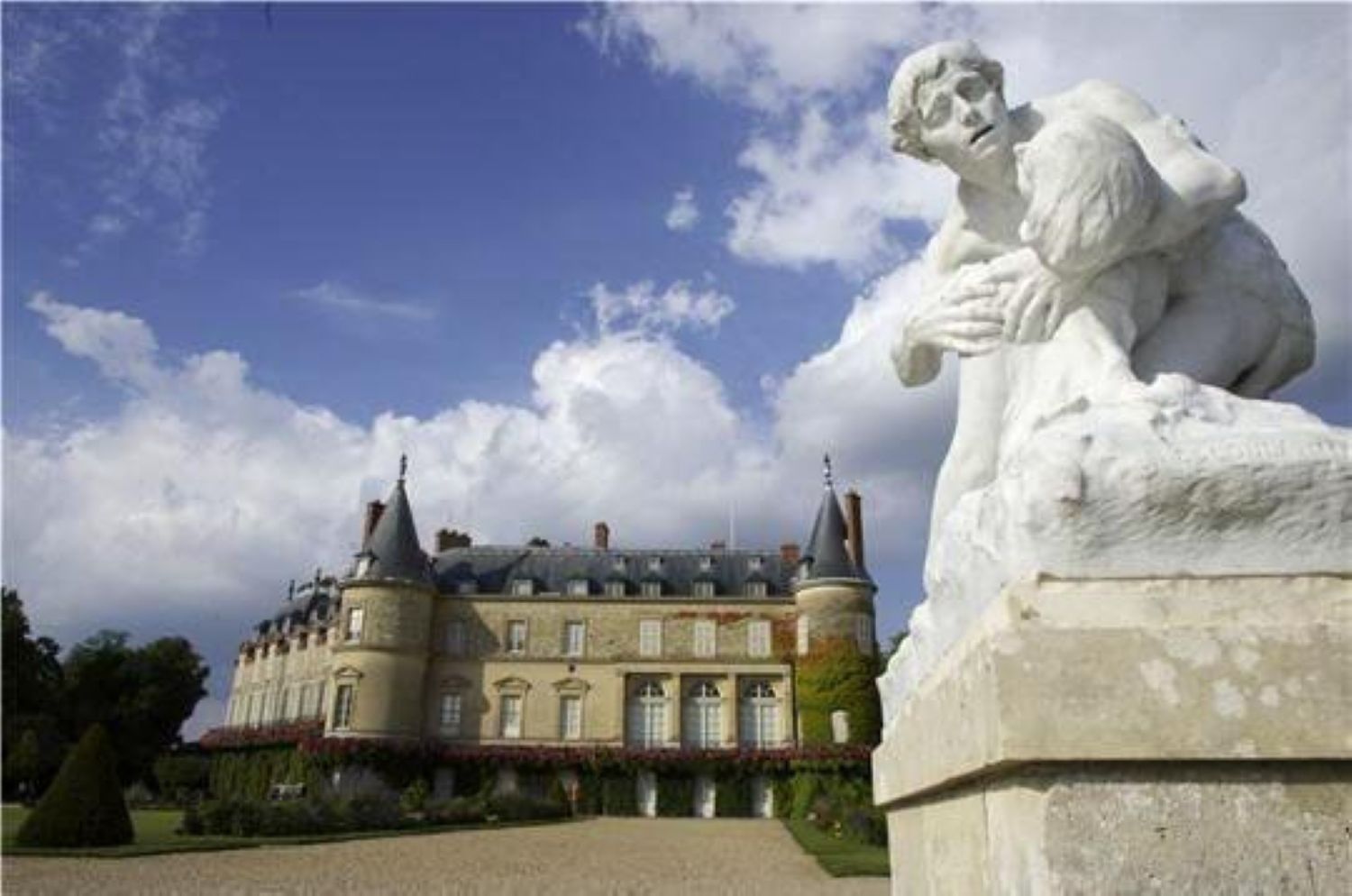
The Château de Rambouillet consists of a main building with a triangular plan, from which stands a single wing made of millstone, flanked by a crenellated medieval tower. The latter is called the “François I tower,” tradition having it that the king died in the upper chamber of this tower in 1547. The entrance gate to the main courtyard is located on the axis of the main building, between the tower on the right and a small pavilion serving as a lodge on the left. The main entrance to the château, surmounted by a neoclassical pediment, leads to a grand staircase. in the Renaissance style, covered with groin vaults and arched vaults built of brick. The staircase leads to the Marble Room, built in the 16C: a former guard room, the walls and floors are decorated with geometric marble slabs. On the mezzanine floor, the dining room, covered in wood paneling and decorated with Empire-style furniture, dates from the early 19C. The adjoining room is Napoleon I’s bathroom, decorated by Godard in 1809 in the Pompeian style: it houses a tinned copper bathtub in an alcove and features neoclassical décor. Upstairs, a series of adjoining rooms remains: the so-called Marie-Antoinette boudoir, adorned with Rococo-style painted woodwork and a stucco frieze along the cornice, richly iconographic. The grand salon with furnishings consisting of yellow damask armchairs and woodwork decorated in a naturalistic style The Council Chamber adorned with Gobelins tapestry on a pink background with floral decoration and furniture depicting love scenes, the Louis XV armchairs upholstered in Beauvais tapestries depicting La Fontaine’s fables on their seats, The Meridian Room, equipped in a niche with a white glazed earthenware stove, installed during the presidency of René Coty. The oratory surmounted by a trompe-l’oeil coffered dome, surrounded by pilasters adorned with censers, pontifical tiaras, bishops’ mitres, and medallions, and furnished with a variety of furnishings. The Assembly antechamber, in the Rococo style, equipped with a fireplace and two hidden doors, On the second floor is the suite allocated to foreign heads of state, Finally, the large dining room, formerly the king’s chamber and in which Charles X signed his abdication in 1830, is decorated with tapestries from the Gobelins factory.
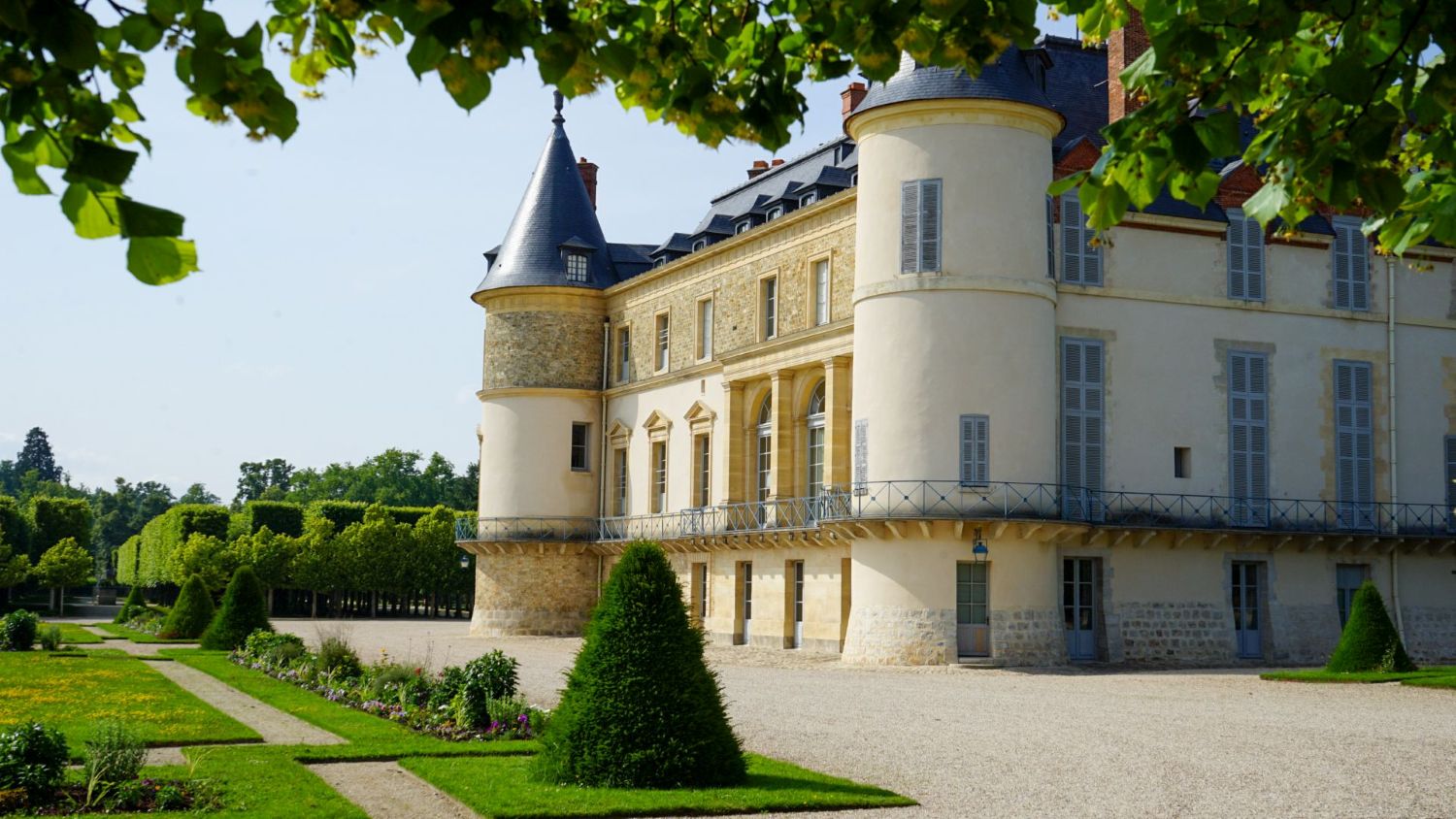
The French-style park was designed by Fleuriau d’Armenonville in 1700. It included terraces, flowerbeds, and rows of lime trees. Starting from the grand canal that crosses the estate, the Count of Toulouse had a network of secondary canals dug, creating strings of geometric islands that were once populated by statues and are now refuges for wildlife. In 1779, the Duke of Penthièvre created a picturesque and magical garden adorned with factories, a grotto topped by a Chinese kiosk, a hermitage, and canals intersecting to form six islands. Unable to resist the trend, the Duke created an English garden where he built the famous shell cottage. A small neoclassical temple, the Queen’s Dairy, was built to entertain Queen Marie-Antoinette during her stays in the Château de Rambouillet.
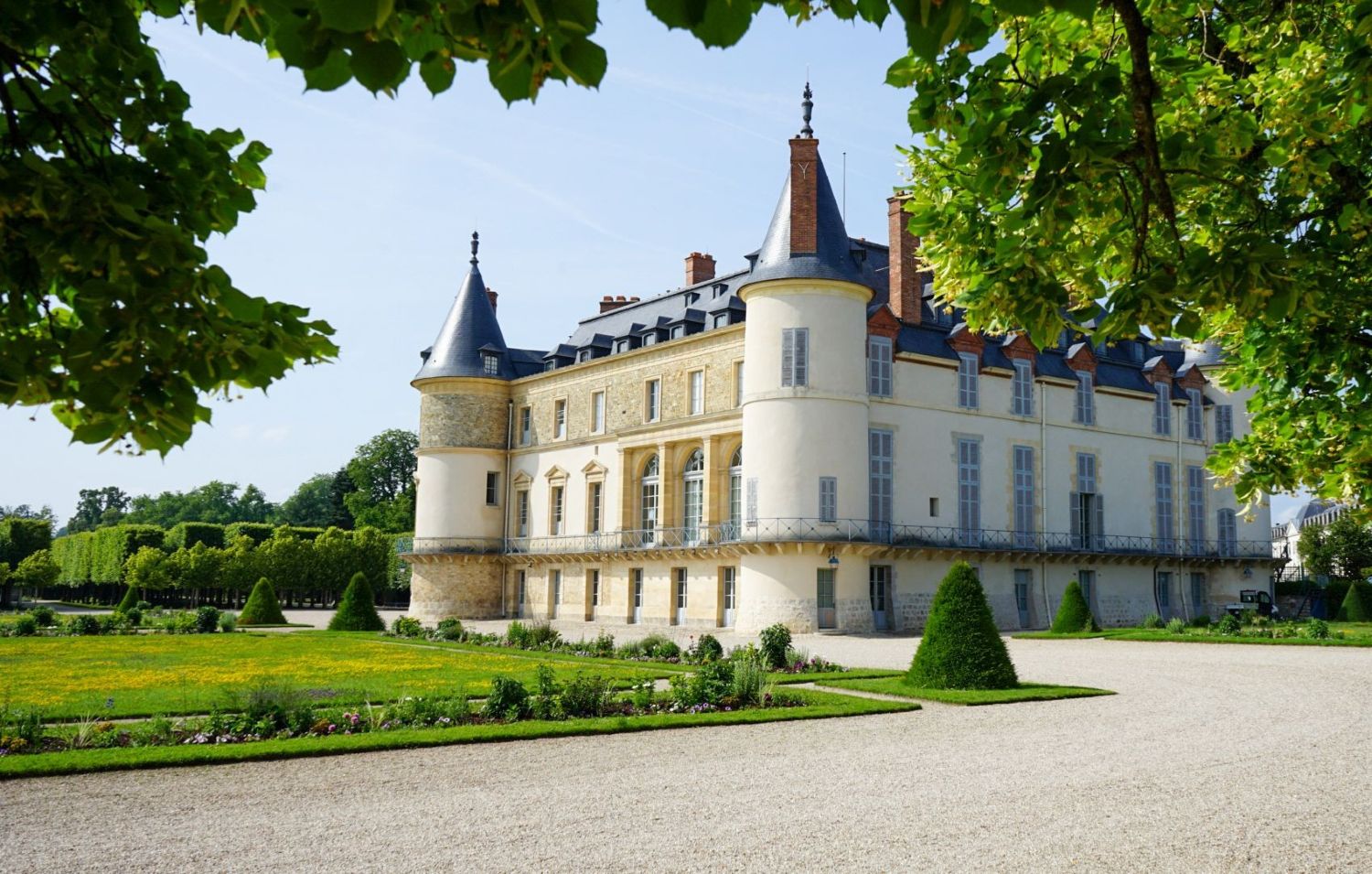
A bit of history,long illustrious history indeed tell us that in 1368, Jean Bernier, knight, advisor, and master of requests of the King’s household, provost of Paris, purchased a simple manor house from Girard de Tournebu, which he had transformed into a veritable fortified castle surrounded by a moat in 1374. In 1384, Guillaume, Jean Bernier’s son, sold this new château to Regnault d’Angennes, squire and chief valet of the king. It remained in the Angennes family for more than three centuries, until 1699. Jean II d’Angennes and his wife Philippa du Bellay devoted their lives and a good part of their inheritance to rebuilding it. Their grandson, Jacques d’Angennes , captain of the bodyguards of François I, expanded the estate by purchasing the lands of Auffargis and Poigny, the castellany of Essarts-le-Roi and various surrounding lands, thus creating a magnificent hunting estate. A great hunting enthusiast, François I often came to Rambouillet. He died there on March 31, 1547 of septicemia, according to tradition in the upper room of the large tower, which has survived to this day despite the considerable transformations made to the castle. In 1612, Louis XIII erected the land of Rambouillet into a marquisate for the benefit of the Angennes, Fleuriau d’Armenonville family, was who had the French gardens transformed by creating a succession of flowerbeds and water features, fed by the numerous springs of these marshy lands. A canal was dug in the axis of the southwest facade of the castle and extended by a green carpet. Another canal, perpendicular, runs along the embroidery flowerbeds which extend at the foot of the castle. Beyond these flowerbeds are three ponds of different shapes. Louis-Alexandre de Bourbon, Count of Toulouse and Duke of Penthièvre, the legitimated natural son of Louis XIV and Madame de Montespan, Admiral of France, wishing to own a hunting estate not far from Versailles, set his sights on Rambouillet. Fleuriau d’Armenonville was forced to cede the estate to the king in 1706. The whole was elevated to a duchy-peerage in May 1711. He had splendid stables and vast outbuildings built, connected to the château by an underground passage. He also had major works carried out on the château itself. Upon the death of the Count of Toulouse in 1737, the estate passed to his only son, Louis Jean Marie de Bourbon, Duke of Penthièvre. Born in Rambouillet, the latter spent a lot of time there and devoted himself mainly to the beautification of the gardens. He had the canal network developed to create a series of islands and had 25 hectares of the English-style park landscaped with factories, following a fashion that was then beginning to spread throughout France. The Shell Cottage, the Hermitage and the Chinese Kiosk date from the 1770s and 1780s. Louis XVI, who, like Louis XV, often hunted in the Yvelines forest but found his Château de Saint-Hubert too small, asked his cousin the Duke of Penthièvre to give him his Château de Rambouillet. The sale was concluded on 23 December 1783. Ultimately, the king decided to keep the château but had vast outbuildings built, capable of accommodating 400 servants, in place of the old stables, and new stables for 500 horses. Marie-Antoinette hated the Château de Rambouillet. In an attempt to make her love the estate, Louis XVI had a wing redesigned to create new, modern apartments, had a farm and a magnificent dairy built in the greatest secrecy, inaugurated in June 1787, and had the gardens redesigned in the picturesque English style that so pleased the queen.
During the French revolution, from 1793 onward, the castle was abandoned for about ten years. In 1804, at the request of Napoleon I, Rambouillet castle was turned into a hunting lodge and a residential residence. The restoration was completed in 1807. On his way into exile, Napoleon passed through Rambouillet on the night of June 29-30, 1815. With the return of the Bourbons to the throne, the castle was refurnished and work was carried out to remove the imperial insignia. Charles X enjoyed hunting at Rambouillet. It was there that, also taking the road to exile, he abdicated in favor of his grandson the Duke of Bordeaux on August 2, 1830. Louis-Philippe I did not want to keep the castle on his civil list and handed it over to the administration of the domains, which rented it to various occupants: Baron de Schickler, Count Duchâtel, a luxury restaurant, a Parisian circle. But from 1883, the presidents of the Republic resumed the tradition of hunting at Rambouillet. Jules Grévy, Sadi Carnot, Jean Casimir-Perier loved the château. It was converted into a summer residence for Félix Faure in 1895 and officially became the presidential residence on February 23, 1896, serving as a summer vacation spot (from May to October) for all presidents up to René Coty (his wife Germaine Coty died there in 1955) and as the main location for presidential hunts. Under Vincent Auriol, several dozen rooms were fitted out to accommodate foreign delegations. Georges Pompidou enjoyed inviting relatives there from Friday evening, devoting the next day to hunting; Valéry Giscard d’Estaing did the same, with guests or family. He even organizes certain councils of ministers at the castle. The estate was given back in 2009 under Nicolas Sarkozy.
The city of Rambouillet on the castle: https://rambouillet.fr/loisirs/tourisme/chateau-de-rambouillet/
The Rambouillet tourist office on the castle: https://www.rambouillet-tourisme.fr/en/le-domaine-national-de-rambouillet/
The official Château de Rambouillet: https://www.chateau-rambouillet.fr/en/
The Yvelines dept 78 tourist office on the Rambouillet castle : https://www.destination-yvelines.fr/chateaux/chateau-de-rambouillet/
There you go folks, another dandy royal, imperial, and presidential city to you. You will love it at Rambouillet and still an off the beaten path site me think. For ease of writing or maybe laziness most of the text is from wikipedia and bits from the tourist offices, Again hope you enjoy the post on the Château de Rambouillet, part I !!! as I.
And remember ,happy travels, good health, and many cheers to all !!!

 Paris1972-Versailles2003