
We have driven and walked in my eternal Paris, and would like to have an imprint in my blog on the wonderful family times we had there, There is so much to see , doing my best, and glad found me this picture in my cd rom vault ,which now transposing in my blog for you and me, This was my former worked city, so glad to post more memorable spots on it, I thank you for your readership over the years and to bear with my rants! After Paris is to rant, shout and yelled about, me think. Therefore, here is my take on curiosities of Paris , part XLI !!! Hope you enjoy the post as I.
The Esplanade Pierre-Vidal-Naquet is a private street located in the 13éme arrondissement of Paris. It begins at 53, quai Panhard-et-Levassor and ends at 6, rue Marguerite-Duras. It is named after the French historian and Hellenist Pierre Vidal-Naquet, an anti-torture activist. It is served by RER line C at the Bibliothèque François-Mitterrand station. As part of the installation of the Paris VII – Diderot University on the Paris Rive Gauche campus, the two buildings of the Grands Moulins and the Halle aux farines were completely renovated and were connected by an esplanade, first provisionally named “voie FG/13”, then “esplanade des Grands-Moulins” and, finally, esplanade Pierre-Vidal-Naquet by decree of the Mayor of Paris dated January 30, 2008, You see here the Monochrome for Paris ,a sculpture by the American artist Nancy Rubins, erected in 2013 located on the central lawn of the esplanade, near the Seine between the two buildings of the Paris-Diderot University. It is a sculpture approximately 10 meters high and 10 meters wide, consisting of a stainless steel structure from which hang 60 aluminum boats (50 canoes and 10 rowboats). The whole takes the form of a sort of metal tree, whose leaves are said to be made of boats. However, what caught my eye was the yellow Wallace Fountain, There were created by Sir Richard Wallace who spent a large part of his life in Paris. After losing great fortune, 50 water fountains were brought to Paris. The first Wallace Fountain, installed in 1872 on Boulevard de la Villette, was a huge success, so much so that Paris ordered 30 more fountains. The “Wallace fountains” have become symbols of Paris’ historical and urban heritage. Most of the fountains are green, but there are 5 colored fountains: The one in the pic at Esplanade Pierre-Vidal-Naquet in yellow; the Avenue d’Ivry in red; the Rue Jean-Anouilh in pink; the Place Pierre-Riboulet in blue;and the Parc des Expositions Porte de Versailles in red.

The Paris tourist office on the 13éme arrondissement de Paris : https://parisjetaime.com/eng/article/explore-paris-s-13th-arrondissement-paris-a835
The official Wallace fountain on a guide of them in Paris book : https://wallacefountains.org/get-the-guidebook/
The Rue des Pirogues-de-Bercy is a street located in the 12éme arrondissement of Paris, It has a length of 350 meters,in the quartier or neighborhood of Bercy, which begins at no. 112, quai de Bercy and ends at no. 48, rue Baron-Le-Roy. It takes its name from the pirogues (boats), dating from the Neolithic period which were discovered on the site during the development of the Bercy park. The street is served by the metro line 14 at the Cour Saint-Émilion station. The street is on the site of the former pleasure house of Pâté Pâris and its garden which extended from the Seine to rue Baron-Le-Roy. The street was created as part of the development of the ZAC de Bercy under the provisional name of “voie BU/12” and took its current name by municipal decree of February 11, 1993. Notable buildings here are at no. 50 begins the passage Dubuffet, a private road. And at no. 64, the Paris School of Bakery and Pastry (see pic).
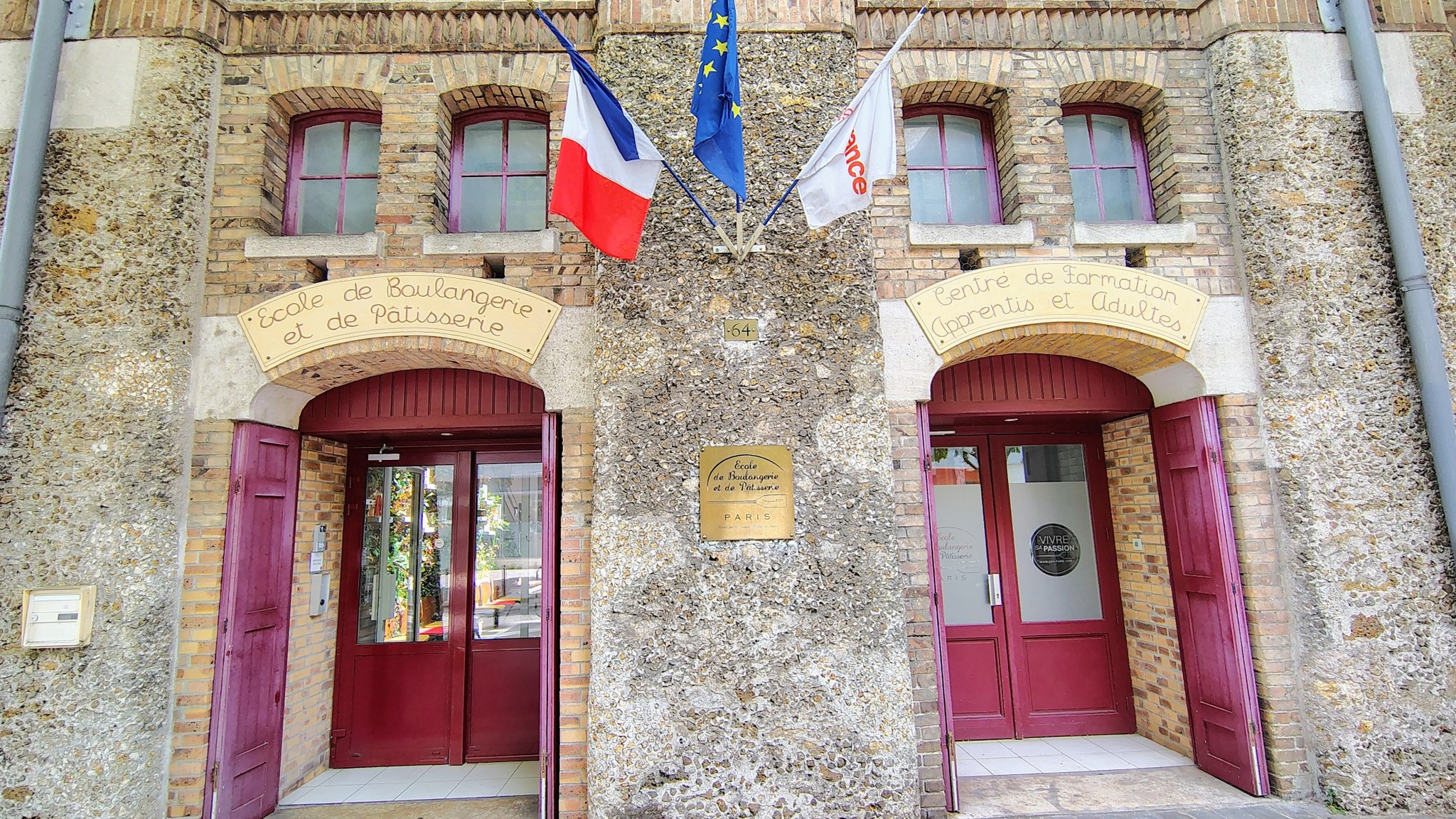
The official École de Boulangerie et de Pâtisserie de Paris (EBP Paris) ; https://www.ebp-paris.com/en/
The Paris tourist office on the 12éme arrondissement de Paris : https://parisjetaime.com/eng/article/explore-paris-s-12th-arrondissement-a824
The Church Saint Sulpice (see posts) is in the Odéon neighborhood of the 6éme district of Paris. It is located in place Saint-Sulpice with an official address of 2 rue Palatine. It is dedicated to Sulpice the pious, Archbishop of Bourges in the 7C. The magnificent fountain located in front of the church of the same name. The fountain Saint Sulpice was erected from 1843 to 1848. At the top of the fountain, 4 statues of bishops at the 4 cardinal points. In the main basin, 4 lions hold the coat of arms of Paris. It is sometimes called the fountain of the sacred orators and is also mischievously called the fountain of the four cardinal points because it is decorated with four statues of Catholic bishops, famous preachers from the time of Louis XIV, but who were never named cardinals. However, the faces of the fountain are roughly aligned with the cardinal points. It is a monumental fountain of imposing dimensions. On a base made up of three octagonal basins arranged in a pyramid, the first of which is about 10 meters wide, rises a massive aedicule with a square base topped by a canopy roof bearing a cruciform finial. The entire structure reaches a height of approximately 12 meters. The four bishops depicted were notable orators during the reign of Louis XIV, these were Jacques-Bénigne Bossuet , Bishop of Meaux,(eagle of Meaux by the king), statue by Jean-Jacques Feuchère, north face; François de Salignac de La Mothe-Fénelon, known as Fénelon , Archbishop of Cambrai, statue by François Lanno, east face; Esprit Fléchier, Bishop of Lavaur and Nîmes, statue by Louis Desprez, west face; and Jean-Baptiste Massillon, Bishop of Clermont-Ferrand, statue by Jacques-Auguste Fauginet, south face.

The official Church of Saint Sulpice: https://www.paroissesaintsulpice.paris/visiter-et-decouvrir/
The Paris tourist office on the Church Saint Sulpice: https://parisjetaime.com/eng/culture/eglise-saint-sulpice-p1572
The City of Paris on its fountains so fontaine Saint Sulpice : https://www.paris.fr/pages/fontaine-raconte-moi-des-histoires-16377
The Bouquinistes, (see post) riverside booksellers, are an enormous ‘open-air bookshop’ that is a part of the Parisian landscape, adding to the charm of the Seine riverbanks. They provide a lively atmosphere, cultural attraction, and literary and historic heritage. Located on the Right Bank, from Pont Marie to Quai du Louvre, and on the Left Bank, from Quai de la Tournelle to Quai Voltaire, some 226 riverside booksellers with their 900 ‘book boxes’ have 300,000 or so old and modern literary works to discover – a veritable treasure. See pic afar the Conciergerie,(see post), The Quai de Gesvres is a road located on the right bank of the Seine, in the Saint-Merri neighborhood or quartier of the 4éme arrondissement or district. It is extended upstream by the quai de l’Hôtel de Ville and downstream by the quai de la Mégisserie. The old wharf of Gesvres, built on land granted by King Louis XIII to René Potier de Tresmes, who became duke and peer, and whose son had the name changed from Tresmes to Gesvres, was built between rue Saint-Martin and Place du Châtelet, under letters patent of February 1642 and August 30, 1642 between Pont Notre-Dame and Pont au Change. The destruction of the houses which separated it from the rue de Gesvres, in 1786, made it possible to widen it. The metro line 7 passes through the old gallery, the remains of which were found during its construction in the 1920s. The quai Le Pelletier and the old quai de Gesvres will be united by a decree of April 2, 1868. The administration of the City Theater, which it borders.
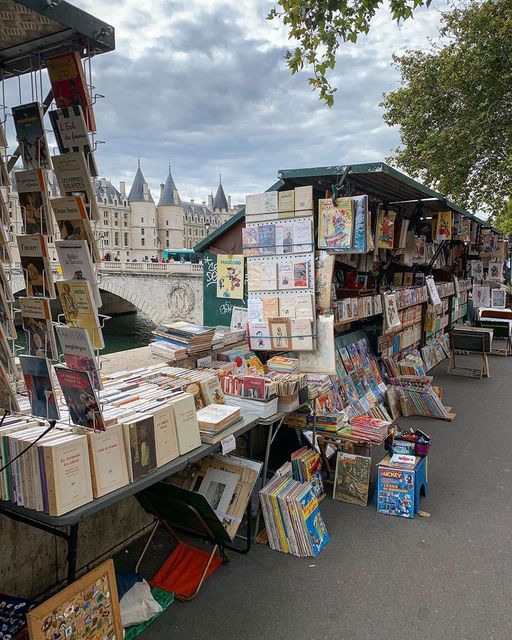
The Paris tourist office on the Bouquinistes: https://parisjetaime.com/eng/shopping/les-bouquinistes-de-paris-p3737
The Maison Loo (see post) located at 48 rue de Courcelles in the 8éme arrondissement of Paris ,is a Chinese Pagoda that it is in no way a religious building, but simply the result of one man’s love for his country of origin , China , and his will to share it with his adopted country, France. Arriving in Paris in 1902, Ching Tsai Loo was a dazzlingly successful art dealer. He bought a private mansion built in 1880, in the classic French style, to carry out his activity there a few steps from Parc Monceau. The mansion is raised by 2 floors, the roof is rebuilt, and the entire building is painted red , A construction completed in 1926. And although it was sold in 2011, it continues its activity according to the wishes of its illustrious founder , namely to be a cultural link between France and China. The official Galerie C.T. Loo & Cie is today the oldest gallery of Asian art in Paris and the only real Chinese house in Paris. A unique decoration of 600 m 2 of Asian arts.

The official pagoda of Paris or Maison Loo: http://www.pagodaparis.com/pagoda_paris.html
The Paris tourist office on the Pagoda of Paris: https://parisjetaime.com/eng/culture/the-pagoda-paris-p1135
The port de l’Arsenal (see post) or bassin de l’ Arsenal, connects the Canal Saint-Martin (see post) to the Seine river, between the quai de la Rapée and the place de la Bastille. It was once a freight port which since 1983 has become a marina. It is part of the network of Parisian canals and constitutes the border between the 4éme and 12éme arrondissements of Paris. The reason it was named Port de l’Arsenal is because it served from the 16C to the 19C as a depository for weapons and ammunition. The Arsenal basin has a body of water which is 3 meters above the level of the Seine river. It is connected to the river by a lock to allow navigation. The Arsenal lock is the 9th lock on the Saint-Martin canal. A footbridge, called the Passarelle Mornay, (Rue Mornay) was built in 1895. Spanning the two banks of the Arsenal basin, it links Boulevard Bourdon in the 4éme arrondissement to Boulevard de la Bastille in the 12éme arrondissement. This passarelle is now call the Passarelle Jim Morrison, (see pic), The Paris-Arsenal marina opened in 1983, offers 177 berths.

The Paris tourist office on the port de l’Arsenal :https://parisjetaime.com/eng/transport/port-de-l-arsenal-p1888
The city of Paris on the port de l’Arsenal : https://www.paris.fr/lieux/port-de-l-arsenal-19156
The Fayolle marine, management company of the port de l’Arsenal : https://fayollemarine.eu/page-port-arsenal/accueil-arsenal/
The Place de la Reine-Astrid is a square in the 8éme arrondissement of Paris, near the Pont de l’Alma. It is located at the corner of Avenue Montaigne and Cours Albert-Ier. It also borders Place de l’Alma. To the north is the Esplanade d’Arménie. To the south, it faces Place Diana. The square is named after Queen Astrid, wife of Leopold III king of Belgium. The district is served by metro line 9 at the Alma – Marceau station. The site was originally called Square de l’Alma. In 1883, the statue of Ernest-Eugène Chrétien Guerrier reforging his sword was installed there. In 1925, it was transferred to the Galli Square (4éme arrondissement), then it was melted down between 1942 and 1944 during the nazis occupation. During the 1900 Universal Exhibition, the sculptor Auguste Rodin installed a pavilion there, comprising six rooms, where his works were exhibited. The square was created and took its current name in 1936. It was inaugurated under its new name on January 21, 1937. Notable buildings are Le Monument de la reconnaissance de la Belgique à la France or the Monument to the Gratitude of Belgium to France by de Rudder (see photo), inaugurated in 1923, is located on the square. No. 2 (also 42 Cours Albert-Ier and 41 Rue Jean-Goujon): apartment building from 1907-1908; construction symmetrical to No. 4. In 1910, the building won an award from the jury of the Concours de façades de la Ville de Paris. No. 4 (also 2 Avenue Montaigne and 46 Rue Jean-Goujon): neo-Louis XV style building built in 1899; building symmetrical to No. 2.

The Paris tourist office on the 8éme arrondissement de Paris : https://parisjetaime.com/eng/article/explore-paris-s-8th-arrondissement-a826
The Belgian memorials abroad on the: Le Monument de la reconnaissance de la Belgique à la France:https://bel-memorial.org/cities/abroad/france/paris/paris_mon_reconnaissance_a_la_France.htm
The Place Marcelin-Berthelot is located between the quartier Sorbonne neighborhood of the 5éme arrondissement or district of Paris. This square pays homage to the chemist, physical chemist, biologist, epistemologist and politician Marcellin Berthelot. This square was named in 1715 “Place Cambray” or “Place Cambrai”, due to the presence of the house of the Bishop of Cambrai and the College of Cambrai which were located there. In 1877 it became “Place du Collège-de-France” due to its location in front of the entrance to the institution and took its current name by decree of 1907. The Place Marcelin-Berthelot is served nearby by metro line 10 at the Maubert – Mutualité station. Notable buildings here are the Collège de France,(see more below) which has its main entrance at no, 11. From east to west, it includes: Square Yves-Coppens, which houses a statue of Pierre de Ronsard (towards Rue Jean-de-Beauvais); Square Auguste-Mariette-Pacha; next to the central staircase, the base of the monument dedicated in 1917 to Marcellin Berthelot, dismantled in 1941, of which only the bust was saved and is now in the gardens of the Collège de France; Square Michel-Foucault, which has that of Dante (towards Rue Saint-Jacques). In the center of the square, at the top of the stairs, is a statue of Claude Bernard (who lived opposite, on rue des Écoles-see post), recalling that the laboratory occupied by the physiologist from 1847 to 1878 when he worked in the institution overlooked it directly.
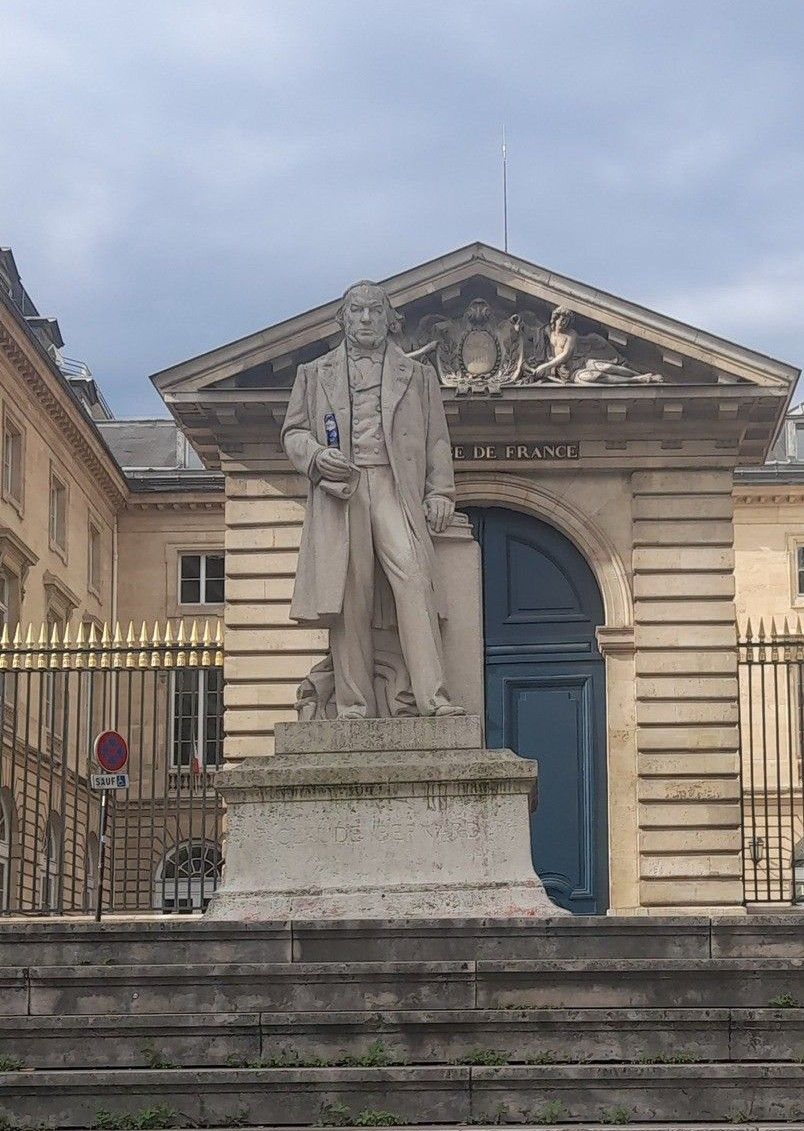
The Collège de France, formerly known as the Collège Royal, is a major French educational and research institution, established by king François Ier in 1530. Two positions for readers were initially created, one for Greek and one for Hebrew, but in 1530 there were five readers who quickly became six: two readers in Greek: Pierre Danes and Jacques Thouzat (known as Toussain); two then three in Hebrew: François Vatable, Agacio Guidacerio then Paul Paradis; one in mathematics: Oronce Fine. Then this number increased to ten with: Latin eloquence, with Bartholomaeus Latomus, in 1534; Oriental languages, with Guillaume Postel, in 1538; a reader of Greek and Latin philosophy, with Francesco Vimercato, in 1542; and a reader in medicine, with Guido Guidi, in 1542. The Collège de France inspired, at the end of the Age of Enlightenment, the founders of the Conservatoire national des arts et métiers (see post). In 1848, the short-lived École d’administration was attached to the Collège de France. The Direction des Bibliothèques, Archives et Collections (DBAC) of the Collège de France brings together twelve libraries, an archives service, an online resources, bibliometrics and research services department as well as a conservation and works management department, located on two sites in the 5éme arrondissement at 11 place Marcelin-Berthelot and 52 rue du Cardinal-Lemoine. The Collège de France is a public institution of higher education and research (a public institution of a scientific, cultural and professional nature) whose ambition and missions are unique in the world. The Collège de France has fulfilled a dual vocation: to be both the place of the most daring research and that of its teaching.
The official college de France: https://www.college-de-france.fr/en/the-college/the-college-de-france-today
The Paris tourist office on the 5éme arrondissement de Paris :https://parisjetaime.com/eng/article/explore-paris-s-5th-arrondissement-a820
There you go folks, a dandy city to explore and enjoy with the family, Memorable moments in my eternal Paris, driving and walking all over in my road warrior trails brings out sublime awesome spots with nice memorable family visits of yesteryear always remember and always looking forward to be back, eventually. Again hope you enjoy the post on curiosities of Paris , part XLI !!! as I.
And remember, happy travels, good health, and many cheers to all !!!

 Paris1972-Versailles2003