
I am becoming sentimental again, and even if mentioned in previous post do not have one alone on it and it so richly deserves one me think. I like to tell you a bit on the city of Auvers sur Oise. I found some pics in my cd rom vault that should be in my blog for you and me. Therefore, this is my take on this is Auvers sur Oise !!! Hope you enjoy it as I.
The town of Auvers-sur-Oise is located in the Val-d’Oise department no, 95 in the Île-de-France region of my belle France. It is located 6 km from Pontoise, 29 km from Paris, 41 km from Versailles ,and 488 km from my current home, It is bypass by the D928, D4 roads, And by train from Paris, Saint-Lazare station, Gare du Nord, or by RER line C, you must change either at Saint-Ouen-l’Aumône or at Pontoise or Valmondois. A direct train connects the Gare du Nord to Auvers-sur-Oise on Saturdays, Sundays, and public holidays from early April to late October, check update, The town owes its international renown to the landscape painters, especially the Impressionists, Charles-François Daubigny, Paul Cézanne, Camille Corot, Camille Pissarro, and Vincent van Gogh, who came here to draw their inspiration. I came to it taking Rue des Reservoir or D186 in Versailles to Bd Saint Antoine then continue on Rue de Versailles same road to connect with the A13 Autoroute de Normandie at exit/sortie 6 and take it dir Paris to the interchange with the A86 to Gennevilliers to connect with the N315/A15/A115 dir CDG Airport short on the La Francilienne N184 to connect with the D928 to Auvers sur Oise,in about an hour give or take your driving habits.
I did this time my road warrior trail came by saw and left quickly, The Church Notre Dame de l’Assomption was made world famous by Vincent van Gogh, who depicted it in one of his paintings (now in the Musée d’Orsay). This Vexin church was built in the 12-13C. It was founded by Philip I, then rebuilt under the leadership of Adelaide of Savoy, who often resided in the royal manor north of the church after the death of her husband, Louis VI, in 1137. This reconstruction began with the eastern sections and ended with the nave, which features a three-story elevation with a triforium. It was carried out in the late Romanesque style, still evident in the capitals, quickly shifting to the nascent Gothic style with pointed arched windows and ribbed vaults.
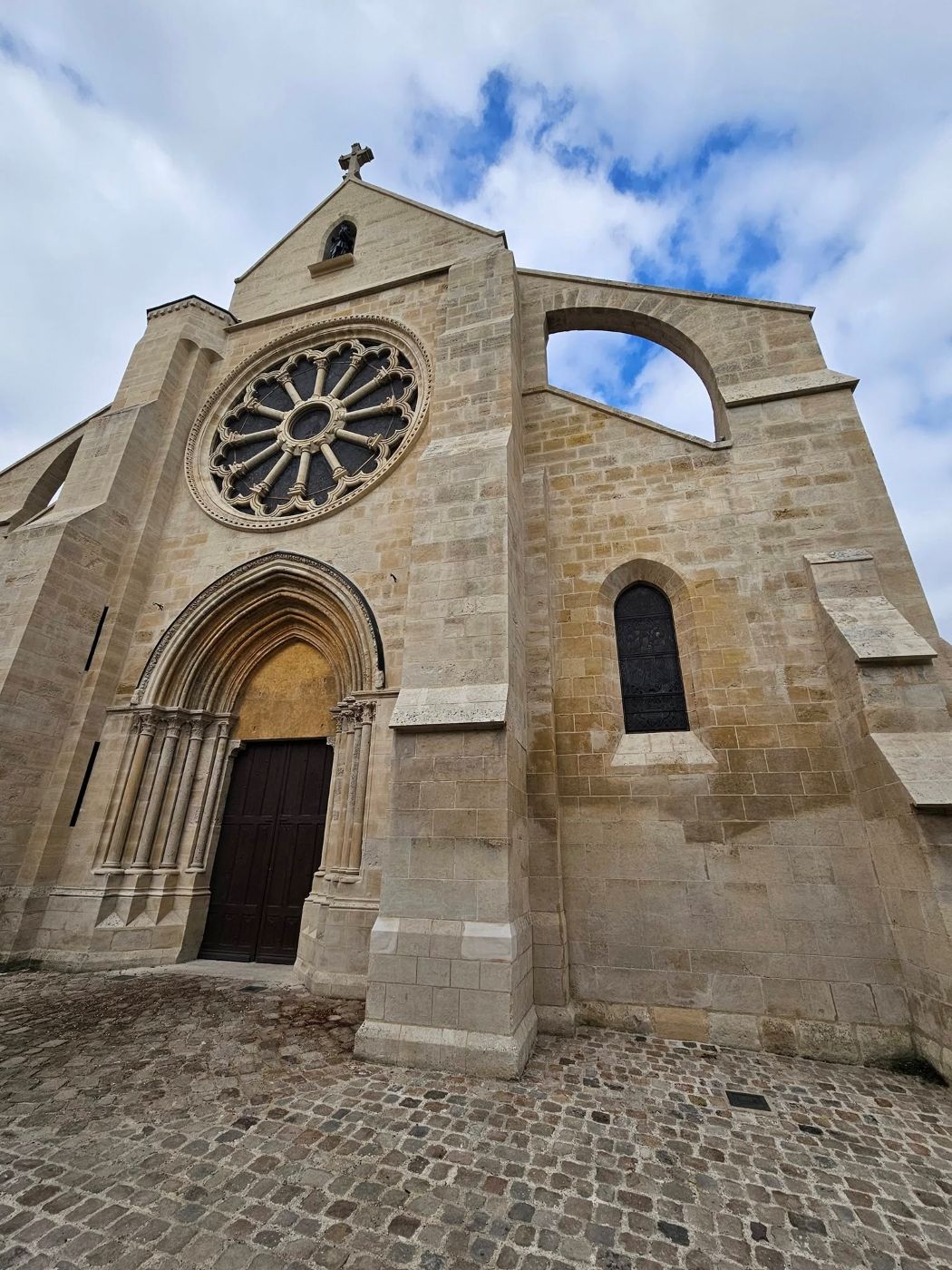
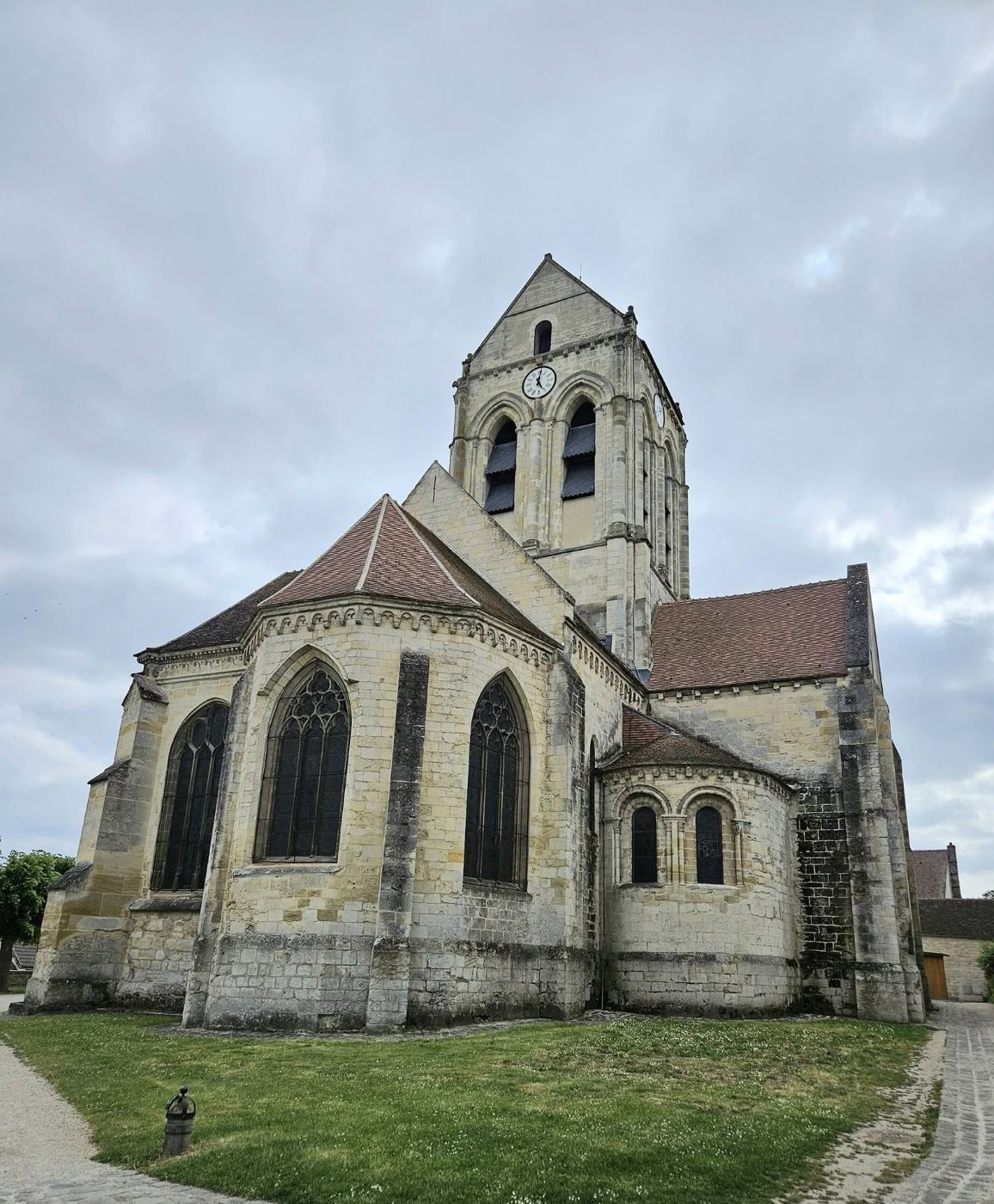
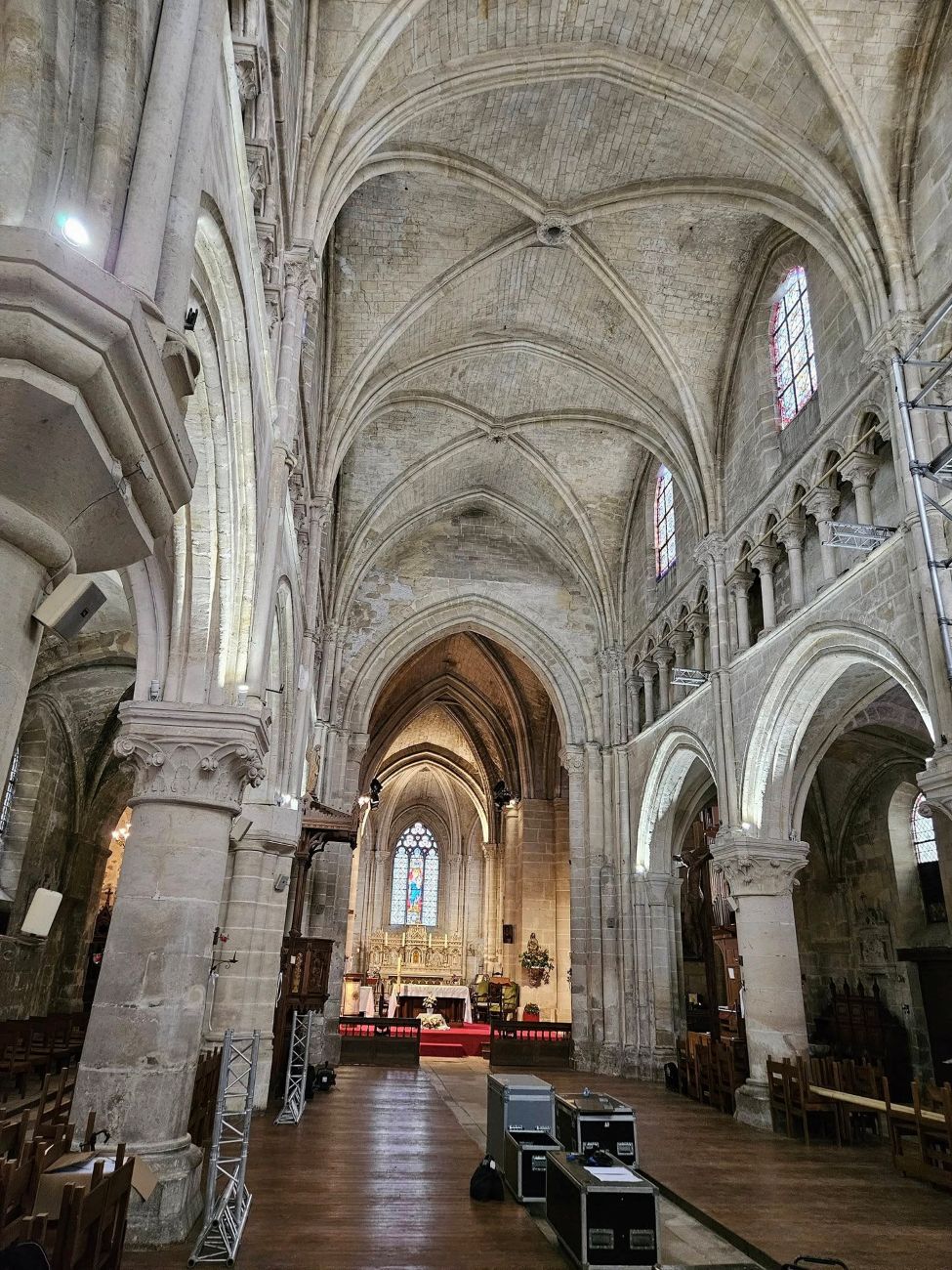
Inside, you will find vestiges of several centuries of history, such as the choir adorned with capitals decorated with motifs of acanthus leaves, palmettes, foliage, and fantastical creatures characteristics of medieval art. The choir and transept are the oldest parts of the church; the nave was built around 1220. The chevet was then restored around 1260 and its windows enlarged. In 1850, the sacristy was added. The flamboyant rose window, damaged by a storm, was redone in 1876. The Church Notre Dame de l’Assomption ,interior has large pillars decorated with 12C Romanesque capitals. The nave is paved with old tombstones turned over, coming from the adjoining disused cemetery. The bell tower houses three bells: one named Marie-Louise dating from 1733, and two from 1891, named Adolphine-Caroline and Constance-Eugénie. An organ was installed in the church in May 2006. of neo-classical aesthetic. In the 17C, the church was surrounded by an enclosure which reinforced the existing walls and the external staircase was fitted out.

And to reach the Church Notre Dame de l’Assomption, you’ll take an external staircase built in 1615, it was part of the fortification system established around the church by Jean-François de Berbis, Lord of Hérouville and Auvers. It provided direct access to the parish cemetery and was moved to the outskirts of the town in the 19C. Throughout the year, the church hosts cultural and religious events, such as classical music concerts, special masses, and art exhibitions.
Other things to see here with more time are the Ravoux inn and its painted facade saw the arrival of Vincent van Gogh in May 1890, who rented a small, modest room under the roof, lit only by a skylight. The old door of the Montmaur or Montmort farm, on Rue de la Sansonne, is located in a private garden opposite the main entrance to the tourist office – Daubigny Museum. The 17C crenellated gate on rue Daubigny gives access to the public garden of the Daubigny Museum. The house-studio of Charles-François Daubigny, 61 rue Daubigny, was built for the painter between 1861 and 1862. It has the distinction of having been entirely decorated on the interior walls by the painter, his son Karl and his painter friends Achille-François Oudinot and Camille Corot. The Daubigny Museum, at the Colombières manor, was created in 1987 by a small group of art lovers, including Daniel Raskin-Daubigny. It offers visitors the opportunity to discover the works of Charles-François Daubigny, his son Karl and many painters who worked in the Oise Valley, around Auvers, which was a true artistic center at the end of the 19C. The Château d’Auvers or Château de Léry, rue de Léry, was built in 1633 for an Italian banker. The central part of the castle was originally an Italian-style pavilion with a terraced roof. It was enlarged in the 18C with two side pavilions and its facade was then remodeled. The house of Doctor Gachet, rue du Docteur-Gachet, was acquired in April 1872 by Paul Gachet, doctor, art collector and friend of painters including Vincent van Gogh whom he received and treated in 1890. The latter represented this residence several times on his canvases. The Castel Val, rue des Meulières, was built according to the plans of the architect Hector Guimard between 1903 and 1904, who skillfully took advantage of the unevenness of the land The Maison du Pendu or House of the Hanged Man, rue du Four, was made famous by the painter Paul Cézanne, inspired by this then probably very dilapidated house, who represented it at the beginning of 1873, pushed to “paint on the motif” by Pissarro. No hanged man was ever found there, his name coming from a corruption of the name of his Breton owner “Penn Du”, The Absinthe Museum, rue Callé, exhibits the history of this drink banned in 1915 and which was the “green muse” of many 19C artists.
You can always associe Auvers sur Oise with Van Gogh, the town where the impressionists took by pencil and palette,Here the town sits next to the Oise river and the extrance to the Vexin regional park, but in another world,Vincent Van Gogh lived here and painted his last 70 portraits of his life, However, if you climb by the heights of the town into the rue Daubigny you see the shop of the painter Charles-François Daubigny, the precursor of the Impressionists,You go up further in steps of stone to the sanctuary of Notre Dame where there is a bust of Daubigny and a portrait reproduction of Van Gogh painted between june 4 and 8, 1890, Of course, he stayed at the Auberge Ravoux aka maison Van Gogh,place de la Mairie, There is an audiovisual of his last day here of the sad 29 July 1890,His tomb is next to that of his brother Théo with two stones with lots of simplicity, Auvers sur Oise, a modest rural town has played a major role in the world history of painting, primarily that of the landscape artists of the Barbizon school and then in Impressionism. From 1857, the landscape painter Charles-François Daubigny regularly visited Auvers, which he painted from his canoe, the Botin, or from the island of Vaux, on the Oise between Auvers and Méry. In 1872, Doctor Paul Gachet bought a house in Auvers so that his sick wife could “breathe fresh air”; a doctor by trade, he kept his practice and clientele in Paris, including Camille Pissarro’s mother, whom he treated, as well as the painter’s children, in Auvers. He was also an amateur painter and engraver under the pseudonym Paul van Ryssel. A friend of Daubigny and Corot, he welcomed artists into his home until the end of his life, including Paul Cézanne and Camille Pissarro, who came to visit him as a neighbor from his house in Pontoise. A great art collector, he remains a key figure in the history of art at the end of the 19C. Paul Cézanne came to “learn to paint” with Pissarro, and for this purpose he settled in Auvers throughout 1873 and the first months of 1874. His work rate was not compatible with the rapid Impressionist touch that captured the moment; his paintings, such as the House of Doctor Gachet (1873, Musée d’Orsay), have been declared “constructivist” by art history. He then returned to his native Provence, but the happy memory of this stay brought him back during the summers of 1877 and 1881. Victor Vignon, who participated in the last four Impressionist salons, painted in Auvers and Pontoise with Pissarro, Cézanne and Guillaumin. He was also close to Doctor Gachet and Murer, and was highly regarded by the Van Gogh brothers. Frédéric Samuel Cordey, a friend of Renoir, also painted in Auvers with them and exhibited at the 1877 salon. Eugène Murer was a pastry chef and restaurateur on Boulevard Voltaire in Paris. But he was also a writer and art collector. A friend of Pissarro, Cézanne, Renoir, Sisley, Guillaumin and Vignon, he bought their paintings at unbeatable prices. In 1878, he had a house built for himself on Rue du Four in Auvers and set up a gallery there where his one hundred and twenty Impressionist paintings were exhibited, which were unfortunately later dispersed due to a disagreement with his sister Marie. He took up painting himself and exhibited at Ambroise Vollard in 1898. Norbert Gœneutte, a painter close to the Impressionists – without ever having participated in any of their salons – expressed himself mainly through engraving. A friend of Renoir, Cordey, Murer and Doctor Gachet, the latter brought him to Auvers in 1891 to treat his chest condition, which was worsening. Essentially a portraitist of women, he painted watercolors and small outdoor canvases with sharp angles and surprising colors between two engravings. He is buried in the Auvers cemetery. Later, other painters continued to frequent Auvers: Le Douanier Rousseau and then Maurice de Vlaminck, who came to follow in the footsteps of Van Gogh, whom he admired, came to draw their inspiration there. And my favorite film is La Vie passionnée or Lust for Life (1956) by Vincente Minnelli with Kirk Douglas, Anthony Quinn and James Donald.
A bit of history I like tell us that this town is mentioned for the first time in a charter from the beginning of the 9C. The King of France Philip I inherited it at the end of the 11C. Auvers thus belonged in the 12C to Louis VI the Fat who, in 1131, gave the church to the Abbey of Saint-Vincent de Senlis which kept it until 1790. At the beginning of the 18C ,the village finally entered definitively into the royal domain. During the Wars of Religion, the village, like all of the French Vexin, underwent a new period as difficult as the Hundred Years’ War. Auvers is located between Pontoise and L’Isle-Adam,(see post) in the center of the hunting grounds of the Prince of Conti. He therefore ardently wished to acquire it in order to remove this barrier to his pleasure. In 1743, after much insistence, he obtained from the king the hunting concession as a precautionary measure: the country was then ruined by the proliferation of game. On May 2, 1779, the sales contract was finally signed, but the Prince of Conti having died in 1776, it was his son Louis-François-Joseph de Bourbon-Conti who made the coveted acquisition. But he only kept the lordship for four years, transferring it in October 1783 to Monsieur, brother of Louis XVI and future Louis XVIII Vincent van Gogh arrived in Auvers in May 1890, invited by Doctor Paul Gachet to undergo therapy. On July 26, 1890, he attempted suicide in an open field before dying three days later on July 29, 1890, in his room at the Ravoux Inn, which can still be visited, He painted 70 paintings in Auvers, many of which had the village or its countryside as a backdrop. On September 3, 1914, a patrol of the 3rd German Horse Grenadiers was reported in Auvers. These incursions finally ceased after the Battles of the Ourcq and the Marne of WWI.
The town of Auvers sur Oise on its heritage: http://www.ville-auverssuroise.fr/ville-auvers-sur-oise/patrimoine
The Auvers sur Oise tourist office on its heritage : https://tourisme-auverssuroise.fr/a-voir/
The local Cergy-Pontoise tourist office on the church : https://www.ot-cergypontoise.fr/fr/fiche/734513/eglise-notre-dame-de-lassomption/
The Val d’Oise dept 95 tourist office on Auvers sur Oise : https://www.valdoise-tourisme.com/les-incontournables/auvers-sur-oise-sur-les-pas-des-impressionnistes/
There you go folks, as said my blog is my life’s history ,here is a bit more of it, This is a bit off Paris but worth the detour me think for the history, and culture of it, me think. Again, hope you enjoy this post on this is Auvers sur Oise !!! as I
And remember, happy travels, good health, and many cheers to all !!!

 Paris1972-Versailles2003
I did a day trip to Auvers sur Oise several years ago from Paris, and it was a beautiful time. Being a van Gogh fan, I saw the sites where he lived the last few months of his life, all the while admiring the beauty of the town. Thanks for sharing!
LikeLiked by 1 person
Glad it brough you back memories of this wonderful town. Thanks for stopping by Cheers
LikeLiked by 1 person