
We have driven and walked in my former memorable City of Versailles, and would like to have an imprint in my blog on the wonderful family times we had there, There is so much to see , doing my best, and glad found me these older pictures in my cd rom, which now transposing in my blog for you and me, This was my old home, so glad to post, Therefore, here is my take on curiosities of Versailles, part XII !!! Hope you enjoy the post as I.
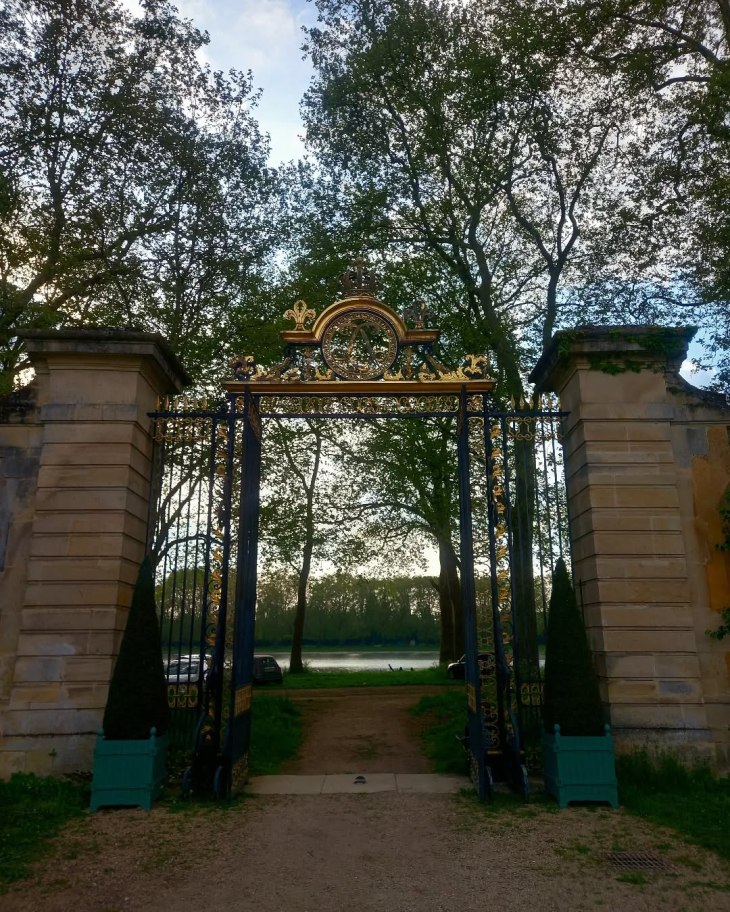
The potager du roi (see post) is the vegetable garden created in 1683 at the Palace of Versailles for King Louis XIV by Jean-Baptiste de La Quintinie, then director of the royal gardens. Now an urban garden, it covers 9 hectares. The vegetable garden is located next to the pièce d’eau des Suisses (see post) or Swiss pond. The king entered through a monumental wrought iron gate, the grille du roi (see pic) or king’s gate, which opens onto the path leading to the Swiss Pond. It is one of the most beautiful in Versailles and is one of the few original gates.This gate, recently lavishly renovated, is located on the Allée du roi or king’s alley. It was here that Louis XIV passed to come and inspect with his inner court the cultivation of his cucumbers and strawberries forced by the teams of the brilliant La Quintinie, his head gardener, at the end of the 17C. There, we see the rays of the setting sun caressing the high branches of the hundred-year-old plane trees bordering the Pièce d’Eau des Suisses and the gilding of this monumental gate ,The Pièce d’Eau des Suisses is a basin forming part of the park of the Palace of Versailles, built between 1679 and 1682. It owes its name to the fact that it was dug by a regiment of Swiss Guards (the king’s guard). It was created to drain the potager du roi,
The official Potager du Roi : http://www.potager-du-roi.fr/site/potager/index.htm
The city of Versailles tourist office on the Swiss pond: https://www.versailles-tourisme.com/la-piece-d-eau-des-suisses.html
The market or marché is the Marché de Notre Dame and Halles Notre Dame,(see posts) the difference is the Marché is open air, fruits, veggies, etc alternating with a clothing market while the Halles are covered market dating from the domaine de Clagny c1665. The Halles Notre-Dame are open Tuesday to Saturday from 7h to 19h30. Sunday from 7h to 14h. The Carrés Notre-Dame: Tuesday, Friday Saturday, and Sunday morning from 7h to 14h. On Thursdays and Saturdays, clothes, souvenirs and jewelry are in the spotlight to satisfy tourists and locals who will definitely find what they are looking for.

The city of Versailles on the markets : https://www.versailles.fr/970/economie-et-commerces/commerces-et-marches/les-marches-versaillais.htm
The rue de l’Indépendance-Américaine or American Independence Street is in the immediate vicinity of the Palace of Versailles, whose l’aile du Midi or southern wing runs along, it is located in the Saint-Louis district. It begins at Rue Pierre-Girault-de-Nohac and ends at Rue de l’Orangerie, opposite the pièce d’eau des Suisses. This street commemorates French participation in the American War of Independence. It was previously called “rue Gambetta” (1885), previously “rue de la Bibliothèque” (1841), and formerly “rue de la Surintendance” (1693-1793 and 1804-1841, before 1793 sometimes “rue de la Surintendance et des Quatre Fermes”, and “rue de la Fédération” or “rue de l’Union” (1793-1804) before taking its current name since 1935. Under the Ancien Régime,(monarchy), it housed many official services of the monarchy with the ministries of Foreign Affairs, War, the Superintendence and the General Control of Finance in addition to the Grand Commun which housed the food services of the castle, making the street an administrative city of the time.
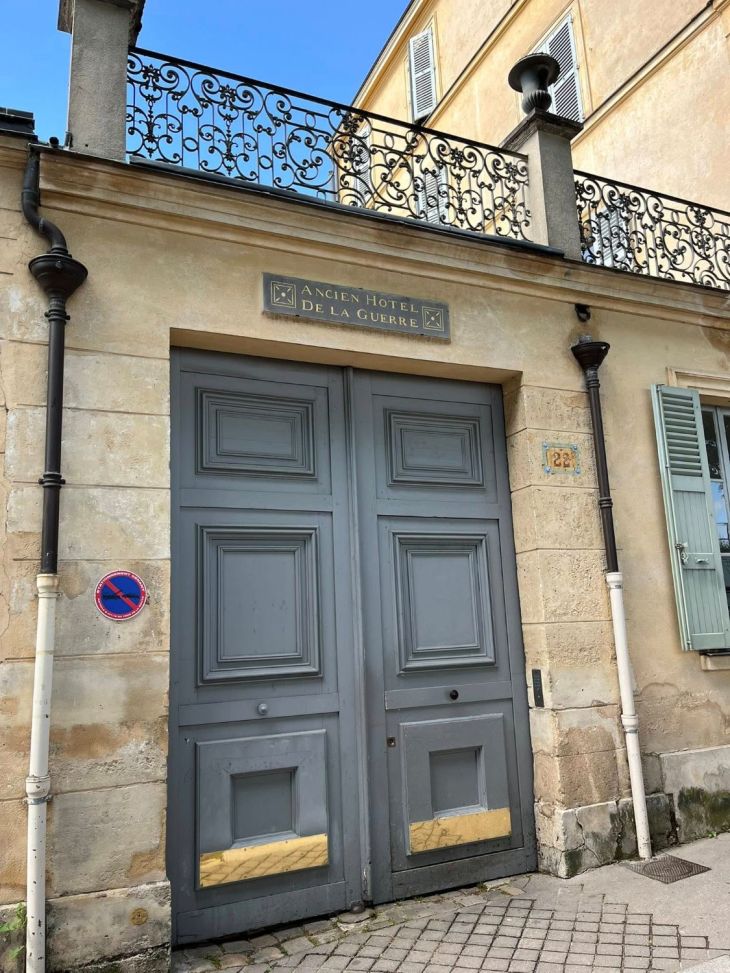
Notable buildings (see my posts) The Aile du Midi (see pic from the street ) or South wing of the palace, built in 1679, called the old wing as opposed to the north wing, built in 1685, called the new wing, The South Wing spans 150 meters with two parallel buildings separated by three courtyards, featuring classical Italian architecture. Between 1679 and 1681, architect Jules Hardouin-Mansart designed and built this wing, which initially housed the royal children of France. The Gallery of Battles within the wing is 118 meters long and displays paintings illustrating French military victories. The Congress Hall ,also in this wing has served as a venue for parliamentary meetings and presidential elections since 1953. Visitors can access the wing through two entrance levels, with the garden-level access located on the grounds side of the palace. See at no. 1: Grand Commun, no. 3: Hôtel de la Guerre, no. 5: Hôtel des Affaires étrangères et de la Marine, current central library of Versailles. It was in this building that the Treaty of Paris of 1783 was negotiated, putting an end to the American War of Independence. no. 6: former Hôtel de la Superintendance des Bâtiments du roi, built in 1670, one of the oldest houses in Versailles. Having become too small to meet the space requirements of the administration staff, a newer larger Superintendance of Buildings was built in 1683 on the other side of the same street (see no. 9), while maintaining the accommodation of the superintendents of buildings in this house. Louvois occupied an apartment on the first floor where he died in 1691. No. 8, 8 bis, 10 and 10 bis: former site of the Hôtel de Chevreuse (also called Hôtel de Luynes), designed by the architect Jules Hardouin-Mansart in 1683 and demolished in 1823. Of the hotel, only the outbuildings at No. 8 remain, the other pavilions dating from the 19C. No. 9: Hôtel de la Surintendance, minor seminary, then Vauban barracks, completed in 1692 (see No. 6). No. 12: Hôtel du Grand Contrôle, formerly Hôtel de Beauvillier, designed by the architect Jules Hardouin-Mansart in 1681, converted into a luxury hotel in 2021, also covering the Hôtel du Petit Contrôle and the Pavilion at the foot of the Hundred Steps.

The Palais des Congrès de Versailles is a conference and cultural events center located at 10, rue de la Chancellerie. Close to the Place d’Armes, it faces the Château de Versailles and its gardens. The Congress Palace is the first convention center built in France. It is located in the Golden Square of Versailles, opposite the château and in the heart of the Saint-Louis district, the cultural and historical center of the city. It was inaugurated in 1967 by Georges Pompidou and Alain Poher. The Palais des Congrès de Versailles covers 3,700 m2 spread over three floors. It is organized around the large central amphitheater, the Richelieu amphitheater, and ten subcommittee rooms with an art-deco style ensemble. It has a capacity of 1,500 people.

The official Palais des Congres of Versailles: https://www.versaillespalaisdescongres.com/en/
The Hôtel de la Guerre, now known as Hôtel de la Guerre – Caserne Carnot, is the name of a building located at 3, rue de l’Indépendance-Américaine, near the palace. It was built by Jean-Baptiste Berthier in 1760 to consolidate various services then scattered throughout Paris. It was one of the first buildings constructed in France to limit the risk of fire. It currently houses the central management of the French Army’s Defense Infrastructure Service. Little of the original decor of the Hôtel de la Guerre remains today, with the exception of the Salon de Diane. On the vault, stucco paintings illustrate the reversal of alliances in 1756. On the walls hang a painting representing King Louis XV on horseback giving his orders during the War of Flanders in 1745, the work of Charles Cozette, and six canvases by Pierre Lenfant, painted between 1757 and 1771. Commissioned by Louis XV, they represent the War of the Austrian Succession.
The Jardin des Récollets is located at the intersection of rue de Bailly and rue de Fontenay in the Saint-Louis district, The garden in the continuity of the Cour des Senteurs invites you to relax. In the heart of the city of Versailles, this park, certified Eco Jardin, is a stroll and a setting of greenery and flowers which connects the palace and the historic district of Saint Louis. The former convent of the Récollets, founded in the 17C for a branch of the Franciscans. Its original function ceased at the French revolution and since the 19C its buildings have been used for military purposes. It is located at 9, rue des Récollets, behind the Cour des Senteurs. In 2001, the convent land located behind the building became the Jardin des Récollets, Formerly a royal vegetable garden under Louis XIII and at the beginning of the reign of Louis XIV, this land was then abandoned in favor of a new vegetable garden and left fallow in the middle of the extension of the service buildings of the palace. Begun in July 1759, construction was completed a year and a half later. On June 26, 1762, King Louis XV, accompanied by the dauphin, came to visit the building. During the French revolution, the Ministry of War moved to Paris and the building was temporarily occupied by the services of the new department of Seine-et-Oise (today mostly Yvelines dept 78) , which caused serious damage to it. In 1798, it served as an extension to the arms factory installed in the neighboring Grand Commun (see post). The army would then take possession of it with the installation of nearly 500 infantry troops, then in 1884, the installation of a new School of Artillery, Engineering and Train, which in 1912, would become the Military School of Engineering Application. During the nazi occupation, a police school was installed there and briefly after the war, a center for preparing for the Grandes Écoles. In 1946, the Higher Technical School of Engineering moved there, the previous School of Engineering Application having moved to Angers. The building is today occupied by the central directorate of the Defense Infrastructure Service (former central directorate of engineering).

The Versailles tourist office on its heritage: https://en.versailles-tourisme.com/visiting-the-city.html
The city of Versailles on its heritage: https://www.versailles.fr/65/decouvrir-versailles.htm
There you go folks, dandy monuments and town to explore and enjoy with the family, Memorable moments in my belle France, walking all over in my dear Versailles brings out sublime awesome spots with nice memorable family visits of yesteryear always remember and always looking forward to be back, eventually. Again hope you enjoy the post on curiosities of Versailles, part XII !!! as I.
And remember, happy travels, good health, and many cheers to all !!!

 Paris1972-Versailles2003