
I have done plenty of posts on the streets of my dear Versailles but there are always older new pictures not in my blog that should be for you and me, After all, this blog is my life’s history and I thank you for coming along with me on my ride. Versailles needs no introduction me think ! However, just to make sure ,,,,I am bragging lol! I used to lived in Versailles for almost 10 years upon entering France!And have come back to visit several times never tired of it. Therefore, let me tell you about the streets of Versailles, part VII !!! Hope you enjoy it as I.
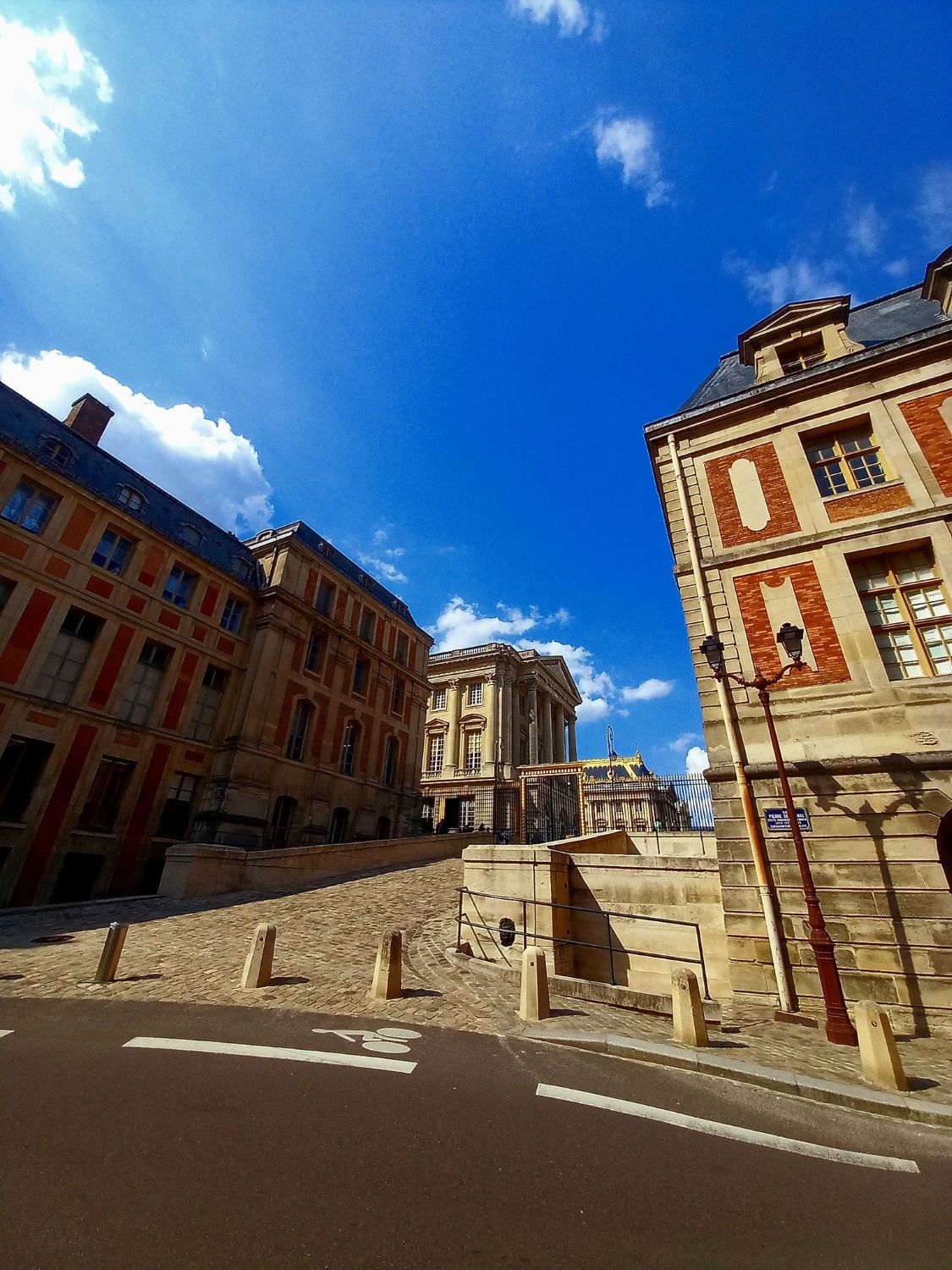
The street is in the vieux Versailles neighborhood very close to the palace, It is named after the historian and poet Pierre de Nolhac . The Rue Pierre de Nolhac runs south of the palace between the Grand Commun by the Rue de l’Indépendance-Américaine and the Dufour Pavilion. Wonderful architecture and history to walk ! Pierre de Nolhac was curator of the Palace Museum of Versailles between 1892 and 1920, and one of the museum’s leading figures. A member of the Académie Française in 1922, his museographic choice is maintained at the Palace of Versailles. Pierre de Nolhac was also behind the founding of the Society of Friends of Versailles in 1907, (an assoc which I am proud member since 2007), thanks to which the Palace of Versailles continues to acquire a large number of historical works and furnishings to this day. Pierre de Nolhac left his position in 1920, after twenty-seven years of service to the Palace of Versailles. The name of Pierre de Nolhac has remained closely linked to the rebirth of the royal Versailles at the beginning of the Third Republic. His saying “When spring enchants the sky of Paris for others, it is in Versailles that my reverie seeks it.” Pierre de Nolhac (The Resurrection of Versailles).
The houses, called “baraques” had a ground floor opening onto the street, a slate roof, a cellar, a backroom with a fireplace and windows giving onto the centre of the square. They entirely enclosed the four Carrés or squares located on either side of the crossroad formed by the two main roads Rue Royale and Rue d’Anjou, respectively dedicated to the sale of seafood (“Carré à la Marée”, later named “Carré au Puits”), meat (“Carré à la Boucherie”, later named “Carré à la Terre”), oats (“Carré à l’Avoine”, which kept its name, where horse feed was sold to private horse owners and for the King’s horses) and, lastly, fruit and vegetables (“Carré aux Herbes”, now known as the “Carré à La Fontaine”). The quarter and its “baraques” (which were authorised to add a second storey) were developed later under the reign of King Louis XV. The Carré à La Fontaine derived its name from the reservoir built in 1766 by Pluyette, an architect and engineer. Like all reservoirs in those days, it served as a water supply in case of fire. The internal parts have been replace and now houses the Maison de l’architecture et du patrimoine or house of architecture and heritage adminstrative office, 61bis Rue Royale, The Rue Royale is in the Saint-Louis district here since 1685 when the Parc aux Cerfs was divided into lots. Formerly Rue Impériale from 1804 to 1815, and Rue Nationale from 1848 to 1852. You have at No. 2: Former Hôtel du Cheval Blanc. The sign has been restored to the porch. At No. 3: Former performance hall for 600 people between 1756 and 1780. It was built in 1756 by Charles Fleury and Laurent Génisson-le-Comte and by the king’s architect, Louis Le Dreux de la Châtre. It was rented by Marguerite Brunet, known as La Montansier, before the construction of the eponymous theater in 1777 on Rue des Réservoirs (see post). At No. 5: Opposite Rue du Général Leclerc, the monumental entrance porch of the King’s Bodyguard barracks, which later became the Croÿ military circle. On the site of the stables after the French revolution, the barracks housed Napoleon I’s lancers. The guards returned under the Restoration, giving the place the name Croÿ Barracks, after their company. It then housed the 27th Dragoon Regiment from 1893 to 1919 and the tank school from 1919 to 1940. Only the small circular forecourt, the surrounding area of the former watering-trough courtyard, and the square “pavilion” housing the guards remain. Since March 2015, the Saint-Louis community center has benefited from a new, fully renovated residence within the Croÿ barracks At No. 6: Naudin Pavilion ,geographer to the king, At No. 8: A pharmacy since 1820 At No. 15: A pastry shop for two centuries, At Nos. 18 to 58: Part of the Carrés Saint-Louis, At Nos. 37 to 69: Part of the Carrés Saint-Louis, At No 59 Fontaine des Quatre Pavés (see pic) At No. 93: Directoire-style mansion inhabited by the Tharaud brothers, Orientalist writers, from 1926 to 1951, At No. 95: Former property of the Duchess of Duras until 1862. Currently owned by the bishopric under the name Villa Saint-Paul, At No. 97: Notre-Dame du Grandchamp Vocational High School (with a chapel). In 1804, a girls’ boarding school was established on this site (a hunting reserve of the Duke of Chevreuse) by the canonesses of Saint-Augustin. Sarah Bernhardt attended the school in 1853. They were expelled by the 1905 laws separating Church and State. In 1907, the Petit-Séminaire and the bishopric were established there, which remained until 1969, at the initiative of Monsignor Gibier. Its chapel, built in 1804, is dedicated to the Immaculate Conception.

The city of Versailles on its heritage/history :https://www.versailles.fr/65/decouvrir-versailles.htm
The Versailles tourist office on its heritage : https://en.versailles-tourisme.com/visiting-the-city.html
The Versailles tourist office on the district of Saint Louis/Vieux Versailles : https://www.versailles-tourisme.com/quartier-saint-louis.html
There you go folks, a hugely wonderful gorgeous city very popular indeed, all worth it, The monuments are awesome and the street walks are sublime. Again, hope you enjoy this post on the streets of Versailles, part VII !!! as I.
And remember, happy travels, good health ,and many cheers to all !!!

 Paris1972-Versailles2003