
I am again to tell you about more streets of my eternal Paris. I have many many posts on Paris and several on the streets of the most beautiful city in the world. I have come up with pictures from cd rom vault that should be here for you and me. As always thank you for following my blog some since Nov 26, 2010. Therefore, here is my take on the streets of Paris, part XXIV !!! Hope you enjoy it as I.
The Avenue Marceau is in the 8éme and 16éme arrondissements of Paris, forming the boundary between the two ;even side for the 8éme and odd side for the 16éme. It starts at Avenue du Président-Wilson, almost at the height of Place de l’Alma, and ends at Place Charles-de-Gaulle. It is named after François Séverin Marceau, a general of the French revolution. This street was opened by a decree of August 13, 1854, between Rue Circulaire and Place de l’Étoile. It was extended by a decree of March 6, 1858 between rue Circulaire and avenue de l’Empereur under the name of “avenue Joséphine”, in honor of Joséphine de Beauharnais. It received its current name by a decree of August 16, 1879. There already existed a rue Marceau (in the 12éme arrondissement) which received on this occasion the name rue de Wattignies. Notable buildings here ,me think, are at No. 5, at the intersection with rue Léonce-Reynaud: Pierre Bergé – Yves Saint Laurent Foundation, former Yves Saint Laurent fashion house, transformed into an Yves Saint Laurent museum opened in October 2017. (see pic and post), at No. 11: the building was built in 1883. It was purchased in 1937 by the Basque government in exile after the victory of the nationalists in the Spanish Civil War. Considering that this building had been acquired with public money, Franco demanded its restitution. He won his case in 1951 and the building then housed the cultural services of the Spanish embassy. It is now the Octavio Paz Library of the Cervantes Institute, whose building is located in the same district, at 7 rue Quentin-Bauchart. At No. 22: Headquarters of the Spanish Embassy in France. No. 31: Church of Saint-Pierre-de-Chaillot. No. 32: Clothilde de La Rochelambert, Countess of La Bédoyère then Princess of Moskowa, lady-in-waiting to Empress Eugénie, died there in 1884. The historian Albert Vandal, of the Académie française, died there in 1910. No. 34: After having lived at No. 26 avenue Marceau until 1919, Madame Sacerdote, the famous fashion designer Jenny (the second woman in France to have been decorated with the Legion of Honour for her services to couture) and her husband Joseph, lived here until 1940, No. 64: Hotel of the Countess of Breteuil in 1910, today occupied by the InterContinental Marceau Hotel. No. 78 bis: Radisson Blu Champs-Élysées Hotel. No. 81: Former home of Pierre-Gabriel Chandon de Briailles, a former co-owner of the Moët & Chandon champagne house.

The Paris tourist office on the 8éme arrondissement de Paris : https://parisjetaime.com/eng/article/explore-paris-s-8th-arrondissement-a826
The Paris tourist office on the 16éme arrondissement de Paris : https://parisjetaime.com/eng/article/a-la-decouverte-du-16e-arrondissement-de-paris-a830
The Place du Louvre is located in the 1er arrondissement or district of Paris, in the Saint-Germain-l’Auxerrois quartier or neighborhood. It is so named because it is located in front of the Louvre Palace. It is serve by Metro Line 1 at the Louvre-Rivoli station. I have ,also, used the parking Louvre Samaritaine right on the square, This is where the Vikings camped when they attempted to capture Paris in 885, Subsequently, with the construction of the Louvre and the development of the city, this site was dotted with fine mansions such as the Petit-Bourbon (built at the end of the 14C for the Duke of Bourbon, it was confiscated by the king around 1523 and destroyed in 1525, with the exception of the chapel and the north wing, which housed the gallery known as the Salle du Petit-Bourbon or Théâtre du Petit-Bourbon, which in turn disappeared in 1665). In 1300 and 1313, a street that ran in front of the old Louvre and ended at the quay was called “Osteriche.” It is named, as well as the district, “rue d’Autraiche”, “rue d’Aultraiche”, “rue d’Autriche” and “rue d’Autruche” The “rue d’Autriche” subsequently took the name of “rue du Petit-Bourbon”, which it carried until 1792 when it took the name of “rue du Petit-Muséum” , The part of the square located in front of the colonnade of the Louvre was called “place d’Iéna” from 1806 to 1814, in memory of the battle of the same name which took place on October 14, 1806 (not to be confused with the current place d’Iéna). The creation of the current Place du Louvre was declared to be of public utility in 1853, when Napoleon III and Prefect Haussmann were about to complete the Rue de Rivoli, which, since the First Empire (Napoléon Ier), had stopped at the level of the Rue de Rohan. On April 12, 1855, Jacques Hittorff was responsible for the construction of the “Louvre Town Hall” . Notable buildings here are the eastern side of the square is occupied by the Church of Saint-Germain-l’Auxerrois (see post) and the City/Town Hall of the 1er arrondissement of Paris. It faces the Colonnade du Louvre , separated from it by the Rue de l’Amiral-de-Coligny. The Clinique du Louvre officially at 17 Rue Saint-Germain l’Auxerrois,is just in front of the Place du Louvre, my father was treated there once !! Very nice memories and care, There is a small green space made up of planters in the ground faces the Church Saint-Germain l’Auxerrois, and the city/town hall of the 1er arrondissement. It is also opposite the Louvre Museum of Egyptian Antiquities, entrance on the cour Carré courtyard. It pays tribute to Michel Caldaguès, who served as mayor of the first arrondissement of Paris for 17 years. He was the first President of the Paris Council after the reform of the organization of the Paris region in 1967, making the city a town and a department no, 75. The Paris Municipal Council had become the Paris Council. He was also a deputy of Paris and senator, then an honorary member of Parliament, Officer of the Legion of Honor and Knight of the National Order of Merit. The garden is not to step into just see it from outside low fence.

The Paris tourist office on Paris Centre (arrond, 1-4): https://parisjetaime.com/eng/article/explore-the-centre-of-paris-a846
For the memories of always, the Clinique du Louvre presentation: https://www.louvre-cliniques-paris.fr/la-clinique/presentation/
The rue du Louvre was created in 1853 and located in the 1er and 2éme arrondissements or district of Paris. About 20 meters wide, it extends for about 700 meters, and it begins at 154 rue de Rivoli and ends at 30 rue du Mail and 67 rue Montmartre. It gave its initial name to the metro line 1 station, called Louvre – Rivoli since 1989. It takes its name from its proximity to the Louvre Palace (museum). The street was opened as part of the transformations of Paris under the Second Empire (Napoléon III). The opening was planned in two stages: in 1853, the clearing of the Louvre Palace and the creation of a street between the Quai du Louvre and the Rue Saint-Honoré were declared to be of public utility; In 1860, the extension of Rue du Louvre to Rue Montmartre was declared to be of public utility. In fact, the road was completed in three stages: in 1888, between Rue Saint-Honoré and Rue Coquillière; in 1880, between Rue Coquillière and Rue d’Argout; and in 1906, between Rue d’Argout and Rue Montmartre. The Rue du Louvre was not fully completed until 1934 with the construction of the building housing the daily newspaper Paris-Soir. In 1972, the southern section of Rue du Louvre was renamed Rue de l’Amiral-de-Coligny. Notable buildings here are at No. 15: Building facade (1892) with the Cour-des-Fermes passageway. No. 37 former headquarters of Le Figaro until August 2005. Previously the joint headquarters of L’Humanité and Ce soir, built in 1937 in the ocean liner style, with a vast hall and roof terraces. No. 40: former Central-Hôtel. No. 46 bis: Central Gutenberg telephone office. Building built in 1891 with two towers, all built in blue-tinted bricks. Nos. 11 and 13: remains of a tower from the Philippe Auguste wall. No. 19: former Hôtel d’Olonne, headquarters of the caisse d’épargne de Paris,a savings bank. Nos. 48-52: central post office of the Louvre.

The Paris tourist office on Paris Centre (arrond, 1-4): https://parisjetaime.com/eng/article/explore-the-centre-of-paris-a846
The Rue Mazarine is located in the Monnaie quartier or neighborhood of the 6éme arrondissement or district of Paris. Its name comes from the proximity of the Collège des Quatre-Nations, now the Institut de France (see post and pic here) , founded by Jules Mazarin. This road is traced on the site of the counterscarp path of the Philippe Auguste enclosure wall. It is the former rue des Fossés-de-Nesle, running along the outside of the Philippe Auguste enclosure. It is mentioned under the name of “rue de Nesle” in a manuscript from 1636. The street is served by metro lines 4 and 10 at the Odéon station. Notable buildings here are at No. 1: Marks the level of the 1910 flood at the corner of Rue de Seine. No. 4 bis: Home of the Republican historian and philosopher Edgar Quinet, expelled from the Collège de France by Guizot in 1846. Nos. 10-14: Jeu de Paume of the Métayers. Jean-Baptiste Poquelin, aka Molière, created the Illustre Théâtre there in 1643. The troupe’s first performance took place on January 1, 1644. Later studio of the painter Joseph Vernet. No. 20: Home of the Girondin deputy Charles Barbaroux, leader of the Marseillais battalion. He “inspired” Charlotte Corday and was guillotined in Bordeaux. No. 27: Remains of the Philippe Auguste enclosure wall in an underground car park. Access to the Passage Dauphine. No. 28: home of Jean-François Champollion who deciphered the hieroglyphs from the Rosetta Stone in 1822. Also home of the painter Horace Vernet. No. 30: Hôtel des Pompes, where the headquarters of the Compagnie des Gardes-pompes du Roy, the precursor to the Paris fire brigade, was located, founded in 1722 by Louis XV, under the direction of François Dumouriez du Perrier, the first professional firefighter in France. No. 35: inhabited tower of the Philippe Auguste enclosure wall. The seamstress Jeanne Lanvin was born at this address on January 1, 1867, at her parents’ home. No. 42: Jeu de Paume de la Bouteille, aka the Théâtre Guénégaud. Creation of the first Paris Opera in 1669. Performance of Pomone, an opera written by Abbé Pierre Perrin. The Marais troupe merged with Molière’s after the latter’s death, to form the Guénégaud troupe. The latter’s merger with the troupe of the Hôtel de Bourgogne gave rise to the Comédie-Française,(see post) created in 1680. No. 60: home of the painter Édouard Manet and historic entrance to the Gründ bookstore, now the headquarters of the PSL University. It was also on Rue Mazarine, in the Bergeron tennis court, that the Cordeliers club took refuge after being expelled in 1792 during the French revolution from the convent whose name it bears. In Honoré de Balzac’s La Rabouilleuse, Madame Bridau came to live on this street in 1811 to reduce her lifestyle. In Émile Zola’s Thérèse Raquin, Madame Raquin bought a haberdashery on the Passage du Pont-Neuf. This is a covered passageway which joins rue Mazarine to rue de Seine.

The Paris tourist office on the 6éme arrondissement de Paris: https://parisjetaime.com/eng/article/explore-paris-s-6th-arrondissement-a823
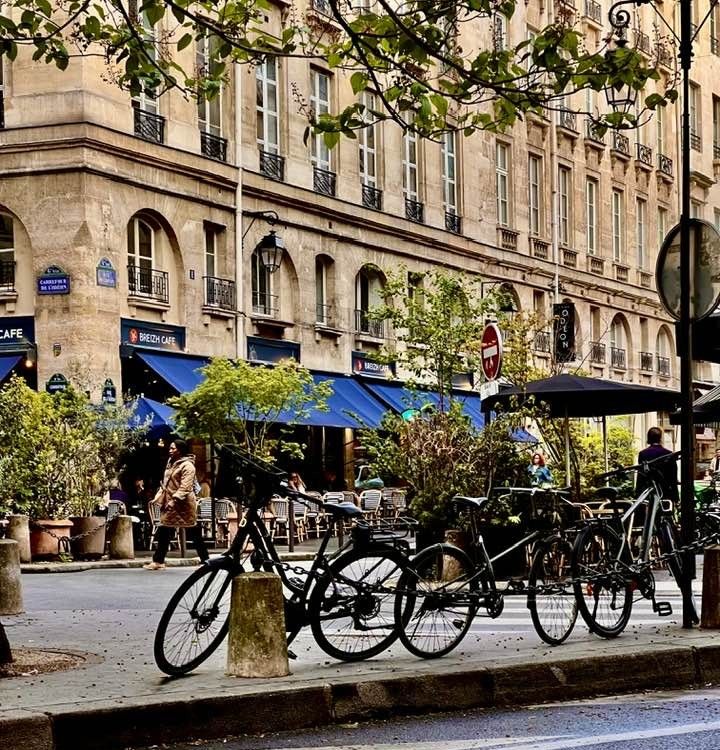
The Carrefour de l’Odéon is a square located in the Odéon quartier or neighborhood in the 6éme arrondissement or district of Paris. It is served nearby by metro lines 4 and 10 at the Odéon station. It is named after its proximity to the Odéon Theater. The Carrefour de l’Odéon opened onto the space on Rue de Condé by letters patent dated August 10, 1779, under the name “Carrefour du Riche-Laboureur.” It took its current name in 1801 in reference to the performance hall renamed the Odéon Theater in 1797. Notable buildings, and some of my favorite restaurants in Paris are at No. 4: On the central reservation opposite this building, a bust of Charles Aznavour, inaugurated in May 2021, faces the Odéon theater, and the singer’s childhood neighborhood. At No. 3 L’Avant Comptoir de la Terre et de la Mer (tops), At No. 4 Les Éditeurs resto, At No. 6 La Maison du Whisky Odéon, and at No. 9 Le Comptoir du Relais (tops).
The Paris tourist office on the 6éme arrondissement de Paris: https://parisjetaime.com/eng/article/explore-paris-s-6th-arrondissement-a823
The Place d’Estienne-d’Orves is located between the Chaussée-d’Antin and the Saint-Georges quartiers or neighborhoods of the 9éme arrondissement or district of Paris. It is served by Metro line 12 at the Trinité – d’Estienne d’Orves station, located under the western end of the rue de Châteaudun, at its outlet onto the place d’Estienne-d’Orves. The station opened on November 5, 1910 on the line between Porte de Versailles and the temporary terminus of Notre-Dame-de-Lorette. The station has two entrances divided into three metro entrances: entrance no. 1 “Place d’Estienne-d’Orves” comprising two staircases with Dervaux balustrades set back to back, one fixed and decorated with a Dervaux candelabra, the other mechanical in the direction of the exit, both opening out at no. 2 of the aforementioned square; and access no. 2 “Rue de Châteaudun”, consisting of a fixed staircase decorated with a ceramic and wrought iron surround in the characteristic North-South style, located opposite no. 50 of this street and allowing only the exit. It has two platforms, with a conventional length of 75 meters, separated by the metro tracks located in the center and the vault On March 27, 1931, line A became the current metro line 12 following the absorption of the Nord-Sud company on January 1, 1930 by its competitor, the CMP. In May 1945, at the same time as the eponymous square, the station was renamed Trinité – d’Estienne d’Orves, in homage to the French resistance fighter Honoré d’Estienne d’Orves shot by the nazis on August 29, 1941 at Mont Valérien.

The official RATP metro line 12: https://www.ratp.fr/en/plans-lignes/metro/12
The Paris tourist office on the 9éme arrondissement de Paris: https://parisjetaime.com/eng/article/explore-paris-s-9th-arrondissement-a828
The Rue de l’Abreuvoir is located in the Grandes-Carrières quartier or neighborhood of the 18éme arrondissement or district of Paris. It is 133 meters long,and it begins at 9 Rue des Saules and ends at Place Dalida. It is served by metro line 12 at the Lamarck – Caulaincourt station. Among the most photographed streets in Montmartre, Rue de l’Abreuvoir undoubtedly ranks high on the list, for many reasons, starting with the famous Maison Rose ,and its view of the Sacré Cœur from the Allée des Brouillards and Place Dalida. This street originates from an alley mentioned as early as 1325 under the name of “ruelle qui va au But”, that is to say to the fountain of this name which is today located on Place Constantin-Pecqueur. In 1843, it was called “chemin de l’Abreuvoir” because of the path which led to the old Montmartre watering trough located at the corner of Rue Girardon. Notable buildings here are at No. 2: La Maison Rose, founded by the dancer Germaine and the painter Ramon Pichot in 1908, the establishment was the meeting place for the artists of Montmartre throughout the 20C, represented by many painters, including Maurice Utrillo, At No. 4: the sundial , At No 12 the small building constructed in 1883 was once the address of Camille Pissaro, who rented a pied-à-terre there between 1888 and 1892. At No. 16 (corner of rue Girardon): villa Radet a superb early 20C residence, named after the mill of the same name, moved to the corner of Rue Lepic and Rue Girardon and (wrongly) renamed Moulin de la Galette. Note that this is the only odd-numbered 15 on the street, as it is overlooked throughout by the gardens of the Cité Internationale des Arts and the Folie Sandrin. It is today the Montmartre site of the Cité internationale des arts, located on the site of the old watering trough of the village of Montmartre which still existed in 1854.

The Paris tourist office on the 18éme arrondissement de Paris: https://parisjetaime.com/eng/article/explore-paris-s-18th-arrondissement-a832
There you go folks, another dandy beautiful set of glorious streets of my eternal Paris. I have criss cross them many and have many in my blog already, Again, hope you enjoy this post on the streets of Paris, part XXIV !!! as I.
And remember happy travels, good health, and many cheers to all !!!

 Paris1972-Versailles2003