
We have driven and walked in my eternal Paris, and would like to have an imprint in my blog on the wonderful family times we had there, There is so much to see , doing my best, and glad found me these pictures in my cd rom vault ,which now transposing in my blog for you and me, This was my former worked city, so glad to post more memorable spots on it, I thank you for your readership over the years and to bear with my rants! After Paris is to rant, shout and yelled about, me think. Therefore, here is my take on curiosities of Paris , part XXXII !!! Hope you enjoy the post as I.
The Moulin-Rouge is a cabaret founded in 1889 by Joseph Oller and Charles Zidler, who already owned the Olympia. It is located on 82 Boulevard de Clichy in the 18éme arrondissement of Paris, at the foot of the Butte Montmartre. It is the oldest and most famous of the Parisien cabarets. A new dance inspired by Quadrille is more and more popular: the French Cancan, performed to a frenzied rhythm by dancers in alluring costumes with petticoats and slit panties. Illustrious dancers will go down in the history of the Moulin-Rouge, including La Goulue, Jane Avril, Môme Fromage, Grille d´Égout, Nini Pattes en l’Air and Yvette Guilbert. The Moulin-Rouge is a place loved by artists, the most emblematic of which is Henri de Toulouse-Lautrec. His posters and paintings assured the Moulin-Rouge a rapid and international notoriety.
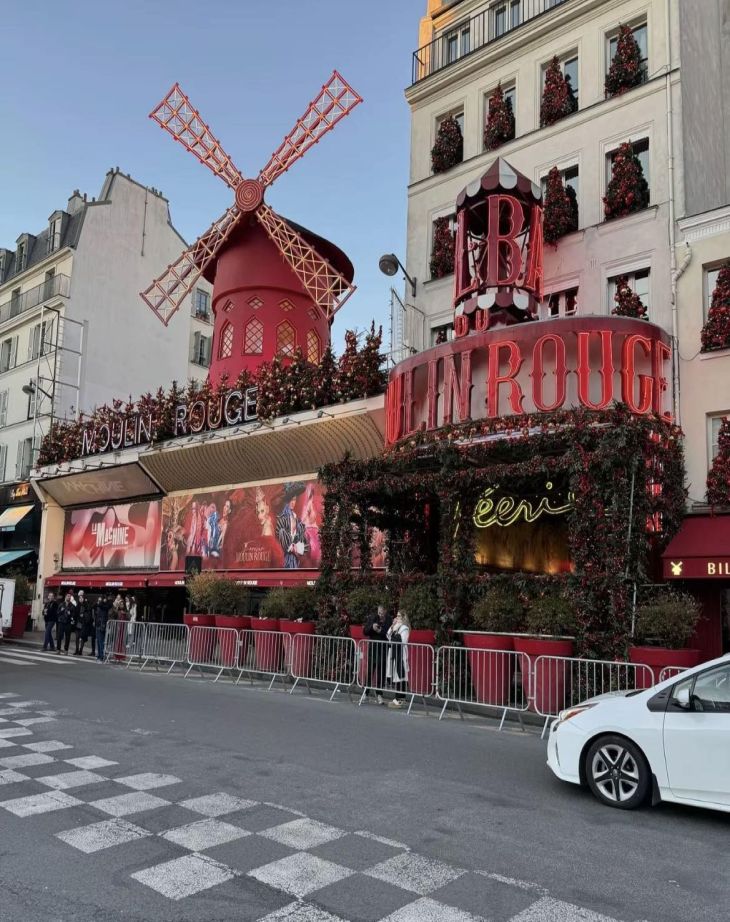
The official Moulin Rouge: https://www.moulinrouge.fr/en/homepage/
The Paris tourist office on the Moulin Rouge : https://parisjetaime.com/eng/culture/moulin-rouge-p3609
The Georges Pompidou National Center for Art and Culture (CNAC),commonly known as the Georges Pompidou Center, or Centre Pompidou or the Centre Beaubourg or simply the Beaubourg is a polycultural institution born from the will of the President. Georges Pompidou, a great lover of modern art, created in the heart of Paris an original cultural institution entirely devoted to modern and contemporary creation, where visual arts would be associated with books, design, music and cinema. Within the National Museum of Modern Art / Center for Industrial Creation (MNAM / CCI), it has one of the world’s three largest collections of modern and contemporary art and the first in Europe. It also houses major galleries of temporary exhibitions, theaters and cinemas, and the BPI, the first public reading library in Europe. On either side of the square, two annexes house the IRCAM and the Brancusi workshop. It is under renovation check for schedules.
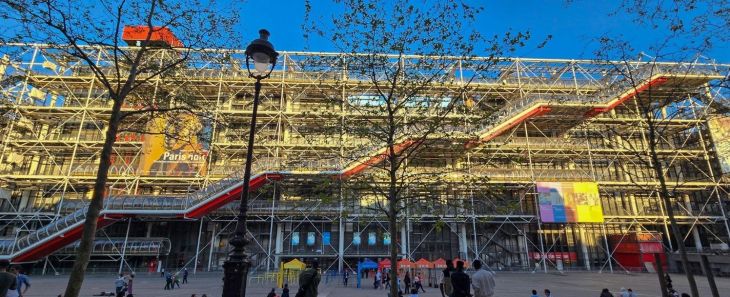
The official Centre Pompidou:https://www.centrepompidou.fr/en
The Paris tourist office on the Centre Pompidou: https://parisjetaime.com/eng/culture/centre-pompidou-p3593
The Parc Montsouris is a public garden located in the quartier or neighborhood of the same name, in the 14éme arrondissement or district of Paris. This English-style park, laid out at the end of the 19C, covers 15 hectares. The park is home to a large number of bird species and is home to numerous trees. It is located between Porte de Gentilly and Porte d’Arcueil. It is bordered by Boulevard Jourdan , Rue Gazan ,Rue de la Cité-Universitaire , Avenue Reille ,Rue Nansouty and Rue Émile-Deutsch-de-la-Meurthe. At the intersection of Rue d’Alésia with Rue de la Tombe Issoire there is a Wallace Fountain. Parc Montsouris is accessible by public transport via RER Line B at Cité Universitaire station; By line 3a of the tramway to the Cité universitaire and Montsouris stations; by bus lines 21, 88, and 216. Today is a public garden maintained by the City of Paris’s green spaces department.

The Paris tourist office on the Parc Montsouris : https://parisjetaime.com/eng/culture/parc-montsouris-p3531
The Quai Louis-Blériot is a quay located along the Seine, in the 16th arrondissement of Paris. It is 1,620 meters long,and it begins at 9, avenue de Versailles and 5, rue Maurice-Bourdet and ends at 191, boulevard Murat. On the south side, the Quai Louis-Blériot is extended along the Seine by the Quai Saint-Exupéry. The district is served by metro line 10 at the stations Église d’Auteuil, Chardon-Lagache and Mirabeau. Notable buildings other than below are at no. 40: Art Deco style building from 1932. At the intersection with the Pont Mirabeau, below, Voie Georges-Pompidou, an inscription indicates the level of the Seine during the flood of 1910 ,and the Port d’Auteuil. The Hôtel Nozal, at 17-21 quai Louis Blériot, stands out with its beige brick silhouette, an Art Nouveau aesthetic mixed with neo-Gothic. Built in 1911 for the painter Alexandre Nozal, brother of the industrialist Léon Nozal, patron of Hector Guimard, this ship, located on the banks of the Seine, served as a home port for a traveling artist. The semicircular bay on the second floor is set within a large triangular gable. A vast overhanging loggia with double columns dominates the rounded prow facing southwest. Alexandre Nozal’s studio was located in the rotunda.The base of the Hôtel Nozal was converted into a boat shed. The top floor was used for reception, with the workshop opening onto the rear façade, the lounge and the dining room in the circular loggia projection. The bedrooms were on the first floor. The ground floor below was reserved for storage. Originally, the hotel opened directly onto the Quai d’Auteuil, a former towpath converted into a quay in 1883, named after the aviator Louis Blériot, the first to cross the Channel in 1909.
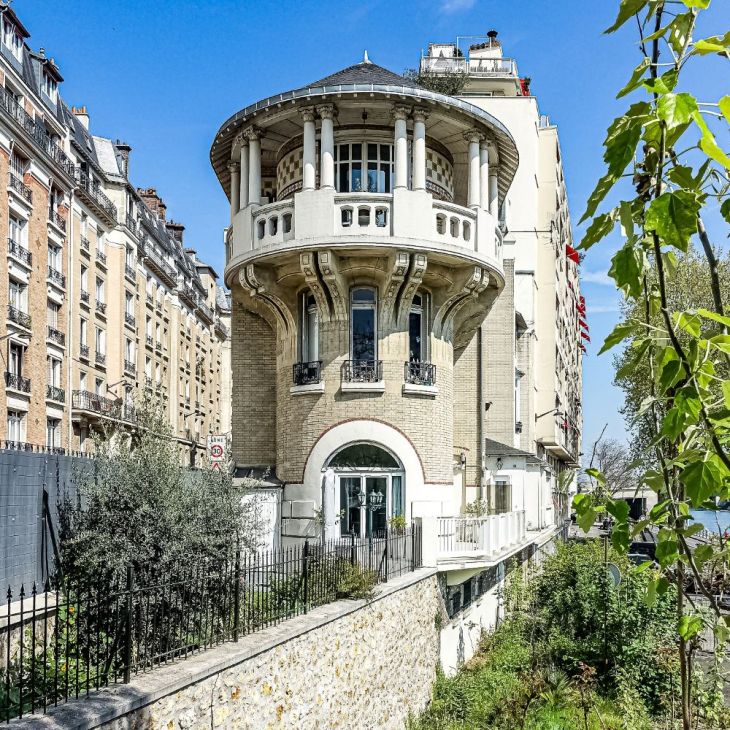
The Paris tourist office on the 16éme arrondissement : https://parisjetaime.com/eng/article/a-la-decouverte-du-16e-arrondissement-de-paris-a830
The Rue de l’Arbre-Sec is in the 1er arrondissement of Paris. The street begins at Rue des Prêtres-Saint-Germain-l’Auxerrois and Place de l’École and ends at Rue Saint-Honoré. It is accessible from the Louvre-Rivoli metro line 1, and Pont-Neuf metro line 7. Several hypotheses have been made as to the origin of the street’s name. Rue de l’Arbre-Sec, attested in the 13C, was located for its southern part inside the Carolingian wall of Paris built in the 10C, the filled remains of the ditch of which were found at the intersection of the street with that of Rivoli during excavations in 2009. In the 1950s, this street which linked La Samaritaine dept store to Les Halles, was one of the busiest in the district. Remarkable buildings here other than the below are at nos. 14 and 16: between these two numbers formerly opened the Impasse des Provençaux and, at the level of No. 17, began the cloister of Saint-Germain-l’Auxerrois. The apse of the Church of Saint-Germain-l’Auxerrois (see post) offers a curiosity on Rue de l’Arbre-Sec: the perimeter of the chapel. The central chapel is decorated with a frieze made up of sections of carp (heads, bodies and tails). This chapel, financed by a wealthy draper named Tronson, dates from 1505. At No. 21 was the rear facade of the Hôtel Sourdis, a service entrance of which was located at no. 25 where the old Impasse Courbaton remains, closed by a grilled door. This cul-de-sac, which already existed in the 13C, communicated with the Impasse Sourdis, the entrance to which was on Rue des Fossés-Saint-Germain-l’Auxerrois. At the end of the 15C, the Hôtel Sourdis belonged to the Marquise de Sourdis, born Isabelle Babou de la Bourdaisière, maternal aunt of Gabrielle d’Estrées. The hotel had access to the Saint-Germain-l’Auxerrois cloister and through there to the house known as Doyenne, inhabited by the mistress of Henri IV, and where she died on April 9, 1549 while returning from the financier Zamet. At the crossroads of rue de l’Arbre-Sec (nos. 25-27, no.) and rue Saint-Honoré (no. 111) is the fountain of the Croix-du-Trahoir (see pic) which dates from the 17C. The Croix-du-Trahoir, erected on the same square, has some celebrity in the annals of judicial executions. This is where the convicts of the jurisdiction of Saint-Germain-l’Auxerrois were put to death. The Fontaine de la Croix-du-Trahoir fountain is located at the intersection of Rue de l’Arbre-Sec and Rue Saint-Honoré (at number 111). Built in 1776 by the architect Jacques-Germain Soufflot, as indicated by a plaque affixed to the north facade, the first Croix-du-Trahoir fountain was built by the sculptor Jean Goujon at the initiative of Francis I in 1529. It was rebuilt in 1606 and then moved a few meters in 1636 to improve traffic flow on Rue Saint-Honoré. It is inspired by the nymphs created by Jean Goujon for the Fontaine des Innocents. We note the use of a stalactite bossage, similar to that of the Medici Fountain. A mascaron allows the water from the fountain to flow. It is a technical building serving as a water distributor for the services of the Palais-Royal and the ministers’ hotels. It was supplied by the Samaritaine pump located on the Pont-Neuf. The premises were occupied by fountain workers until the middle of the 20C, then inaugurated in 1966 by General de Gaulle as the Andorran consulate. Unoccupied from 1995 to 2002, it was then squatted by an artists’ collective, Le Laboratoire de la création, which is today subsidized by the city of Paris and sponsored by the Nobel Prize winner for literature, Gao Xingjian. It has an art gallery on the ground floor, open to the public, a music studio in the basement, and four workshops for visual artists and filmmakers on the upper floors.
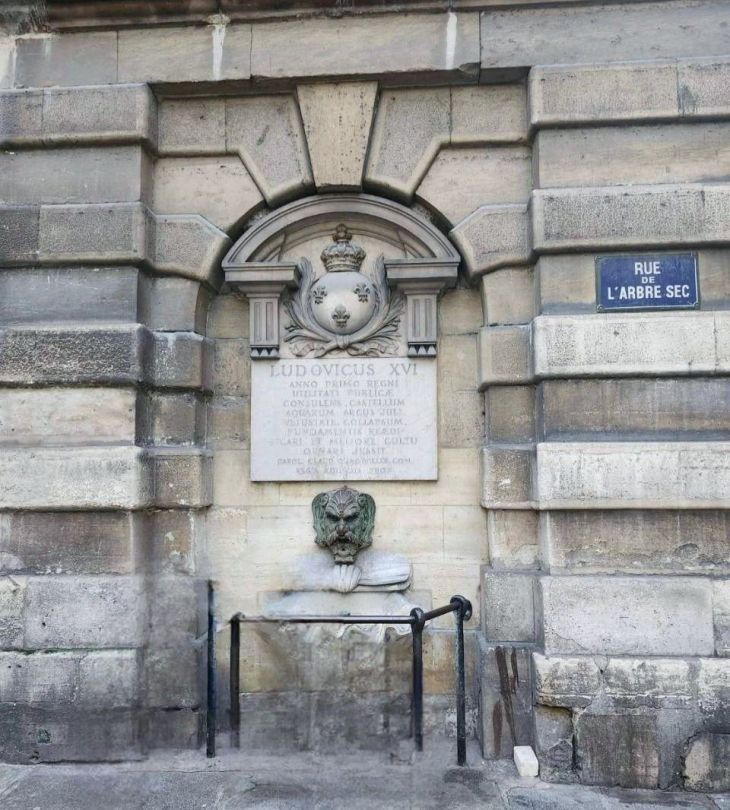
The local Marais Louvre site on the fountain of the Cross of Trahoir: https://marais-louvre.fr/petite-histoire-de-la-fontaine-de-la-croix-du-trahoir
The Paris tourist office on the Paris Centre (districts 1-4) : https://parisjetaime.com/eng/article/explore-the-centre-of-paris-a846
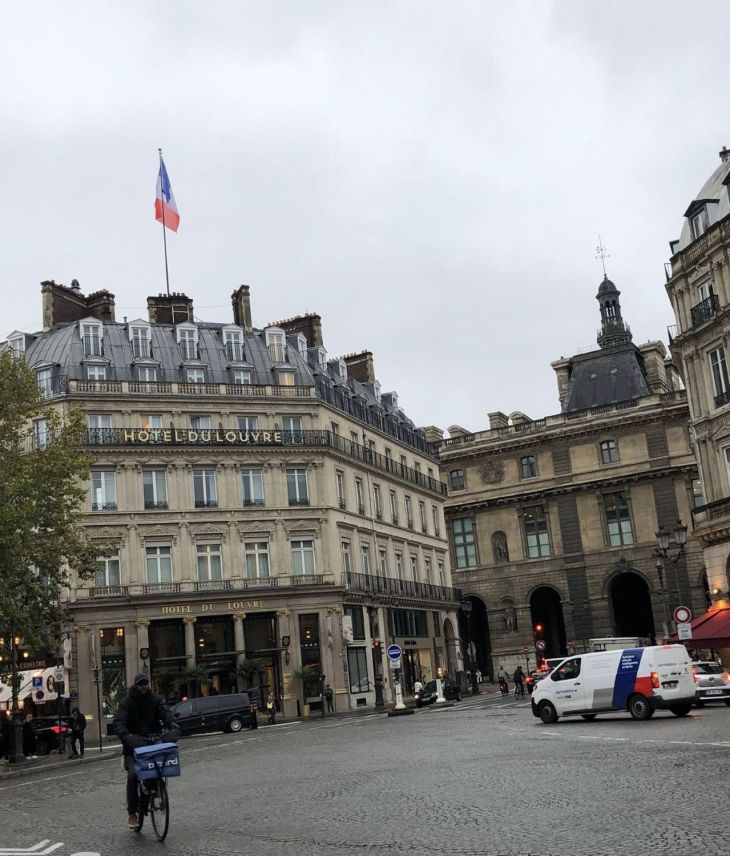
The Place André-Malraux is in the 1er arrondissement of Paris. The two fountains of the Théâtre-Français were built at the request of Baron Haussmann in 1874. They are placed symmetrically with respect to the Avenue de l’Opéra, which crosses the square diagonally. You see the fountain on Rue Saint Honoré and the fountain on Rue de Richelieu. The square is located at the crossroads of Avenue de Opéra, Rue Saint-Honoré, Rue de Montpensier and Rue de Richelieu, and Place Colette near the Comédie-Française. Its north and east sides are built with buildings in the typical architecture of the Second Empire, today mainly used as offices. To the west, the square is bordered by Rue de Richelieu, on which stands the Comédie-Française. To the south, the buildings are heterogeneous and older, consisting of the southern sidewalk of Rue Saint-Honoré, divided up and built without a unified urban planning program after the destruction of the former Quinze-Vingts hospital in the second half of the 18C. On the axis of Avenue de l’Opéra, the Hôtel du Louvre dominates the square. Since 1977, this square has been named after André Malraux, a French writer, adventurer, politician and intellectual. The square was developed under the name “Place du Théâtre-Français” as part of the opening of Avenue de l’Opéra in the 1860s. On May 13, 1956, a vibrant homage to Joan of Arc was held with a highly symbolic statue, since it is the place where the latter, in 1429, unsuccessfully attacked the ramparts of Paris, Notable buildings here are at nos. 1 and 172, rue de Rivoli: Second Empire style Hôtel du Louvre, located opposite the Louvre Museum It is owned by the Luxembourg-based Constellation Hotels Holdings group, controlled by Qatari capital, and is operated by the Hyatt chain. The psychoanalyst Sigmund Freud stayed at the hotel in 1910 and wrote Leonardo da Vinci’s A Childhood Memories there. The hotel also inspired Arthur Conan Doyle, who had a character stay there in a Sherlock Holmes adventure; In the lobby, a plaque installed at the initiative of the Sherlock Holmes Society of France refers to it. In the novel Pot-Bouille, Émile Zola places the evening meal after the wedding at the Hôtel du Louvre. During WWII, the Hôtel du Louvre was the headquarters of an SS Sonderkommando. The Impressionist painter Camille Pissarro stayed there in a suite on the second floor, between December 1897 and February 1898. His self-portrait, preserved at the Dallas Museum (USA), shows him sitting at the window. His eye problems no longer allow him to work outdoors. He will not finish this painting. Perhaps he abandoned it in his haste to complete his series of urban paintings, representing the Avenue de l’Opéra.
The official Hyatt on the Louvre hotel : https://www.hyatt.com/en-US/hotel/france/hotel-du-louvre/paraz
The Paris tourist office on Paris Centre (arrond 1-4) : https://parisjetaime.com/eng/article/explore-the-centre-of-paris-a846
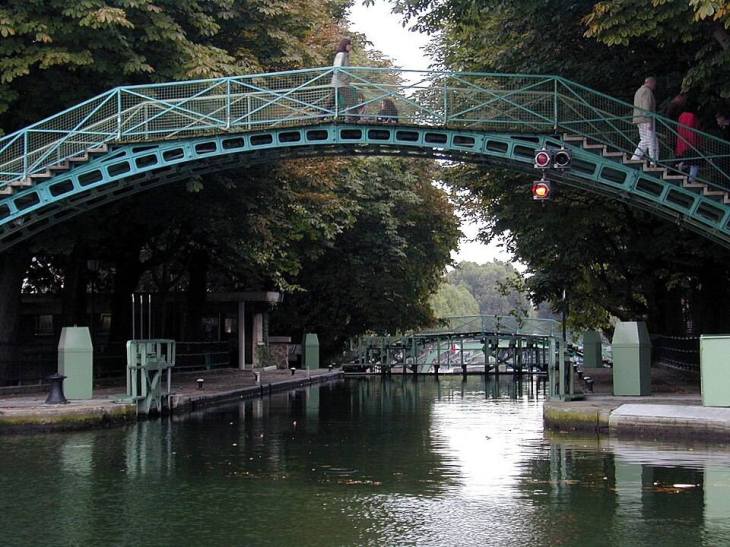
The Passerelle Michèle Morgan footbridge span the Canal Saint-Martin in the 10éme arrondissement of Paris. The footbridge crosses the Bassin des Récollets, upstream from the Récollets locks, near the Villemin – Mahsa Jîna Amini garden. The écluse des Récollets or lock is one of nine double locks that allow boats to navigate the Saint-Martin Canal, built in 1825. Walkers can discover this lock during a stroll along the canal. Framed by the Grange aux Belles footbridge and the Bichat footbridge, it is located near the Récollets Square and the Villemin Gardens. It connects the Quai de Valmy to the Quai de Jemmapes at Rue Bichat, the road from which it owes its former name, the Passerelle Bichat, for which locals still refer to, This site is served by the metro stations Jacques Bonsergent line 5 and Gare de l’Est lines 4, 5, and 7. The former Passerelle Bichat, in October 2024, the footbridge was renamed the Passerelle Michèle-Morgan to pay tribute to the French actress, however, was officially inaugurated on February 28, 2025, on the occasion of the actress’s birthday. Built during the second half of the 19C, this footbridge features a cast iron arched structure typical of the industrial era. The footbridge allows pedestrians to travel between the Jacques Bonsergent and Gare de l’Est metro stations while admiring the Récollets basin.
The Paris tourist office on the Canal Saint Martin: https://parisjetaime.com/transport/canal-saint-martin-p1960
The city of Paris on the passerelles of the Canal Saint Martin: https://www.paris.fr/pages/les-passerelles-du-canal-saint-martin-un-pont-vers-l-histoire-de-paris-16492
The Paris tourist office on the écluse des Récollets: https://parisjetaime.com/eng/culture/ecluse-des-recollets-p1800
There you go folks, a dandy city to explore and enjoy with the family, Memorable moments in my eternal Paris, driving and walking all over in my road warrior trails brings out sublime awesome spots with nice memorable family visits of yesteryear always remember and always looking forward to be back, eventually. Again hope you enjoy the post on curiosities of Paris, part XXXII !!! as I.
And remember, happy travels, good health, and many cheers to all !!!

 Paris1972-Versailles2003