
We have driven and walked in my eternal Paris, and would like to have an imprint in my blog on the wonderful family times we had there, There is so much to see , doing my best, and glad found me these pictures in my cd rom vault ,which now transposing in my blog for you and me, This was my former worked city, so glad to post more memorable spots on it, I thank you for your readership over the years and to bear with my rants! After Paris is to rant, shout and yelled about, me think. Therefore, here is my take on curiosities of Paris , part XXVII !!! Hope you enjoy the post as I.
The gare de Neuilly – Porte Maillot or the Neuilly-Porte Maillot station is located in the 17éme arrondissement of Paris. It is served by trains on RER lines C and E. The historic station building is located on the eastern edge of the City of Neuilly-sur-Seine,(Hauts de Seine dept 92) on the edge of the Place de la Porte-Maillot, from which it takes its name. The platforms for RER line C are located between the two tracks of Boulevard Pereire, built in 1988, east of Boulevard Gouvion-Saint-Cyr and the Palais des Congrès. The new station for RER line E is located beneath the Place de la Porte-Maillot. The Auteuil rail line and its stations were built on the initiative of the Pereire brothers, founders of the Compagnie du chemin de fer de Paris à Saint-Germain de Laye; they opened for service on May 2, 1854. The station was one of seven stations on the 8 km long line from Pont-Cardinet station to Auteuil-Boulogne station, also known as the Auteuil rail line. In 1867, it was incorporated into the Petite Ceinture line. This line closed on January 6, 1985, to allow its partial transformation and to constitute one of the branches of the RER C. Neuilly – Porte Maillot station reopened in this new context on September 25, 1988. Since May 6, 2024, the station has been served by RER line E.
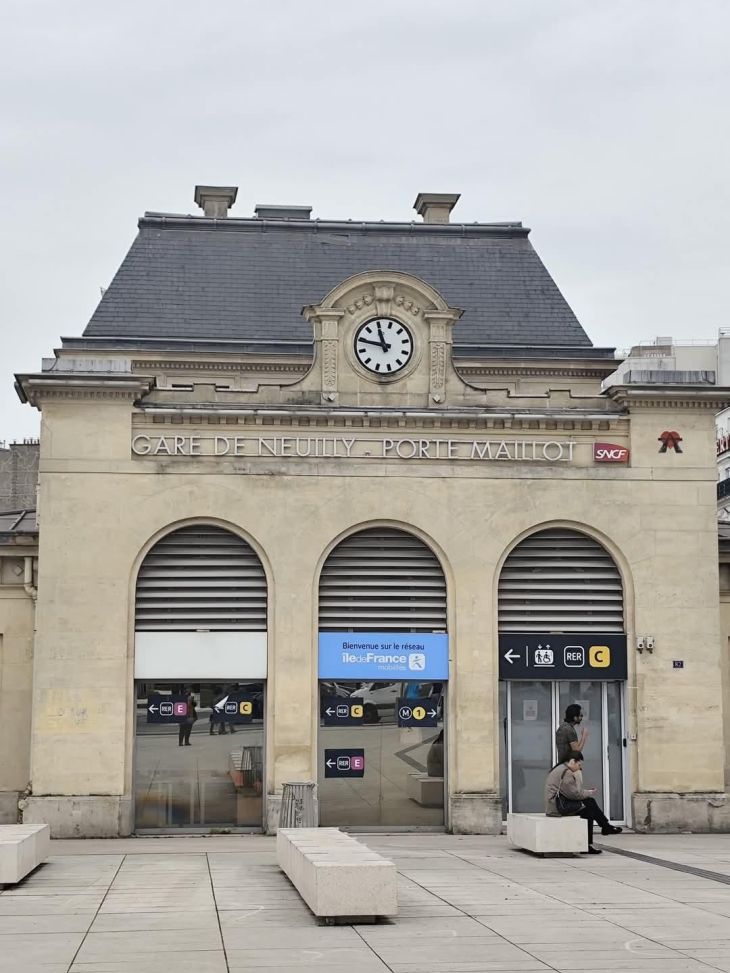
The official Transilien network on the Neuilly Porte Maillot station : https://www.transilien.com/fr/gare/neuilly-porte-maillot-8738102
A train station is inevitably a setting steeped in history. And the Gare Saint-Lazare delights anyone with a passion for old buildings, architecture, or artistic movements. It was my first working train station coming to worked in Paris ! The passerelle Eugénie aka the Passerelle de l’Impératrice, with its windows painted by a former railway worker, incredible glass roofs and monumental staircase, is one of the secret features of the Gare Saint-Lazare, which is revealed, notably during Heritage Days. But anyone can see it from the outside, from the forecourt. This closed footbridge, which connects the station to the current Hilton Paris Opéra Hotel (stayed on business convention here), was used by the bourgeoisie and other prestigious and international travelers when taking the train and boat was still a luxury. These travelers had the advantage, upon getting off their train, of being able to go directly to their hotel, which was called Terminus at the time and belonged to the SNCF without having to cross the crowds in the street. The Passerelle is associated with Empress Eugénie, who is said to have used it. Completely redesigned and renovated by the renowned Maison de Gastronomie, Le Dalloyau Saint-Lazare resto, on the second floor, the 200 m² restaurant has around 100 seats and welcomes Parisians and travelers from around the world every day from breakfast to dinner, including lunch and afternoon tea. On one of the establishment’s walls, the artist Bishop created a large, colorful, and quirky modern fresco that perfectly blends in with the footbridge’s Eiffel-style design.
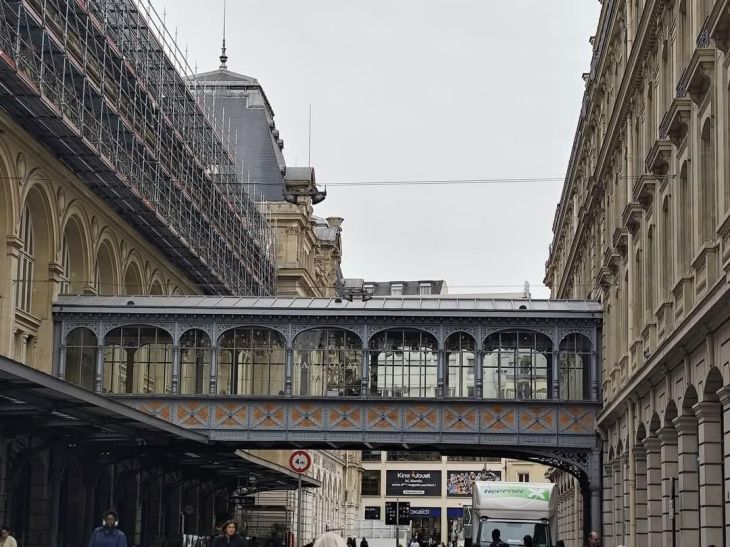
The Paris tourist office on the Gare Saint Lazare : https://parisjetaime.com/eng/transport/gare-saint-lazare-p1941
The Paris tourist office on the Le Dalloyau resto : https://parisjetaime.com/eng/convention/restaurant/dalloyau-saint-lazare-pc4539
The Abbaye Saint-Germain-des-Prés or Abbey , which includes the current Church of Saint-Germain-des-Prés, is a former Benedictine abbey in Paris located at 3 Place Saint-Germain-des-Prés in the current 6éme arrondissement. Founded in the mid-6C as the Basilica of the Holy Cross and Saint Vincent by the Merovingian king Childebert I and Saint Germain, Bishop of Paris, it owes its current name to the latter. This is one of the monuments of Paris that has been left out for years, do need to see and have more pictures.

The Paris tourist office on the Church Saint Germain des Prés : https://parisjetaime.com/eng/culture/eglise-saint-germain-des-pres-p1011
The beffroi de la mairie du 1er arrondissement de Paris at Place du Louvre This is the Belfry of the City/town hall of the 1st arrondissement at 38 meters high.Concert to listen to, every Wednesday from 13h30 to 14h, The construction began in 1858 based on plans by Théodore Ballu. This magnificent building consists of four unequal floors: the ground floor and the first floor are square, the upper floors are octagonal. On the second floor, three dials have a golden sun cadran in their centers, and give the following information: the hour and minutes in golden Roman numerals on a blue background. The signs of the zodiac appear around the dial but are not functional. The temperature is approximately + 40 to – 40. A turret on the rear façade contains the spiral staircase that leads to the third floor, and continues to the balustraded platform via wooden and metal stairs. The barometer dial; the set of three dials installed in 1862 was restored in 2004. The belfry-campanile plays a carillon, among the best in France. It has 38 bells on three chromatic scales, installed in 1884, and remained in operation until 1975. Completely restored since then, it is still heard at regular times.

The mansion Hôtel Ponsin located at 42 rue Fortuny of the 17éme arrondissement of Paris. The Master glassmaker Joseph Ponsin commissioned this French Renaissance-style mansion from architect Alfred Boland. He could practice his professional activity and exhibit his works there: the basement housed three furnaces, the ground floor housed an exhibition hall, and the first floor housed a workshop and office. The residential apartments were located on the second and third floors. Ponsin exhibited a light palace made of blown glass at the 1900 World’s Fair for the Saint-Gobain factory. The private mansions they had built there still remain in place, with a few exceptions, and form a coherent architectural ensemble that perfectly illustrates the taste for historicism and eclecticism that dominated French architecture at the time. In 1877, it was named after the Spanish painter José Maria Fortuny, who had lived there. These sculptures are part of a sumptuous decor once designed by Ponsin. On the third floor, two caryatids support a portico formed by a large sculpted cornice to which garlands of flowers falling in bouquets are attached. They once encased a beautiful stained-glass window exhibited at the Universal Exhibition of 1878, illustrating the ages of man. At the other end, a second stained-glass window represented the Château de Chenonceaux. These two stained-glass windows embellished the large reception gallery located on the third floor of the hotel. They testified to Ponsin’s research into the application of his art to architecture.

There you go folks, a dandy city to explore and enjoy with the family, Memorable moments in my eternal Paris, driving and walking all over in my road warrior trails brings out sublime awesome spots with nice memorable family visits of yesteryear always remember and always looking forward to be back, eventually. Again hope you enjoy the post on curiosities of Paris, part XXVII !!! as I.
And remember, happy travels, good health, and many cheers to all !!!

 Paris1972-Versailles2003