
We have driven and walked in my eternal Paris, and would like to have an imprint in my blog on the wonderful family times we had there, There is so much to see , doing my best, and glad found me these older pictures in my cd rom vault ,which now transposing in my blog for you and me, This was my former worked city, so glad to post more memorable spots on it, I thank you for your readership over the years and to bear with my rants! After Paris is to rant, shout and yelled about, me think. Therefore, here is my take on curiosities of Paris , part XXIV !!! Hope you enjoy the post as I.
The Rue de Mogador is located in the 9me arrondissement or district of Paris. It begins at 46 Boulevard Haussmann and ends at 75-75 bis Rue Saint-Lazare. Mogador was the original name of the city of Essaouira in Morocco, the site of a battle between France and Morocco in 1844. Before the opening of Boulevard Haussmann, Rue de Mogador began at Rue des Mathurins; the section between the latter road and Boulevard Haussmann became part of Rue Scribe before being incorporated into Place Diaghilev. This street was opened in 1845 on land belonging to an entrepreneur named Dufaud. Ordinance of December 11, 1845, between Boulevard Haussmann and Rue de Provence. Decree of October 30, 1894, between Rue de Provence and Rue Joubert. Decree of February 16, 1900, between Rue Joubert and Rue de la Victoire. Decree of May 13, 1899, between Rue de la Victoire and Rue Saint-Lazare It underwent many modifications and was completed in 1901 by the opening between Rue de la Victoire and Rue Joubert, thus joining Rue de Mogador to extension of the street, which had long been started on the side of Rue Saint-Lazare. The section leading to Boulevard Haussmann was formerly known as Passage Sandrier-des-Fossés, contractor for the works on the Cour Louis-Philippe. On December 13, 1909, Rue de Mogador, along with Rue de la Chaussée-d’Antin, which runs parallel to it, was converted into a one-way street with a return route, the first in Paris. Remarkable Buildings here is the one at No. 25: Théâtre Mogador. built in 1919. One of the few theaters I have actually seen a show over the years in Paris ! See Ghost ,created in 2011 from the film of the same name by Jerry Zucker, starring Demi Moore, Patrick Swayze, and Whoopi Goldberg, the show received three Tony Award nominations in 2012. A spectacular staging aims to demonstrate once again that we can perfectly combine popular success and artistic quality.
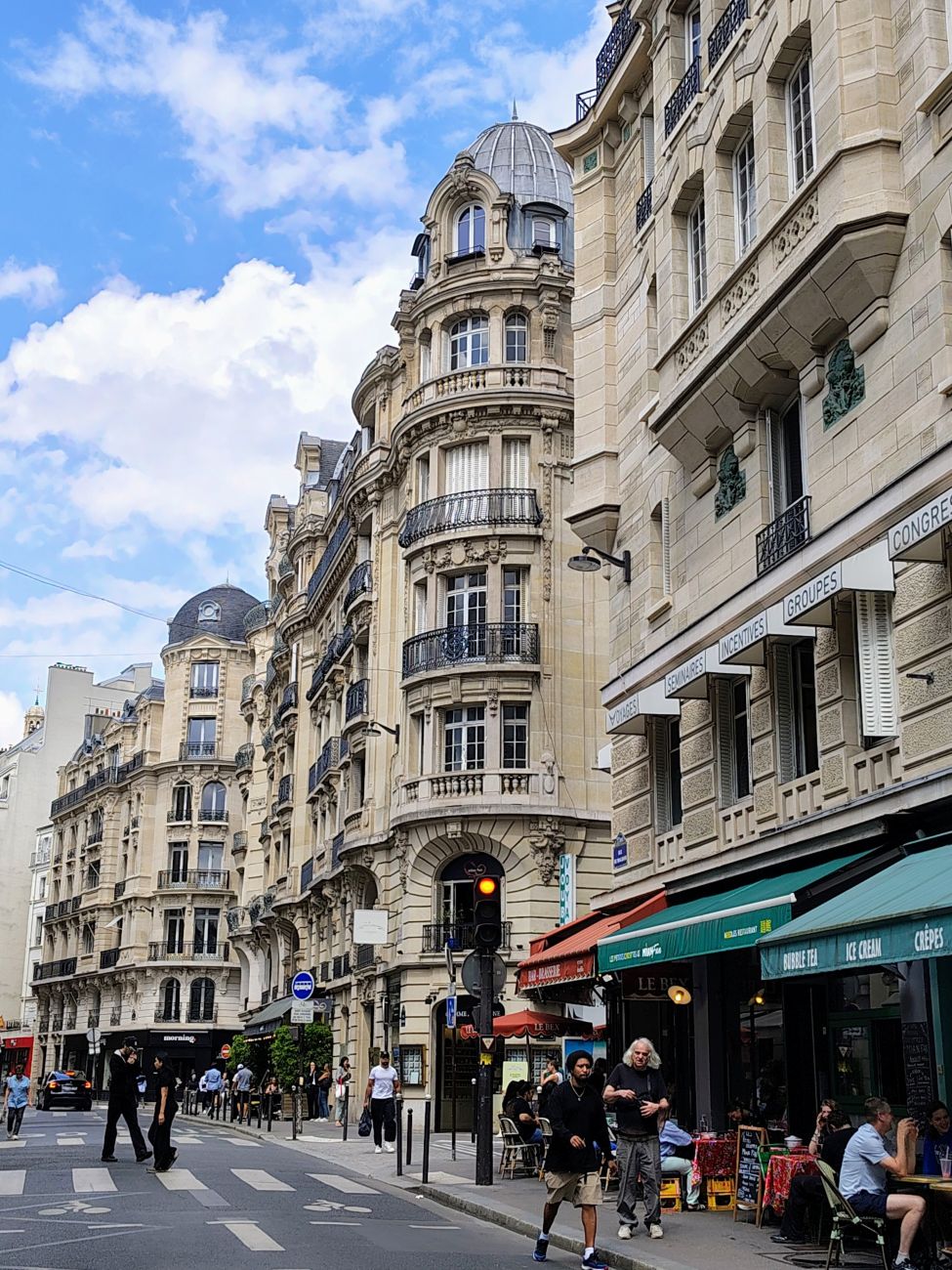
The Cité Chaptal is, also in the 9éme arrondissement or district of Paris, and begins at 20 bis, rue Chaptal and ends in a cul-de-sac. At the end of this cul-de-sac is the International Visual Theatre. It is named after the Jean Chaptal, a chemist, physician, and politician. He gave his name to the Chaptalization , and due to its proximity to the eponymous street and who also owned the land. This street was opened at the same time as Rue Chaptal, by royal decree of January 12, 1825. The Rue Chaptal begins at 1, rue Pierre-Fontaine and ends at 66, rue Blanche. It is a one-way street, running east-west. It is served by metro line 2, at the Blanche and Pigalle stations, and by metro line 12 at the Pigalle station. Notable buildings see at No. 7: former Grand-Guignol theater, early 19C convent chapel converted into an artist’s studio by the orientalist painter Georges Rochegrosse, then into a theater from 1896. Now home to the International Visual Theater since 2004. Property of the City of Paris.

The Grand Guignol Theatre is a former Parisian performance hall located at 7 Cité Chaptal ,active from 1896 to 1963. Specializing in plays featuring macabre and bloody stories, it has by extension given its name to the theatrical genre, the Grand Guignol, and to the adjective Grand-Guignollesque. The term has become pejorative over time and now refers, more generally, to works abusing violence or grandiloquent effects. The small 280-seat hall was inaugurated on May 16, 1896, under the name Théâtre-Salon, at the end of Impasse Chaptal (whose real name is Cité Chaptal), in a former convent chapel that had served as an artist’s studio for the painter Georges-Antoine Rochegrosse. In this wide room, therefore at the heart of the show, with green armchairs and “grilled” dressing rooms and bathtubs, a very varied audience from the neighborhood and the wealthy districts came to have fun and quiver with pleasure. The turn of the century and its emerging anxieties would bring success to the second director, Max Maurey, also an author, who took over the reins in 1899 and would favor the staging over the text by starting to use special effects. He also built up a specialized repertoire by calling on new authors. The success was immense. Some plays like The System of Doctor Goudron and Professor Plume (1903) after Edgar Allan Poe became classics. With the appearance of talking cinema and especially American genre films like Frankenstein and Doctor X, competition became tough. The Grand Guignol somehow survived the Occupation period. A new succession of managements from 1955 onwards led to its definitive closure on January 5, 1963. Since 2004, it has been the headquarters of the International Visual Theatre (IVT), a cultural center for deaf culture, made up of three poles: a theater, a training center and a publishing house, linked in a common mission of transmission and diffusion of French Sign Language (LSF) and its culture.
Notable buildings on Rue Chaptal are at No. 9: In 1857, the art dealer Adolphe Goupil bought a plot of land at this address and built a luxurious mansion there, including workshops, a printing press and an exhibition hall. This was the headquarters of the Goupil & Cie company from 1860 to 1890. Vincent van Gogh worked there from May 1875 to April 1876. No. 10: A remarkable effigy of Beethoven; the musician is surrounded by two muses, one playing the lyre and the other the violin, No. 11 bis: family apartment of the Ginsburg family from 1932 to 1947. This is where Serge Gainsbourg grew up, and he went to the nursery school located just opposite, No. 16: the Hôtel Scheffer-Renan was the home of the Dutch-born painter Ary Scheffer and has housed the Musée de la Vie Romantique since 1987. At No. 20: the Cité Chaptal with successively the Parisian studio of the orientalist painter Georges Rochegrosse, then the Grand-Guignol, and today the International Visual Theatre. No. 22: La Nouvelle Athènes art gallery, specializing in 19C painting and drawing. No. 26: Louise Walser-Gaillard library (formerly Chaptal), named after a deaf activist from the Belle Époque. Name changed in October 2019. As well as the Pauline-García-Viardot Garden, inaugurated in 2021. No. 33: Tristan de Quelen art gallery, specializing in old paintings.
The Paris tourist office on the Théâtre Morgador : https://parisjetaime.com/eng/culture/theatre-mogador-p2919
The Paris tourist office on the 9éme arrondissement de Paris : https://parisjetaime.com/eng/article/explore-paris-s-9th-arrondissement-a828
The official international Visual Théâtre (IVT) : https://ivt.fr/
There you go folks, a dandy city to explore and enjoy with the family, Memorable moments in my eternal Paris,driving and walking all over in my road warrior trails brings out sublime awesome spots with nice memorable family visits of yesteryear always remember and always looking forward to be back, eventually. Again hope you enjoy the post on curiosities of Paris, part XXIV !!! as I.
And remember, happy travels, good health, and many cheers to all !!!

 Paris1972-Versailles2003