
A wonderful area, great architecture, beautiful history and just great walkable area of my eternal Paris. I think to post on it because of its architecture and historical context and the area in which it is as of now. One of the things I encourage always is to not just visit a place but get to know it, local point of view. This is what I am trying to convey in my blog when I post long on architecture and history of the places of my belle France! This is sort of an update as found me additional pictures in my cd rom vault and older paper pictures to do this post for you and me, Therefore, this is my take on the Hôtel Dieu of Paris !!! Hope you enjoy it as I.

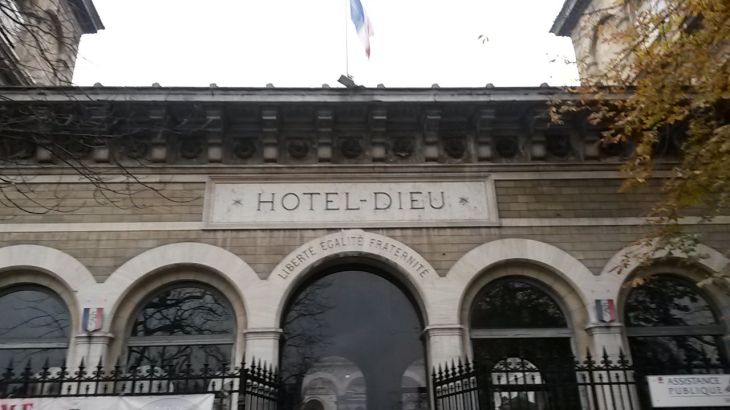
The Hôtel Dieu hospital is part of the AP-HP Hospital University group. However, Novaxia, private property developer, leader in urban transformation came in as investor. If the AP-HP remains the owner of the 55,000 m2 of the Hôtel-Dieu site, it therefore concedes 20,000 m2 in Novaxia, via the signing of an 80-year lease. The projects included in the offer an incubator, house of associations, and the teams installed by the AP-HP in the Hôtel-Dieu. It also meets the objective of a social dimension marked for this site with social housing, house of disability, and associative crèche.
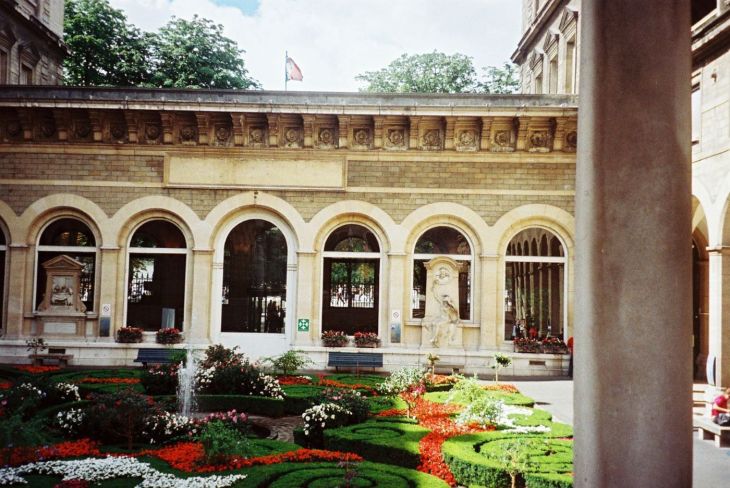
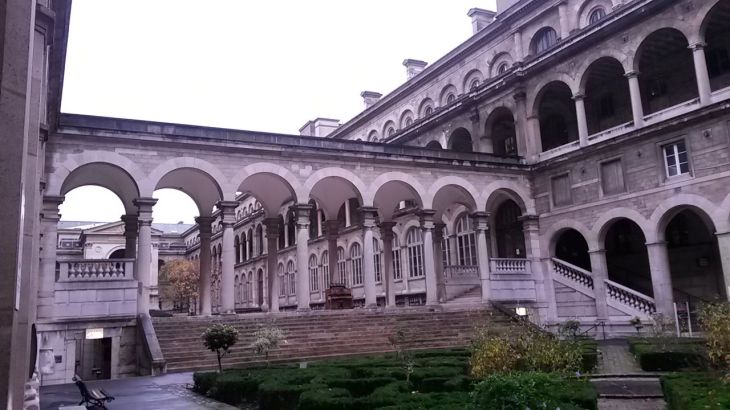
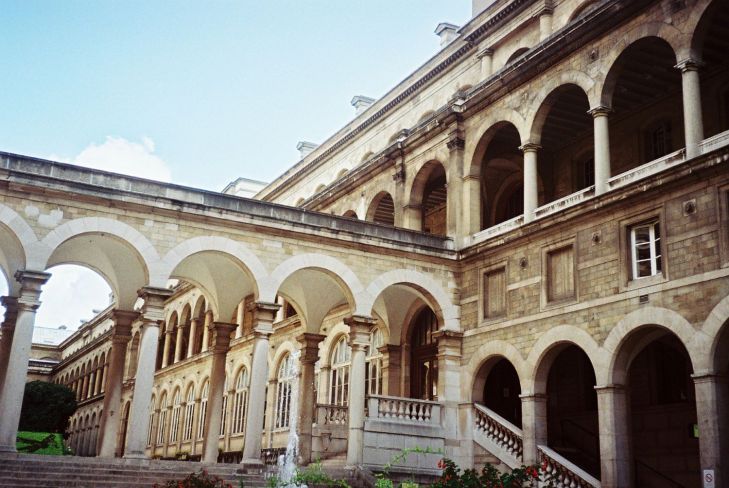
I like to tell you a lot of its history always wonderful,me think. The Hôtel-Dieu de Paris is a hospital built between 1867 and 1878 on the Île de la Cité, on the northern edge of the Parvis Notre-Dame in the 4th arrondissement of Paris. The Hôtel-Dieu is by virtue of its founding date, the oldest hospital in the capital. Founded in 651 by the Parisian bishop Saint Landry, it is a symbol of charity and hospitality. It is currently one of the hospitals of the Assistance Publique – Hôpital de Paris. This hospital is part of the Paris-Descartes Faculty of Medicine. The « new » Hôtel-Dieu de Paris is a hospital establishment built from 1867 to 1878 on the Île de la Cité, on the northern edge of the Parvis Notre-Dame square in the 4éme arrondissement of Paris. The Hôtel-Dieu is by the date of its foundation, the oldest hospital in the city as was created in 651 by the Parisian bishop Saint Landry, it was the symbol of charity and hospitality. Originally modest, the old Hôtel-Dieu built from the 7C to the 17C occupied the other side of the current Parvis Notre-Dame – Place Jean-Paul-II on the bank of the small arm of the Seine before its extention on the left bank, the Pont au Double connecting the two buildings. In the years 1867-1878, this complex was destroyed and then rebuilt on the north side of the forecourt where the current buildings are now located. If tradition, in reality established in the 17C, it traces the foundation of this hospital to Saint Landry, 28th bishop of Paris around 650, the first main buildings found to be assigned to the destitute, infirm and sick only date back to 829; they are located opposite a former church, the Saint-Etienne church. In 1157, letters patent mention a Hôtel-Dieu–Saint-Christophe, because of a dedicated chapel dedicated to this saint. All these buildings, from the origin until 1878, occupy the south side of the present Parvis Notre-Dame square between Petit-Pont and Pont au Double. In 1606, an annex to the Hôtel-Dieu, the Salle Saint-Charles, was built on the left bank. In 1684, Louis XIV donated the Petit Châtelet to the Hôtel-Dieu. The hospital then expanded along rue de la Bûcherie (current quay of Montebello). Louis XIV decides, under the influence of the Parliament and the company of the Blessed Sacrament to create the general hospital in April 1656. The General Hospital should not be confused, with the nature at the same time prison, manufacturing and conventual, intended among others to beggars, vagabonds, prostitutes, debauched, and abandoned children, of the Hôtel-Dieu, which keeps its independence and its specificity from the care of poor patients. The sick of the General Hospital are systematically sent to the Hôtel-Dieu for treatment ,except venereal sick persons. But it was not until the end of the 18C that the hospital became a healing machine, where the patient was treated there and returned cured. However, it was not until the 19C that the hospital became a place for practicing medicine and science, but also a place for teaching and medical research.
In 1837, the extension of the Quai de la Bûcherie (now Quai de Montebello) was declared of public utility. To do this, the old Hôtel-Dieu was demolished and a new annex was built in 1840 between the new quay and rue de la Bûcherie. During the Second Empire,(Napoléon III) , the buildings became cramped to cope with the evolution of medicine and the missions of hospitals, so that their replacement was decided. On May 22, 1865, the removal of the old Hôtel-Dieu and its reconstruction north of the Parvis Notre-Dame were declared of public utility. The buildings of the old Hôtel-Dieu, intended for destruction are replaced by new high constructions, from 1867 to 1878, on a plot of 22,000 square meters delimited to the north by the quai Napoléon (future quai aux Fleurs), at south by the Place du Parvis, to the west by the rue de la Cité (previously rue de la Juiverie), to the east by the rue d’Arcole on the parvis or forecourt of the cathedral, The construction of the new Hôtel-Dieu is part of a large-scale urban project which profoundly changes the urban landscape of a central part of the Île de la Cité, near the cathedral, where a whole set of streets and houses are demolished both for the development of a larger forecourt and for the opening of the hospital site. The current buildings were built from 1866 to 1876, on the initiative of Baron Haussmann in the redeveloped perimeter of Notre-Dame Cathedral. The Third Republic completed the construction of the hospital on its current site at the end of the 19C, with the main entrance at 1, place du Parvis. It was not until 1908 that the Augustinian nuns permanently left the Hôtel-Dieu. They will find refuge in a convent located in the 14éme arrondissement of Paris, rue Maison-Dieu (now a medical building). The splendid central courtyard, which leads to a chapel, was converted in 1975 into a French garden.
The future museum, that will have a vast area of 7,000 to 9,000 m² , decision on its precise location within the Hôtel-Dieu could be made, they hope, “before the summer.” 2025, But politics are in the way so stay tune for more of it, The Historical and Artistic Museum of Paris Hospitals first opened its doors in 1934. The museum’s initial orientations strongly influenced the profile of the collection, with significant transfers of religious paintings, works of art from bequests, and collections of pharmaceutical earthenware. The first, founding donation of the museum, came from the Charité Hospital. The collections are largely made up of objects and works donated by hospitals and the AP-HP administration. Today, they are also enriched by donations from individuals and businesses. The museum also opens its doors to French cultural and museum institutions through the loan of numerous works and objects. The museum’s collections include approximately 13,000 works and objects representing hospital life from the Middle Ages to the present day. The museum does not have a year-round exhibition space; it offers temporary exhibitions presented in AP-HP hospitals. It still close check for opening times.
You can get to the Hôtel-Dieu walking, best of course. However, public transports take you on Metro line 4 stop/arrét Cité, Hôtel de Ville lines 1 and 11, Châtelet lines 1,4,7, and 14. Cluny-la Sorbonne and Maubert-Mutualité line 10 as well as RER B and C Saint Michel-Notre Dame. By bus stop/arrét Cité-Palais de Justice on lines 21, 38, 47, 85, and 96. Also, stop/arrét Cité-Parvis Notre Dame on line 47, Pont Neuf-Quai du louver on line 81, Hôtel de Ville stop on lines 69 and 74, Notre Dame-Quai de Montebello on line 24. There is no parking on site but plenty nearby at Parvis Notre Dame, Hôtel de Ville, and Palais de Justice underground parking garages.
The official hospitals of Paris on the Hôtel Dieu : https://www.aphp.fr/contenu/hopital-hotel-dieu-1
The official Public Assistance Hospitals of Paris on the Hôtel Dieu : https://hoteldieu.aphp.fr/decouvrir-lhotel-dieu/
The Paris Tourist office on the Hôtel Dieu : https://parisjetaime.com/eng/pro/hopital-hotel-dieu-p2688
The official Novaxia on the future Hôtel Dieu : https://www.novaxia.fr/projet/hotel-dieu-paris-1er/
There you go folks , I feel great to tell you about another wonderful Paris institution which we love and have even gone inside walks its hallways and enjoy the garden while doing our walks in the area. You need to do it quickly before modernity changes all the beauty of it, the Hôtel-Dieu is worth a visit. Again, hope you enjoy this post on the Hôtel-Dieu of Paris !!! as I.
And remember, happy travesls, good health, and many cheers to all !!!

 Paris1972-Versailles2003