
I have many posts on the garden, but this one was one of my sneak shots into this glorious institution. I found a picture in my cd rom vault and should be the catalyst to do this post for you and me, This is an icon of Paris, even if only visit on European Heritage Days, Nevertheless, let me tell you a bit on the Petit Luxembourg of Paris !!! Hope you enjoy the post as I.
The Petit Luxembourg or Hôtel de la Présidence has been the residence of the President of the French Senate since 1825. It is adjacent to the Luxembourg Palace in the 6éme arrondissement of Paris, to the west of the latter, on rue de Vaugirard. Today, the right wing is the official residence of the President of the Senate: it houses his office, those of his staff, official lounges and the President’s private apartments. A majestic grand staircase considered one of the most beautiful of its time. The stone staircase is made up of 31 steps; it has a magnificent banister made of interlacing stone from Saint-Leu. This interlacing is also repeated at the bottom of the arcades on the 1st floor where mirrors reflect the ceiling. The vaulted ceiling is remarkable: it is decorated with an oval cap containing an allegorical painting by the painter Hippolyte Berteaux, created in 1894. The four corners are decorated with cartouches surrounded by winged angels: the arms of the Bourbon-Condé, burned at the stake during the French revolution, were represented there.
Next to the Petit Luxembourg, Queen Marie de Medici founded the couvent de la congrégation bénédictine des Filles de Notre-Dame du Calvaire or convent of the Benedictine congregation of the Daughters of Our Lady of Calvary in 1622. In 1840, the architect Alphonse de Gisors demolished the convent buildings except for the cloister and the Queen’s private chapel. The convent chapel was destroyed, but its arranged facade was rebuilt at the end of the courtyard of No. 17bis rue de Vaugirard, on the site of the nave of the old chapel. See the bust of Marie de Médicis on top…This facade is perfectly visible from the street (see pic).
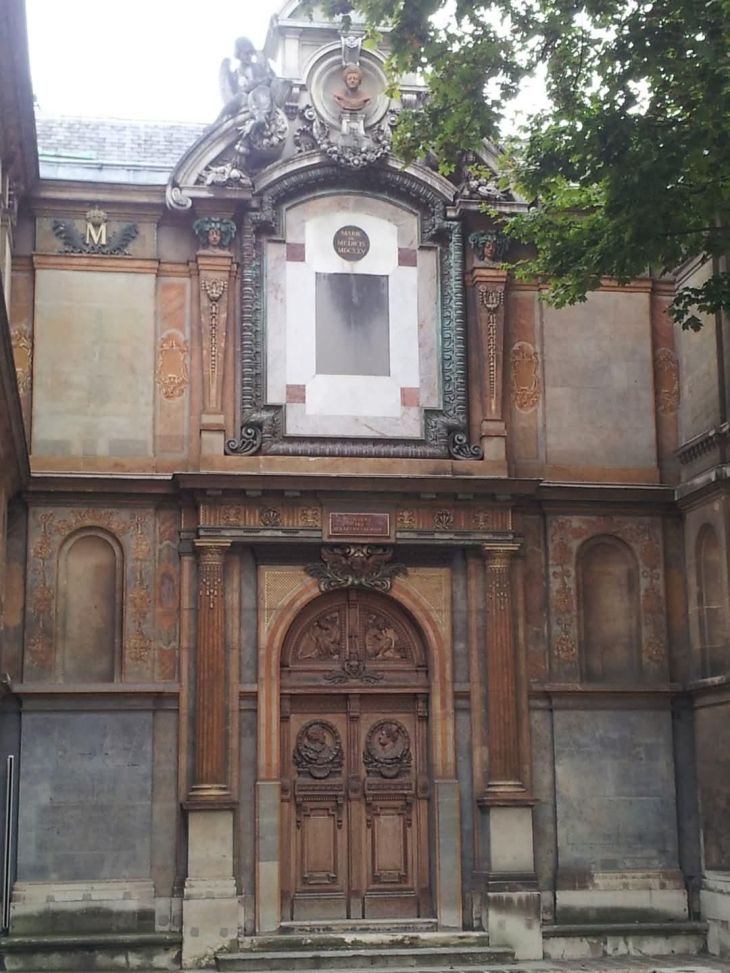
In 1875, the cloister was covered with a glass roof: it is heated and serves as a winter garden. This astonishing garden, reserved for the use of the President of the Senate and his guests, today houses orchids and tropical plants. There is a consecrated chapel, called the Chapelle de la Reine or Queen’s Chapel, richly decorated. The chapel was previously the site of Mass, attended by the President of the Senate and his family. Today, the chapel is a living place of history. It is one of the most beautiful places in the palace. The left wing, which includes the Boffrand rooms, houses dining rooms and lounges, which are used for receptions and conferences organized by the President but also by other senators. Foreign dignitaries invited by the President of the Senate are generally welcomed in the Petit Luxembourg. The private apartments are located upstairs. It has since been open to visitors on European Heritage Days.
A bit of history tell us that this private mansion was built in the mid-16C. It was acquired a few years later, in 1570, by François de Luxembourg, Duke of Piney, a peer of France who gave it its name. In 1612, the mansion and the surrounding land were purchased by the regent, the Queen Mother Marie de Medici. She had a new palace built on the property. The name Palais du Luxembourg remained for both buildings, but from then on, the former Hôtel du Duc de Piney was called Petit Luxembourg to distinguish it from the large neighboring palace, then called Palais Médicis and later Grand Luxembourg. In 1627, Marie de Medici gave the mansion to Cardinal Richelieu, then her protégé. The cardinal in turn bequeathed it in 1639 to his niece, Marie de Combalet, Duchess of Aiguillon. The Prince of Condé inherited it in turn in 1674, and bequeathed it to his son Henri Jules de Bourbon-Condé. In 1729, Louis de Bourbon-Condé created the Petit Luxembourg Academy there, which brought together scholars and artists. By an edict of December 1778, King Louis XVI granted the Luxembourg estate to his brother, Monsieur, Count of Provence, the future Louis XVIII, as an increase in appanage. During the French revolution, after leaving Versailles, Monsieur settled in the Petit Luxembourg. No longer feeling free enough to move around, he decided, like his elder brother, to flee Paris in June 1791. From then on, the Grand and Petit Luxembourg were confiscated and became “national property”. In 1795, it was assigned to the Directory. It was in the Petit Luxembourg that the Constitution of the Year VIII was drafted and that, on December 25, 1799, the three consuls formed their government. The Conservative Senate sat there from 1800 to 1804 before moving to the neighboring Grand Luxembourg. Under the Restoration (1814-30), the State acquired it in 1825 to make it the residence of the President of the Chamber of Peers. Except during revolutionary or war periods, the Petit Luxembourg has remained the residence of the President of the Upper House ever since. In 1940, the palace was occupied by the General Staff of the West Luftwaffe, its generals being housed in the Petit Luxembourg.
The official Senate of France on the Petit Luxembourg : https://www.senat.fr/connaitre-le-senat/patrimoine/le-petit-luxembourg.html
The official Senate of France with virtual visit of the Petit Luxembourg : https://www.senat.fr/le-senat-et-vous/visiter-le-senat/visite-virtuelle-du-petit-luxembourg.html
The Paris tourist office on the palais du luxembourg (wrong trans has most in German!) : https://parisjetaime.com/eng/culture/senat-palais-du-luxembourg-p1046
There you go folks, always a happening in my eternal Paris. The jardin du Luxembourg (see posts) are sublime, and plenty to see here. Again, hope you enjoy this unique post on the Petit Luxembourg of Paris as I.
And remember, happy travels, good health, and many cheers to all !!!

 Paris1972-Versailles2003