
We have driven and walked in this wonderful Normandy region for many years, more before as lived not far, Wonderful family times we had there, There is so much to see , doing my best, and glad found me these pictures in my cd rom vault ,which now transposing in my blog for you and me, I thank you for your readership over the years and to bear with my rants! .Do read my other post on wonderful Vernon, Therefore, here is my take on the Collegiate Church Notre-Dame of Vernon !!! Hope you enjoy the post as I.
The town of Vernon is located in the department no 27 of Eure in the Normandie region of my belle France. It is at the crossroads of the roads from Évreux to Beauvais, and from Paris to Rouen via the Seine Valley. It is close to Giverny. The town is 7km from Giverny, 66 km from Rouen, 66 km from Versailles, and 481 km from my current home on the A13, The A13 autoroute de Normandie connects Vernon to: Paris (by Porte d’Auteuil) ,Rouen ; Deauville; and Caen. The D 6015 roads takes you towards Mantes-la-Jolie and Paris and, Gaillon, Val-de-Reuil and Rouen. D181 towards Évreux and, Gisors, Beauvais, Amiens and Reims. D 313 towards Gasny and, Les Andelys.
The Collegiate Church of Notre-Dame is located opposite the city/town hall, set back from Rue Carnot. The church, preserving parts from the 11C, 13C, 14C-15C.The western façade dates from the 14-15C. The decoration of the main portal is dedicated to the Virgin Mary, to whom the collegiate church is dedicated. The lintel was created by Ferdinand Taluet in 1866. It depicts several scenes from the life of Mary: the Annunciation, the Visitation, the Adoration of the Magi, and the Presentation of Jesus in the Temple. The statues of the tympanum were hammered out during the Revolution. I must admit perhaps lazy,some from my brochures, but most of the text comes from wikipedia.
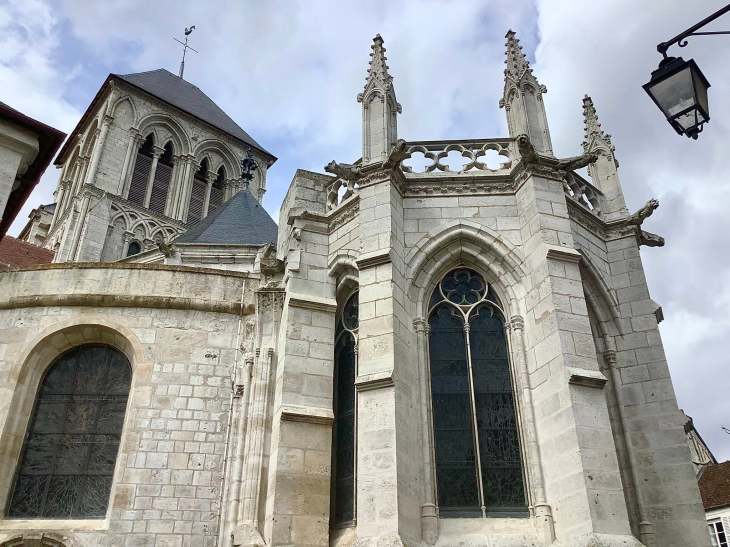
The Collegiate Church Notre Dame has two 70-meter-high spires. Major works carried out between 1360 and 1610 affected the nave and façade of the collegiate church, creating a magnificent Gothic structure with six bays and thirteen side chapels. It was completed in the 17C. This church is one of the oldest in Normandy, made of Vernon limestone, with a Latin cross plan and a non-projecting transept; floors, a single nave, ribbed vaults, and a slate roof. Visitors to the collegiate church will be struck by the difference in lighting and height between the old choir and the more recent nave. The nave has above the choir, a Christ on the Cross, surrounded by the Virgin and Saint John, was created around 1644 by the sculptor Jean Drouilly. Leaning against the pillars of the entrance, the statues of the Twelve Apostles are by another regional artist, Joseph Décorchemont; they date from the 19C. Behind the organ, the rose window created in 1975 is the work of the glass painter Jacques Bony. This is the oldest part of the church. The choir is, in fact, Romanesque. It is closed by nine semicircular arches with columns made from a single block of stone. The columns are topped with flared capitals. Some are decorated with foliage or show animals. The remarkable high altar in Louis XVI style comes from the Gaillon charterhouse. It was installed on this site in 1791. The ambulatory is said to be the first in Gothic style in Normandy, dating from the 1160s. Above the door leading outside, to the right of the Chapel of the Virgin, a stained-glass window evokes a verse from the Gospel according to Saint John: “I am the light of the world” In the ambulatory, the sacristy is accessed by a Renaissance-style door with napkin fold panels, framed by a decoration from the same period.

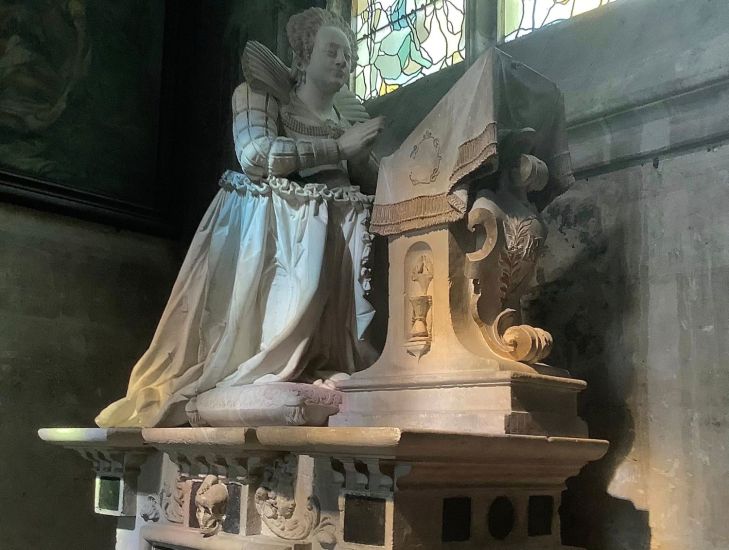
The old baptismal chapel see to the left of the chapel, a modern statue depicts Saint Adjutor as a knighted monk, wearing a coarse robe, a shield at his side, and chains in his left hand. Chapel of Saint Vincent de Paul. This chapel houses the mausoleum, from the Church of Saint Genevieve (destroyed in 1792), of Marie Maignart, organ donor, who died in 1610 at the age of 23. She is depicted praying, kneeling on a cushion, and dressed in the farthingale robe typical of the Henri IV period. To the right of the chapel, a recently restored statue of Saint Catherine.
The Chapel of the Brothers of Charity. The chapel covers two bays of the nave. The vaults are remarkable with their late 15C Flamboyant Gothic ribs. The Charity of the Blessed Sacrament was founded in the 14C by the cloth cutters and other bourgeois of the town of Vernon. It was responsible for the burial of the dead. The altarpiece, probably from the beginning of the 16C, painted on wood, horizontal with the upper part projecting, is a Passion of Christ represented in five episodes separated by Renaissance-style columns: Flagellation; Ascent to Calvary; Crucifixion; Entombment; Resurrection.
The Baptismal Chapel has a 15th-century wooden triptych depicts the Passion, Death, and Resurrection of Christ. A carved wooden panel depicts an angel bringing communion to the imprisoned Saint Avoye. It dates from the 17C. The bay is lit by a stained-glass window with predominantly red and white to evoke the glory of Christ during the Resurrection. The Sainte-Geneviève Chapel has a painting depicting a splendid Resurrection attributed to Annibale Carracci. The upward movement of the lines and colors of the stained-glass window evokes the Cosmos. The Virgin Chapel is located in the axis of the collegiate church and features 14C architecture. It features a 14C statue of the Virgin and Child in polychrome wood. The stained-glass windows evoke the litanies of the Virgin.
The Chapel of Our Lady of the Rosary is so named because of the painting placed in the altarpiece. It represents Saint Dominic receiving the rosary. A beautiful stone statue from the 17C represents the Virgin and a painting by Claude Vignon, from the same period, represents the Institution of the Rosary. The stained glass window from the Hermet-Juteau workshop symbolically represents the three rosaries, each composed of five decades of Ave Maria, which correspond to the mysteries of the life of Christ. At the top of the window, the rose petals allude to the prayers dedicated to the Virgin. The Chapel of Saint Vincent Saint Vincent, patron saint of winegrowers, is represented in monochrome on the altarpiece. The stained glass window from the Hermet-Juteau workshop evokes the vine through its shapes and colors.
The Sainte-Madeleine Chapel has a modern painting depicting Saint Magdalene, a repentant sinner. This is the theme of repentance evoked by the modern, abstract stained-glass window from the Hermet-Juteau workshop. The shapes may suggest a woman, a crowd at prayer, or Madeleine’s hair. The Saint-Mauxe Chapel depicts the cult of Saint Mauxe was introduced to the parish in the 12C. The chapel houses the polychrome statue of this martyred bishop, as well as a painting depicting a Descent from the Cross by Jouvenet, dating from the 17C. Also, a beautiful statue of Saint Anne from the 16C. The colors of the modern stained-glass window from the Hermet-Juteau workshop are inspired by suffering and martyrdom: blood red and the gray of ashes.
The Notre-Dame-de-Lourdes Chapel houses the last stained-glass window from the 16C. It was restored in the 19C. It shows scenes from the life of Christ and Saint John the Baptist. Below and from left to right: Saint John the Baptist offers baptism to the crowd, Saint John the Baptist baptizes Jesus, Saint John the Baptist is beheaded, and Nativity of Saint John the Baptist, The Saint-Joseph and Notre-Dame-de-Fatima Chapel has a stained-glass window created in 1975 by the glass painter Jacques Bony. It evokes two old churches in Vernon destroyed during the French revolution. Jacques Bony lent his face to Saint Jacques, and that of his wife Geneviève Bony to Sainte Geneviève. The left half of the stained-glass window depicts Saint Genevieve visiting the Parisians during the Hun siege in 451. The Pont Neuf can be seen, and on the far left, Notre-Dame. The right half features Saint James, venerated in Santiago de Compostela, whose cathedral is depicted on the far right.

The organ were built in 1610 by Jean Ourry. Transformed and embellished over the centuries, the organ was last restored in 1979 by Alfred & Daniel Kern. The wooden case and the gallery, thirteen sculpted panels from the early 17C that adorn the front, depict David, the Virtues, and musical angels. They were restored by the sculptor Fancelli in 1979.

A bit of history tell us that work on the church began towards the end of the 11C. The collegiate church was dedicated to “the Holy Mother of God” around 1072, the church being built on the site of a pagan temple. In 1160, William of Vernon Senior founded the college of sixteen canons. During the revolutionary period, the former collegiate church became the “Temple of Reason.” , Viscount Félix Leclerc de Pulligny, an archaeologist, restored the collegiate church in 1871.Claude Monet painted numerous pictures of the collegiate church of Vernon from 1883 to 1894, following the local climatic variations During WWII, the collegiate church suffered bombings in 1940 and 1944, during which it lost all its stained-glass windows.
The town of Vernon on its heritage, see église collegiale: https://www.vernon27.fr/la-ville/histoire-de-vernon/a-voir-a-visiter/
The assoc Friends of the Organ of the church of Vernon: https://www.amis-orgue-vernon.fr/
The local Nouvelle Normandie tourist office on the church: https://www.nouvelle-normandie-tourisme.com/activites/collegiale-notre-dame-2/
The Eure dept 27 (eureka) tourist office on Vernon : https://www.eureka-attractivity.com/seminar/vernon/
There you go folks, a dandy city to explore and enjoy with the family, Memorable moments in my road warrior trails and this area was on many times,driving and walking all over the countryside, towns and cities with sublime awesome spots with nice memorable family visits of yesteryear always remember and always looking forward to be back, eventually. Again hope you enjoy the post on the Collegiate Church Notre-Dame of Vernon !!! as I.
And remember, happy travels, good health, and many cheers to all !!!

 Paris1972-Versailles2003
I thought you were going to talk about the new French Prime Minister, who is originally from and was elected in this town in Normandy. He does not yet have his martyr’s chapel though.
LikeLiked by 1 person
I write about travel not politics and was an elected once..
LikeLiked by 1 person