
I am again to tell you about more streets of my eternal Paris. I have many many posts on Paris and several on the streets of the most beautiful city in the world. I have come up with pictures from cd rom vault that should be here for you and me. As always thank you for following my blog some since Nov 26, 2010. Therefore, here is my take on the streets of Paris, part XXII !!! Hope you enjoy it as I.
The Rue Saint-Dominique is located in the Saint-Thomas-d’Aquin, Invalides, and Gros-Caillou quartiers or neighborhoods of the 7éme arrondissement or district de Paris. It is 1,800 meters long ,and begins at 221-223 Boulevard Saint-Germain and ends at Place du Général-Gouraud. It owes its name to the Dominican monks who settled there in 1631. The Rue Saint-Dominique is served by metro lines 8, 12, and 13 at the Solférino, Assemblée nationale, Invalides, and La Tour-Maubourg stations, and by RER C at the Invalides station. Until the 16C, the street was only a path called with different names in successive years. In 1631, the Dominicans settled in the street (current Dominican novitiate and Saint-Thomas-d’Aquin Church) and obtained from the abbots of Saint-Germain-des-Près to fix marble tables at each end of the street on which was inscribed “rue Saint-Dominique jadis des vaches”. It is cited under the name of Rue Saint Dominique in a manuscript of 1636. Notable buildings are at No. 1 (formerly no. 67): Hôtel Amelot de Gournay, also called de Mortemart. Built in 1710. Sold in 1713, under construction. The hotel is particularly remarkable for its oval courtyard and its facade on the courtyard with colossal pilasters on the ground, an extremely early arrangement. The hotel now houses, in the right wing overlooking the courtyard, the Paraguayan embassy, while the ground floor lounges depend on the house of Latin America. No. 3: Hôtel de Périgord: hotel from 1688 which belonged to the convent of the Dames de Bellechasse, who rented it to several persons over the years. The chemist Jean-Baptiste Dumas lived there. No. 5: former Hôtel de Tavannes (1728). This hotel, property of the convent of the Dames de Bellechasse, was rented to several persons over the years. Gustave Doré died there in 1883. No. 16: Petit Hôtel de Conti, built in 1727-1729 for Abbot Charles Maurice de Broglie. Sold in 1735 by Abbot de Broglie to the Dowager Princess of Conti. Rented several times over the years. The hotel was acquired by the French State in 1817, No. 28: Hôtel de La Rochefoucauld d’Estissac. built in 1708 and successively inhabited by Frédéric-Maurice de la Tour d’Auvergne and then by his son, Cardinal Henri de la Tour d’Auvergne. On May 30, 1764, the hotel became the property of the Count of Caraman, and then, in 1820, of the Count of La Rochefoucauld, French ambassador, who then passed it on to his son, the Duke of Estissac, whose descendants retained it until 1929. It was then purchased by the Maison de la Chimie Foundation, tasked with creating an institution dedicated to encouraging exchanges between learned societies and the chemical industry. This foundation had the two wings overlooking the courtyard renovated in the Art Deco style and the central building and its interior decorations restored. The Maison de la Chimie now houses symposia and conferences. No. 53: Hôtel Kinsky ,nothing remains of the hotel built in 1769. The current hotel, which has been extensively remodeled, includes a large lounge on the ground floor, which has retained an 18C decor created for Princess Kinski, the owner in 1773, including a ceiling painted in 1779. In 1801, the hotel was rented for three years to the English writer William Beckford. It then belonged to Marshal Lannes. In the 19C, it was the residence of the writer Charles de Pomairols, who held a literary salon there. It was purchased in 1919 by the banker Louis Louis-Dreyfus, who carried out work on the building. Requisitioned during the Occupation (WWII), the hotel became French State property in 1945. After housing services of the Ministry of Culture (directorate of music, dance, theater and shows), it was put up for sale by the State in September 2006 and purchased by Sheikh Hamad bin Jassem Al Thani, a member of the ruling family of Qatar. Built on a plot of 4,137 m2, the hotel, with a surface area of 3,509 m2, includes a landscaped park of 2,400 m2 with an artificial grotto and a pond. No. 92: Saint-Pierre-du-Gros-Caillou Church. Nos. 129-131: Gros-Caillou fountain, also known as the Mars fountain; built in 1806, it is part of a group of 15 fountains commissioned by Napoleon I. It is on this street that Honoré de Balzac located the most beautiful private mansions in The Human Comedy, notably in The Splendors and Miseries of Courtesans, My anecdote and going to Domino’s Pizza, 65 Rue Saint–Dominique take out pizzas and going to the Port de Suffren to eat them with my family while looking above the Tour Eiffel ! Yeah !!! See pic at end Tour Eiffel.
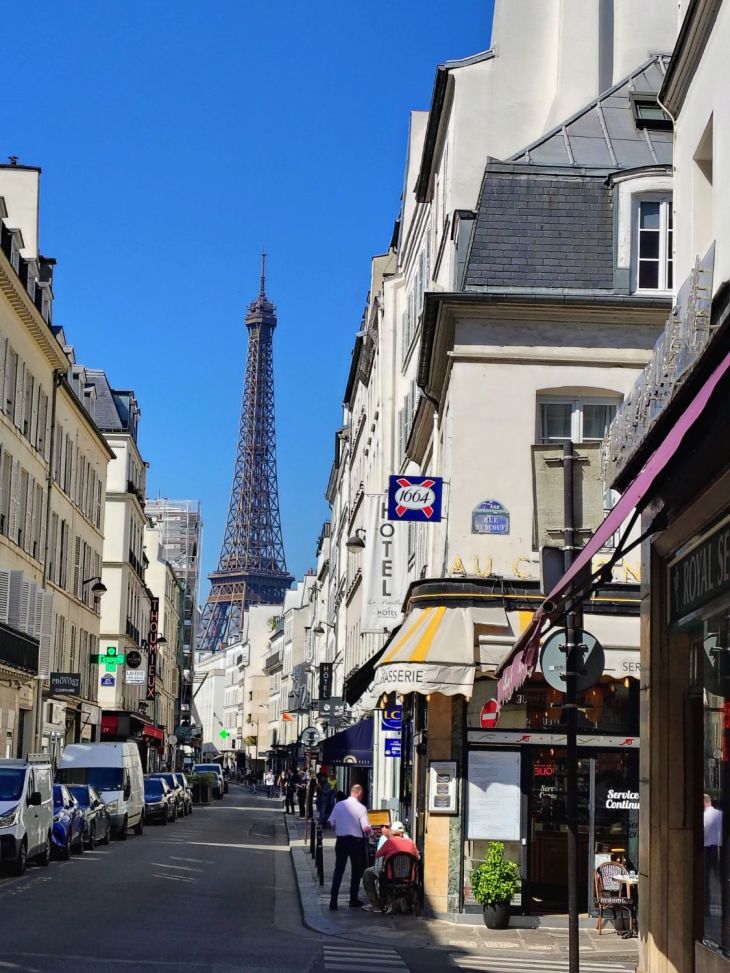
The Paris tourist office on the 7éme arrondissement de Paris : https://parisjetaime.com/eng/article/explore-paris-s-7th-arrondissement-a825
The Avenue Rapp is located in the 7éme arrondissement of Paris. It is 440 meters long, it starts at the place de la Résistance and ends up Place du Général-Gouraud. It is mainly served by line C of the RER, at the Pont de l’Alma station. This avenue was name in honor of the general of French Empire Jean Rapp, who distinguished himself during the campaign of Egypt, the Battle of Austerlitz and remained famous for having repeatedly saved life of Napoleon I , the avenue was inaugurated in 1858, and it was first called avenue du Champ-de-Mars before taking its current name in 1864 From 1894 to 1899, there was the Champ-de-Mars racecourse, where shows had succeeded the racetrack at the Pont de l’Alma, which had been forced to close in 1892. Then, left for preparatory work for the 1900 universal exhibition. The Montmartre racecourse, which opened on May 13, 1900, succeeded it. Some interesting things to see here , me think are: at no 1: mansion of the beginning of the 20C, housing the Bulgaria Embassy today. At no 20: a clock tower emerges behind the roof of the Haussmann facade. At this address, the Grands Magasins du Louvre department stores had built their administrative and warehouse headquarters in 1860. The belfry lit at night was to be visible by far converted in the 1980s, in an apartment, At no 33: building from 1898; today; the Luxembourg Embassy. The main here and see pic at no 29, the Lavirotte building , The architect Jules Lavirotte built between 1900 and 1901 this building for which he was the winner of the Façades competition in the city of Paris in 1901. He used various materials stone, stucco, sandstone and ceramics associated with plant, animals, characters and sex symbols. The building is a testimony to Art Nouveau of Parisian architecture.
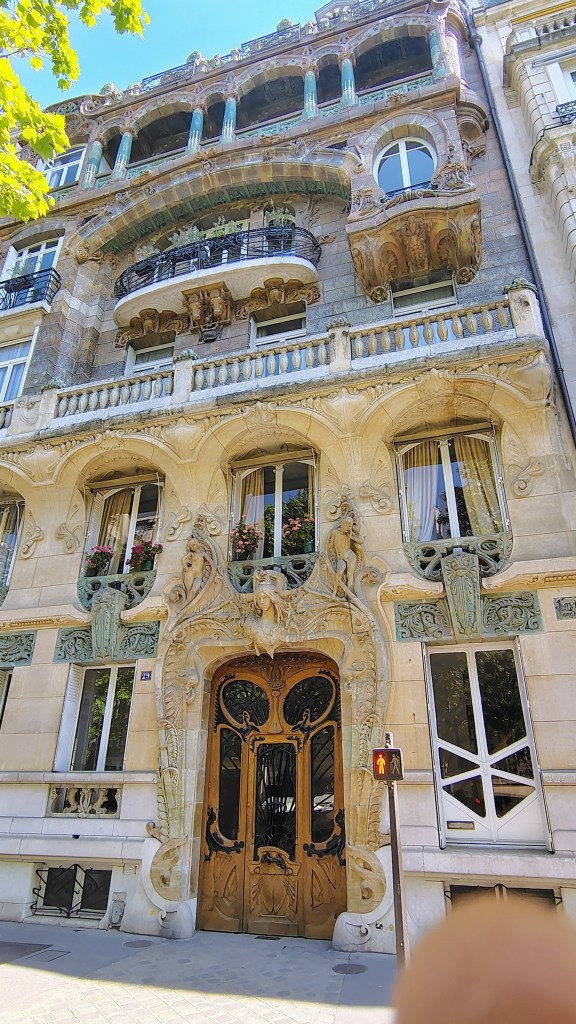
The City of Paris cultural site on the building of ave Rapp : https://www.sortiraparis.com/arts-culture/histoire-patrimoine/articles/301263-l-immeuble-lavirotte-joyau-art-nouveau-de-l-avenue-rapp-a-paris
The Paris tourist office on 20 unusual places to see in Paris, see ave Rapp :
https://parisjetaime.com/eng/article/20-unusual-places-to-see-in-paris-a1089
The rue de Monttessuy is a street in the 7éme arrondissement of Paris. It begins at 18, avenue Rapp and ends at 21, avenue de La Bourdonnais. The name of the street refers to the diplomat Gustave de Monttessuy, owner of several plots of land in the Gros-Caillou neighborhood or quartier in the 19C, who himself resided on rue Saint-Dominique. This road was opened by the City of Paris on land belonging to the Count of Monttessuy in 1857 under the name “rue Desgenettes.” By a decree of November 10, 1873, it took the name “rue de Montessuy” (with one “t”) before taking its current name (with two “t”) by a decree of February 17, 1908. See pic at end Tour Eiffel.
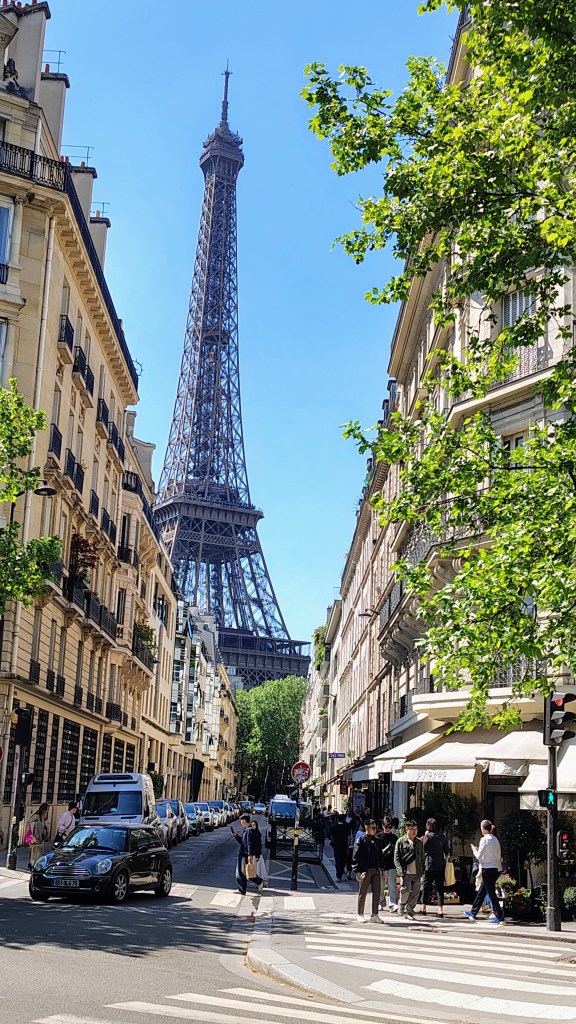
The Paris tourist office on the 7éme arrondissement : https://parisjetaime.com/eng/article/explore-paris-s-7th-arrondissement-a825
The place de la Résistance is a square in the 7éme arrondissement of Paris. The square is located on the banks of the Seine, and is joined by five avenues and one street: Pont de l’Alma; Quai d’Orsay; Quai Branly; Avenue Rapp; Avenue Bosquet; and Rue Cognacq-Jay. The square is a tribute to the Free French Forces (FFL) and the French Forces of the Interior (FFI) who fought against the Nazi occupation during WWII. This square was created in 1951 by detaching part of Avenues Rapp and Bosquet. Place de la Résistance is served by crossing the Pont de l’Alma on foot by metro line 9 at the Alma-Marceau station and by the Pont de l’Alma RER C station, Notable buildings here are at No. 1 (other entrances at 91-93, Quai d’Orsay and 26, Rue Cognacq-Jay), Art Deco building (see pic) built in 1930. The former headquarters of Météo-France was located at 1, Quai Jacques Chirac, and Avenue Rapp, was sold in early 2010 to the Russian Federation. The buildings were demolished in 2015 to build an Orthodox spiritual and cultural center on its site, including the Cathedral of the Holy Trinity of Paris. The Paris Sewers Museum is located opposite 93, quai d’Orsay.
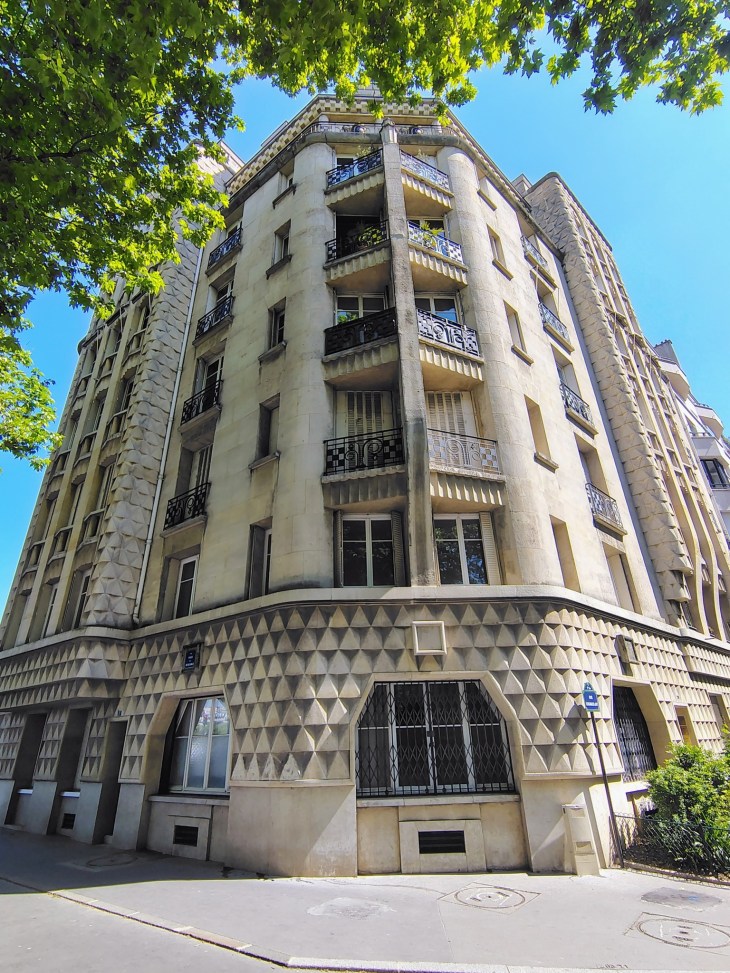
The Paris tourist office on the 7éme arrondissement : https://parisjetaime.com/eng/article/explore-paris-s-7th-arrondissement-a825
There you go folks, another dandy beautiful set of glorious streets of my eternal Paris. I have criss cross them many and have many in my blog already, Again, hope you enjoy this post on the streets of Paris, part XXII !!! as I.
And remember happy travels, good health, and many cheers to all !!!

 Paris1972-Versailles2003