
Again looking at my travels and pictures in my cd rom vault, I came upon this time that we visited several times while in living in the area you know where., I need to tell you about this off the beaten path City of Boulogne-Billancourt, worth the detour, me think for the memories of always. Therefore, here is my take on this is Boulogne-Billancourt !!! Hope you enjoy the post as I.
The City of Boulogne-Billancourt is located in the Hauts-de-Seine department no 92 in the Île-de-France region of my belle France, It is 10 km from my Gare Saint Lazare in Paris, 12 km from my former Versailles, and 474 km from my current home, Boulogne-Billancourt is bordered to the south and west by a loop of the Seine, to the east by the 16éme arrondissement of Paris, and to the north by the Bois de Boulogne . It is the first City downstream from Paris.
A former place of pilgrimage, Boulogne-Billancourt developed due to its central position between the Louvre and the royal residences around three roads, the Pavement of the King (now Avenue Jean-Baptiste-Clément), the Route de la Reine leading to the Pont de Saint-Cloud, the Green Path extended by the Route du Vieux Pont de Sèvres (now doubled by Avenues Édouard-Vaillant and Général-Leclerc). Today, the town is served by the A 13 autoroute de Normandie, bypassing it to the north between the city and the Bois de Boulogne, and the Route Nationale des Quais, connecting the Voie Georges-Pompidou to the N 118 at the Pont de Sèvres from the south. The city’s main roads are Boulevard d’Auteuil, Avenue Jean-Baptiste-Clément (RD 103), Route de la Reine (RD 907), Avenues du Général-Leclerc and Édouard-Vaillant (RD 910), Boulevard de la République and Avenue André-Morizet (RD 50), and Boulevard Jean-Jaurès (RD 2 to Route de la Reine).Glorious many times driven in these roads lots of memories flashing as I write, Boulogne-Billancourt is served by two lines of the Paris metropolitan network. The center and south of the town are accessible from the Marcel Sembat, Billancourt, and Pont de Sèvres stations on Line 9. The other two Boulogne stations, Boulogne-Jean-Jaurès and Boulogne-Pont de Saint-Cloud, on Line 10.
The Albert Kahn Departmental Museum, and Gardens, are a collection of seven landscaped gardens evoking the four corners of the globe; and the Archives of the Planet, the world’s largest collection of 180,000 cubic meters of film and 72,000 autochrome photographic documents, collected before the war by image hunters paid by grants offered by Albert Kahn. The films and autochromes can be viewed on site. Temporary exhibitions are held on its premises. The garden was created by Albert Kahn on land acquired in 1895, entrusting part of the work to landscape architects Henri and Achille Duchêne. Until 1910, he developed a series of landscaped scenes in different styles on 3.9 hectares, which together formed a staged garden, a style characteristic of the late 19C. Albert Kahn believed in universal peace.
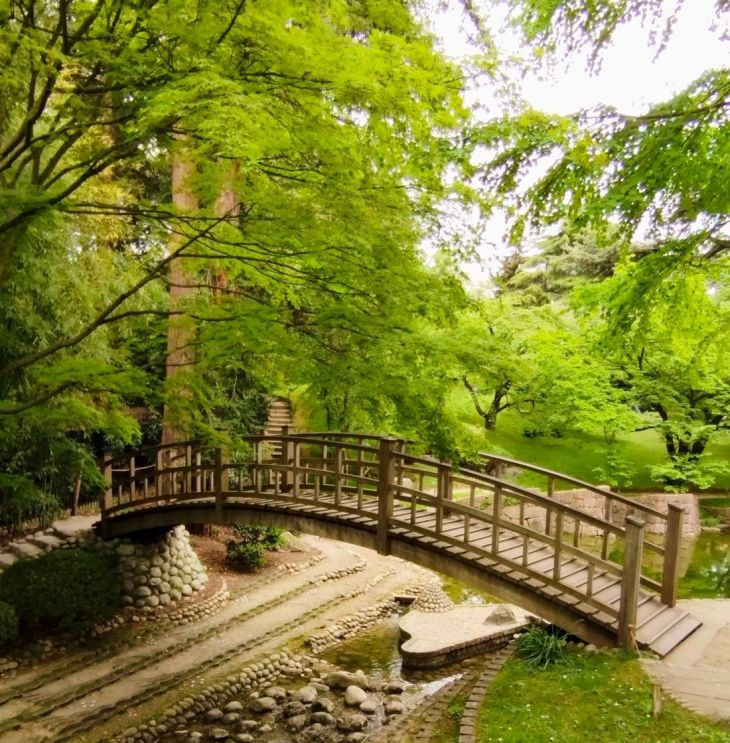
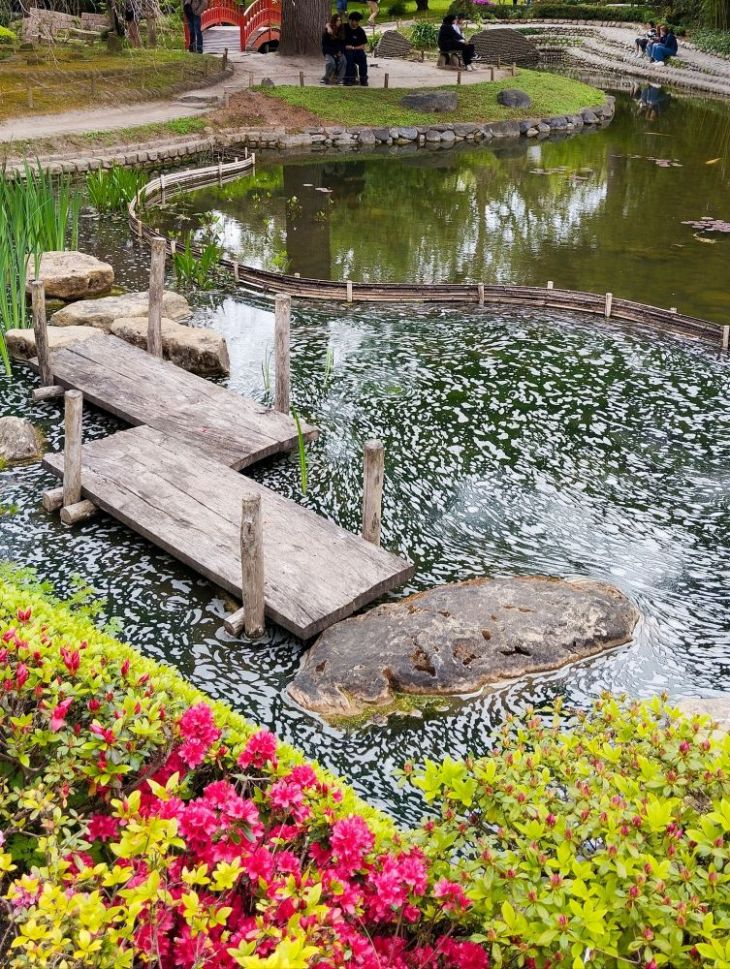
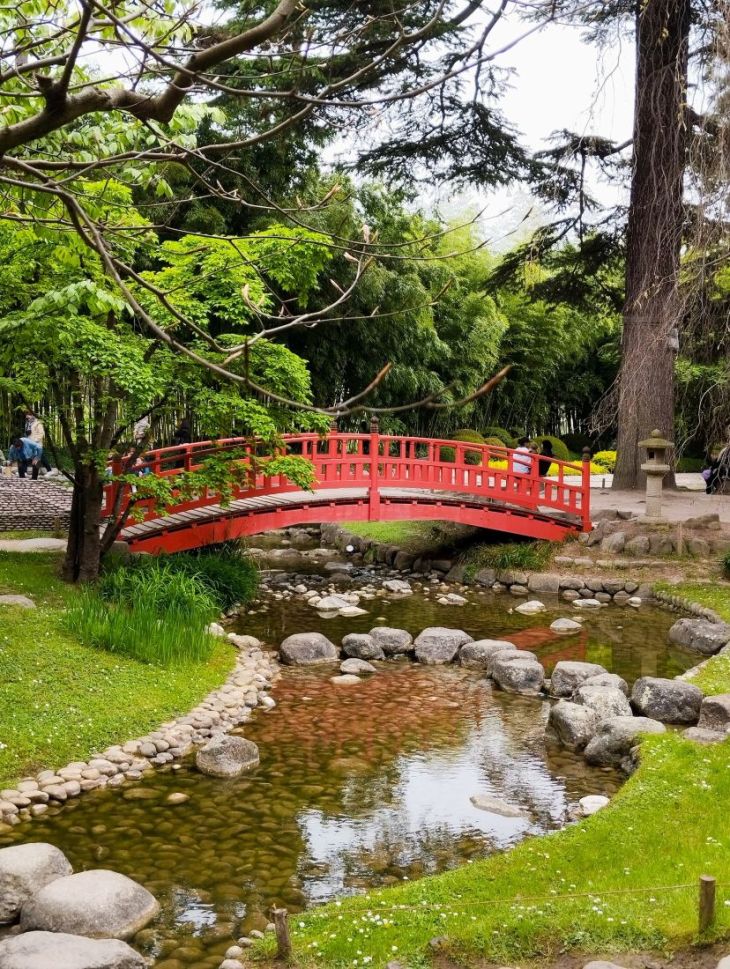
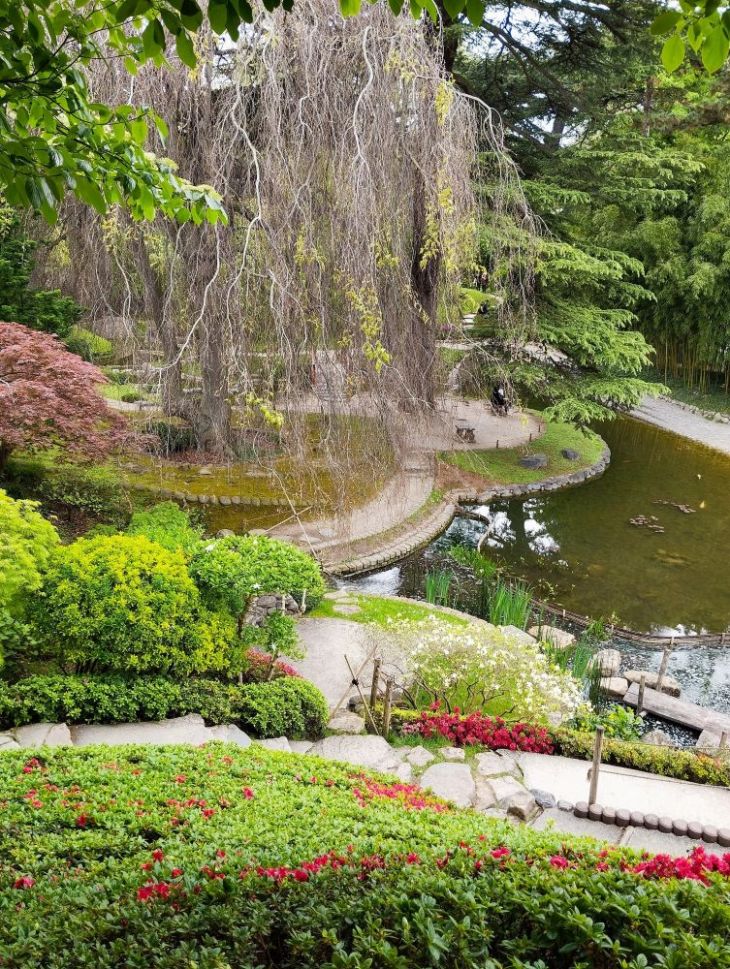
To support his utopia, he created a garden made up of several scenes reconciling the styles of each country. It consists of a Japanese village, (see pics) created in 1898, upon Albert Kahn’s return from his second trip to Japan, by a gardener and a carpenter-mason from that country. From his trip to Japan in 1897, Albert Kahn brought back, in pieces, two houses as well as the gates and a tea pavilion replaced in 1965 and inaugurated in 1966 by the Society of Tea Masters of the Urasenke School of Tea Ceremony, in collaboration with the city of Kyoto (tea ceremonies are still practiced there); a modern Japanese garden,(see pics) which partially replaced the first garden in 1990, with its two wooden bridges, its azalea-covered mountain (evoking Mount Fuji), and its pebble banks designed by landscape architect Fumiaki Takano. In homage to Albert Kahn, F. Takano organized his garden around a stream that evokes the banker’s life and work, from birth (a cone of pebbles) to death (a spiral); a French-style garden, created in 1895 by two prestigious landscape designers of the time: Henri and Achille Duchêne; it includes a green room with symmetrical flowerbeds arranged in front of the greenhouse of a winter garden and an ornamental orchard, where clipped fruit trees (mainly pear and apple trees) are associated with old rose bushes in geometric flowerbeds; an English garden where garden factories (a cottage, a rockery bridge, a well – the only vestige of a dairy) are arranged around the perimeter of a vast undulating lawn through which a river winds. Very large trees present a wide variety of species (sequoia, ginkgo, hemp palms, tulip trees, etc.), testifying to Albert Kahn’s taste for plant richness; a Vosges forest reminds the banker of the landscapes of his childhood. The 3,000 m² site, planted with pines and spruce, recreates the Lorraine side of the Vosges mountains, dotted with granite boulders, while the Alsatian side of the Vosges is organized around a valley dotted with sandstone blocks. This part of the site suffered greatly from the 1999 storm and has benefited from exemplary restoration; a blue forest presents a group of Atlas cedars and Colorado spruces whose needles form a gray-blue plant screen contrasted in spring by azalea and rhododendron flowers. The whole evokes a plant tableau devoted to color, in the center of which a marsh, a double body of water decorated with aquatic plants, allows for plays of light; and a golden forest and its meadow of tall grasses mixed with perennial flowers are planted with birch trees which take on golden hues in autumn.
Some other things to see, which are many and worth a look , me think are the Notre-Dame-des-Menus Church, built in the 14C, the Saint-François-de-Sales House , Château Buchillot an 18C folly, once annexed to Château Rothschild. The three buildings have been converted into the Paul Belmondo Museum. Château Rothschild was built from 1855 to 1861 in the Louis XIV style at the request of the banker James de Rothschild. It was surrounded by splendid French and English gardens on thirty hectares. It was then looted by the Nazis and damaged by the Americans during WWII. Sold to Khalid Abdulaziz Al Ibrahim, it is now completely abandoned, in ruins, the City/Town Hall was inaugurated in 1934, The Church of Saint Nicholas the Wonderworker is one of ten tiny Orthodox churches built between the two wars by White Russians fleeing the 1917 Russian revolution. Built in 1927 with funds collected from Russian workers in the Renault factories, it was the active cultural center of the approximately four thousand Russians of “Billancoursk” who wanted to perpetuate in exile the holy Russia annihilated on its territory. Destroyed by the Allied bombings of April 1943, it was not rebuilt until 1960, the second generation having dispersed and married into French society. Restored in 2003, the church has since housed the Saint-Nicolas choir. The Lion Fountain in Square Farman ,the Fountain of the Nymphs, Square Léon-Blum, the Bibliothèque Marmottan or Library built at the current 7 Place Denfert-Rochereau between 1890 and 1920 in a First Empire style by Paul Marmottan, a passionate collector of this period, also legatee of the Marmottan Museum, occasionally opens the archives of Napoleonic Europe for which it was designed to researchers and historians. It provides them with an auditorium for their conferences, which also serves as a concert hall for a music school , The Museum of the Thirties, or M-A30, is a municipal museum created in 1939; It presents a collection of works and art objects dating from the 1930s, including a representative part of the Art Deco movement. The Paul Landowski Museum-Garden, built underground on what remains of the gardens of the sculptor Paul Landowski’s studio, presents around a hundred small sculptures, models of his great monuments such as the Christ of Corcovado or the mausoleum of Sun Yat-sen, and drawings. This garden museum is now closed, but a Paul Landowski Museum was opened in 2017 as part of the Musée des Années Trente, Renault Museum in four rooms in a 19C mansion at 27 rue des Abondances allow visitors to explore the history of automobile factories and the Renault company through films, documents, and objects. The Paul Belmondo Museum, located in the buildings of Château Buchillot, presents the 259 sculptures and 878 drawings bequeathed by his children to the city. A medal cabinet exhibits 444 works cast by the sculptor. The Théâtre de l’Ouest Parisien (TOP), 1, place Bernard-Palissy, occupies a building which was successively the City/town hall and then the village hall ,it is today the Carré Belle-Feuille.
A bit of history tell us that its median position on the old east-west road to Versailles, on the right bank of the Seine, between the Louvre Palace and the courtyard, is the origin of its development. In 1860, the city of Paris absorbed the territory of the former villages that were located within the Thiers fortifications. The part of the former villages of Auteuil and Passy located outside the defense line was then allocated to Boulogne-Billancourt as compensation for the loss of the greater part of Longchamp, expropriated to make a racecourse and attached to the Bois de Boulogne. The City was created from the merger, under the name Boulogne-sur-Seine in 1790, of Boulogne-la-Petite, a parish established in 1343 around the Notre-Dame de Boulogne-sur-Seyne Church, and the right bank of the Saint-Cloud river. The name Boulogne-Billancourt, adopted late in 1926, marks the dismantling, in favor of the 16éme arrondissement, of the vast territory of Longchamp and the Bois de Boulogne, and the addition, granted in 1860 as compensation, of Billancourt, away from Auteuil, Boulogne was apparently destroyed during the Hundred Years’ War and began to develop again when Francis I settled in the Château de Boulogne north of Longchamp, then part of Boulogne territory. After the Fronde and the transfer of the Court to Versailles, connected by a new bridge, then to Saint-Cloud under the Regency and until the Queen moved to the same château, who also had her road built in 1760, courtiers going to or returning from Paris by these new roads covered the parish with holiday resorts like the old manse of Billancourt. During the French Revolution, the village of Boulogne la Petite was enlarged by almost a third by acquiring the territory that Saint-Cloud had owned along the right bank of the Seine and the city adopted the name Boulogne-sur-Seine in 1790. Very fashionable under the Consulate and the First Empire, the city urbanized in the 19C and was reduced by Longchamp under the Second Empire (Napoléon III), then enlarged in 1860 by the Parc des Princes, designed by Haussmann, and Billancourt, designed by Baron de Gourcuff. The fighting and Prussian occupation following the siege of Paris during the war of 1870 ruined Boulogne. However, it would not be until 1926 that it adopted the name Boulogne-Billancourt.
The City of Boulogne-Billancourt on its history/heritage : https://www.boulognebillancourt.com/ma-ville/histoire-et-patrimoine
The Boulogne-Billancourt tourist office on the museums : https://otbb.org/musees/
The official Albert Khan museum : https://albert-kahn.hauts-de-seine.fr/en/
There you go folks, a nice very residential town with a nice history and beautiful architecture all over, worth the detour. Boulogne-Billancourt is one to know, and glad now fully in my blog. Again, hope you enjoy the post on this is Boulogne-Billancourt as I.
And remember, happy travels, good health, and many cheers to all !!!

 Paris1972-Versailles2003
This made me thinks of my youth. I think the adress of the Club Dorothée studios or offices ended with “Boulogne-Billancourt Cédex”. 😀
LikeLiked by 2 people
Ah yes could be , thanks for stopping by Cheers
LikeLiked by 1 person