
I am becoming sentimental again, and this is a town of memories on my road warrior mode in my belle France. I like to tell you a bit on the town of Jouy en Josas. A passing memory but as everything in my blog, part of my life’s history that should be here. Therefore, this is my take on this is Jouy en Josas !!! Hope you enjoy it as I.
The town of Jouy-en-Josas is located in the Yvelines department,no, 78, in the Île-de-France region of my belle France. Jouy is drained by the Bièvre, a tributary of the Seine River. It is 4 km from Versailles, 19 km from Paris, 22 km from Saint-Germain-en-Laye, and 463 km from our current home. The A86 borders the town, and through Paris with the RN 118. We used to come here by the Avenue de Sceaux, to take the Rue du Maréchal Leclerc ( D10) towards St Cyr l’école but took a left on Rue du Maréchal Joffre (D91) to connect with Rue du Maréchal Juin to connect with the N12 which continues to exit 2 Rue Charles de Gaulle ( D446) Go next roundabout and return on same D446 road to castle right hand side and the museum, and if continue into the town on rue de la liberation we reach the grand école HEC.
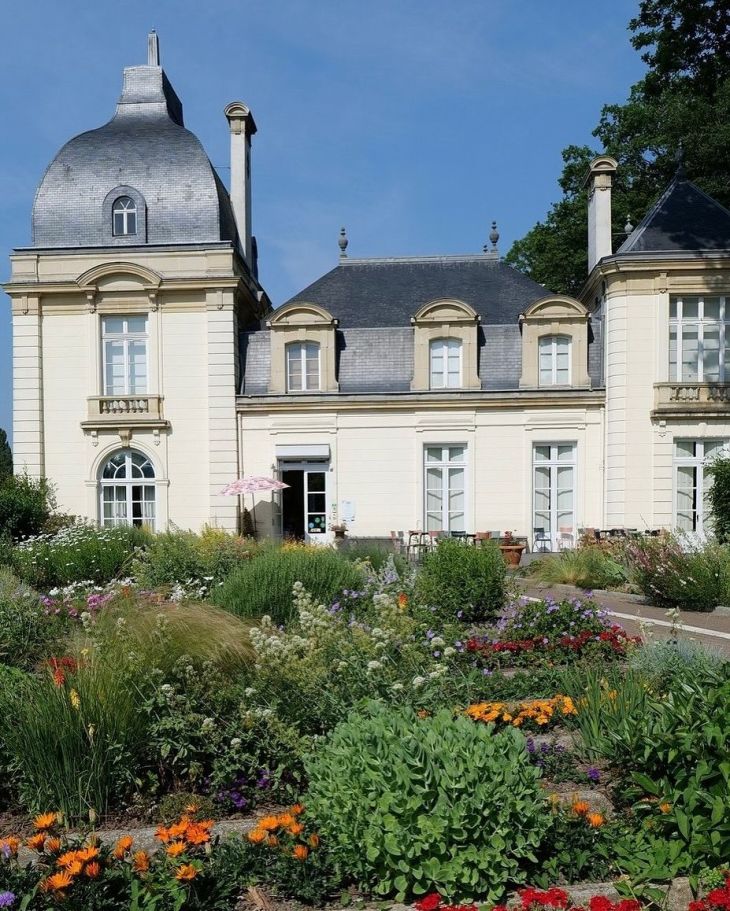
The musée de la toile de Jouy museum, 54 de la rue Charles-de-Gaulle, located within the Château de l’Églantine. The castle was built in the mid-19C by Marshal of the Empire François Certain de Canrobert. However, the current building was built in 1891-1892, after the Marshal had sold it. It was therefore built later for one of the owners, Mr. Viennot, a municipal councilor and head of the cantonal battalion. The property took the name “l’Églantine” upon Viennot’s death, his wife calling herself “Viennot d’Églantine”. In 1979, the town of Jouy-en-Josas purchased this estate from the SCI de l’Eglantine, which in 1991 became the Musée de la Toile de Jouy. Built on a U-shaped plan, this building, despite its small size, offers a wide variety of styles. The central section forms an L-shape with a raised ground floor and a pristine white attic. Its central section is flanked by two pavilions with slate roofs, one of which is rounded, known as an imperial roof, and the other rectilinear, known as a pavilion. When the municipal council considered the possibility of purchasing the property in 1975, one of the motivations was to create a Toile de Jouy museum there. Since 1991, the castle has housed the Toile de Jouy museum, created in 1977, dedicated to the printed canvases produced by the Oberkampf factory. These printed canvases, very fashionable in the 18C, were known as Toile de Jouy. Visitors can discover the printing equipment and old drawings used to make Toiles de Jouy, as well as wooden boards, copper plates and rolls, dyes and screen printing frames used to print this canvas from 1760 to 1843. Rare copper plates used to print Toiles de Jouy can be seen at the Lambinet Museum in Versailles (see post). The designs that make up Toiles de Jouy can be divided into two categories: floral canvases and narrative canvases. There, you can see collections of Toiles de Jouy (Indians and figure canvases), printing equipment and old drawings. The Manufacturer’s family, their living environment, their memories, are not forgotten: 18C furniture, precious objects and wardrobe evoke the world of Christophe-Philippe Oberkampf. The Oberkampf factory’s very comprehensive collection of toile de Jouy is complemented by a vast collection of 18C printed textiles. Visitors will have the pleasure of discovering chintz imported from India in the 1760s, but also productions from Oberkampf’s French competitors based in Nantes, Normandy and Alsace. In addition to examples of contemporary costumes made with toile de Jouy and a collection of works by great French artists exhibiting dresses as they were worn in the 18C, magnificent objects from the Oberkampf family collection are also on display. Worth the detour !
Other things to see here, me think are the parish Church of Saint-Martin is rustic in style and is notable for its bell tower. It was rebuilt in 1545, but the triumphal arch and the bell tower are from the 13C. Inside, one can admire very beautiful statues and sculptures, in particular a large Virgin and Child in polychrome wood from the 12C, mentioned in the 16C as the object of the pilgrimage of “la Diège”, a popular Frenchification of the abbreviation Dié Ge from the words: Dei genitrix; it was in the chapel of the Viltain farm until its destruction around 1780; 1.42 meters high, it is veiled, crowned, seated on a seat (restored) with Jesus standing between her legs, his feet carried by two angels; She holds a rose in her hand, while the child Jesus blesses, according to the Latin form, the World whose ball she holds in her left hand. It was restored by Viollet-le-Duc; a stone sculpted group of Saint-Martin sharing his cloak. The church also preserves a painting from the 19C: Christ Relieving the Unfortunate, The organ dates from the 19C, and was renovated in 2006. The Château de Jouy belonged to Jean d’Escoubleau in 1543. It included a main building, probably U-shaped, since it mentions three covered galleries on terraces along the courtyard of the castle. It was acquired in 1719 by the Marquis d’Asfeld, then owned by Antoine Louis Rouillé, eldest son of Louis Rollin, advisor and minister to Louis XV, who bequeathed it to his daughter Marie Catherine, married to the Marquis de Beuvron. It then enjoyed a prosperous period until the French revolution when it was demolished, then rebuilt in the early 1800s by Armand Seguin, a supplier to the army. In 1841, it was bought by the banker James Mallet, husband of Laure Oberkampf, who died there in 1868 and it remained in the family until its acquisition in 1955 by the Paris Chamber of Commerce to establish the HEC campus there. This is one of the most prestigious of French schools and one of my Franco-American friends, was assistant director there which we visit the school as well as her house in Marly le Roi, The château de Vilvert castle was built for Baron Cabrol de Mouté , husband of Louise Mallet , granddaughter of Oberkampf, and mayor of Jouy from 1868 to 1879. The castle served as an ambulance (i.e., a first aid post) during the Franco-Prussian war of 1870. It has been the property of INRA since 1946 and cannot be visited, but worth the look me think,
A bit of history I like tell us that Josas was the name of one of the two vici composing the ancient country of Hurepoix, the other being to the northeast the country of Châtres currently called Arpajon. It was an ecclesiastical district, one of the three (archdeaconries) of the bishopric of Paris, attested in the Latinized forms Archidiaconus Josiacensis in 1352 and French Josays in 1525. They occupied the first rank of the chapter of the cathedral, after the dean and the great precentor. The archdeaconry of Josas itself included two deaneries, that of Châteaufort and that of Montlhéry. Various discoveries attest to a Gallo-Roman presence in various places in the town, whose name is that of the Roman owner of an estate at the time of Diocletian, Antoine d’Aquin , personal physician to Louis XIV, superintendent of mineral waters in France, became lord of Jouy from 1684 to 1701, when he sold it to his son-in-law. It was in his château in Jouy that the treaty of reversal of the Alliances (called the Treaty of Jouy then the Treaty of Versailles) was signed on May 1, 1756, which united France with Austria. Marie-Catherine de Rouillé, lady of Jouy, married in 1749 Anne-François d’Harcourt , Duke of Beuvron, lieutenant-general of the king’s armies for Normandy. The last lord of Jouy, he rented a mill and land to Oberkampf to establish his factory. In 1759, Christophe-Philippe Oberkampf, an entrepreneur of German origin, settled in Jouy-en-Josas to establish his toile de Jouy factory (see above). He became its first mayor in 1790. The decline of the company began in 1799 and especially in 1815 with the fall of Napoleon I and then the death of Oberkampf. Bankruptcy was complete in 1843. The town is also the headquarters of HEC Paris,(see above) which established its campus in 1964 in the castle and its grounds, purchased in 1955 from the Mallet family by the Paris Chamber of Commerce and Industry to install its school and campus there.
The official musée de la toile de Jouy : https://www.museedelatoiledejouy.fr/
The town of jouy en Josas on the museum : https://www.jouy-en-josas.fr/musee_toile_jouy.aspx
The Jouy en Josas tourist office on the museum : https://www.jouy-en-josas-tourisme.fr/fr/fiche/790653/musee-de-la-toile-de-jouy/
There you go folks, as said my blog is my life’s history ,here is a bit more of it, An off the beaten path city of my belleFrance, worth the detour for the history of it, me think. Again, hope you enjoy this post on this is Jouy en Josas !!! as I
And remember, happy travels, good health, and many cheers to all !!!

 Paris1972-Versailles2003