
I am back with new pictures from my cd rom vault that should be in my blog for you and me, This is always a memorable spot for my family, for the memories, the happy times, and arts, architecture and history of my belle France. Again ,I have written before but always worth more on this jewel of Normandy. The City of Rouen is in department no, 76 of Seine-Maritime in the region of Normandie, and in my belle France. Therefore, here is again ,my take on the Cathédrale Notre Dame of Rouen, part III !!! Hope you enjoy the post as I
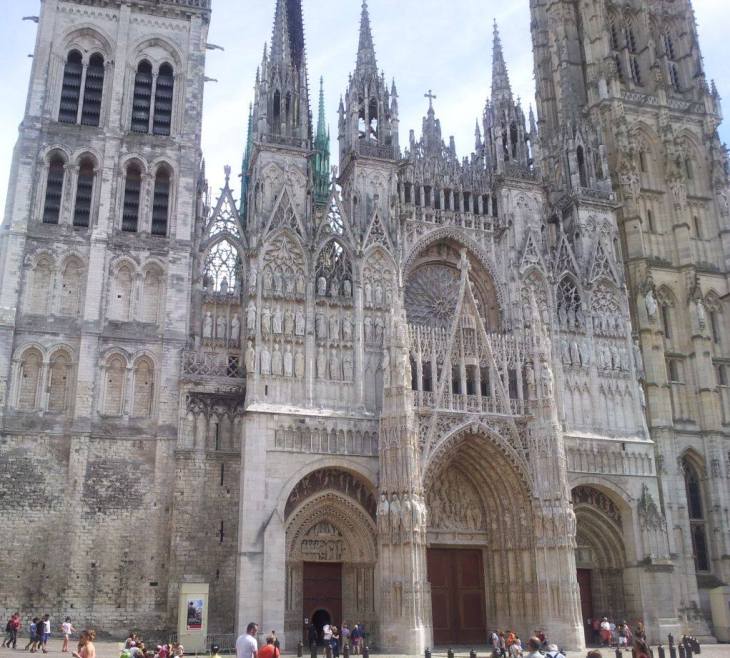
The Cathédrale Notre Dame de Rouen, is a marvel, its gothic architecture inspired Claude Monet, with an arrow as high as 151 meters (498 ft), the highest in France. The tour Saint Romain of 77 meters high (254 ft) at the north face and the tour de Beurre of 80 meters (264 ft) in its south face. Just a marvel inside and outside, a must to see, me think. The Cathedral Notre-Dame de Rouen is the highest in France and was the highest building in the world at the time of its completion in 1876, and will remain until 1880, it is also the cathedral which, by the width of its western facade of 61.60 meters , holds the record of France. Awesome !!
The portal Saint-Jean in the north is the only tympan that is intact. The tympan is divided into two parts, represents events of the lives of St. John the Baptist and St. John the Evangelist. The upper part represents the mysterious passage of St. John the Evangelist. The lower register, from left to right, tells the feast of Herod, the dance of Salome and the decollation of Saint John the Baptist. Between the broken arch and the discharge arch, in the upper tympan of the gate, is the baptism of Christ in the center and the details of the life of Saint John in Chinese shadows. The portal Saint-Étienne is unrecognizable on the portal of the same name in the south. Its tympan is divided into two parts: a Christ in Majesty in a mandorla that welcomes faithful and pilgrims because he was not mutilated by the Protestants, and under the stoning of St. Stephen. The configuration of the tympan such as the glorious Christ in the skies, surrounded by angels, on the upper part, and St Stephen stoned by his executioners in the presence of Saul, illustrates the story of the Martyr of Saint Stephen.
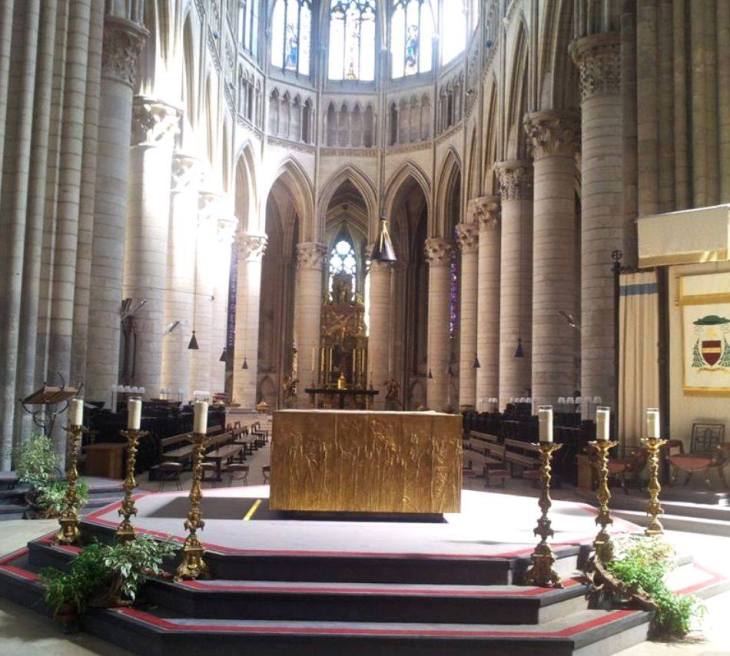
The choir, very homogeneous, dates from the middle of the 13C. One immediately notices the round pillars or drums which contrast with the fasciculated piers of the nave and the transept. The choir thus gives off an impression of elegance and lightness. The apse is on three levels, leaving a large space for the windows, which contributes to the luminosity of the sanctuary. The fourteen piers of the choir are decorated with fairly simple capitals: foliage crosiers and human heads for each, except for three capitals near the transept which are decorated with a beautiful row of celandine leaves decorated with a human head,
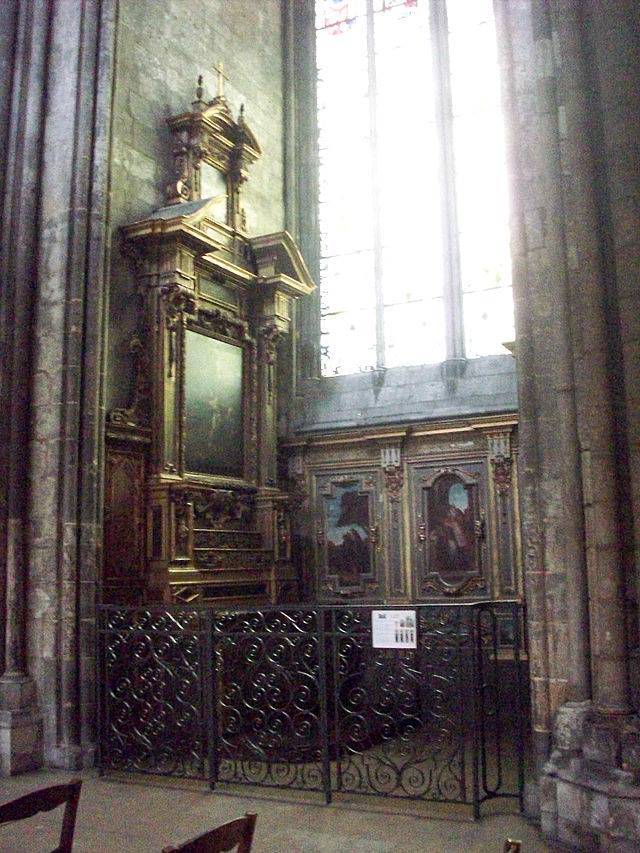
The Chapelle Sainte-Catherine is the only one to have survived the bombardment of April 19, 1944. Its flying buttresses held firm under the force of the explosions. Thanks to them, the nave did not collapse. This small chapel is richer than the others. The altar, the altarpiece, and the paneling are 17C. and painted panels depicting the life of Saint Brice, Bishop of Tours in the 5C. In the center of the altarpiece, one can see a beautiful 16C painting illustrating the Flagellation. The stained-glass window of this south chapel is the only one that managed to survive the extensive restorations of the 19C. The Corpus Vitrearum indicates that only Saint Nicholas can be attributed to the 15C.
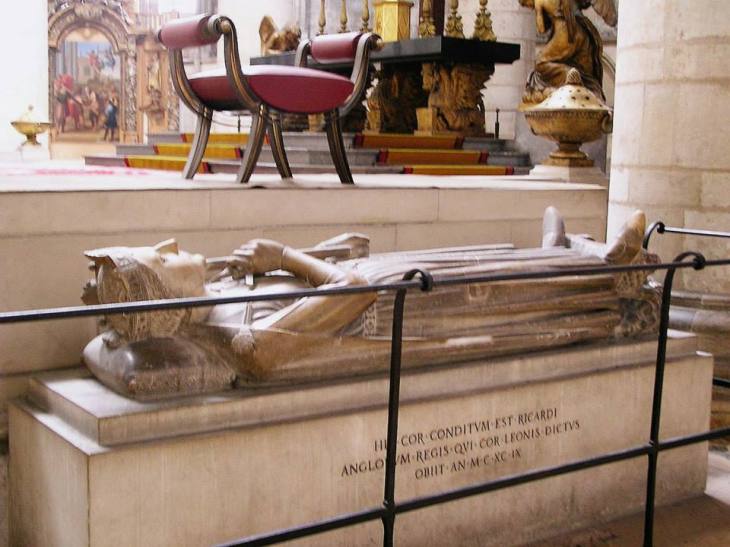
The story goes that his heart, brains, and eyes were placed in the cathedral of Rouen, the capital of Normandy, where he was Duke. According to some chronicles, his entrails awaited the hour of vengeance in the church of the Château de Châlus Chabrol; according to others, they were in Rouen. Then, in accordance with his last wishes, his body, dismembered, salted, and wrapped in cowhide, was buried beside his father in the Abbey Church of Fontevraud (see post) . His bones, extracted from his grave, desecrated during the French revolution, were never found. You see in the picture, the13C recumbent tomb figure of Richard the Lionheart. The tomb was restored in the 19C. His recumbent figure has a lion at his feet, a symbol of resurrection. It is a psychopomp, an animal that must carry the soul of the deceased to heaven. With a particularity ,it is as far as I can find the only recumbent statue listed in France to have a scene sculpted under its psychopomp. We see a dog symbolizing good governance chasing a rabbit embodying lust and a small dragon representing Evil, while a dove of peace arrives. That of Richard the Lionheart contained his heart, the lead reliquary of which is preserved with the cathedral’s treasure. His epitaph Richard I, called the Lionheart (8 September 1157, Beaumont Palace in Oxford – 6 April 1199, Château de Châlus-Chabrol) was King of England, Duke of Normandy, Duke of Aquitaine, Count of Poitiers, Count of Maine and Count of Anjou from 1189 until his death in 1199. On March 23, 1199, Richard besieged the castle of Châlus-Chabrol, owned by Viscount Adémar V of Limoges , known as Boson. On the 26th, the king was hit by a crossbow bolt. The author of the shot is not identified with certainty. The bolt was removed but gangrene set in. Richard died on April 6, 1199, eleven days after his injury. His body was buried in the Abbey of Fontevraud, his embalmed heart was enclosed in a reliquary and buried in a tomb surmounted by a recumbent effigy in Rouen Cathedral, and his entrails were placed in the church (currently in ruins) of the castle of Châlus-Chabrol. This division of the body into multiple burials is a practice initiated in the mid-11C by knights and sovereigns of the Kingdom of England and the Holy Roman Empire who died on crusade or far from their chosen burial site.
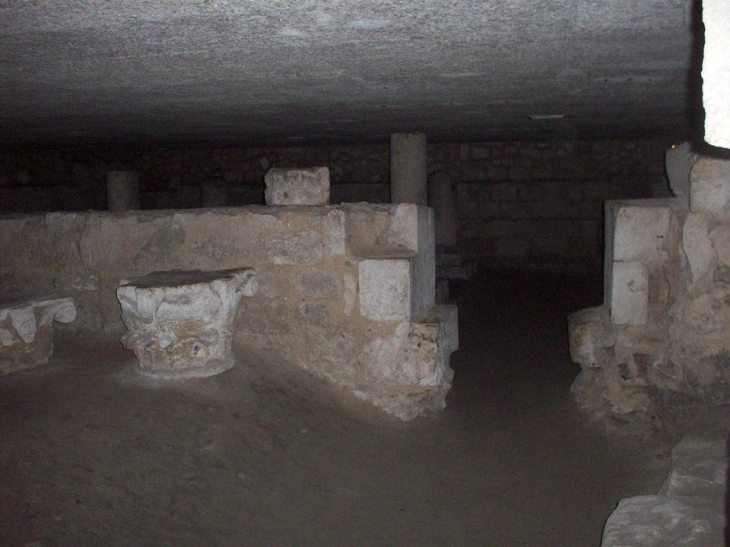
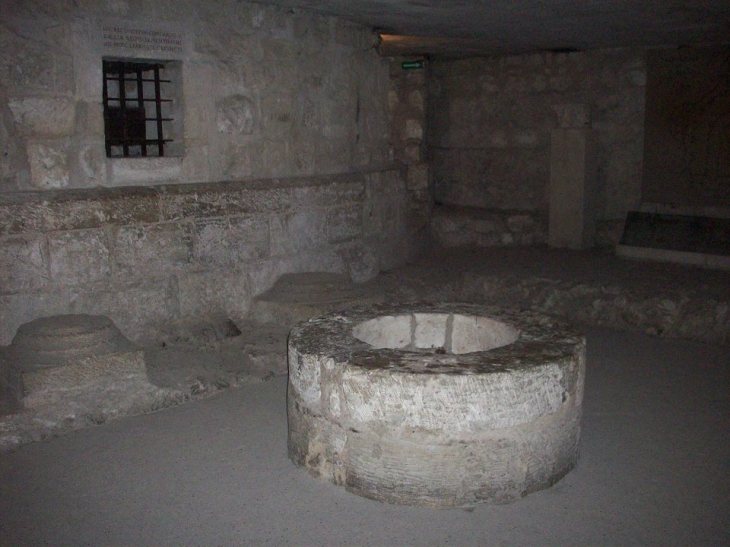
The rectangular crypt access to the crypt is from the Chapele of Sainte Jeanne-d’Arc, in the southern transept. Leveled and filled during the reconstruction of the Gothic choir at the beginning of the 13C, the first evidence of the existence of this crypt was provided in the 19C, by the discovery of remains in the northern part of the ambulatory and in the north arm of the transept. From 1935, the cleared crypt allowed the celebration of Mass. During the restoration work following the destruction that the cathedral suffered from the bombings of WWII, the excavation of the crypt was undertaken. It was developed in 1956. It was at this time that the rectangular crypt was discovered. To preserve it, a concrete slab was poured on which rests the floor of the choir, allowing these remains to be preserved. The rectangular crypt retains capitals dating from the 1150s, which are believed to be remnants of a reconstruction of the nave. The rectangular crypt was separated from the ambulatory, which opened onto three radiating apses. A fragment preserved at the Departmental Museum of Antiquities of Rouen shows the crypt’s paving in the 11C in stone and marble.
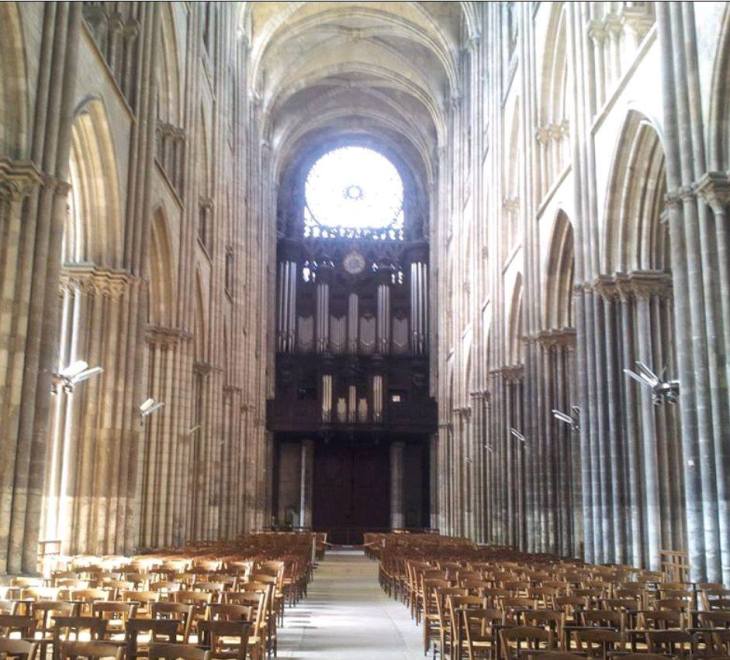
The gallery organ, story tell us that according to a 14C text, Rouen Cathedral holds the honor of possessing one of the first organs in France. It was reportedly destroyed in the fire of 1514. Even before this date, Archbishop Robert de Croismare had a larger organ built on the gallery, on the reverse side of the west façade. A hurricane destroyed it in 1683, leaving no hope of restoration. In 1686, the chapter commissioned organ builder Robert Clicquot to build a new instrument. As for the organ case, the order fell to the Parisian carpenter Joseph Pilon. This case still sits enthroned beneath the west rose window. It therefore dates from the late 17C. The organ underwent major renovations at the end of the 18C.
The official Cathedral of Rouen: http://www.cathedrale-rouen.net/site/index.php
The Rouen tourist office on the Cathedral: https://en.visiterouen.com/heritages/history/the-cathedral-intimate-and-flamboyant/
The city of Rouen on the Cathedral: https://rouen.fr/cathedrale-notre-dame
The Seine Maritime dept 76 on the Cathedral of Rouen: https://www.seine-maritime-tourisme.com/en/touristic_sheet/cathedrale-notre-dame-de-rouen-rouen-en-5132815/
This is a city to walk in its history and architecture superbe examples of my belle France over the centuries. The Notre Dame Cathedral is awesome, a must just to see it alone. It is an emblematic monument of Rouen, Again, hope you enjoy this post on the Cathédrale Notre Dame of Rouen, part III !!! as I
And remember, happy travels, good health, and many cheers to all !!!

 Paris1972-Versailles2003
💜
LikeLiked by 1 person
I lived in Normandy for two years when I taught English abroad, and I would make frequent trips to Rouen for bureaucratic appointments, as well as to visit. Such a gorgeous little city, with an impressive cathedral!
LikeLiked by 1 person
Yes indeed, is one of our favorite cities too. Thanks for stopping by Cheers
LikeLiked by 1 person