
This is a pleasant road warrior ride in beautiful countryside in the Normandie region, We had visited many times over the years and always looking forward to be back, eventually, Again, looking in my cd rom vault found me this picture that need to be in my blog for you and me, This one is in Falaise in the dept 14 of Calvados in the region of Normandie and in my belle France, The town is 38 km from Caen, 73 km from Alençon, 131 km from Rouen,189 km from Versailles, and 342 km from my current home, The town is served by the N158 and the A88 linking Caen to Alençon where it joins the A28. However, we came on the A13 autoroute de Normandie to Caen, and then then the N158 to center town on the D511 and castle, It is rare do not have more of this historical castle,
Let me tell you a bit on the Château de Falaise aka Château Guillaume-le-Conquérant in Falaise,The castle was where the future William the Conqueror was born and which was one of his main residences, is both a stronghold and a symbol of princely power and the cradle of the Anglo-Norman dynasty. The castle, owned by the town, I took one of my road warrior swing but memorable ride and wonderful property that needs to be visited more in depth, eventually,Therefore, here is my take on the Château Guillaume-le-Conquérant !!! Hope you enjoy the post as I.
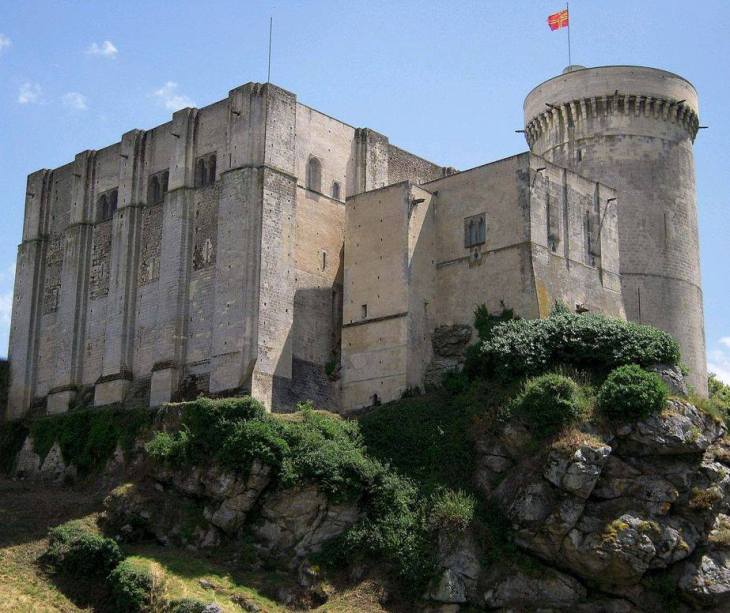
The first traces of stone fortifications, partly dressed in a herringbone style, date from the 10C, which makes the Falaise Castle one of the first Norman stone castles. A first masonry enclosure from the beginning of the 11C, between 1019 and 1023, perhaps under Richard I of Normandy, but more likely under his son, Richard II. It was also in 1027-1028 that William II of Normandy, the future William the Conqueror, was born at the castle. Henry I Beauclerc, the youngest son of William the Conqueror, in 1106, after the Battle of Tinchebray, proclaimed himself King of England and Duke of Normandy, and had to rebuild Normandy and its castles in order to face numerous enemies, allied with his brothers, and undertook a large campaign to reinforce the ducal castles. In Falaise, he consolidated the city and castle walls, and had a chapel dedicated to Saint Nicholas built in the castle’s bailey. Around 1123-1125, the latter undertook the construction of a large keep-palace with a quadrangular plan typical of Anglo-Norman architecture. Henry I’s grandson, Henry II and his sons invested significant sums in the maintenance and improvement of the castle. It was Henry II who provided the enclosure with its first flanking towers, and who in the second half of the 12C, added a new construction to the large keep. It is known that the new Duke-King William spent Christmas 1159 at Falaise Castle with his wife, Eleanor of Aquitaine, and his court. In the 12C, in order to regulate the flow of the Marescot River, new locks and canals were installed, creating a vast expanse of water at the foot of the southern rampart of the castle, and the defensive system was completed by thorn hedges, palisades and moated systems. In 1174, following the Battle of Alnwick, William the Lion, King of Scotland, taken prisoner by the King of England Henry II, was imprisoned at Falaise in July 1174. It was at Falaise that John Lackland imprisoned his nephew Arthur of Brittany. Finally, the third keep was built in 1207 by the King of France Philip Augustus, following the annexation of the Duchy of Normandy to the royal domain by his army. During the Wars of Religion, the fortress was disputed between Montgomery and Marshal Matignon, and was taken in 1590 by the Leaguers.
The Château Guillaume-le-Conquérant was abandoned in the 17C, was used as a stone quarry. The upper floors of the keep were destroyed. From 1809 to 1944, the Falaise college was established within the walls of the castle, From 1864, a restoration campaign that saved the keeps from ruin. The keeps were little affected by the Allied bombings during the fighting in the Falaise pocket in WWII, which razed the modern buildings, but also the Romanesque chapel of Saint-Nicolas which was located in the center of the esplanade.The Battle of the Falaise Pocket took place in August 1944. The town, already heavily hit on June 7 by Allied strategic bombings of Operation Overlord, suffered further destruction. Between 1987 and 1997, renovations were undertaken to improve the tourist accessibility of the site and to give it a look corresponding to the 19C engravings. In April 2013, the castle was given a new scenography, focusing in particular on new technologies. Visitors can discover the interior of the castle, as it probably was in the 12C, thanks to digital touch tablets called “HistoPad”. The castle is open to visitors.
Some things to see here with more time are the Musée des automates, formerly Automate Avenue: a collection of 300 animated automatons from the 1920s to the 1960s, staged in a reconstruction of Parisian shop windows, opened on May 28, 1994. Musée André-Lemaître: it presents 90 works by the painter, born in Falaise in 1909. The Place Guillaume-le-Conquérant, on which stands the statue of William the Conqueror. Church Saint-Gervais: more than 900 years of history. Construction began in 1066 in Romanesque style, then flamboyant Gothic and Renaissance in 1570. Church Saint-Laurent, Romanesque church whose construction began in the 11C. Notre-Dame de Guibray Church ,construction started in the 11C. Trinity Church , construction started in the 13C, without a bell tower. Urban fortifications: an enclosure originally 2 km long, three-quarters of which are still visible, including the Porte des Cordeliers. Also, the Château de la Fresnaye 17C.
The official Château Guillaume le Conquerant : https://www.chateau-guillaume-leconquerant.fr/
The town of Falaise on its heritage: https://www.falaise.fr/se-divertir-sengager/tourisme/
The local Falaise Suisse Normande tourist office on the castle: https://www.falaise-suissenormande.com/en/explorer/falaise-cite-medievale-de-normandie/chateau-medieval-guillaume-le-conquerant/
The Calvados dept 14 tourist office on the Château Guillaume le Conquerant: https://www.calvados-tourisme.com/offre/chateau-guillaume-le-conquerant/
There you go folks, a wonderful road warrior ride in beautiful countryside of beautiful Normandie enjoying its pleasures of always! Worth the detour, me think, a wonderful ride into architecture and history finds. Again, hope you enjoy the post on the Château Guillaume-le-Conquérant !!! as I.
And remember, happy travels, good health, and many cheers to all !!!

 Paris1972-Versailles2003
That is what I call a castle
LikeLiked by 3 people
Indeed there are many definitions depending on the traditions of the places. Thanks for stopping by Cheers
LikeLike
💛
LikeLiked by 1 person