
The beautiful Petit Trianon of Versailles. You know if reading my blog, I lived here for 9 + years! sublime but more importantly for me , the Petit Trianon was my hanging out area, we jogged here, and ate on the little Angelina open air terrace; so many family memories. I am lucky to have found me older pictures in my cd rom vault not yet in my blog, but they should be for you and me. Do go along with me on another tidbit of this wonderful beautiful domaine , and do read my several posts on it in my blog Therefore, here is my take on the Petit Trianon of Versailles,the Chapel !!!Hope you enjoy the post as I.
The Petit Trianon was primarily a feminine domain, built for Madame de Pompadour, who died before its construction was completed. It was occupied by the royal favorite Madame du Barry until the death of Louis XV, and then served as a refuge for Queen Marie-Antoinette until the French revolution. Madame de Pompadour invited the king to immerse himself in the botanical sciences that fascinated him. Thus, at the same time as he launched work on the Grand Trianon, he created a new menagerie nearby dedicated to domestic animals, and a garden called the Jardin Français or French Garden with flowerbeds, a vegetable garden, and even heated greenhouses, innovative for the time, for growing exotic flowers and fruits. The management of these gardens was entrusted to Claude Richard ,and his son Antoine Richard . It was here that the botanist Bernard de Jussieu worked on his classification of plants, following the nomenclature established by the Swedish scientist Carl von Linné . In 1750, Louis XV asked his architect Ange-Jacques Gabriel to build a small building where he could eat in the summer while enjoying his French Garden: this is the Pavillon Français or French Pavilion, which can still be seen today at the back of the Petit Trianon. It was from here that people began to talk about the Petit Trianon and, by contrast, the Grand Trianon. In 1753, a second pavilion, the Pavillon Frais or Fresh Pavilion, was built to serve snacks. Through these small spaces and this French Garden, it is Louis XV’s desire to enjoy more privacy that is expressed here. He would receive his friends and his mistress there for dinners or less formal afternoons. Finally, in 1761, under the direction of Ange-Jacques Gabriel, construction of the Petit Trianon began. Unfortunately for Madame de Pompadour, work was not completed until 1768, four years after her death. Louis XV was then infatuated with a new mistress, the famous Madame du Barry, who would become his last mistress and the first occupant of the Petit Trianon. Built for a woman, Madame de Pompadour, and inhabited by another woman, Madame du Barry, the Petit Trianon was a feminine residence that defied the rules of protocol. Here, Louis XV thus left the noble floor to his mistress, preferring to install his apartments in the attic, on the top floor.
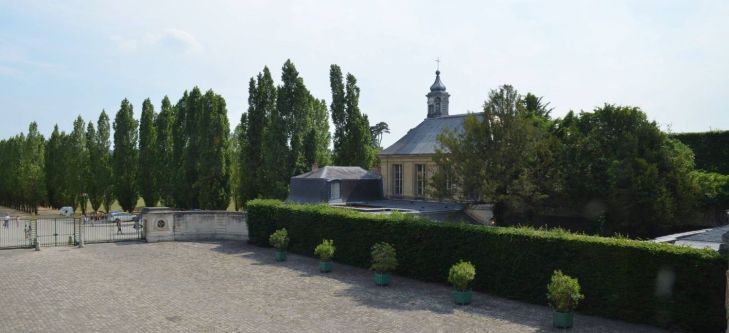
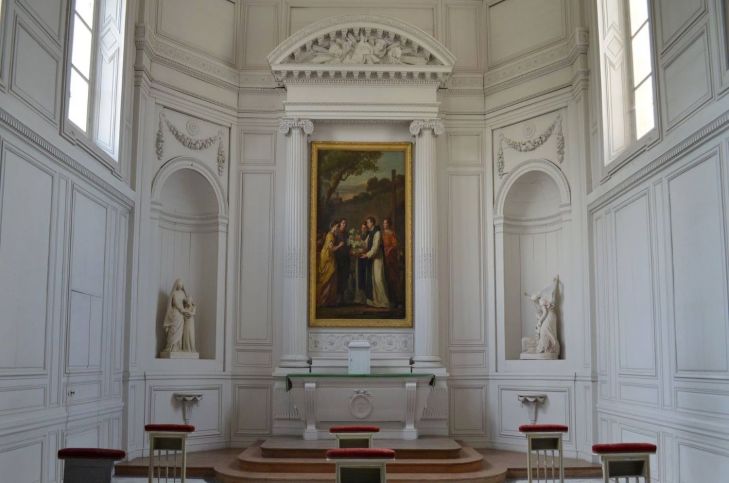
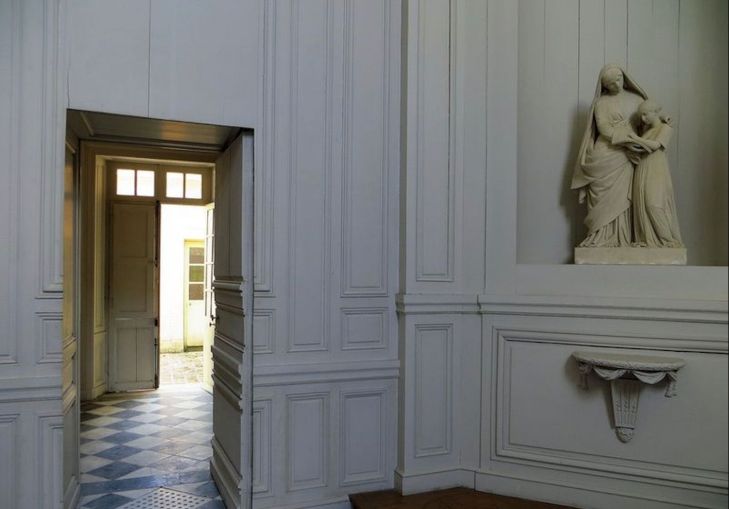
In 1772, Ange-Jacques Gabriel had a chapel built, topped with a bell tower. This would be the last addition during the reign of Louis XV, The Petit Trianon Chapel rises on two levels. Its decor is very sober; the room is lit by tall windows, two of which are painted in trompe-l’oeil, due to the presence of the adjoining outbuilding. The altar is framed by two columns and adorned with a radiant glory created by Joseph Prévôt. It is also surmounted by a painting by Joseph Marie Vien, painted specifically and installed in 1776. It depicts Saint Thibault of Marly offering Saint Louis and his wife, Margaret of Provence, an eleven-branched lily, symbolizing the posterity of his descendants. Facing the altar is a gallery, which can be accessed via the outbuildings staircase or directly from the French Garden.
But even before the king’s death on May 10, 1774, the Petit Trianon had changed hands. Indeed, in the spring of 1774, while at the Petit Trianon with his mistress, Louis XV was feeling unwell. The first symptoms of smallpox, which would kill him a few months later, were felt. Since the King of France could not die in sin, he had Madame du Barry dismissed, not without heartbreak. No sooner had she left than, on August 15, 1774, Louis XVI, who, like his wife and Louis XV’s daughters, hated Madame du Barry, presented the Petit Trianon to Queen Marie-Antoinette. The key he gave her was adorned with 531 diamonds. Marie-Antoinette became chatelaine of the Petit Trianon, and for the first time in French history, a queen became the owner. During the French revolution, the furnishings of the Petit Trianon were sold at auction. Marie-Antoinette’s small château was transformed into an inn, which saved it from destruction. Napoleon Bonaparte, in power as First Consul from 1799 to 1804 and then as Emperor of the French from 1804 to 1815, restored the Petit Trianon, which he offered to his sister Pauline in 1805. During the Restoration (monarchy 1815-1830), the estate was given to Marie-Antoinette and Louis XVI’s daughter, Marie-Thérèse of France, Duchess of Angoulême, who had survived the Temple prison. She spent little time there, the memories being too painful. Later, Louis-Philippe, King of the French and instigator of the July Monarchy (1830-48), offered the Petit Trianon to his son, the Duke of Orléans, and his daughter-in-law, Helen of Mecklenburg-Schwerin. These were the last occupants of Marie-Antoinette’s former château. During the Second Empire (1852-70), Empress Eugenie, wife of Emperor Napoleon III and an admirer of Marie-Antoinette, decided to transform the Petit Trianon into a museum in memory of the deposed queen. She had the small château refurnished in 18C style. In the second half of the 20C, and continuing to this day, the Petit Trianon has been refurnished, redecorated, and redesigned to commemorate the women who inhabited it before the French revolution. This sublime Petit Trianon, one of my favorite places in Versailles, far from the crowds of the château.
The Château de Versailles on the Petit Trianon, see Chapel: https://en.chateauversailles.fr/discover/estate/estate-trianon/petit-trianon#the-ground-floor
The city of Versailles Tourist office on the Petit Trianon : https://en.versailles-tourisme.com/le-petit-trianon.html
There you go folks, Versailles is Royal, magnificent, gorgeous, historical, architectural wonders and the history of France and the world. You need to spent more time, there are a lot of wonderful architecturally stunning full of incredible history to see in my dear Versailles. Again, hope you enjoy this post on the Petit Trianon of Versailles, the Chapel !!! as I
And remember, happy travels, good health, and many cheers to all !!!

 Paris1972-Versailles2003