
This is the BHVP or Bibliothéque National de la Ville de Paris! And if the archives were good, this is awesome! Paris here I am for an off the beaten path site that should be visited to know more about the history and architecture of my eternal Paris. I am updating this post with new pics, text and links for you and me, Therefore, here is my take on the Historical Library of the City of Paris (BHVP) !! Hope you enjoy the post as I.

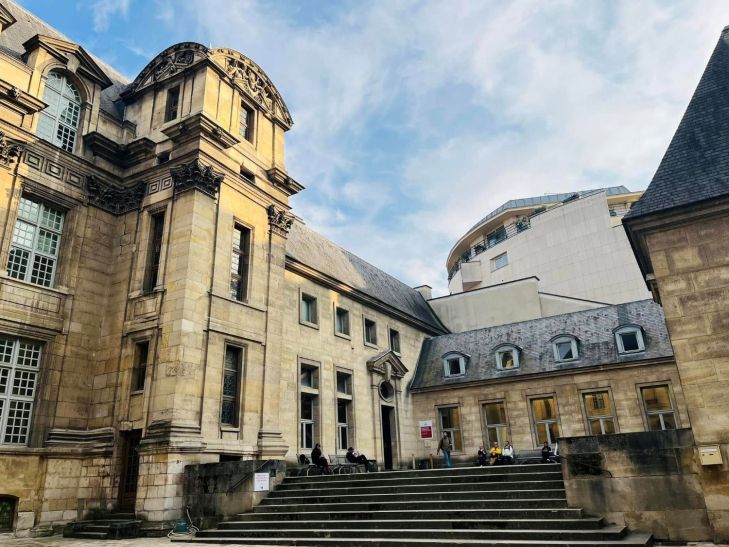
The Historical Library of the City of Paris (BHVP) is at 24 rue Pavée, but access through the garden of the Hotel Lamoignon at 25, rue des Francs-Bourgeois. Metro St Paul line 1. The library specializes in the history of Paris and the Île-de-France region . As part of the network of municipal libraries in the city of Paris, it has been located since 1969 in the Hôtel d’Angoulême-Lamoignon.
In the courtyard, a small modern pavilion keeps the memory of the first two inhabitants of the hotel: Diane de France and Charles d’Angoulême. The library collections include more than 2 million documents of all kinds, relating to the history of Paris and the Île-de-France region, literature and theater. They consist of printed books, newspapers and ephemeral documents, manuscripts, maps and plans and iconographic documents (drawings, prints, posters, postcards and photographs). A reading room with 86 seats allows consultation of documents and access to computer stations (computerized catalog, electronic resources, internet). The documents can only be viewed on site. The documents of the library can be photographed by the readers subject to their state of conservation and in the respect of the legislation on the copyright. The library organizes punctually visits and regularly presents conferences touching on such specialty of its collections .
The BHVP ,also regularly exhibits documents in the library reception windows. It participates each year in welcoming the public as part of the European Heritage Days in September. The library is open Monday to Saturday from 10h to 18h. Closed Sundays and holidays. Registration is free and gives access to the entire network of specialized libraries of the City of Paris. The reader card is issued for all adults on presentation of an identity card and the provision of an identity photograph.

A bit of history I like tell us that the first library of the City of Paris was created thanks to Antoine Moriau ; Prosecutor of the city of Paris from 1722 to 1755, collector of books and various documents in Paris, he rents the Hôtel Angoulême-Lamoignon to install his collections there, which he bequeaths to the City of Paris. The city of Paris then decides to open the city’s first public library, inaugurated on April 13, 1763 !! The library collections were completely destroyed during the fire at the city/town hall, during the Paris Commune on May 24, 1871. From 1872, this public library specially dedicated to the history of Paris was installed in the city Hôtel Carnavalet , where a museum dedicated to the historical collections of the city of Paris was created. The collections of the museum and the library being very rich, a separation is operated between the two establishments in 1898: the museum remains in Carnavalet and the library moved to a hotel later known as Le Peletier de Saint-Fargeau at 29 rue de Sévigné. The transfer of the library to the Hôtel de Lamoignon in 1968 and its opening in January 1969, after the restoration and development work marks the renewal of the library.
A bit on the Hôtel Angoulême-Lamoignon been located at the corner of rue Pavée and rue Neuve Sainte-Catherine the latter currently the rue des Francs-Bourgeois, between December 1559 and October 1560 the construction of the Hôtel de Pisseleu, which later took the names of Hôtel d’Angoulême and Hôtel de Lamoignon was done on order of François de Pisseleu, abbot of Saint-Corneille de Compiègne, Five years after the death of François de Pisseleu, his hotel was acquired by Jean Bodin, lord of Montguichet, advisor to waters and forests at the Marble Table of Paris, Jean Bodin’s hotel was acquired in 1584 by Diane de France, legitimized daughter of King Henry II of France and a young Piedmontese woman, Filippa Duci. However, the building was burdened with rents and redemption procedures for the benefit of Charles de Barbanson, heir of François de Pisseleu, and the Duchess of Étampes. These legal constraints prevented the Duchess of Angoulême from completing the work, forcing her to rent, and later purchase, a pavilion located on the other side of Rue Pavée. This legal uncertainty lasted until the early 17C. It was not until 1611 that Diane de France was able to commission the finishing work on her mansion, raising the south wing on the garden side to its final height, and the northern half of the main building with a second pavilion overlooking the courtyard, symmetrically aligned with the previously constructed structures. The contract specified that the work was to be completed by 1612.
Henry III’s nephew, Charles of Angoulême, son of Charles IX and Marie Touchet, inherited this mansion in 1619, upon the death of the Duchess of Angoulême, and lived there until 1650. The mansion was then shared among several tenants, including Guillaume I de Lamoignon, first president of the Parliament of Paris, rented it out in part, and made it a meeting place for the leading figures of his time: Madame de Sévigné, Boileau, Jean Racine, Bourdaloue, Regnard, Guy Patin, etc. The mansion was inhabited by the Lamoignons in 1688 until 1750, when Guillaume de Lamoignon de Blancmesnil left for the Chancellery of France. Antoine Moriau, prosecutor of the King and the City of Paris, driven by a passion for historical documents, rented the mansion to use as his library. Upon his death in 1759, he bequeathed 14,000 volumes to the city (prints and historical documents about Paris), which opened the collections to the public in 1763, in a historic gesture: it was the first library opened by the City. It was the residence of Alphonse Daudet for nine years, from 1867 to 1876, it was the center of literary social events;with periodic visits by Turgenev, Flaubert, and Edmond de Goncourt amongt others, The Hôtel d’Angoulême was purchased by the Paris City Hall in 1928 and then restored from 1955 to 1968 to house the Historical Library of the City of Paris, also dedicated to the history of Paris. Until now housed next door at the Hotel Le Peletier in Saint-Fargeau, it moved here in 1969.
The official BHVP : https://ccfr.bnf.fr/portailccfr/ark:/16871/0029338
The City of Paris on the BHVP : https://www.paris.fr/lieux/bibliotheque-historique-de-la-ville-de-paris-bhvp-16
The specialised libraries in Paris of which the BHVP is part : https://bibliotheques-specialisees.paris.fr/geosearch/fa7b6521-e2b6-4526-a443-0c796fc62e83
The local Paris Marais on the hôtel d’Angoulême : https://www.parismarais.com/fr/arts-et-culture/hotels-particuliers-du-marais/hotel-d-angouleme.html
There you go folks, if you are into knowing what you visit ,then a visit to the BHVP is a must, I love it and cannot get filled of information on my eternal Paris ever. highly recommended by those interested in the history and architecture of the most beautiful city in the world=PARIS! Again, hope you enjoy this post on the Historical Library of the City of Paris (BHVP) !! as I.
And remember, happy travels ,good health, and many cheers to all !!!

 Paris1972-Versailles2003