
I have heard about it ,and finally took a ride by a while back, Once again found older pictures in my cd rom vault and should be in my blog for you and me. I was on my road warrior mode in Paris and stumble onto this wonderful historical and architecturally stunning monument ,much read before in my eternal Paris.Therefore, glad to tell you about the Cité internationale universitaire de Paris (CiuP) in Paris !!! Hope you enjoy the post as I.
The Cité internationale universitaire de Paris (CiuP), built from 1923 to 1968, is a foundation which, within its 40 Parisian houses, welcomes researchers, artists and high-level athletes from all over the world. These university residences are almost all located in the south of the 14éme arrondissement, in the 34-hectare quadrilateral delimited by the boulevard périphérique (BP) ,and the boulevard Jourdan, between the Porte de Gentilly and the Porte d’Orléans. Three residences are outside this quadrilateral or “off the walls”: the Fondation Haraucourt is on the Île-de-Bréhat, in the Côtes-d’Armor dept 22 of Brittany; the Résidence Lila, inaugurated in 2005, is on avenue René-Fonck, in the 19éme arrondissement of Paris; The Quai de la Loire Residence, opened in 2007, is located in La Villette, also in the 19éme arrondissement.

The Maison Internationale is inspired by the Château de Fontainebleau (see posts). It houses the administration, a catering center, a swimming pool, gyms, a theater, a central library, conference rooms, and student housing. I got here driving on the avenue Saint Cloud /Avenue des Etats Unis (D185) then continue on D182 to connect with the A13 Autoroute de Normandie dir Paris, go by Porte d’Auteuil on the BP boulevard périphérique past Porte Saint Cloud over the Pont Aval bridge bear right on rue Romain Rolland turn right on Avenue Aristide Briand /D920 turn left on Rue Barbés/D50, turn left on Avenue Lucien Descaves go underneath the A6a autoroute ,the road becomes Avenue David Weill , and turn right on Boulevard Jourdan to main entrance on your right hand side, All toll free It is serve by public transport on the tramway line 3a at the Cité universitaire station; RER line B at the Cité universitaire station; metro line 4 at the Porte d’Orléans station; bus lines 21, 67 and 216 at the Stade Charlety – Porte de Gentilly station.

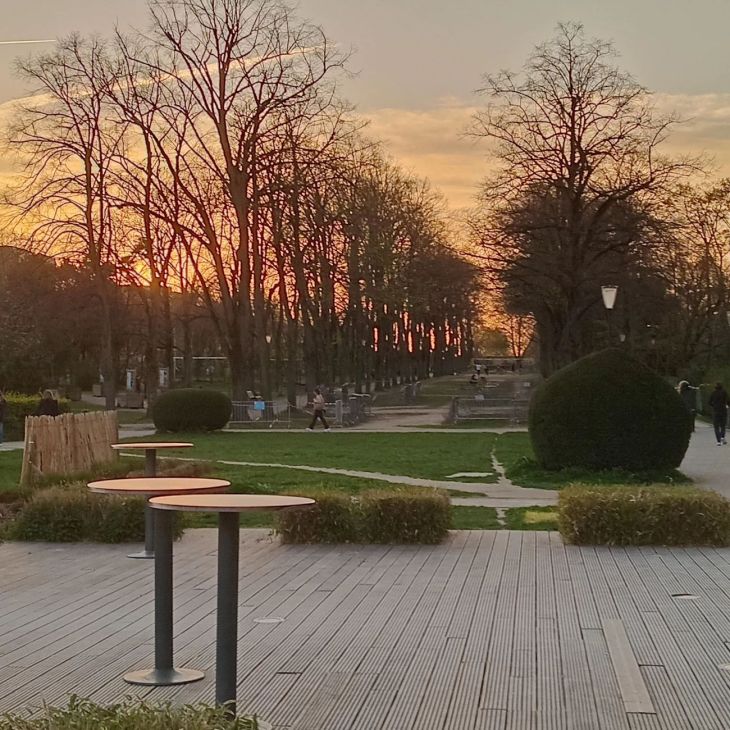
A bit of history tell us that the project for a residence for students from all over the world was born in the early 1920s from the combination of hygiene and pacifist concerns at the end of the Great War or WWI. The land chosen for the project was located to the south of the city, on the belt of the Thiers wall built in 1845. Their declassification, voted in 1919, was to allow the extension of the city: subdivision of the rampart area and development of a belt of green spaces around the city (parks, gardens, sports fields, etc.). The first student residence opened its doors in 1925 thanks to Émile Deutsch de la Meurthe, a businessman from Lorraine at the head of Pétroles Jupiter. A philanthropist, he had expressed his intention to build “garden hamlets” to accommodate 350 deserving but less fortunate students in healthy and airy housing surrounded by greenery by 1927, half of the estate was already built, financed by patrons, industrialists and foreign governments. In less than 15 years, 19 houses were built, in styles revealing the architectural eclecticism of the interwar period and the policy of cross-breeding conducted at the Cité. During WWII , the site was occupied by the Nazis and then American armies: the damage was significant. At the end of the war, the Cité internationale universitaire de Paris launched a vast restoration campaign for its estate. Thus, it returned to its pre-war state at the end of the 1950s. In 2013, in the heart of the historic city, the Indian Embassy opened the new Maison de l’Inde building, which was the first building in France with a wooden structure on 7 floors. The Cité universitaire has several theaters, which constitute one of the centers of Parisian cultural life.
One sentimental favorite which have been inside but can’t find me pictures (still looking in my vault) is the Fondation Rosa Abreu de Grancher, former Maison de Cuba, (not call anymore due to the dictatorship there) The now, Rosa Abreu de Grancher Foundation, was built thanks to a donation made in 1929 by Pierre Sanchez Abreu and his sister Rosalia Abreu, supplemented by a contribution from the National Foundation of the International University City. It is named after their aunt, Rosa Abreu, of Cuban origin, and her husband, the French professor Jacques-Joseph Grancher. The House of Cuba was designed in a Spanish colonial style, built from 1930 and opened in 1933 to host Cuban students studying in Paris.
The official Cite International Universitaire : https://www.ciup.fr/en/about-us-a-world-in-the-heart-of-paris/
The official theater of the Cité International : https://www.theatredelacite.com/
The Paris tourist office on the Cité International Universitaire: https://parisjetaime.com/eng/culture/cite-internationale-universitaire-de-paris-son-parc-cet-ses-pavillons-p3650
The Cité International Universitaire on the Fondation Abreu de Grancher (Maison de Cuba) : https://www.ciup.fr/en/discover-the-fondation-abreu-de-grancher/
There you go folks, never know where you are going to end up in Paris if you let your legs do the walking, always amazing my eternal Paris. This is another example as to why the most beautiful City in the world , history and architecture all the best, enjoy it. Again, hope you enjoy this post on the Cité internationale universitaire de Paris (CiuP) in Paris !!! as I.
And remember, happy travels, good health, and many cheers to all !!!

 Paris1972-Versailles2003