
I am taken you back to Paris, yes a never ending story, The eternal city never stop amazing me of its beauty and things to see even if worked in it for almost 10 years while visiting zillion times living nearby in Versailles, Once again, found me older pictures in one cd rom that should be in my blog, These are wondertful architecture gems glad to have them here for you and me. Therefore, here is my take on the bibliothèque Mazarine of Paris !!! Hope you enjoy the post as I.

The Bibliothéque Mazarine or Mazarine Library, commonly known as the Mazarine, is the oldest public library in France. Located on Quai de Conti, in the Monnaie quartier or neighborhood of the 6éme arrondissement or district of Paris, it has been public and open to all since 1643 and has been administratively attached to the Institut de France (see post) since 1945. Its holdings, added to over time, originally came from the personal library of Cardinal Mazarin. He was already the owner of a library of several thousand works in Rome, commissioned Gabriel Naudé to build a second library in Paris in 1643. The acquisition, in August 1643, of the library of Canon Descordes constitutes, in a way, the founding act of this library. Over the following years, Naudé continued to enrich the library through purchases, both in France and neighboring countries; in 1644 he traveled to Flanders, in 1645-1646 to Italy, in 1646-1647 to Germany, and in 1647 to England and Holland. At the same time, the library was augmented by some fine collections such as the Brienne collection, that of Rollan and that of Jean Tileman Stella, and numerous works donated or dedicated to Mazarin. The library thus constituted probably numbered around 40,000 volumes by 1648, making it the largest collection assembled in Europe until then.
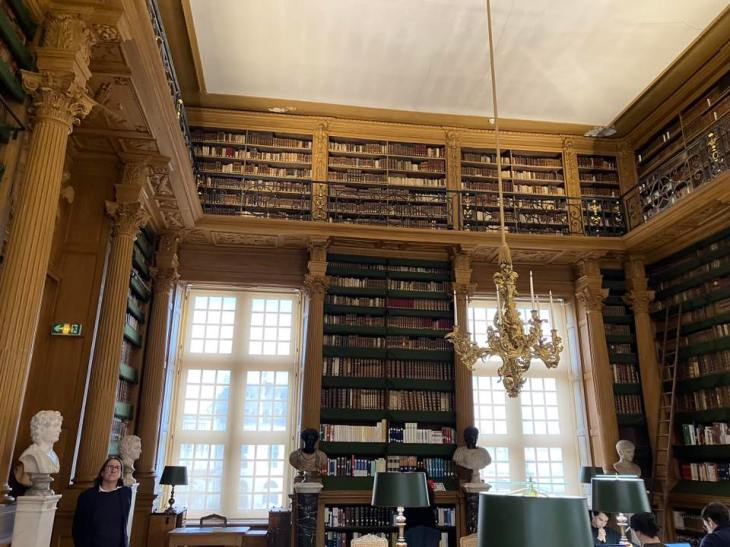
In December 1651, the Parliament placed a price on Mazarin’s head and decided, to raise this sum, to sell everything in the Mazarin Palace, starting with the library. and it was dispersed from January 8 to February 17, 1652. Naudé nevertheless managed to save by various means a small part of the works, with the idea of one day being able to reconstitute the library. Upon his triumphant return to Paris, in February 1653, Mazarin recalled Naudé, who had in the meantime become librarian to Queen Christina of Sweden, but he died on the way and it was to his former collaborator, François de la Poterie, that Mazarin entrusted the task of reconstituting a library. La Poterie carried out this task as best he could by recovering the works saved by Naudé, by buying his personal library and by adopting his methods. By 1661, this second library of Mazarin had practically regained the importance of the first. Wishing to imitate his predecessor Richelieu and to avoid his library being dispersed once again after his death, Mazarin decided to bequeath it to the Collège des Quatre-Nations,(today the Institut de France) which he founded by will in 1661. Letters patent establishing regulations for the Collège des Quatre-Nations, given by Louis XIV in March 1688 and registered in Parliament on March 23 of the same year, confirm these provisions by specifying them. The library, reopened in 1689 in the eastern wing of the building constructed to house the college, welcomed students, foreign visitors and the learned public throughout the 18C, while continuing to enrich its collections until, by the end of the 18C, it had more than 60,000 volumes. During the French revolution, the Mazarine Library remained in operation due to its public nature, but the college was abolished.
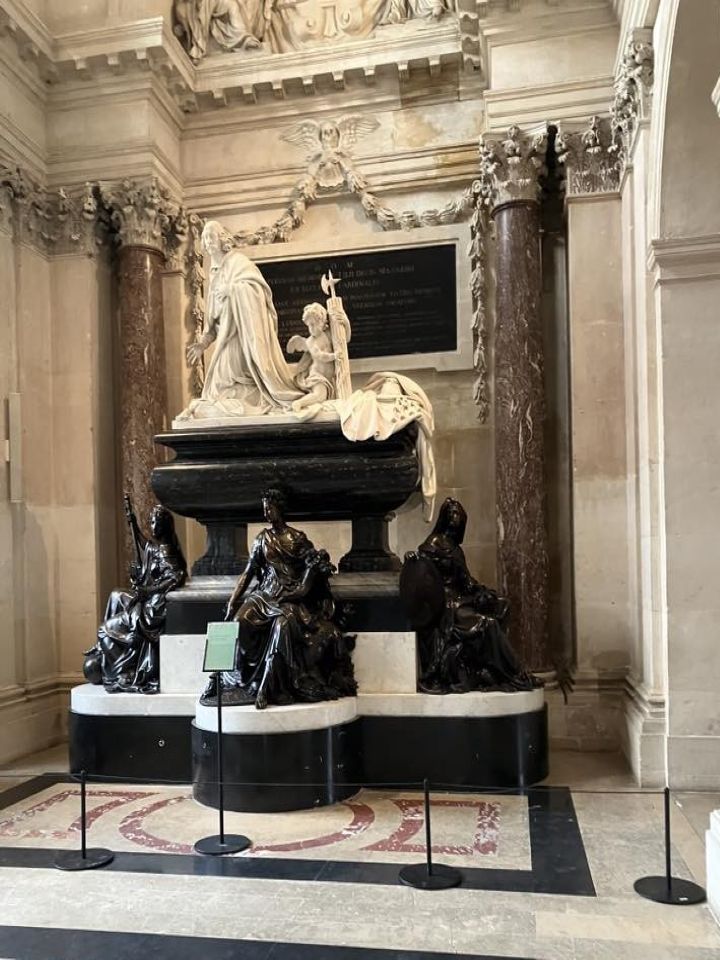
The library now holds approximately 600,000 volumes. While its very rich ancient collection of nearly 200,000 volumes is encyclopedic, its modern collection specializes in history, particularly the religious, literary, and cultural history of the Middle Ages (12-15C) and the 16-17C, the history of books, and the local and regional history of France. Although the collection of Mazarin manuscripts is today the result of an exchange in 1668 with the Royal Library at the National Library of France, the library still has more than 4,600 manuscripts (including around 1,500 medieval manuscripts, including many illuminated manuscripts), mainly from revolutionary seizures; 2,370 incunabula, including a copy of the Gutenberg Bible known as the Mazarine Bible, and the largest collection of Mazarinades in the world. The library also received several important collections in the 19-20C, including the archives of Pierre-Antoine Lebrun, Joseph Tastu and Arsène Thiébaut de Berneaud; the library and scientific archives of Albert Demangeon and his son-in-law Aimé Perpillou (geography); the very rich library of Dr. Marcel Chatillon (history of the Antilles) or part of those of the Chevalier de Paravey (travels), of Jean-Jacques Ampère (Nordic civilizations), of Prosper Faugère (Blaise Pascal and Jansenism), etc.
The official Bibliothéque Mazarin : https://www.bibliotheque-mazarine.fr/en/
The official institut de France : https://www.institutdefrance.fr/en/visit-us/
The Paris tourist office on the Institut de France : https://parisjetaime.com/eng/culture/institut-de-france-p1120
There you go folks, this is another memorable post on my eternal Paris! Yes, the most beautiful city in the world, is the least we can say, And while at it marvel of its wonderful architecture and history, Again, hope you enjoy the post on the bibliothèque Mazarine of Paris !!! as I.
And remember, happy travels, good health, and many cheers to all !!!

 Paris1972-Versailles2003