
I am again to tell you about more streets of my eternal Paris. I have many many posts on Paris and several on the streets of the most beautiful city in the world. I have come up with pictures from cd rom vault that should be here for you and me. As always thank you for following my blog some since 2010. Therefore, here is my take on the streets of Paris, part XIII !!! Hope you enjoy it as I.
The Avenue Paul-Doumer is a street in the 16éme arrondissement or district of Paris. It is named after former French President Paul Doumer. It begins at Place du Trocadéro-et-du-11-Novembre (or more precisely, its annex, Place José-Marti) and ends at 2 Chaussée de la Muette. It is 970 meters long, and its width varies from a maximum of 30 meters to a minimum of 20 meters. This avenue was created by a decree of January 30, 1912, and initially served as a sort of extension of Rue de la Pompe. It was developed in its current form between 1924 and 1933, destroying the houses overflowing from Rue Scheffer, Rue Pétrarque, Rue de la Tour, and Rue Nicolo, as well as the small Passy reservoirs. Called “Avenue de la Muette”, it took its current name by a decree of July 19, 1932. It was inaugurated on May 12, 1933, one year after the assassination of President Paul Doumer. The part of the avenue located at the intersection with Rue du Commandant-Schloesing was named Place José-Marti (Cuba) in 1955. The notable buildings by me are at the corner of Avenue Paul-Doumer Avenue and Rue Benjamin-Franklin, in Square Yorktown: Monument to Benjamin Franklin (1898) by John J. Boyle , No. 1: luxurious residential building with a rounded facade, in the “ocean liner” style, which occupies the corner of Rue Benjamin-Franklin , and Avenue Paul-Doumer, Without doubt one of the most beautiful views of the city. Today, it houses the offices of the set designer Philippe Starck. It is at No. 19 of the avenue that the apartment of Corey (Alain Delon), the main character in the film The Red Circle, directed in 1970 by Jean-Pierre Melville, is located. No. 60: 1930s building with a stone phoenix spreads its wings on the pediment of the building, where we can read this sentence: “And staring at the sun, it is reborn from its ashes.” No. 71 ; the actress Brigitte Bardot lived at this address in the 1960s , No. 90: Mayfair cinema, opened in 1967 with careful decoration (marble, mahogany doors, woodwork). It had a 300-seat auditorium and a smoking lounge. Renamed Mayfair-Pathé, it closed in 1988 while The Big Blue film was showing.
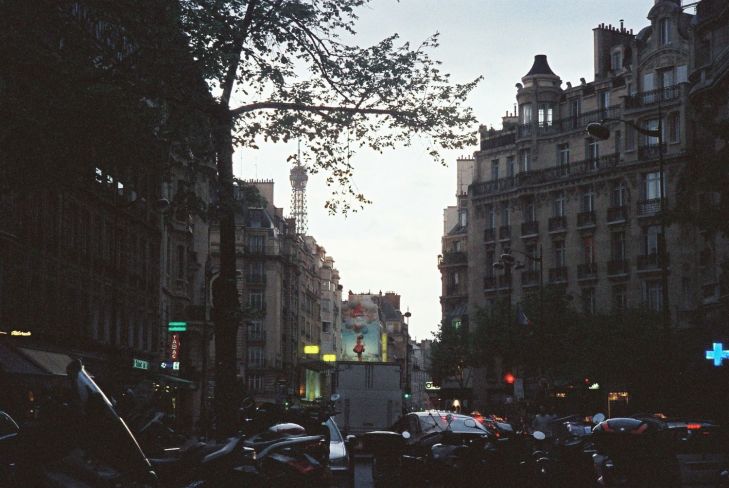
The Rue Saint-Denis, located in the 1er, 2éme, and 10éme arrondissements or districts of Paris, is one of the oldest streets in the city: its axis was traced as early as the 1C by the Romans. It is the triumphal route of royal entries into the city. It was through Rue Saint-Denis that kings and queens solemnly entered Paris. It is mentioned under the name of “rue Saint Denis” in a manuscript from 1636. Parallel to the boulevard de Sébastopol and the rue Saint-Martin, the street is part of the 1er arrondissement, Saint-Germain l’Auxerrois neighborhood or quartier, for the part between avenue Victoria and the rue de Rivoli, the neighborhood or quartier of Les Halles for the part between the rue de Rivoli and the rue Étienne-Marcel and the 2éme arrondissement, the Bonne-Nouvelle neighborhood or quartier from the rue Étienne-Marcel to the boulevard Saint-Denis. This road is so named because it is the road that leads directly from the pont au Change to the town of Saint-Denis, where the necropolis of the kings of France is located, and from which it took its name. My notable buildings here are at No. 4 Au Trappiste, one of my all time favorite hangouts in Paris ! No. 20 (corner of 33 bis rue des Lombards): site of Sainte-Catherine Hospital. Nos. 43 to 45 (between rue des Innocents and rue Berger): site of the Church of the Holy Innocents, the recluse of the Holy Innocents, and the cemetery of the Holy Innocents. No. 60 (corner of rue de la Cossonnerie): site of the Church of the Holy Sepulchre. No. 82: site of the Abbey of Saint-Magloire in Paris, active from around 1150 until 1572. Its monks then moved to the Church of Saint-Jacques-du-Haut-Pas, rue Saint-Jacques; They were succeeded by the convent of the Augustinians of the Order of the Penitence of the Magdalen (Convent of the Penitent Daughters), closed in 1790. The church and the convent buildings were replaced by an inn, later demolished. No. 92: Church of Saint-Leu-Saint-Gilles. No. 133 and Rue Mauconseil: site of the Saint-Jacques hospital for pilgrims, recalled by the statues of Saint-Jacques on the facade at the corner of Rue Étienne-Marcel. Former section of Rue Mauconseil, opened in the 1850s. Nos. 110-112-135: site of the Porte aux Peintres, also called Porte Saint-Denis, located on the Philippe Auguste enclosure. No. 142 (corner of 28 rue Greneta): site of the Trinity Hospital, founded in the 12C under the name of « hôpital de la Croix-de-la-Reine » or Queen’s Cross Hospital to accommodate travelers who arrived after the closing of the gates of the Philippe Auguste enclosure; the establishment, its gate and its church were demolished in 1817. At the same time, the Queen’s fountain was built on its facade. The current fountain, the second of the name, was built in 1732. Nos. 164-176: site of the Trinity Cemetery. No. 183: site of the Saint-Sauveur Church. Nos. 224-226: site of the Convent of the Daughters of Saint-Chaumont or Convent of the Daughters of the Christian Union, founded in 1673, rebuilt in 1734-1735, the walls of which are partly preserved. This is the only vestige of the pious or charitable establishments that lined the rue Saint-Denis. No. 266: site of the Church of the Trinity. Nos. 285 and 248, at the crossroads of the Grands Boulevards: Porte Saint-Denis.
The Paris tourist office on its arrondissements or districts : https://parisjetaime.com/eng/discover-paris/paris-by-district/arrondissements-paris-i081
There you go folks, another dandy beautiful set of glorious streets of my eternal Paris. I have criss cross them many and have many in my blog already, Again, hope you enjoy this post on the streets of Paris, part XIII !!! as I.
And remember happy travels, good health, and many cheers to all !!!

 Paris1972-Versailles2003