
I am going to tackle a familiar territory in more ways than one, My dear late wife Martine’ step father is from here and of course, family trips took us here and he still has a secondary home nearby, I just found me some old pictures in my cd rom vault that should be in my blog for you and me. Another dot in my world map, Let me tell you about the Cathédrale Notre Dame de l’Assomption of Clermont-Ferrand !!! Hope you enjoy the post as I.
The city of Clermont-Ferrand is located dept no 63 of Puy de Dôme in the Auvergne-Rhône-Alpes region of my belle France. It is the historic capital of Auvergne ,The modern city was born from the Union in the 17C from two ancient rival cities, Clermont and Montferrand. It then takes the name of Arvernis then Clermont. At the beginning of the 12C, the counts of Auvergne founded the competing city of Montferrand. In 1630, Louis XIII imposed by the edict of Troyes the unification of the two neighboring cities. This union will be reaffirmed by Louis XV in 1731. The city of Clermont-Ferrand is at the crossroads of the Nord-Sud Paris motorway axes at about 420 km, Béziers 340 km by the A71 and A75 highways and Lyon 165 km, Bordeaux 370 km by the A89). It is 413 km from Versailles on the A71 and 669 km from my current home taking the N165 ,A11, A85 to hook up again with the A71,
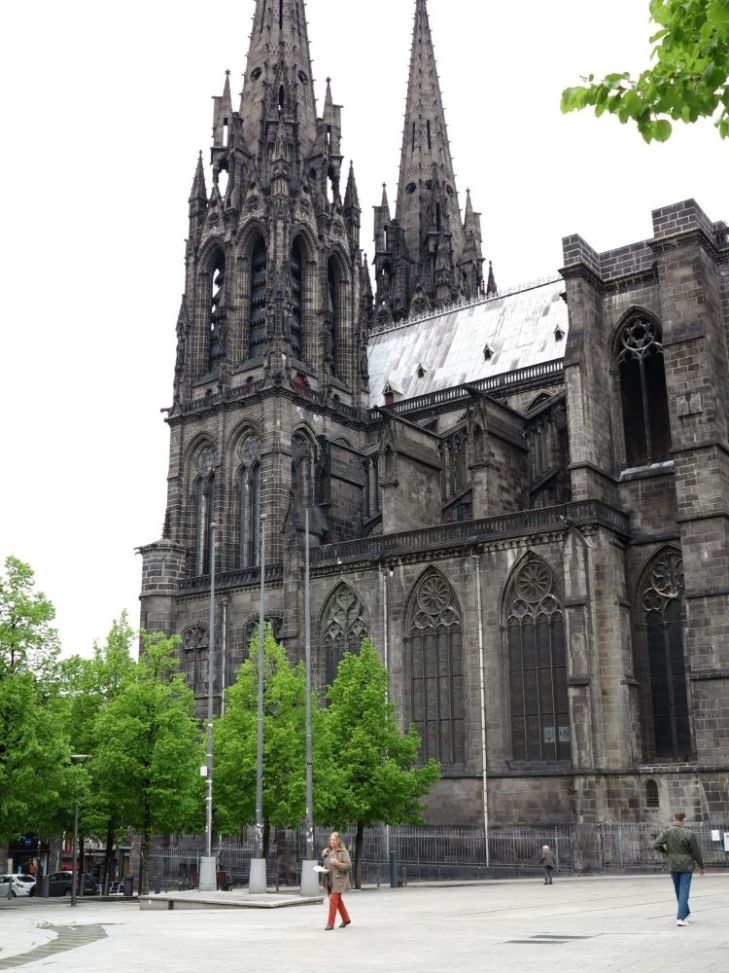
The Cathédrale Notre-Dame-de-l’Assomption was built from 1248 in the center of the city of Clermont. It replaced a Romanesque cathedral located in the same place which itself had been preceded by two other Christian sanctuaries. Its initial patronage is that of Saint-Vital and Saint-Agricol. Most of the current construction dates from the second half of the 13C; the western facade and other renovations were carried out by Eugène Viollet-le-Duc during the second half of the 19C.
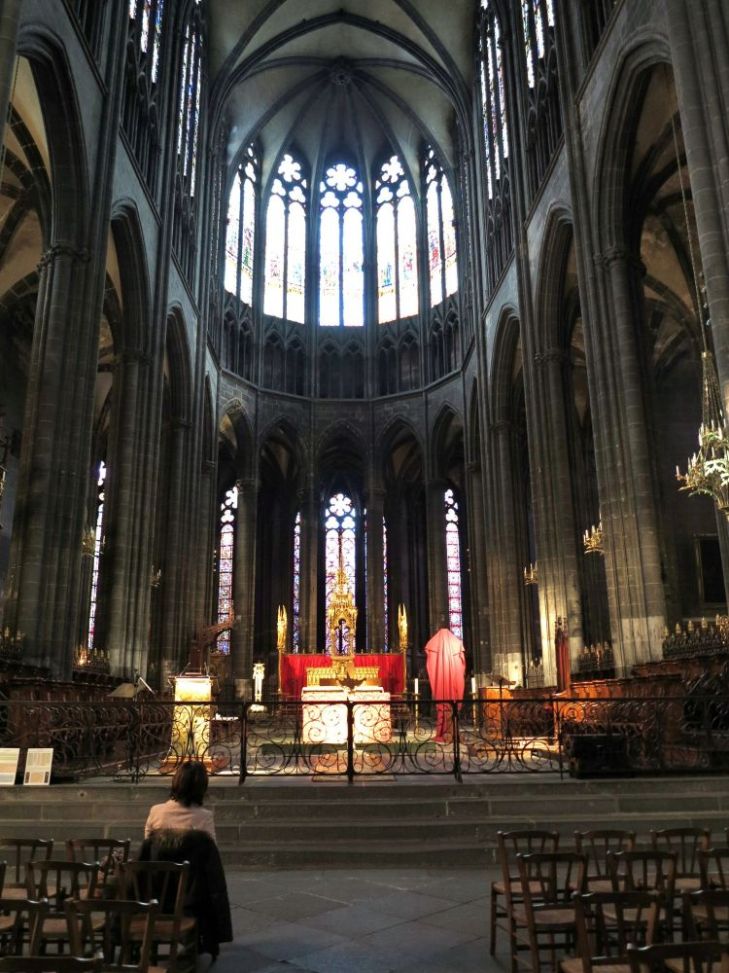
The center of the crypt is organized from three confessions overlooking a square room made up of three naves covered with edges based on columns, The choir, the transept and the start of the nave are completed around 1273. From 1325 to 1340, the towers of the transept arms were raised by an unknown artisan. The nave seems to be completed in the 1340s, based on the facade of the Romanesque building, which was ultimately destroyed in the 19C, The Tour Bayette tower, which flanks the east side of the north portal, owes its name to the lookout formerly posted at its summit. It is surmounted by a turret, itself adorned with a wrought iron campanile with a southern look. This is the only tower remaining of the four similar towers. The predominantly blue rose placed above the north portal dates from the 14C as well as that with orange tone which overlooks the southern portal. Both are an 8.50 -meter square. Dating from 1350, the southern facade once overlooked the buildings of the bishopric.
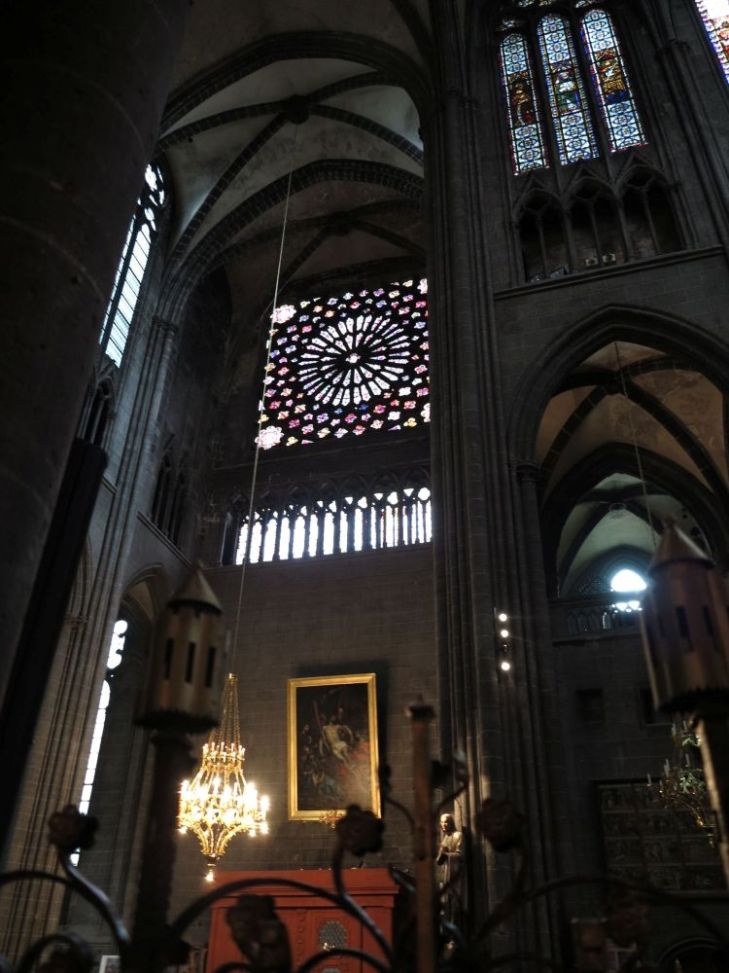
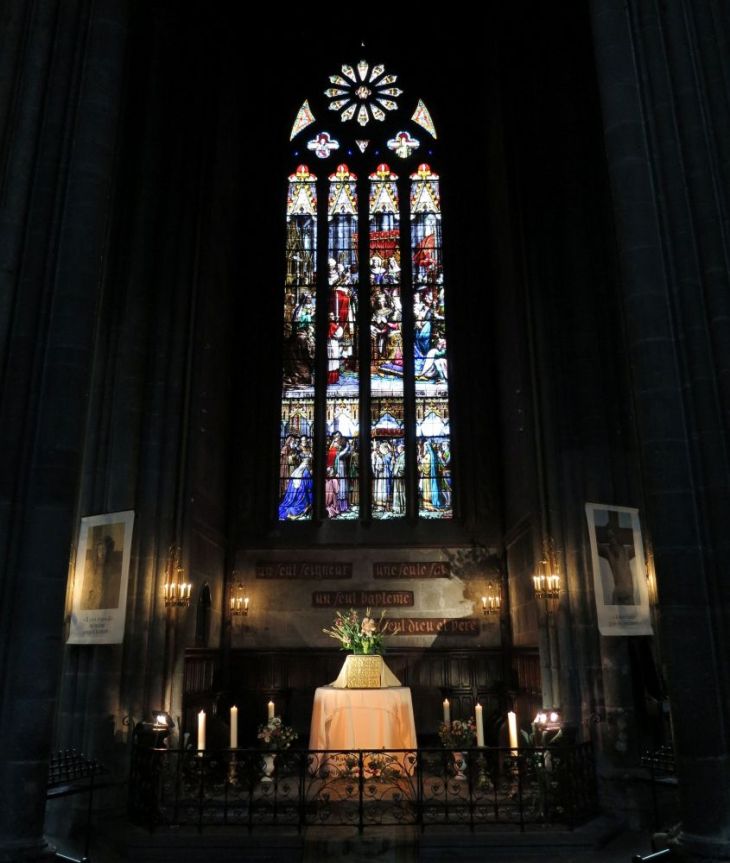
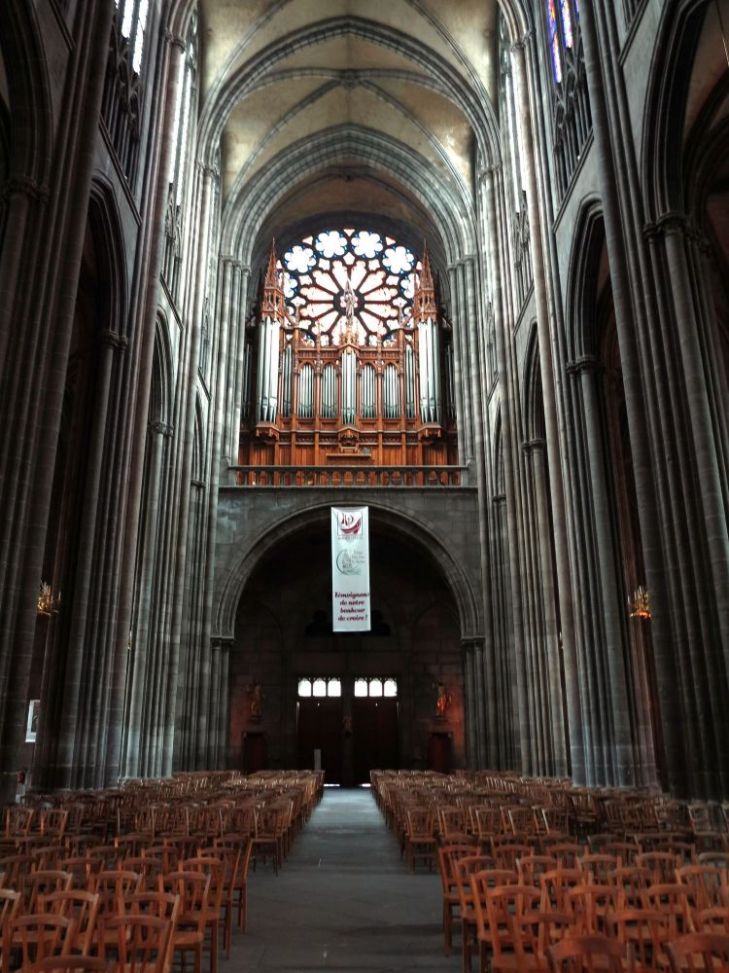
The Cathédrale Notre Dame de l’Assomption, presents a prestigious collection of medieval stained glass, the most beautiful in France after the Sainte-Chapelle, Chartres and Bourges. The stained glass windows of the chapels of the choir or ambulatory 13C, high berries of the choir end of the 13C transepts at the beginning of the 14C, high bays of the nave 15C and 16C. Important railings in the years 1830-1840 largely damaged these sets, which were restored in the middle of the 19C, between 1900 and 1930, and finally in 1976-77 the stained glass windows of the ambulatory they are the oldest, contemporary stained glass construction completion. Their dating precisely, in the middle or in the second half of the 13C, The cathedral presents a rare set of murals from the end of the 12C to the 15C. It has a large organ and a choir organ, the large organ was built in 1877, replacing a Ducroquet organ, of which it reuses elements. A Jacquemart we hear him ring all quarters of an hour and we can see his characters move to hit a stamp placed in the center every hour. It is a 16C automata clock in gilded wood, transferred in 1577 from a monastery of the city besieged of Issoire.
A bit of history I like tell us that in the 5C, Namatius, bishop of the City of Arvernes, built a first cathedral, thus obtaining that the Christian worship sort of the district called by Grégoire de Tours the “Vicus Christianorum” (current Saint-Alyre district) in its Historia Francorum of the 6C. The primitive cathedral was destroyed in 760 by Pépin le Bref, and restored by Bishop Adebert between 764 and 768. Again destroyed during the Norman raids in 915, it is bishop Étienne II, former abbot of Conques and brother of the Viscount of Clermont, who undertook to rebuild it in Romanesque style. It is in the 10C in Clermont that appeared the very first statue of a virgin in majesty. Around 946, Étienne II, former bishop of Conques, commanded a reliquary statue for the Virgin, perhaps inspired by the statue-reliquary of Sainte Foy with fine gold, undoubtedly manufactured in the 9C. Destroyed and melted for the treasury of Paris during the French revolution, In 1248, Bishop Hugues de la Tour decided to launch the site of a new cathedral, inspired by the Sainte-Chapelle, which had made its wonder during a visit to Paris. Build a church in the prestigious Gothic style from 1248 to 1287 on the choir, in which Saint Louis came to marry his son, the future Philippe Le Hardi, with Isabelle d’Aragon. The crypt discovered in 1885 is particularly mutilated with destroyed vaults, excavations to install sarcophagi and the foundations of the Gothic cathedral. We can restore its original plan around the year 1000, During the French revolution, the revolutionaries wanted to bring down the Church, and many destruction took place in 1790 and 1793, but the Benedictine Dom Michel François Verdier de Latour succeeded in persuading them that it would constitute an excellent popular gathering place. Only roods, stalls, altar, statues and furniture, with the exception of the Pascal candlestick were destroyed and three of the towers of the transepts were demolished, The Romanesque facade of the cathedral of Etienne II was done in 1851. In 1862, Napoleon III delivers, on the occasion of his stay in the city, the credits necessary for completion work, made from 1866 in 1884, the western facade with its arrows and the last span of the nave were finally completed in full compliance with methods construction of the Middle Ages. The access emmerge on rue des Gras was only carried out at the very beginning of the 20C. During this work, the birthplace of Blaise Pascal was destroyed.
The local Clermont Auvergne Volcans tourist office on the cathedral: https://www.clermontauvergnevolcans.com/en/pages/notre-dame-de-lassomption-cathedral/
The official Cathedral of Clermont : https://www.cathedrale-catholique-clermont.fr/
There you go folks, a central inland city that I can say was there worth a detour going south me think. This is a historical town with nice architecture to see and even more with more time. Again, hope you enjoy the post on the Cathédrale Notre Dame de l’Assomption of Clermont-Ferrand !!! as I.
And remember, happy travels, good health ,and many cheers to all !!!


You have shared many beautiful church edifices in France which I did not know about, plus I find the history is fascinating.
LikeLiked by 1 person
Glad you like them, indeed they are the architecture and history of France! Thanks for stopping by. Cheers
LikeLiked by 1 person