
In my dear gorgeous Versailles; there are many places other than the castle. The city needs to be seen more, my kind of town, actually did lived there for 9+ glorious years! Very nice family memories. I found me older pictures from one of my cd roms ,and again they should be in my blog, Therefore, here is my take again on the gardens of the Château de Versailles, part VI !!! Hope you enjoy the post as I.
One of the wonders of this magnificent palace/museum done from 1837 to all the glories of France by king of the French Louis-Philippe Ier are the gardens. I know the rush to see the wonderful inside, but the gardens are all on its own. The great gardener of France , André Le Nôtre organized the gardens of Versailles around two axes, north-south and east-west. The first part of the bassin de Neptune, goes up by the allée de l’eau and continues until the Orangerie and the piéce d’eau des Suisses. The second, called Grande Perspective, crosses the gardens like an axis of symmetry, beyond the Bassin de Latone, it follows the allée royale to the Grand Canal. These are some more marvels !!
To the north, the basin of Flora or Spring (1674) and the basin of Ceres or Summer (1673); to the south, the basin of Bacchus or Autumn (1674) and the basin of Saturn or Winter (1677). At the bottom of the Latona amphitheater, at the entrance to the royal avenue, a viewpoint allows you to see these four basins at a glance. These four basins were restored in the fall of 2019.
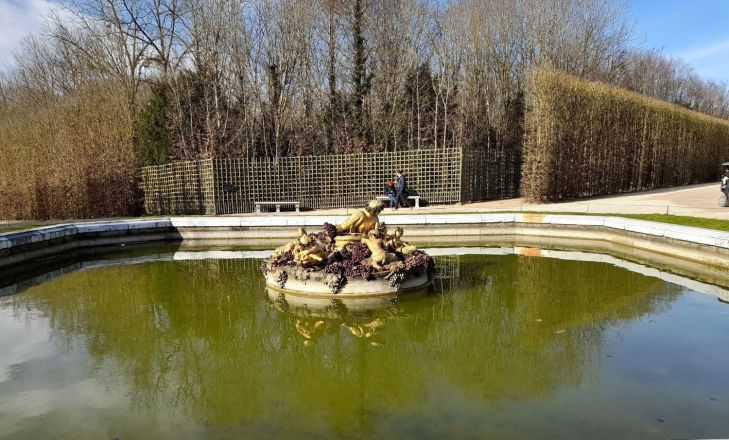
The Basin of Bacchus or Autumn (1674) is located at the intersection of the Bacchus-et-de-Saturne avenue and the Summer avenue. It is surrounded by the Queen’s Grove, the Mirror basin, the Latona parterre, and the Girandole grove. A square basin with cut sides, called the Autumn basin, it is the equal of the three other basins dedicated to the seasons and close to the Royal Alley. In its center is a statue of Bacchus surrounded by four small satyrs, half children, half goats, lying on bunches of grapes. Bacchus, a Roman mythological figure, teaches the world about vine growing. God of wine and drunkenness, he symbolizes the time of the grape harvest. Lead statues of Bacchus and the little satyrs were sculpted by the Marsy brothers from 1673 to 1675.
The Saturn Basin (1672-77), the statue of Winter (1675-83), an astonishing old man frozen with cold with a stove at his feet, and especially the famous group of the Abduction of Proserpine by Pluto (1677-87). The Saturn Basin, or Winter belongs to the group of basins of the Seasons as above. The Great Order brings together a group of sculptures commissioned by Louis XIV in 1674 in which there are statues of the Seasons. The basin is located at the intersection of the Allée du Printemps and the Allée de Bacchus-et-de-Saturne. Saturn sits enthroned in the center of a round pool, surrounded by small cupids, on an island dotted with shells. Four cupids previously formed complementary patterns from which eight jets sprang. They alternated with hourglasses connected by garlands of flowers. The edge was decorated with painted metal icicles.

The circular Dragon basin and fountain is located in the basin of the same name, It represents one of the many legends surrounding the life of Apollo. The serpent Python is killed with an arrow by the Greek god Apollo. The reptile is surrounded by dolphins and Cupids armed with bows and arrows, mounted on swans. The main water jet rises to a height of 27 meters, the highest of the fountains in the Versailles gardens. On each side of this basin, the central group of which was restored in 1889, paths provide access to two groves, that of Triumphant France and to the west, that of the Three Fountains. Dug in 1668, the basin adopted a circular shape in 1683. The Dragon Basin is located at the intersection between the Avenue de Trianon and the Allée d’Eau. It is located in line with the Allée d’Eau and the Neptune Basin which it precedes.

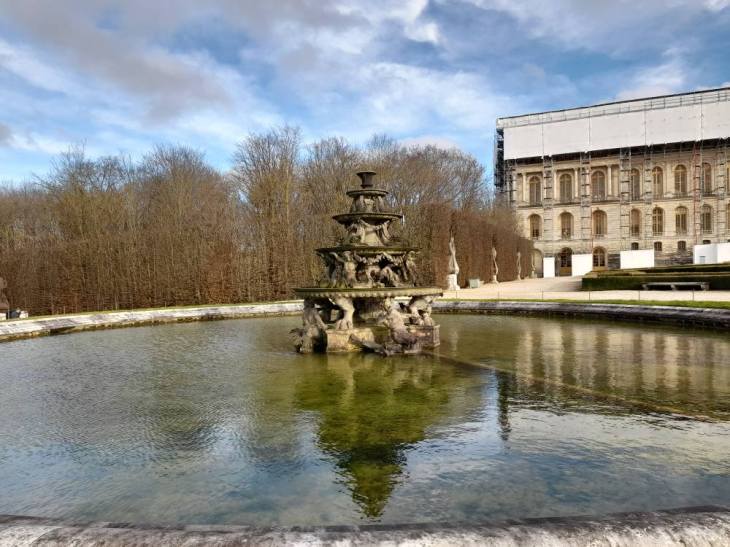
Executed by the sculptor François Girardon based on a design by Le Brun, the Pyramid basin, took three years of work. It is composed of four superimposed lead basins, supported by lead tritons, dolphins and crayfish. Girardon is just as bold in the Pyramid fountain supported by tritons, crayfish and dolphins. The Pyramid basin is located at the intersection of the Allée de Cérès-et-de-Flore and the Allée d’Eau.
The Salle des Marronniers has a layout that resembles a green gallery decorated with a fountain at each end. It replaced a grove designed by Le Nôtre in 1678: the Galerie des Antiques, where, from 1680, Louis XIV had a remarkable collection of antique sculptures or sculptures based on the Antique installed, arranged on pedestals emerging from the small canal that surrounded a central platform with polychrome paving. Ponds adorned the ends of this veritable open-air museum. In 1704, Jules Hardouin-Mansart removed the fountains and the island on the site of which two rows of chestnut trees were planted.

On the orders of Louis XVIII, in 1817, the architect Dufour created the Jardin du Roi or King’s Garden, an enclosed garden, laid out in the English style, planted with superb species, some of which disappeared during the storm of 1999. Today, only the original layout of the Miroir basin remains. The Miroir basin overlooks five paths punctuated by four antique statues, including that of Apollo, and today faces the King’s Garden . Under Louis XIV, the Miroir basin was located at the end of a large body of water called the Île d’Amour, or Île Royale, on which warship models were tested. Not maintained during the revolutionary period, it was removed in 1817 on the orders of Louis XVIII, brother of Louis XVI and Charles X, first king of the Restoration until his death in 1824, The Jardin du Roi is a grove located inside a grove delimited by the Allée du Mail and the Allée d’Apollon. The nearby groves are those of the Bassin du Miroir and the Colonnade and the Salle des Marronniers.

The official Château de Versailles on its gardens: https://en.chateauversailles.fr/discover/estate/gardens
There you go folks, one of the must to see in Versailles and worth it. Another masterpiece of my belle France, and hope you have the time to see it while at this huge property that is the Domaine de Versailles. Again, hope you enjoy this post on the gardens of the Château de Versailles, part VI !!! as I.
And remember, happy travels, good health, and many cheers to all !!!

 Paris1972-Versailles2003