
We have driven and walked in my eternal Paris, and would like to have an imprint in my blog on the wonderful family times we had there, There is so much to see , doing my best, and glad found me these older pictures in my cd rom vault ,which now transposing in my blog for you and me, This was my former worked city, so glad to post more memorable spots on it, I thank you for your readership over the years and to bear with my rants! After Paris is to rant, shout and yelled about, me think. Therefore, here is my take on curiosities of Paris , part XXIII !!! Hope you enjoy the post as I.
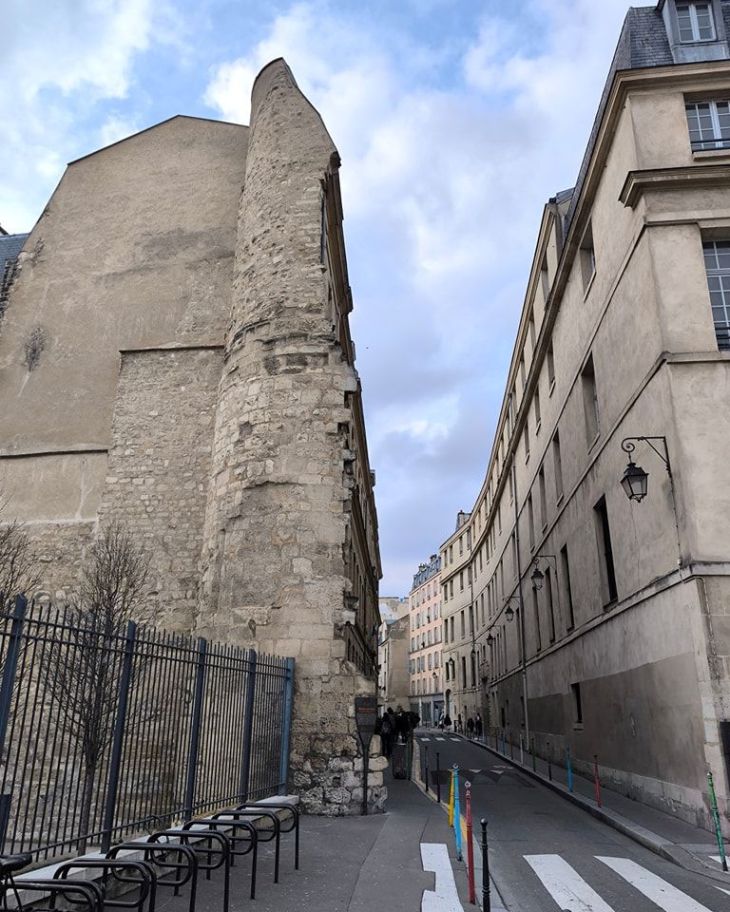
The Rue des Jardins-Saint-Paul is a street located in the 4éme arrondissement of Paris,now call Paris Centre ,and in the Saint-Gervais neighborhood or quartier. The nearest metro stations are Saint-Paul (line 1), Pont Marie (line 7) and Sully – Morland (line 7). It is so named because the oldest part of this street was opened in the 13C on gardens near the Paris enclosure wall. The part between Rue des Barrés and Rue Charlemagne is the oldest part; it is mentioned in sales contracts from 1277 and 1298. This section was called “Rue des Jardins” because the space in front of the fortifications was unbuildable. Notable buildings here tell us that it has the distinction of running along the longest portion of Philippe Auguste’s wall enclosure still in existence. The street runs along a playground that separates it from the remains of the ancient wall of Paris built between 1190 and 1220 during the reign of Philippe Auguste. This section, 60 metres long and 8 metres high, visible only from the side This wall still has two visible towers, one in the middle of the sports field and the other at the intersection with Rue Charlemagne (236 metres long , and named after Charlemagne, King of the Franks and Emperor, who created the Carolingian dynasty) The latter tower is called the Tour Montgomery , named after the captain of Henry II’s Scottish guard and involuntary regicide of the same king in 1559, who was supposedly imprisoned there after the fatal joust. This tower, now reduced to a quarter, defended the porte Saint-Paul gate of the enclosure wall, Notable buildings here are at No. 8: house in which François Rabelais died on 14 March 1553, Nos. 9 and 15: remains of the Philippe Auguste enclosure wall, Nos. 13 and 14: the Lycée Charlemagne high school (the ceilings of the main staircase and the library are decorated with murals as well as certain parts of the building), and No. 18: hotel of the president of Châteaugiron, built under Louis XIV. Old street inscriptions on the corner.
The city of Paris on things to do in the Centre (old 1-4 arrondissements): https://mairiepariscentre.paris.fr/pages/paris-centre-le-city-guide-28004
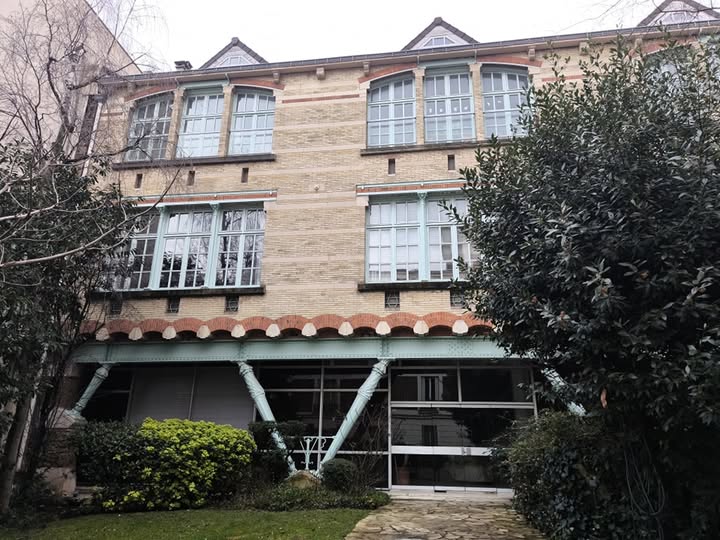
The Avenue de La Frillière is a street in the 16éme arrondissement of Paris, a public street, inside the villa Mulhouse. It begins at 41, rue Claude-Lorrain and ends at 20, rue Parent-de-Rosan. This avenue is named after a residence located in Genillé, in dept 37 Indre-et-Loire, belonging to the owner of the land on which it was traced. Notable buildings here are at No. 10 bis: villa Claude-Lorrain, private road in villa Mulhouse. No. 11: Sacré-Cœur school, (now closed -see photo) by the architect Hector Guimard in 1895. The main facade on the street, the roof, the ceiling of the old courtyard, the iron and cast iron banister of the old interior staircase is nice, The cast iron pillars are stylized and announce Art Nouveau. Through this constructive audacity, we can also see in Guimard the precursor of a certain Le Corbusier who would make him one of the pillars of his constructive principles! The façade is brightened by courses of red brick and ochre bricks. Transformed into a residential building, it is perfectly visible from the street.
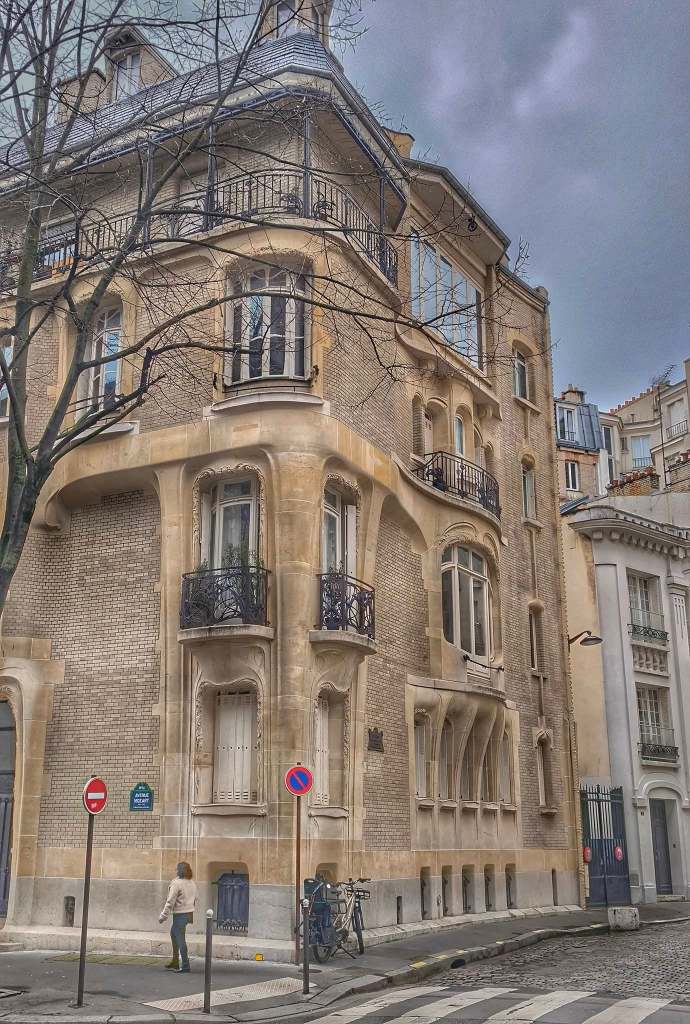
The Avenue Mozart is an avenue in the 16éme arrondissement of Paris. It begins at Chaussée de la Muette (nos. 1-11) and ends at the intersection of Rue La Fontaine (no. 110) and Rue Pierre-Guérin (no. 24). It is 1,180 meters long and 20 meters wide. It is a one-way street from Rue Poussin to La Muette. It should not be confused with two dead ends to which it provides access, having given them their names: Square Mozart and Villa Mozart. It is named after the composer Wolfgang Amadeus Mozart, The avenue is served by the Jasmin, Ranelagh and La Muette metro stations of line 9 of the Paris metro. This street was opened, under the name of “rue Mozart” by a decree of March 2, 1867, The part between the Chaussée de la Muette and the Rue Bois-Le-Vent was not completed until 1896, Moving from the Chaussée de la Muette to the Rue Jean-de-La-Fontaine, one can observe the following remarkable buildings: nos. 28-28 bis: square Mozart, private road; no. 35: J. Audé bookstore, founded in 1936. Its bookseller Nicolas Lefort has participated several times in the television program Télématin to share his literary discoveries, no. 61: from 1973 to its passing in 1994, the writer Michel Fardoulis-Lagrange lived at this address , no. 66: a former red brick Renaissance-style mansion. At the beginning of the 20c, it housed the Salvadoran legation. The ornithologist Louis Magaud d’Aubusson, founding father of the League for the Protection of Birds, lived and died there, nos. 76-78: buildings built in 1896 ,a commemorative plaques pay tribute to Jackie Kennedy, while Jacqueline Bouvier, a student at the Sorbonne, stayed there between September 1949 and June 1950, where she stayed with two friends at the home of Countess Robert de Renty, a member of the Resistance whose husband had died in deportation. André Lanskoy, a painter of Russian origin, lived there after the war and set up his studio; Gennady Rozhdestvensky, Russian conductor, lived his last years there; Pierre-Louis Bourgoin, officer and politician, companion of the Liberation, lived there from 1944 to 1968. No. 120: Houyvet building with its entrance at 2, Villa Flore, built in 1927 by Hector Guimard, No. 122: Guimard hotel; (see photo) private mansion built by the architect Hector Guimard, the major representative of Art Nouveau in France, who lived there from 1913 to 1930. The politician Élisabeth Borne grew up there in an apartment with her mother and sister. She is from May 16, 2022 to January 9, 2024. Prime Minister On December 23, 2024, she was appointed Minister of State, Minister of National Education, Higher Education and Research in the current François Bayrou government and thus made her return to the government.
The Paris tourist office on the 16éme arrondissement or district: https://parisjetaime.com/eng/article/a-la-decouverte-du-16e-arrondissement-de-paris-a830
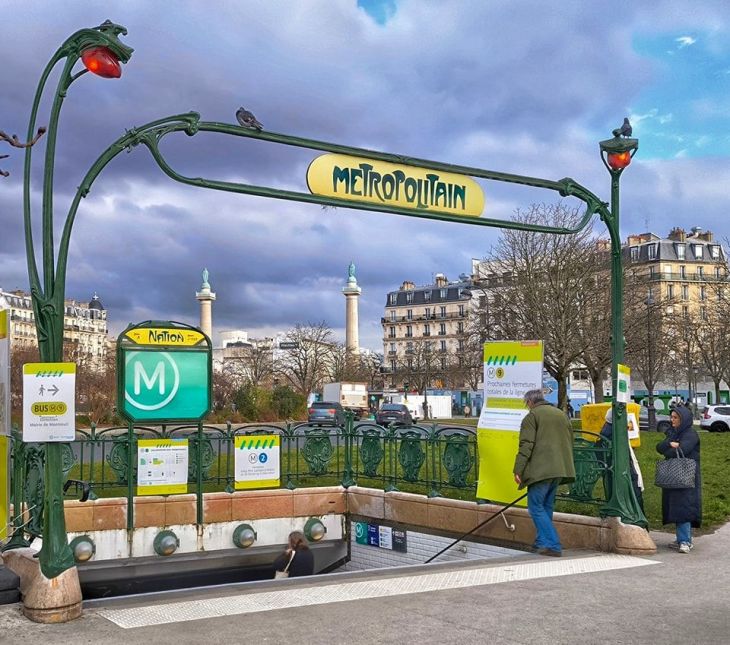
Metro station Nation is a station on lines 1, 2, 6 and 9 of the Paris Métro, located on the border of the 11éme and 12éme arrondissements of Paris. The station is located under and around the Place de la Nation. It takes its name from the Place de la Nation, so named since 1880 in honor of the National Day of France. The station on line 1 is curved, under the southern part of the square. The terminus of line 2 forms a loop under the square. The arrival on the loop is under Avenue de Taillebourg, and the departure under Avenue du Trône, Place des Antilles and Boulevard de Charonne. The terminus of line 6 also forms a loop, with the arrival under Avenue du Bel-Air and the departure under Avenue Dorian, Rue de Picpus and Avenue de Saint-Mandé. The station on line 9, also curved, is located lower than the others, under the northern part of the square, between Boulevard Voltaire and Avenue de Taillebourg. It is the only metro station that has two lines as a terminus. This station has six accesses or entrances, some of which are shared with the RER. Access no. 1 “Avenue du Trône” is located opposite no. 28 Place de la Nation, at the corner of Avenue du Trône and Avenue du Bel-Air. It has a fixed staircase. Access no. 2 “Avenue Dorian” is located opposite no. 6 Place de la Nation, at the corner of Rue Jaucourt and Avenue Dorian. Consisting of a fixed staircase, it is decorated with a Guimard aedicule. Access no. 3 “Boulevard Diderot” opens in front of no. 4 Place de la Nation, at the corner of Boulevard Diderot and Avenue Dorian. With a fixed staircase, it is also decorated with a Guimard-style aedicule. Access no. 4 “Boulevard Voltaire” is located at the right of nos. 1 and 3 Place de la Nation, at the corner of Rue du Faubourg-Saint-Antoine and Boulevard Voltaire. It has escalators reserved for the exit as well as two fixed staircases. It provides direct access to the RER. Access no. 5 “Avenue de Taillebourg” is located opposite no. 15 Place de la Nation, at the corner of Avenue de Taillebourg and Avenue du Trône. It has escalators and fixed escalators and provides direct access to the RER. Access no. 6 “Avenue du Bel-Air” opens in front of no. 24 bis Place de la Nation, at the corner of Avenue du Bel-Air and Rue Fabre-d’Églantine. It consists of an elevator that only provides access to the RER. The station opened on July 19, 1900 during the inauguration of the first section of line 1 between Porte de Vincennes and Porte Maillot. The platforms of line “2 Nord” (now line 2) opened on April 2, 1903, line 6 on March 1, 1909. Finally, line 9 opened on December 10, 1933.
The official RATP transports on metro Nation: https://www.ratp.fr/vos-lignes/vos-stations/nation
There you go folks, a dandy city to explore and enjoy with the family, Memorable moments in my eternal Paris,driving and walking all over in my road warrior trails brings out sublime awesome spots with nice memorable family visits of yesteryear always remember and always looking forward to be back, eventually. Again hope you enjoy the post on curiosities of Paris, part XXIII !!! as I.
And remember, happy travels, good health, and many cheers to all !!!

 Paris1972-Versailles2003