
I was by here on a sentimental walk as this was one of the first area walked with my then girlfriend and later dear late wife Martine, Something off the beaten path with a nice monument to show off, Glad to have found these pictures in one of my cd rom vault to share with the world for you and me. Therefore, here is my take on the Church Saint Laurent of Paris !!! Hope you enjoy it as I.
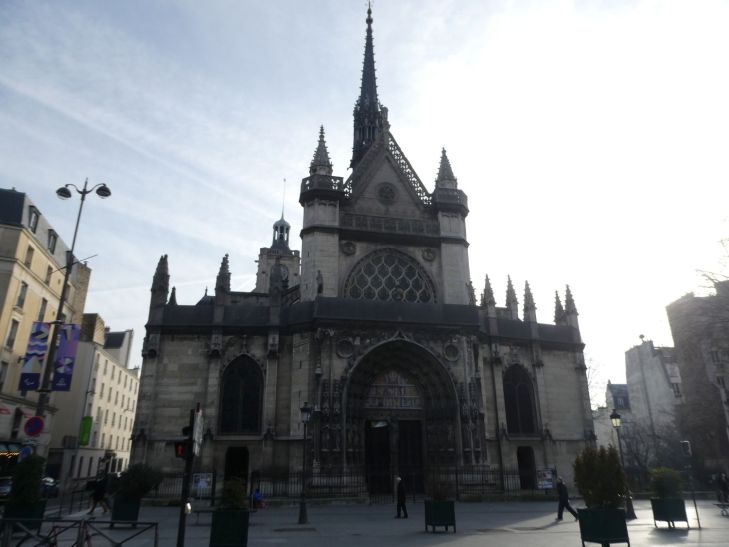
The Church Saint-Laurent is located on the 10éme arrondissement of Paris ; in the old Saint-Laurent enclosure, 119, rue du Faubourg-Saint-Martin, 68, boulevard de Strasbourg and 68, boulevard de Magenta. This church is served by the Gare de l’Est metro lines 4, 5, and 7, Also, bus lines 38, 39, 46, 56, and 91,

The Church Saint-Laurent consists of a nave of four spans extended by a non-salient transept . The choir extends over three spans, the first of which is an extension of the transept, and ends with a three -sided hemicycle. The entire church is on two levels. The nave is a series of large arcades in broken arc . The pillars are flanked by committed columns. Those which overlook the nave go up without interruption to the vault, but the slender effect is broken by the presence of a cornice which underlines the base of the large windows of the second level. The nave is bordered by a double collateral, itself bordered by chapels. The hanging keys of Saint-Laurent constitute, with the stained glass, the artistic richness of the church. These keys can only be really admired with a pair of binoculars or a telephoto lens. They all date back to the 17C and integrated into the spectacular achievements of flamboyant Gothic. They adorn the vaults of the nave, the crossroads and the choir. It is in the transept that we find the most worked keys.

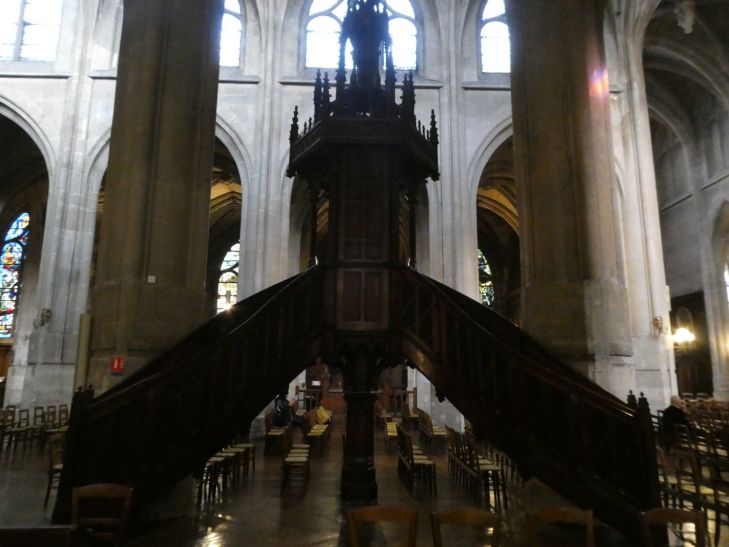
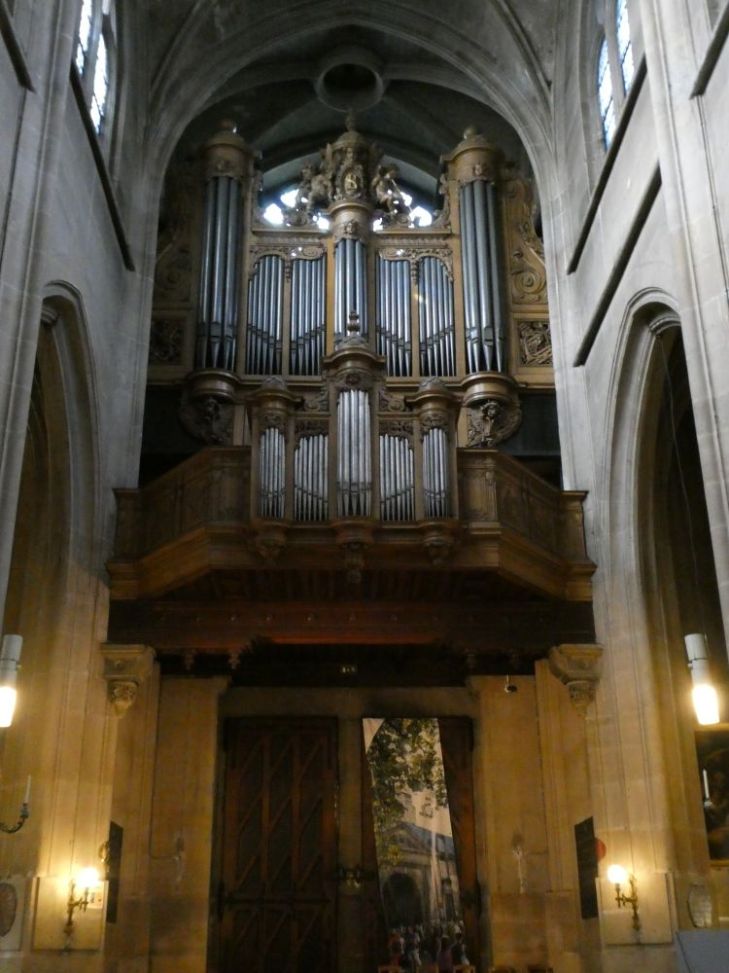
The Choir dates from the first half of the 15C, during the total reconstruction of the church the stone altar dates from 1884. The base presents a bas-relief, the stained glass windows of the choir are from the 20C. I have the pulpit and organ on this section.
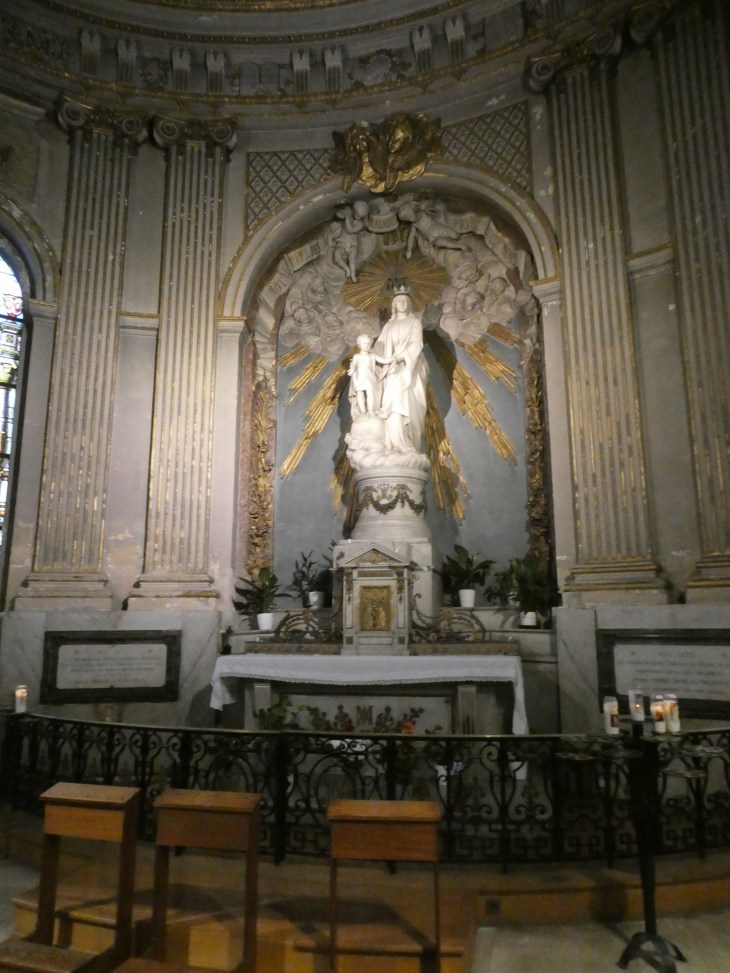
The Chapel of the Virgin dates from 1712. Dedicated to Notre-Dame des Malades (sick), it replaced an old chapel of the three Mary’s, built in 1429, during the total reconstruction of the church. The chapel of the Virgin a place rich in works of art specific to meditation and there are very often there for faithful in prayer. Architecture, paintings, sculptures and stained glass are arranged in a classic style arrangement, chanted by imposing pilasters. The Virgin and Child, a carrare marble statue created in 1900, stands out on a dark central arch, decorated with cherubs. Some historians praise Mary’s softness of the face, as well as her smile. The vault is remarkable. You can see an assumption of the Virgin (1730) and a painting illustrating the sacrifice of Abraham (1728), Finally, the four stained glass windows correspond to the second glass of stained glass, in 1872.
The Chapel of Saint Domnole. The stained glass window dates from 1935 and depicts Saint Laurent, Saint Domnole and Clothaire I, the King of the Francs. The right column has one of their clay Stations of the Cross. Saint Domnole and Clothaire 1er, king of the Francs stained glass of 1935

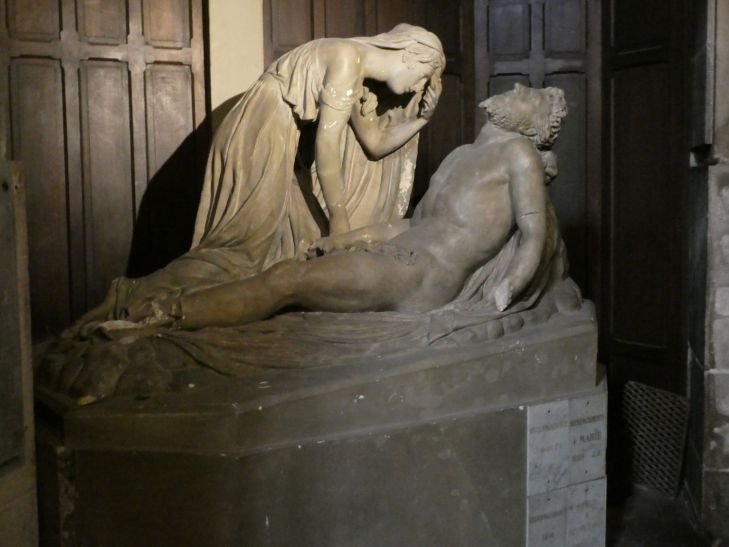
Marie-Madeleine crying on the body of Christ made of plaster in 1829. The tribune organ. The buffet dates from 1682. The organ was restored in the 19C.
The chapel of the Sacred Heart on the left is decorated with paintings by Jean-François Brémond: The descent of Jesus in the underworld (1845), Adoration of the Sacred Heart (1846) and Jesus adored by the Blessed Virgin and Saint Joseph (1846), Eight stained glass windows for the church choir were made in 1846-1847;three of these canopies are still visible. The other stained glass windows were replaced in 1939 , The four large canopies of the Notre-Dame-des-Malades chapel in 1874 representing the Visitation, Notre-Dame des Sept Douleurs, Dormition ,and the Assumption. These canopies are completed by four smaller stained glass windows: Saint Joseph carrying the child Jesus, Saint Anne learns to read to the Virgin, Saint Vincent de Paul collects a child, the guardian angel protects a child. In the chapel dedicated to Saint Francis de Sales was laid the canopy the sweetness of Saint Francis. In the neighboring chapel was set up the canopy Saint Vincent de Paul blessed the first sisters of charity. The choir dates from the first half of the 15th century, during the total reconstruction of the church the stone altar dates from 1884. The base presents a bas-relief, the stained glass windows of the choir are from the 20C.
A bit of history of the Church Saint-Laurent tell us that it was founded at the end of the 5C, outside the walls of Paris near a monastery which welcomed the pilgrims who went to the abbey of Saint-Denis, on the Roman road leading Paris to Senlis , Soissons and Trier, via the Col de la Chapelle. Located outside the walls, the church and the monastery were looted and destroyed by the Normans in 885. A charter of Louis VI le Gros, dated 1122, alludes to a church that the inhabitants of the small agglomeration, which begins to form, names “Sainct-Lorenz-lez-Paris” : a new church, erected in parish, is attested in 1180. This new church, which has become too small, was demolished to make way for the current church in the 15C, Flamboyant Gothic style.We nevertheless, know that the building was dedicated in June 1429 and that it has been suffered since then multiple works. If only a part of the bell tower seems to have anterior to the 15C, the choir is from the 15C, the nave, from the 17C, the aisles of the choir and the oval chapel of the Virgin, from the beginning of the 18C. A classic style facade, recalling that of the Jesuit professes, was raised in 1621. The current facade is a pastiche of the 15C, built in 1862-1865, The general style of the church is flamboyant Gothic with parts in Classic style.
In the 17C, the church was not completed ; in 1621, the foundation stone of the facade was laid by Charlotte-Marguerite de Montmorency, wife of Henri II de Bourbon, prince of Condé. This facade was composed according to the Italian pattern. It was demolished in 1862 , In 1655, the construction of the vaults of the nave and the transept began. It is the last Parisian construction of flamboyant Gothic style, a century and a half after the end of the 15C,In 1712, in place of a chapel of the Trois-Maries, was raised at the bedside the current chapel of the Virgin, this which led to the abolition of six pillars of the ambulatory. On September 1, 1768, the countess of Barry, born Bécu, married religiously in this church with Guillaume du Barry, before being officially presented to King Louis XV and the courtyard at the Palace of Versailles. In 1793, during the French revolution, the church became a temple of reason , and was returned to the Catholic worship in 1795, then to Théophilanthropes in 1797. It became the temple of old age the following year. In 1802, the church again became Catholic , Under the Second Empire (Napoléon III), the boulevards of Strasbourg and Magenta were pierced, respectively from 1853 and 1860. The Church Saint-Laurent was set back from the alignment of the boulevard de Strasbourg. The 18C facade was destroyed, and between 1863 and 1867, lengthened the church with a span, and rebuilt a flamboyant neogothic style facade, decorated with sculptures. It had built a lead arrow. An enameled lava pediment was added in 1870.
The official parish Church Saint Laurent on its full history: https://www.asaintlaurent.com/histoire-de-leglise/
The city of Paris on the Church Saint Laurent: https://www.paris.fr/lieux/eglise-saint-laurent-19501
The Paris tourist office on the Church Saint Laurent: https://parisjetaime.com/eng/culture/eglise-saint-laurent-p1254
There you go only for the lovers of things to see in Paris off the beaten path, this Church Saint Laurent, and sentimental area to walk for me. This is an unique church seldom noticeble but so much to find in my eternal Paris, Again, hope you enjoy this post on the Church Saint Laurent of Paris as I
And remember, happy travels, good health, and many cheers to all !!!

 Paris1972-Versailles2003