
I remember Fontainebleau castle as it was in the Seine et Marne dept 77 that my dear late wife Martine, took me first to show me her department/region back in 1990. We have come here ever since,and it is one of my favorite castles been friend of the association that helps protect its heritage since 2008. Their office is on your left once entering the main entrance to the castle fyi. I have written many posts on it before, but found me new pictures in my cd rom vault that should be in my blog for you and me. Of course, this is also in the Île de France region of my belle France, Do see my many posts on the domain in my blog. Therefore, here is my take on curiosities of the Château de Fontainebleau, part II !!! Hope you enjoy the post as I.
During the reign of Francis I, the church of the former Trinitarian convent was rebuilt, connected to the château by the wing of the Francis I gallery. It was not until the reign of Henry IV that it received its current vault, the Spanish ambassador having remarked to the king that his house at Fontainebleau “would be very beautiful if God were as well housed there as His Majesty.” So this created the Chapelle de la Trinité (see post) in the Château de Fontainebleau ! In order to house God with dignity, the direction of the decoration work was entrusted to the painter Martin Fréminet, who distributed the vault into a series of rich compartments framed by thick ornate stucco moldings. Its exceptional decoration, characteristic of what would later be called the Second School of Fontainebleau, devoted to religious Salvation, foreshadowed the Baroque style and was not completed until 1633, during the reign of Louis XIII. A former convent church of the Trinitarian monks installed here by Saint Louis in 1259, it was attached to the castle under Francis I. Rebuilt from this reign and that of Henry II, it received the current vault under Henry IV and was completed by Louis XIII then enriched by Louis XIV, Louis XV and Louis XVI. It was in this imposing royal chapel, overlooked by its gallery dedicated to the sovereign, that the marriage of Louis XV with Marie Leczinska was celebrated in September 1725, and also the scene of the marriage of Marie-Louise d’Orléans with Charles II of Spain (represented by the Prince of Conti) and the baptism of Prince Louis-Napoléon Bonaparte (future Napoleon III) in 1810 on the knees of his uncle Napoleon I. with 24 other children and the marriage of Ferdinand-Philippe d’Orléans with Hélène de Mecklenburg-Schwerin on May 30, 1837.
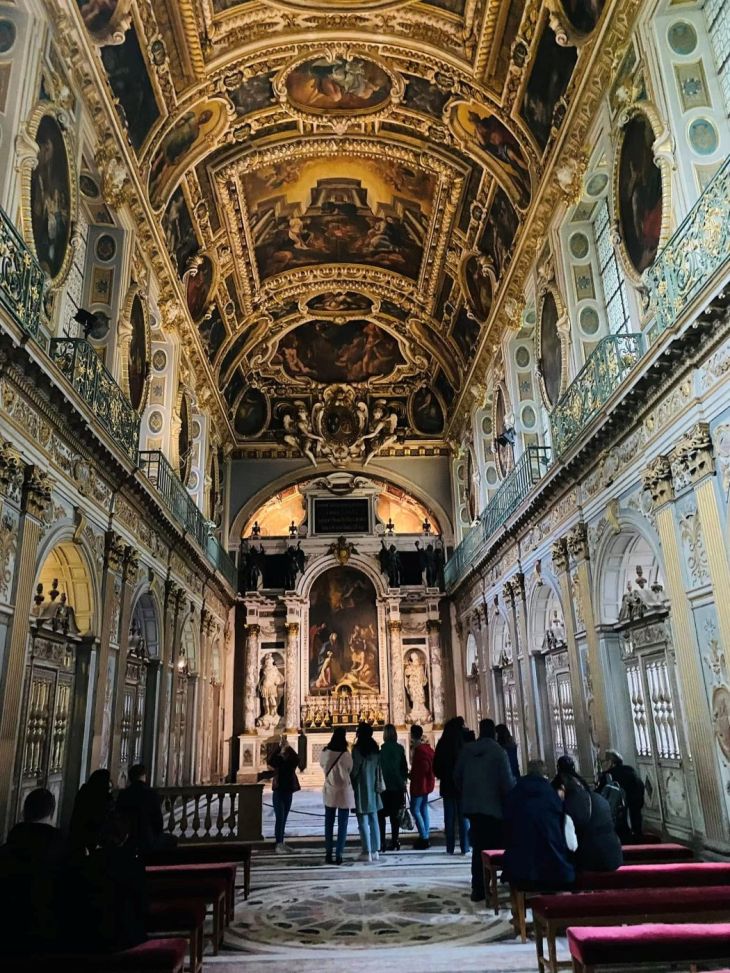
The painter Martin Fréminet painted scenes depicting the mystery of the Redemption of Man (the Trinitarians being a redemptive order): The Apparition of God to Noah above the tribune, The Annunciation behind the high altar, Christ of the Last Judgment surrounded by the first seven intelligences in the center, as well as figures from the Old Law (kings of Judah, prophets, virtues), painted on the vault between 1608 and 1619. The high altar, created by the Italian sculptor Francesco Bordoni in 1633, who also designed the multicolored marble floor, is surrounded by statues of sovereigns (Saint Louis to the right of the altar with the features of Louis XIII, and Charlemagne to the left with the features of Henry IV). The altarpiece was painted by Jean Dubois le Vieux in 1642 and depicts the Holy Trinity at the moment of the Deposition from the Cross. The last decorative paintings executed in the Trinity Chapel were the oval paintings created under Louis XVI. The organ by François-Henry Clicquot, still in place, was built in 1774.
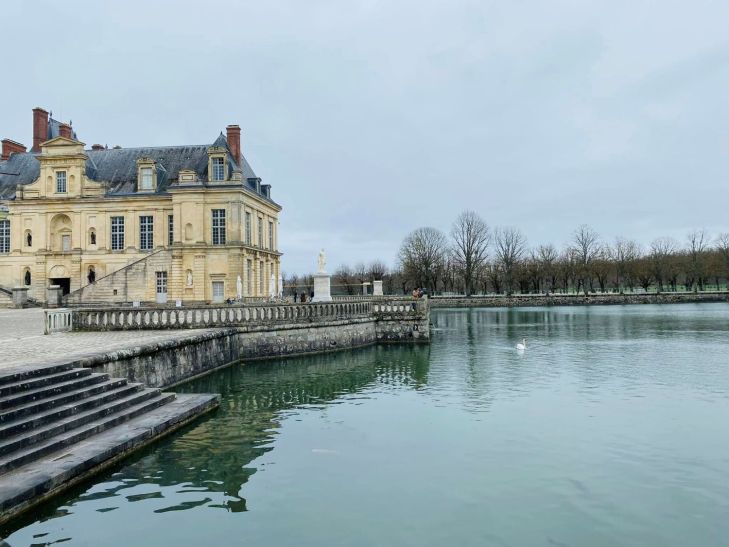
A picture is like a thousand words, one depicts the following (see posts) ! The aile dite de la Belle Cheminée or the wing of the beautiful chimney was built between 1565 and 1570 to the designs of Primaticcio and under the orders of Catherine de Medici. It is marked by two staircases with diverging railings. The niches display bronze statues, originally copies of antiques made by Primaticcio, from casts made in Rome ;those presented here are from the 1930s. These are gods and heroes from Greco-Roman mythology. The Cour de la Fontaine or fountain courtyard in the center of the courtyard stands the fountain dating from 1812, surmounted by a sculpture of Ulysses by Petitot, which was placed here in 1824. The name Cour de la Fontaine recalls that a fountain created by Primaticcio was placed here in 1541, then surmounted by Michelangelo’s Hercules. The Fountain Courtyard overlooks the Carp Pond. Enclosed on three sides and facing south onto the Carp Pond, The étang aux Carpes or Carp pond sits proudly overlooking the gardens, this haven of peace and coolness, built in 1662 by Louis Le Vau and accessible only by water, offers an intimate and dazzling view of the château. Decorated during the reign of Napoleon I with delightful painted paneling adorned with birds and flowers, the Pond Pavilion was the venue for nautical festivals held by Napoleon III and Empress Eugenie during the Second Empire. The pier is located at the Carp Pond. Easy to maneuver, from here you can gain some distance to admire the grandeur and expanse of the Château de Fontainebleau located not far from the forest. From the Marin D’eau Douce boats you can admire the entire castle as well as the gardens and the Pond Pavilion located in the very center of this pond.
The bedroom/room of Queen Anne of Austria, which is located on the 1st floor of the castle , in the apartment known as the Queens Mothers. This apartment is located in a wing built under François 1er to connect 2 buildings between the Cour d’Honneur and the Cour Ovale. Henri II will convert it into an apartment which will be occupied by his widow Catherine de Médicis , then by the second wife of Henri IV and Queen of France, Marie de Médicis , and finally by Anne of Austria, wife of Louis XIII and mother of the future King Louis XIV. It will then welcome the Dauphin under Louis XIV, then distinguished guests, to then be occupied by Mesdames Henriette, Adélaïde and Victoire, the daughters of Louis XV. Split in two under Louis XVI, these apartments will house the Count of Provence, brother of Louis XVI and future Louis XVIII. In 1804, before his coronation on December 2 of the same year, Napoleon I had them fitted out for Pope Pius VII (as the room is known today).The Pope’s apartment (see post) name from the two stays made by Pius VII in 1804 and in 1812-1814, Then, King Louis-Philippe of the 1st July Monarchy lodged his son there, while Napoleon III welcomed his cousin there. This is an older picture …you can see the same as the newer above. it was in a double princely apartment of the Second Empire that is presented today. The sumptuousness of its decorations, attached to the quality of its furnishings, testify to the great eclectic taste of Napoleon III and Eugenie which had it redecorate in the 1860s keeping the exceptional ceilings of the old Henri II chamber and that of Anne of Austria. Space dedicated to prestigious guests staying at the Sovereign’s court, this complete apartment alone illustrates the rich historical sedimentation of the castle.

This is a room that I find above all impressive. It is very well preserved in its original version from 1660, decorated by Charles Errard and Jean Cotelle for the Queen. It shows what a royal apartment of the 17C was like, with many very beautiful pieces of furniture and ornate, but truly sumptuous, decor. Above the door, we notice the portrait of Maria Theresa of Austria, wife of Louis XIV and Queen of France, which faces that of Anne of Austria, her mother-in-law. The gilded and colored coffered ceilings, like the paneling of the walls, add to this profusion of ornaments. During the Second Empire, this room served as a living room. The bed and the carved oak seats date from this period and reflect the Renaissance style, while the carpet, also from the 19C, is in the Louis XVI style. The tapestries of the “triumphs of the Gods” after Noël Coypel were woven at the royal Gobelins factory around 1700.
The Galerie François-Ier (see post) or the Francis I Gallery is a large ceremonial gallery located on the first floor. The work of Italian artists Rosso Fiorentino and Le Primatice in the 1530s made this gallery the most representative decorative ensemble of the first School of Fontainebleau, and testifies to Francis I’s enthusiasm for Italian art. Built between 1528 and 1530, it is approximately 64 meters long and 6 meters wide, and was once a covered bridge with openings on both sides. King Francis I had it built and decorated to connect his apartments to the Trinity Chapel. He kept the keys and showed it to his distinguished guests. Louis XVI had the wing doubled in 1786 by adding apartments, thus depriving it of its opening onto the Jardin de Diane, but having false French windows made to maintain a symmetrical appearance. Under Napoleon I, the transformation of the Galerie François-Ier into the “Gallery of the Emperor” was decided in March 1805. Converted into the “Gallery of the Illustrious”, it housed from the following September the first busts of the aides-de-camp initially intended for the Château de Saint-Cloud, then those of generals, alongside which drawings of Bonaparte’s military campaigns were exhibited. The coffered ceiling plays a rather secondary role in the decorative ensemble and displays a rather classical style. The king’s monogram, bearing a salamander, can be found everywhere. The stuccoes are mostly presented as large figures in high relief accompanied by falling fruit. The paintings, divided into two groups of six frescoes separated by a central bay, represent stories from Greco-Roman mythology and allegories whose meaning escapes us today. The Galerie François Ier, If the Château de Fontainebleau was described as the “New Rome” by Vasari in the 16C, in reference to the Italian artists it attracted and the artistic emulation worthy of the Eternal City of which it was the epicenter, its aura extends beyond the Italian Renaissance to touch 19C Europe.

The Galerie des Assiettes was created during the reign of Louis-Philippe, in 1840, on the site of a former terrace. The ceiling is decorated with 21 fragments of the oil paintings on plaster from the vault of the former Galerie de Diane. These numerous paintings, by Ambroise Dubois and his workshop, date from the reign of Henri IV, around 1600-1605, but were restored and reorganized on this site during the reign of Louis-Philippe. The 128 Sèvres porcelain plates from the Fontainebleau Historical Service are set in the neo-Renaissance style wooden paneling. Represented in turn are some significant events from the reigns of the greatest sovereigns, certain royal properties, different views of the château and the forest of Fontainebleau, as well as the places visited by Louis-Philippe during his first exile (North America with Niagara Falls, England, Sicily).

The official Château de Fontainebleau on the renaissance salons such as Bal et François 1er : https://www.chateaudefontainebleau.fr/les-grands-appartements-des-souverains/les-salles-renaissance/
The official Château de Fontainebleau on the 19C galleries such as Assiettes : https://www.chateaudefontainebleau.fr/le-chateau-et-les-jardins-de-fontainebleau/pieces-fontainebleau/les-grands-appartements/les-galeries-du-xixe-siecle/
The official Château de Fontainebleau on the royal chapels such as Trinité : https://www.chateaudefontainebleau.fr/le-chateau-et-les-jardins-de-fontainebleau/pieces-fontainebleau/les-grands-appartements/chapelles-chateau-fontainebleau/
The official Château de Fontainebleau on the pope’s apartment before bedroom of the Queen Anne of Austria : https://www.chateaudefontainebleau.fr/le-chateau-et-les-jardins-de-fontainebleau/pieces-fontainebleau/les-grands-appartements/appartements/
The city of Fontainebleau and its castle: https://www.fontainebleau.fr/bouger-et-sortir/decouvrir-fontainebleau/la-vraie-demeure-des-rois-la-maison-des-siecles-524.html
The Fontainebleau tourist office on its castle: https://www.fontainebleau-tourisme.com/en/discover-the-region/patrimoine-2/the-chateau-a-grand-history-book-of-france/
The Seine et Marne dept 77 tourist office on the castle: https://www.tourisme-seine-et-marne.fr/visiter-decouvrir/incontournables/670011-chateau-fontainebleau/
The Île de France regional tourist office on Fontainebleau castle : https://www.visitparisregion.com/en/chateau-de-fontainebleau
There you go folks, yes a sublime castle in a beautiful wooded setting right on the edge of the City of Fontainebleau, The Château de Fontainebleau is one of the wonders of our world ! The history of France, Europe, and the World was written from here, Again, hope you enjoy the post on curiosities of the Château de Fontainebleau, part II !!! as I.
And remember, happy travels, good health, and many cheers to all !!!

 Paris1972-Versailles2003