
Once again, coming back from my road warrior trails in my belle France. This one is a first time as usually bypassed it south but glad finally stop by, its a gem, and we will be back, eventually,The town of Les Sables-d’Olonne is located in the Vendée department no, 85) in the Pays-de-la-Loire region of my belle France , Therefore, here is my take on curiosities of Les Sables d’Olonne !!! Hope you enjoy the post as I.
The town of Les Sables-d’Olonne was formed on January 1, 2019, from the merger of the towns of Château-d’Olonne, Olonne-sur-Mer, and Les Sables-d’Olonne. The town is 42 km from La Roche sur Yon (see posts) from where we came from this time along the D160 road to the port and grande plage or big beach where we found free off street parking that was actually illegal but got away with a nice cop for free!! Otherwise 135 euro fine lol!! The town is 252 km from my current town,
The Chapelle du Sacré-Cœur is a magnificent church, a remarkable historical monument, and a popular tourist attraction for visitors to the region. The construction of the chapel began in 1895, at the initiative of the Martin family. This family was very involved in the religious life of the town and financed the construction of the chapel in honor of their son, Louis, who was a priest. Construction of the chapel was completed in 1900 and it was consecrated by the Bishop of Luçon. In 1914, a shrine dedicated to Our Lady of Lourdes was added to the rear of the chapel, further strengthening its status as an important place of worship. The Chapelle du Sacré-Cœur is a magnificent example of Gothic Revival architecture, with elements reminiscent of the great medieval churches. The chapel’s tower is particularly impressive, with a stone spire rising over 50 meters high. Inside the chapel, you can admire stunning stained-glass windows created by the renowned Mauméjean workshops in Bordeaux. These windows depict biblical scenes and holy figures and are particularly notable for their use of light and color to create a spiritual atmosphere.

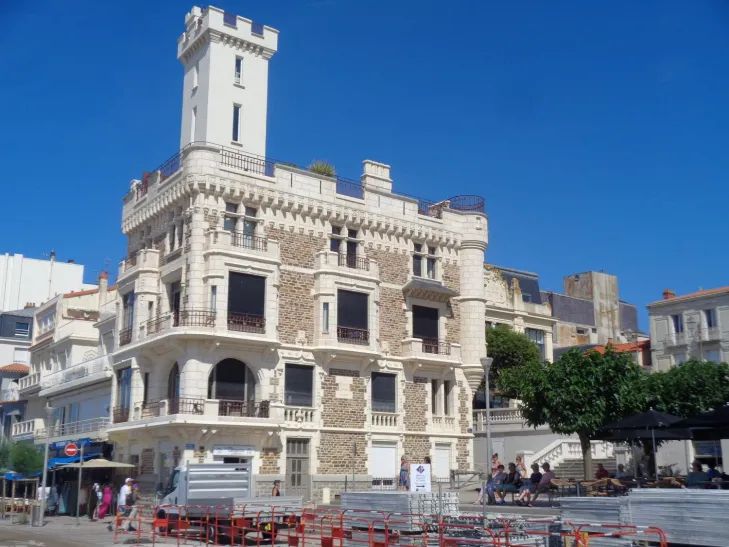
The Remblai or Embankment along promenades Lafargue and Clemenceau is home to many 19C villas facing the sea, the others being scattered throughout the town centre. Among the villas along the Embankment, one of the most emblematic is the Palazzo Clementina. Belonging to the seaside architecture of Les Sables-d’Olonne, The Palazzo Clementina at 10 promenade Lafargue, built on the Remblai in 1919, is emblematic of the extravagance of the villa architects. The architect joyfully mixed styles by superimposing machicolations, bay windows, roof terraces and Italian-style loggias! the palazzo is one of the castle-type villas since it borrows its eclecticism from Italian castles and palaces. On one side, the imposing façade gives the impression of a fortress, reinforced by the tower, watchtowers and arrow slits; on the other, various fanciful touches recall the holiday home. The seaside function is reinforced by the famous crenellated tower, similar to a lighthouse. Windows and terraces face the sea to give its occupants the enjoyment of an exceptional panorama.
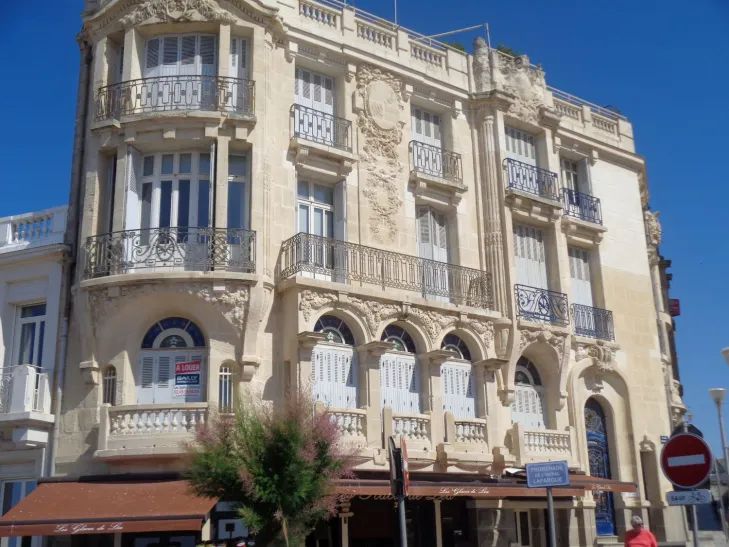
Another is the Villa Mirasol, consisting of four adjoining buildings, was built on the seafront in 1914. It features a luxurious apartment with reception areas, a smoking room, and a circular bedroom on the first floor overlooking the ocean. From the outset, the Mirasol building featured a commercial ground floor, notably occupied by a tea room. The servants’ entrances were separate from the main entrances overlooking Rue Travot. The six bay windows are framed by pilasters and feature a cartouche-shaped dormer window surrounded by plant ornaments, such as garlands of flowers, a shell, or a head of Neptune. The Mirasol appellation is inscribed on a large cartouche framed by interlacing flowers. A scene depicting grape harvesters adorns the side carriage entrance. Originally built to protect the city from the assaults of the sea and silting, the Remblai quickly became the flagship promenade of the Sables coastline. At the end of the 19C, a few architects gave free rein to their imagination with the creation of villas typical of seaside architecture. It did not take more to inaugurate the Remblai promenade on August 6, 1950. The work on the Remblai between 1949-1950 also included the creation of three semi-circular rotundas, between Place Foch and Promenade Joffre. These latter then served as bars or puppet theaters. Nowadays, these rotundas have become beach bars and restaurants, with a breathtaking view of the Bay of Sables and its beaches. Built on a former blockhouse, this four-sided, 8-meter-high clock tower or pendulum was inaugurated on July 1, 1956. Since then, it has been known as a must-see meeting place, easily spotted by all.
Other things to see here are the Sainte-Croix Abbey Museum, the MASC (modern and contemporary art): with works by Victor Brauner, Gaston Chaissac, Philippe Cognée, Claude Viseux, Robert Combas, René Leleu, Albert Marquet, Peter Saul, etc., a room dedicated to popular arts and seaside practices, a series of conferences on modern art organized by the Society of Friends of the Museum, The Blockhaus-Hospital of Les Sables-d’Olonne, built by the nazis in 1943 and transformed into a museum on WWII, open to the public in 2017. The Château Saint-Clair, which houses the lighthouse known as the “Arundel Tower” at the top of its dungeon.
You find the Church of Sainte-Marie d’Olonne The basilica style of the oldest building in the Pays des Olonnes, used by the Carolingians, suggests that the church of Sainte-Marie d’Olonne existed before its first mention in 1042. The church burned down twice during the Wars of Religion and its furnishings were used as firewood by the troops stationed at Pierre Levée’s camp during the Vendée Wars. Marked by the revolutionary episode as its spire and roof had, according to the memoirs of the shipowner Collinet from Sables-d’Olonne, burned in 1797 after being struck by lightning, the church did not regain its roof until 1805.
The Saint-Jean d’Orbestier Abbey, Benedictine abbey founded in 1107 by William, Count of Poitou and Duke of Aquitaine , The Château de Pierre-Levée was built on the model of the Petit Trianon at Versailles in the 18C. Completed in 1777, the château was the site of a camp housing some of the troops responsible for defending the port of Les Sables during the Vendée wars. Several parts of the château (private property). The entrance to the main courtyard is through a beautiful wrought iron gate. The château has gardens from which the statues of naked goddesses that originally adorned it were removed in the 19C.
The Tanchet beach (shared with Les Sables d’Olonne); the Puits d’Enfer, a natural notch into which the ocean rushes at high tide; the dunes of Puits d’Enfer; the cove of Saint-Jean-d’Orbestier; the cove of Moines; the Bois Saint-Jean and its bunkers, remains of the Atlantic Wall; the bay of Cayola and its pebbles. This area is crossed by a cycle-pedestrian path. you find the plage de Sauveterre beach, a famous surfing spot; Granges beach located to the north of the village between the Olonne forest and the Havre de la Gachère channel which marks the separation with the towns of Brem-sur-Mer and Bretignolles-sur-Mer; Aubraie beach between Paracou beach (la Chaume) and Sauveterre beach; the Marais d’Olonne which begin at La Roulière, the old port of Olonne before it silted up.
The town of Les Sables d’Olonne on its heritage : https://ville.lessablesdolonne.fr/culture-patrimoine/patrimoine/architecture/
The Les Sables d’Olonne tourist office on its heritage: https://www.destination-lessablesdolonne.co.uk/faites-le-plein-de-culture-aux-sables-dolonne/
The Vendée dept 85 tourist office on Les Sables d’Olonne :https://www.in-vendee.com/24-hours-les-sables-dolonne
There you go folks, again, another gem of my belle France ! This is real country off the beaten path trails, Again, nice opportunity to see the town again, good for the soul and memories forever, Again, hope you enjoy the post on curiosities of Les Sables d’Olonne !!! as I
And remember, happy travels, good health, and many cheers to all !!!


