
Moving about in my road warrior mode I have come into a real find in my memorable City of Versailles, actually the Château de Versailles of many nice memories ,see my other posts on it, This is in my former Yvelines dept 78 of the Île de France region ,and my belle France. I have found me more pictures in my cd rom vault that should be in my blog for you and me, Therefore, here is my take on the Château de Versailles, part XII !!! Hope you enjoy the post as I.
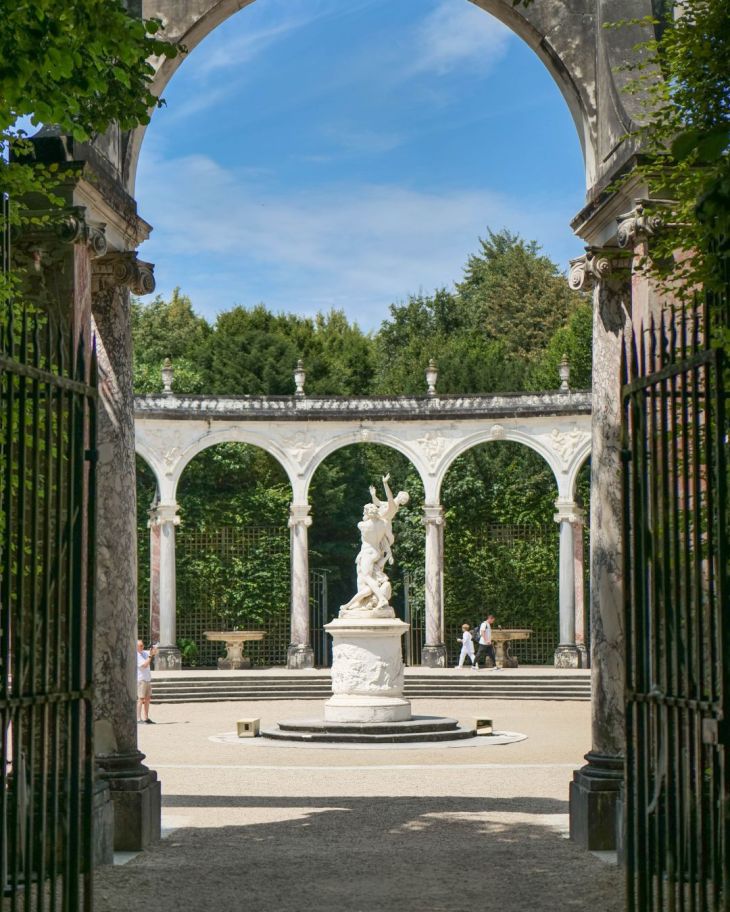
The bosquet de la Colonnade was created from 1678, thought of like a simple greenery room, André Le Nôtre enhances it by adding an existing stream, in order to create a grove with streaming winding among nine small islands. At that time, the grove took the name of bosquet of sources. In 1684, Jules Hardouin-Mansart completely changes the grove, creating a double peristyle with the arcs. The colonnade , name adopted for construction ,originally included 32 arcs and 31 fountains, each arc spanning a jet of simple water, gushing in a basin placed below, except one, reserved for the entrance to the grove. In 1696, the statue “Abduction of Proserpine”, one of the “kidnappings” of the large command of 1664, is installed in the center of the colonnade. The original has been kept since 1955 in the northern vestibule of the Orangerie, In 1704, three additional entries are added, reducing the number of fountains to 28, The colonnade grove is delimited to the west by the Apollo alley and to the south by the Mail alley. To the east is the Mirror basin, and at its northeast angle, the Saturn basin.
The Orangerie (see post) was created between 1684 and 1686, To the south of the Parterre d’Eau of Louis Le Vau was destroyed, in order to adapt the place for a new structure, designed by Hardouin-Mansart. In addition to the orangerie, the staircase of the hundred steps, which facilitates access to the gardens and the Piece d’Eau des Suisses, and the Parterre du Midi are designed and built at that time, giving to the southern gardens of the castle their current configuration and decoration. The orangery houses in winter more than 1,500 shrubs in boxes, mostly orange trees ,about 900, but also laurels, grenadiers or myrtles. In summer, from June 1 to October 10, orange trees and other boxes are exposed in the Parterre Bas. The orangery is under the Parterre du Midi. It is made up of a central gallery 150 meters long, the facade of which is oriented south. This gallery is framed by two side galleries located under the « escaliers des Cent Marches » or staircases of the hundred steps. The whole, lit by large arched windows, enclose the Parterre Bas or Parterre de l’orangerie. The Parterre Bas is delimited on its fourth side, to the south, by a balustrade overlooking the road to Saint-Cyr-l’École (D10). This separates it from the pièce d’eau des Suisses. In its center is a large circular basin, surrounded by six pieces of lawn. The Orangerie houses the proserpine kidnapping statue by Pluto (1696) by François Girardon
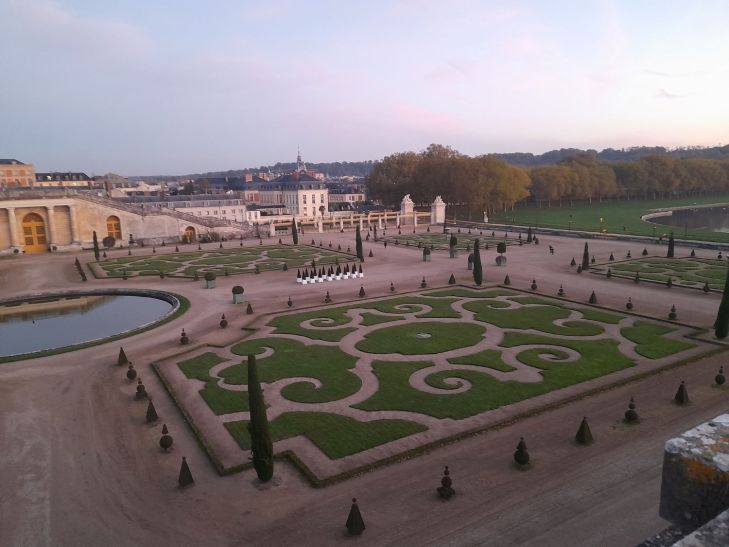
In the far right of the picture above, you can see the newer Airelles Château de Versailles, the Grand Contrôle, by 12 rue de l’Indendance American, with a view of the gardens of the Orangerie, the Pièce d’Eau des Suisses, and the castle, the Grand Contrôle hotel welcomes its hosts in a timeless atmosphere for an unprecedented experience. Today completely restored, this mansion was built in 1681 by Jules Hardouin-Mansart.
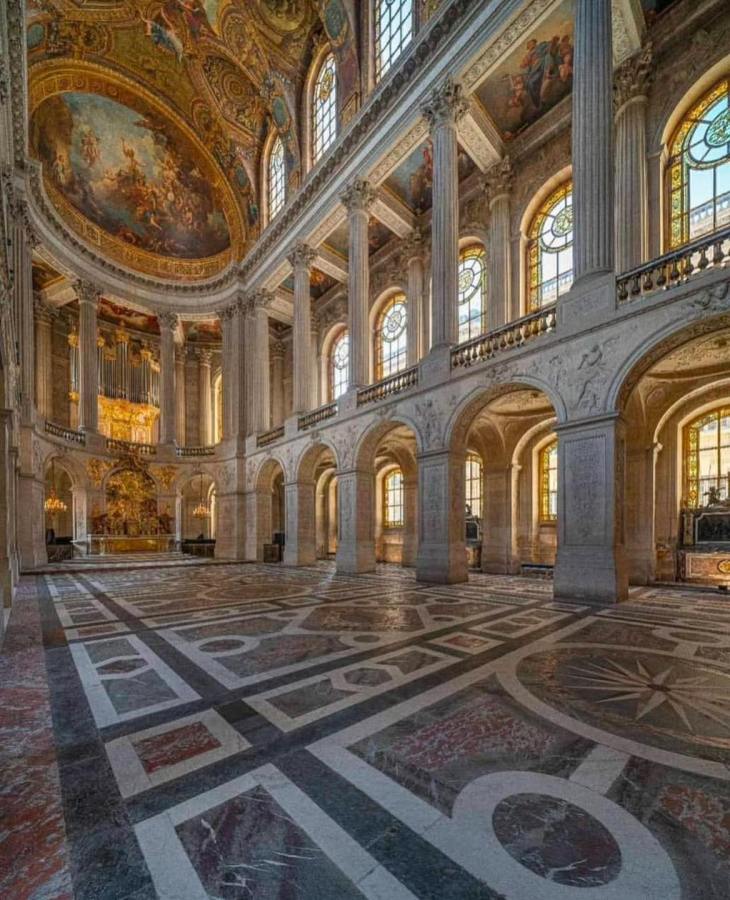
The Chapelle Royale (see post) is near the angle formed by the wing of the large king’s apartment and the north wing. Five sanctuaries followed one another, according to the architectural transformations of the castle. After a construction site in 1687. It is the part of the castle least modified by history. As early as 1663, a cramped sanctuary was housed in the northeast of the castle, at the site of the current golden cabinet of Madame Adelaide (see post). In 1670, the castle enlargement led to the displacement of the chapel to the south, on the site of the current queen’s guards room. The musicians take place on the ground floor. A new chapel, blessed on November 3, 1672, is installed on the site of the current so -called coronation room. In 1682, the Court moved to Versailles. The wing of the Midi is built and the chapel occupies a provisional location in the north, against the cave of Tethys. It takes up the disposition of the previous sanctuary. Designed to be provisional, the chapel of 1682 will be used for 28 years: it is the sanctuary that Louis XIV will have the most known. The first project of a centered plan chapel, in the middle of the northern wing, was formulated in 1679 and set up at the end of the year 1684, The final location of the chapel was found in 1687 the site is Interrupted for ten years by the Augsburg League War. It, then, resumed by Jules Hardouin-Mansart as the superintendence of buildings, after the death of Hardouin-Mansart in May 1708, Louis XIV assumed the functions of superintendent of his own buildings , On June 5, 1710, the chapel was blessed by Cardinal de Noailles , Archbishop of Paris, The one you see today all beautifully renovated to all its splendors.
The Château de Versailles on the Orangerie : https://en.chateauversailles.fr/discover/estate/gardens/orangery
The Château de Versailles on the bosquet or grove of the Colonnade : https://en.chateauversailles.fr/discover/estate/gardens/groves#colonnade-grove
The Château de Versailles on the Royal Chapel : https://en.chateauversailles.fr/discover/estate/palace/royal-chapel
There you go folks, a lovely setting indeed , and gorgeous views with plenty of architecture and history I like. The City will never be forgotten from my mind, sublime, tops and glad to find these gems to share with the world ; Versailles is it. An unique piece of architecture and gorgeous gardens in the sublime Château de Versailles . Again, hope you enjoy this post on the Château de Versailles, part XII as I.
And remember, happy travels, good health, and many cheers to all !!!

 Paris1972-Versailles2003