
I have come to this wonderful region of my belle France for its architecture, history, culinary delights and the Champagne, oh yes Champagne ! , especially the Champagne !! As said, it is a tradition in my house and makes it a good reason to come here, I like to dwell again into one of my favorite wine region, And yes this is the area of Champagne of my belle France, Therefore, here is my take on the unique Champagne houses !!! Hope you enjoy it as I.
I have a long history with the area of Champagne as on my dear late wife Martine side, her and the sisters/brothers started out working in the vineyards to help pay for their schooling and spare cash since early age. Of course, once I met her, the obvious first trip was to Epernay! We came with the maternal grandmother, my parents, and us. Later we came with the boys and to different areas from the big city Reims to smaller towns like Aÿ-Champagne. We all have the story on how it became , thanks to a king Henri IV and a monk Dom Pérignon, and the region is irrigated by the big river Marne; with 3 main grapes, pinot noir, pinot meunier ,and chardonnay. It is a protected brand name worldwide. Only those coming from here should be call Champagne.
The origin of the word champagne comes from the Old French term “canpayne.” Dating back to the 11C, this word means “large expanse of flat land.” It was the numerous open fields on pale plateaus that inspired the name of the Champagne region itself. There are four grape-producing areas that group together the 17 Champagne terroirs: the Montagne de Reims (Marne department 51); the Marne Valley (Marne 51, Aisne 02, and Seine-et-Marne 77); the Côte des Blancs (Marne 51); and the Aube vineyard, on the Côte des Bar (Bar-sur-Aube and Bar-sur-Seine in Aube 02). The Champagne terroirs are classified into three categories (cru or village): “grand cru” terroirs; “Premier Cru” terroirs; “Other Crus” terroirs. Of the 319 villages in the Champagne production area, only 17 are entitled to the “Grand Cru” appellation and 44 to that of “Premier Cru.” Only the half-bottle (37.5 cl), the 75 cl bottle, and the 1.5 l magnum, or two bottles, are commonly used. On a little more than 30 000 hectares of vineyards in total, it is the most northerly vineyard in France with 60 to 80 days of frost per year. It owes its wealth to its fragmentation, each village constituting a cru, that is to say the product of a terroir and a climate; there are 319 Crus. Some plots of the champagne appellation (20 ha) are found in Seine et Marne dept 77 towns of Citry, Nanteuil-sur-Marne and Saâcy-sur-Marne. The geographical area of AOC Champagne is made up of 635 towns.
I will do a brief note on the one tasted lately leaving the grand names out just to show the pearls you and I can have in my belle France, These are :
The Champagne de Venoge is a Champagne house located in Épernay. The house was founded in Mareuil-sur-Ay in 1837 by the Swiss Marc-Henri de Venoge, who quickly moved his activities to Épernay in 2015. The Champagne house of Venoge settled at 33 avenue de Champagne in a private mansion dating from 1900, the Villa Gallice. The house produces around 1,700,000 bottles per year, with vintages ranging from blanc de blancs to blanc de noirs. It notably produces a prestige vintage, the Cuvée des Princes. Created in 1851 the reference to the Cordon Bleu ,the symbol of the house of the riviére de Venoge, the most prestigieuse of the French monarchy ,the order of Saint Esprit , Pretty, slightly golden color, beautiful aromatic complexity combining notes of green apple, lemon and honey. Balanced, round, complex and subtle. Very good aging capacity. A Champagne of exceptional versatility, Blending of Pinot Noir 34% Chardonnay 33% Meunier 33% and Dosage 6,1%.

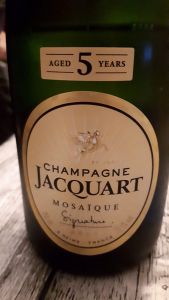
The vineyard selected for Champagne Jacquart now boasts a mosaic of more than 60 vintages among the 150 vinified each year and is the subject of attentive care by our partner winegrowers. 1964: Birth of Champagne Jacquart, Fame mounted on Pegasus becomes the emblem. 1968: Acquisition of 6, Rue de Mars: Les Mosaiques de Reims. 1992: Launch of the Mosaïque range. 2009: Move to the Hôtel de Brimont. Composition: Mosaique 40% Chardonnay 35% Pinot Noir 25% Meunier Including 25% to 35% reserve wines. Dosage: 9 to 10 g/l. Vinification: Alcoholic fermentation in temperature-controlled stainless steel vats. Malolactic fermentation. Maturation: 3 years in bottle on lees minimum. Rest in the cellar after dosage: minimum 3 months after disgorging. This product is available in several formats: half-bottle, bottle, magnum, jeroboam, methuselah, salmanazar, balthazar, nebuchadnezzar. The first Champagne tasted with my then girlfriend in Paris back in 1990;later my dear late wife Martine :it is the house champagne ever since,
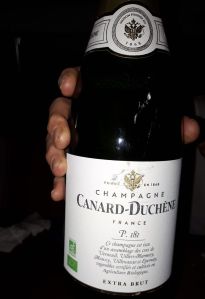
Champagne Canard-Duchêne founded in 1868 from the union of a cooper (Victor Canard) and a winemaker (Léonie Duchêne), the Champagne house Canard-Duchêne is located in Ludes, in the vineyards of the Montagne de Reims. It has belonged to the Alain Thiénot Group since 2004. Canard-Duchêne Extra-brut P.181 white made from a blend of three Champagne grape varieties, a tonic organic champagne with citrus aromas, whose low dosage underlines the freshness.
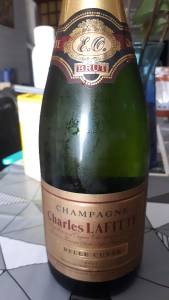
In 1983, Paul-François Vranken made the second major revolution with the creation of the Charles Lafitte champagne brand. The house produces elegant and very balanced champagnes. The traditional blend, dominated by Chardonnay, has certainly contributed greatly to the success of the house. The result is consistent, lively, and cheerful wines that flatter all palates. the location of the presses located in Tours sur Marne, Saudoy, and Merrey sur Arce. The grapes from the Aube, Sézannais, and Marne Valley are pressed on site in the vineyard, and the settled musts are transported by tanker trucks to the wineries. Champagne Charles Lafitte: Brut Belle Cuvée a non-vintage sparkling wine from Champagne, is a classic expression of this renowned region. While the cuvée is not specifically attributed to a grape variety, one can expect a typical blend of Chardonnay, Pinot Noir, and Pinot Meunier. Admire the fine, persistent bubbles, then smell the delicate aromas of white-fleshed fruit and brioche. On the palate, appreciate its liveliness and balanced structure.
Champagne Château de Bligny is the only Château to benefit the «title» of Château in the Champagne Region as a Grower Producer. A unique estate with an unprecedented heritage of history and winemaking. The Marquis de Dampierre builds the Château de Bligny on the foundations of a medieval castle feudal for hunting wolves. Le Baron de Cachard (ennobled by Louis XVIII), have bought the Château de Bligny. Winemaker and wine producer in Ardèche, he has decided in the 20th century to develop and to market sparkling wines from Bligny. These acquisitions are at the origin from the current Château de Bligny vineyard. Today, the Rapeneau family, 7th owner family has strived, since 1999, to perpetuate the heritage of the estate while providing expertise. The Grande Reserve composed equally of Chardonnay and Pinot Noir, the notes are autumnal and then turns to the yellow stone fruits. The mouth has a broad texture, very fleshy fruit, coupled with a natural richness. The yellow fruit is very colorful and the moist density increases. The walnut oil hides some cumin and chili flavors and the finish shows its very fine acidity.

Champagne Lagille et Fils in Treslon since 1818. Winegrowers since the 17C. Champagne Lagille et fils currently covers 7.20 hectares, planted 55% with Meuniers, 30% with Chardonnays and 15% with Pinot Noir. 95% of our vines are located in Treslon or on the edge of the village. With a strong specificity: working with a single grape variety. Only the Grande Réserve is a blended cuvée for us. For the rest, the choice was made to let our terroir speak through each grape variety. The Lagille et Fils Carte Blanche this designates a 100% Meunier blanc de noirs. A golden, brioche and toasted champagne, round and balanced, with good length.

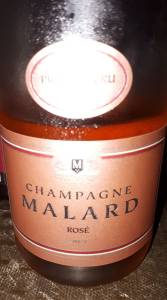
Founded in 1996 by Jean-Louis Malard, the headquarters of Maison Champagne Malard located in the heart of the famous village of AY, classified Grand Cru… The Malard family has been rooted in the world of wine for 3 generations, and this passion, born in Champagne, is transmitted and perpetuated to this day. Guided by the love of this profession, Jean-Louis Malard has been developing his own Champagne wines for almost 30 years… The Rosé cuvée which will be appreciated as an aperitif for its freshness, but also with shellfish, pink meats or desserts based on red fruits. Pink color with copper highlights, with a generous, fine and lively effervescence Delicate aromas of wild strawberries, raspberries and wild blackberries The fruit aromas are balanced by roasted nuances and scents of dried fruits. 90% Pinot Noir and 10% Chardonnay,
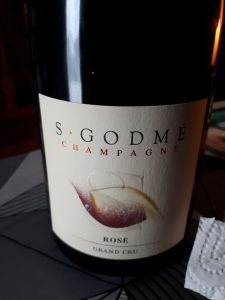
After a career in the wine and fruit growing industry in the USA, Sabine GODMÉ and her husband Jean Marie Guillaume have represented since 1994 the fourth generation of winemakers at Maison Champagne Godmé located in Verzenay , a Grand Cru village, They are thus perpetuating the GODMÉ brand created in 1930 by their grandparents and their parents Michèle and Bertrand. The next generation is already in place, with their children Marie and Matthieu. Verzenay, famous for its mill and its Lighthouse of the Montagne de Reims, the terroir is spread over 5 Grand and Premier Cru villages: Verzenay, Villers-Marmery, Verzy, Beaumont-sur-Vesle,and Montbré. The Rosé Grand Cru Blend: 50% Pinot Noir, 50% Chardonnay. From our Grand Cru villages: Verzenay, Verzy and Beaumont sur Vesle. Made with 40% reserve wines. Dosage: 7 g/l. A discreet and smooth dosage. Aging: 3 years. Nose: Deep and charming with notes of crushed raspberries and blackcurrant. The expression is harmonious and warm. Palate: Fresh, rich and dynamic. Well-balanced with good acidity. The body is supple. The finish is long, vinous and complex.
Maison Champagne Besserat de Bellefon founded in 1843 on the waterfront in the lands of Aÿ, Maison Besserat de Bellefon is now based in Epernay. In 1930, to meet the wishes of his customers and in a quest for excellence, Victor Besserat took on a challenge and designed a Champagne light enough to accompany an entire meal. He produced the famous “Cuvée des Moines” using a unique and singular process within the appellation. This from a bet from the director of the Samaritaine dept store in Paris, a selection of grapes from more than 50 crus, the majority of which come from Premiers and Grands Crus. The Bleu Brut reserve wines come from a “solera” blend initiated around twenty years ago. In the 1960s and 1970s, Maison Besserat de Bellefon was chosen to be the Champagne of the most beautiful cabarets in the world, including the famous Crazy Horse and Moulin Rouge. French airline Air France chooses the Champagne House Besserat de Bellefon for all its flights, including on the legendary Concorde. Besserat de Bellefon is tasted at the Elysée Palace during a lunch between François Mitterrand, President of the French Republic, and Helmut Kohl, Chancellor of the Federal Republic of Germany. On this occasion, the Besserat de Bellefon Cuvée BdeB and Brut 1979 cuvées were served. The Bleu Brut Besserat de Bellefon, historically sourcing from the best villages of Champagne. This cuvée represents a unique and singular production process perpetuated since 1930. Indeed, the house uses less tirage liqueur, which results in a lighter and airier prise de mousse. Its mousse is smooth, creamy, and persistent. Bleu Brut has the particularity of not having undergone malolactic fermentation. Its clear, mineral-filled appearance reveals the depth of an original balance. Full of fruit, spices and great energy, Bleu Brut is luminous and coppery, with great depth. A signature wine. Gateway to the house world. A blend of 45% Meunier – 30% Chardonnay – 25% Pinot Noir grapes from : Avize – Mesnil-sur-Oger – Louvois – Bisseuil – Vertus – Mareuil-sur-Aÿ – Grauves ,and Cumières The reserve wine is from 30% Solera ; dosage: 8g/L, Aging: 3 years on lees / minimum 6 months after disgorging.

The Union des Maisons de Champagne (UMC): https://maisons-champagne.com/en/
The Le Syndicat Général des Vignerons de la Champagne (SGV) : https://www.sgv-champagne.fr/
The Le Comité Interprofessionnel du Vin de Champagne (CIVC) : https://www.champagne.fr/en
There you go folks, a wonderful region of my belle France. The Champagne wines are dear to my family, and we have spent quite a bit of time in it from several years already even from before settling in France , A region of all its contours ,Champagne, a must visit,especially for its bubblies, me think, Again, hope you enjoy the post on the unique Champagne houses !!! as I.
And remember, happy travels, good health, and many cheers to all !!!

 Paris1972-Versailles2003
Lovely informative and interesting post about one of my favourite beverages
LikeLiked by 1 person
Glad you enjoyed it. Thanks for stopping by. Cheers
LikeLiked by 1 person