
We have driven in the area and stop by finally, and a great surprise indeed, This is the nice City of Beaugency in the Loiret dept 45 of the Centre Val de Loire region of my belle France, There is so much to see , and did see more for you and me, So close by it many times and finally in ,a great surprise, nice town indeed! Therefore, here is my take on curiosities of Beaugency, part I !!! Hope you enjoy it as I.
The town of Beaugency is located 29 km from Orléans, 8 km from Meung-sur-Loire, 24 km from Chambord, 147 km from Versailles, and 445 km from my current home, The town is crossed by seven departmental roads: a high-traffic road (the RD 2152), four moderate-traffic roads (the RD 19, 917, 918 and 925) and two low-traffic roads (the RD 719 and RD 925 north of the town). The RD 2152 is a high-traffic road. It is the old RN 152 which linked Briare to Angers via the right bank of the Loire when it was created in 1824, and which succeeded the Imperial Route 172. The A10 autoroute, known as “L’Aquitaine”, links Paris to Bordeaux aat its ring road via Orléans, Tours, Poitiers and Niort. It runs along the northern territorial boundary of the town, but has no exchange with its territory. The nearest access to this autoroute is the Meung-sur-Loire interchange, located 8 km away and constituting exit/sortie no. 15. The Le Mer interchange, constituting exit/sortie no. 16, is located 11 km away.
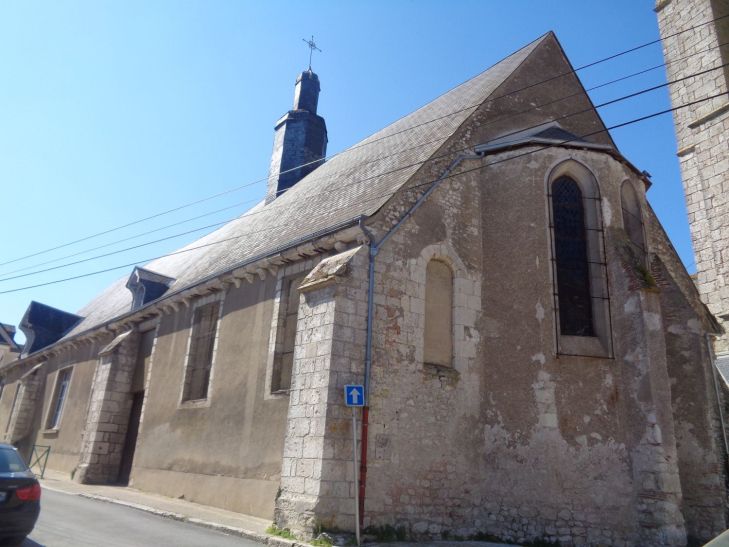
The Chapelle Saint-Thibault at the former Hôtel-Dieu,which was founded by the inhabitants of Beaugency. Thibault V, Count of Blois, made a substantial donation to it in 1176. From the 12C, only a building remains, serving as a sickroom, topped by the Saint-Thibault Chapel. Perhaps it is to Jean d’Orléans-Longueville that we owe the main chapel, which retains its coat of arms. I only took a picture from the back, for the memories of been there.
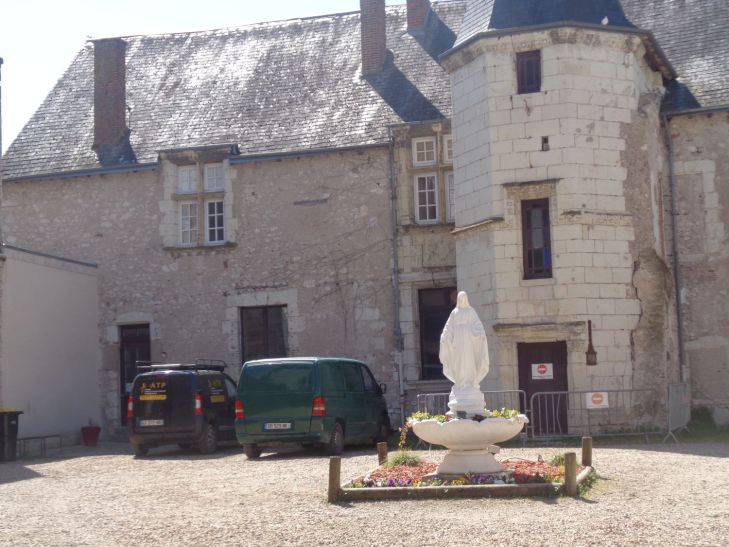
The 12C buildings of the Hôtel Dieu, with a magnificent 16C polygonal turret. ; today provides secondary education from grades 6 to 9, the Collège Maîtrise Notre-Dame – Groupe scolaire Charles de Foucauld belongs to the Catholic network of private schools.
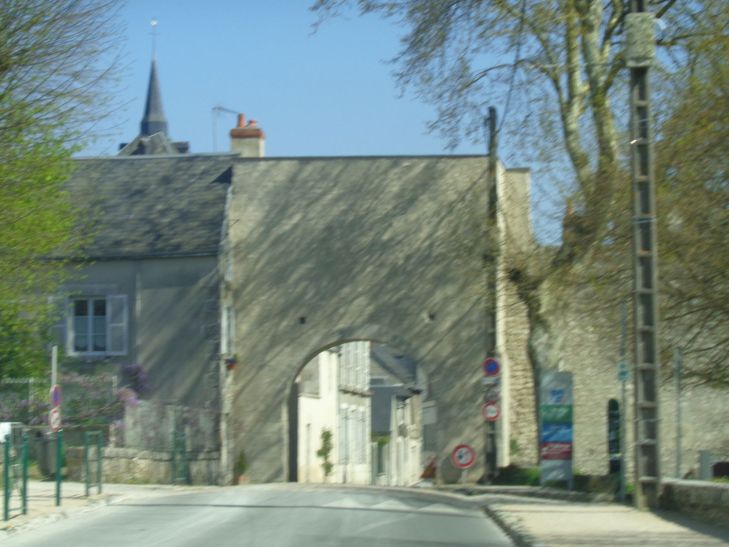
The Porte Tavers is the remnant of the last city wall, the old “Porte-Blésoise” (12C), defended the southern entrance to the city. It is one of the best-preserved Romanesque city gates. It is by 14 Rue Porte Tavers.
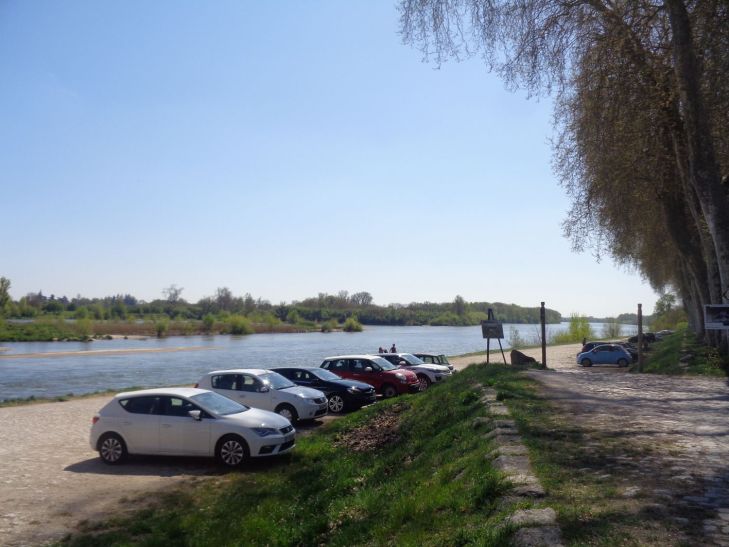
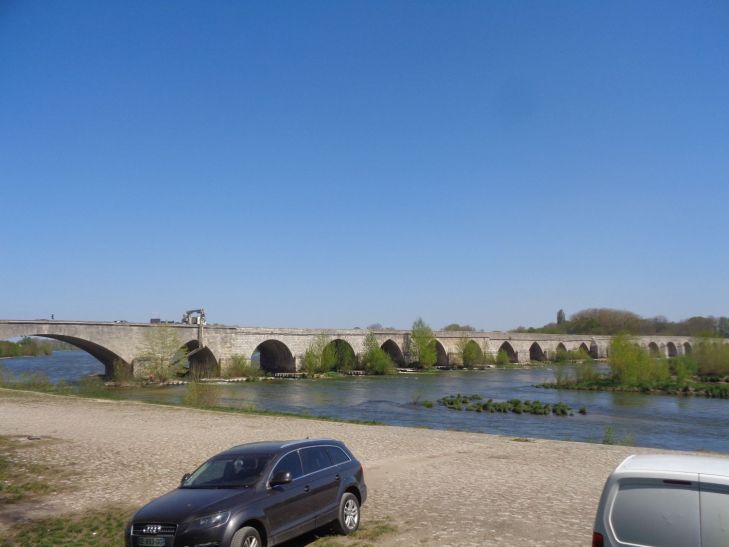
The Parking of the quai de l’Abbaye at 16 Pl. de la Motte is a beautiful place to park for free overlooking the Loire river and the Pont de Beaugency bridge, We did not parked here as prefer the Place Saint Fermin in old town center for free as well.
The Beaugency Bridge crosses the Loire and supports the D 925 departmental road which connects the town to Lailly-en-Val ,The bridge is in masonry. Although very old, the earliest elements are documented to date back to the 14C, the current bridge was completed in 1952., and no further major work until 1978., The bridge, 460 meters long, consists of 23 arches of different shapes and constructions from the 14C, an ogival arch, rebuilt in 1948; two semicircular arches rebuilt in the 18C and 19C; seven pointed arches dating from the 14C, except for arches 8-9 and 9-10, which were rebuilt in 1980; three semicircular arches (from piers 14 to 17) rebuilt in the 18-19C; five basket-handle arches rebuilt in 1948; two semicircular arches rebuilt in 1948. The span of the arches varies from 7 to 15 meters, except for the marine arch, and the width of the piers varies from 6 to 7 meters. The structure supports a 6-meter wide roadway bordered by two sidewalks varying from 1 meter to 3 meters.
A bit of history I like tell us that the site of Beaugency traces of Gallic occupation have been noted in addition to the keep and the lords’ castle, the castrum houses a complete abbey. The dynasty of the lords of Beaugency appeared at the beginning of the 11C in the orbit of that of the counts of Blois, of whom they were then vassals. Their fortress would constitute an important point of resistance against the attempts at encroachment by the kings of France, whose domain adjoined the land of Beaugency, until Philip the Fair acquired the place in 1292. The lords of Beaugency used in their arms the chess of Vermandois, apparently the first emblem used at the birth of the coat of arms, which was borne by seven families in the 13C and which displayed the pride of belonging to a lineage which, through Adelaide de Vermandois, wife of Hugh I of Vermandois, is of Carolingian and Capetian descent. The fame of the local lords was such that Beaugency was chosen to host two councils relating to the marital disputes of two kings of France: in 1104, King Philip I was summoned without success to separate from his illegitimate wife Bertrade de Montfort. Then, in 1152, King Louis VII the Young obtained the annulment of his marriage to Eleanor of Aquitaine. She was notably a stake in the battles of the Hundred Years’ War. Joan of Arc liberated the city from English occupation during her Loire campaign at the Battle of Beaugency just before her victory at Patay on June 18, 1429. At the end of the 16C, during the Wars of Religion, the city was repeatedly the site of violent fighting between opposing troops. The Huguenots burned down all the religious buildings in 1568. Four years later, they fell victim to the St. Bartholomew’s Day massacre. In 1562, the town was taken and pillaged by Protestants, and the women were raped. News of the St. Bartholomew’s Day massacre reached Beaugency on August 24, and the massacre of Protestants was repeated there. Between January 29 and February 8, 1939, more than 2,800 Spanish refugees fleeing the collapse of the Spanish Republic before Franco’s troops arrived in Loiret. Faced with the inadequacy of reception facilities in Orléans, 46 rural reception centers were opened, including one in Beaugency. Some of the refugees returned to Spain, encouraged by the French government, which facilitated the conditions for their return. Those who preferred to remain were grouped together at the Aydes glassworks camp in Fleury-les-Aubrais. Following the Allied landings in Normandy on June 6, 1944, nazis divisions, including “Das Reich,” stationed south of the Loire, moved north to meet the Allied troops. To halt this advance, the Allies decided to bomb all the bridges across the Loire. The bombardment of the Beaugency Bridge took place on June 14, 1944. On September 16, 1944, the Elster Column, commanded by General Botho Henning Elster, surrendered. Advancing from the southwest, it surrendered to General Macon, commander of the 83rd U.S. Infantry Division, in the presence of representatives of the 2nd French Armored Division. After fighting against the French internal resistance, General Elster had contact with the maquis in the northern Indre region and announced his intention to surrender, convinced that he could not return to Germany. However, he wanted his division to be disarmed by regular troops. The 18,850 soldiers and 754 officers of Elster’s division were disarmed at the southern entrance to the bridge.
The town of Beaugency on its heritage (see decouvrir, ma ville , au fil de monuments) :https://www.beaugency.fr/
The local Terres du Val de Loire tourist office on Beaugency : https://en.tourisme-terresduvaldeloire.fr/beaugency-5/
The Loiret dept 45 tourist office on Beaugency : https://www.tourismeloiret.com/fr/voir/villes-villages/beaugency
There you go folks, a dandy area to explore and enjoy with the family, Memorable moments in my belle France, going all over in my road warrior trails brings out sublime awesome spots with nice memorable family visits of yesteryear always remember and always looking forward to be back, eventually. Again hope you enjoy the post on curiosities of Beaugency, part I !!! as I.
And remember, happy travels, good health, and many cheers to all !!!


💙
LikeLiked by 1 person
Thanks for stopping by Cheers
LikeLike
my uncle, lt Sam Magill was the person responsible for negotiating the surrender by General Elster. He drove his jeep to the town of Issoudun at first met with Elster on Sept. 7, 1944. He drove back to his General Macon who could not help Sam with a show of force. Sam’s jeep driver came up with the idea to have bombers provide a show of force to Elster. Sam arranged for the bombers and basically tricked major General Elster to surrender when 16 thunderbolt bombers flew overhead on Sept 8 in Issoudun. Sam then had to arrange three columns of 20,000 Germans to the formal surrender on Sept. 16 on the Beaugency bridge. There is a lot of info on line and on you tube. Check out “the nervy exploit of Sam Magill.”
A fascinating story.
LikeLiked by 1 person
Thanks for sharing yours and stopping by Cheers
LikeLike