
Several years back while visiting my belle France, took a ride into this area. Not aware had some older paper picture in my vault and glad to found them! Not the best quality shots but is all I have for the memories of always. Not back since but left a nice impression ,and hope to be back, eventually. I like to tell you a bit about this town taking advantage of these much older pictures. Therefore, here is my take on this is Le Puy Velay !!! Hope you enjoy the post as I.
The city of Le Puy-en-Velay is in the Haute-Loire dept, no 43 in the Auvergne-Rhône-Alpes region of my belle France. The city is renowned for its manufacture of Puy lace, the culture of the green lentils of Puy and the production of verveine du Velay. It is also known to be the departure of via Podiensis, one of the four French component paths to Santiago, It is 133 km from Lyon, 110 km from Valence, 132 km from Clérmont-Ferrand, 544 km from Versailles, and 792 km from my current house, the city is mainly crossed by the N88 road, historically connecting Lyon and Toulouse, and by the N102 to reach A 75 to the north direction Clermont-Ferrand, and Montélimar in the south, via Pradelles.
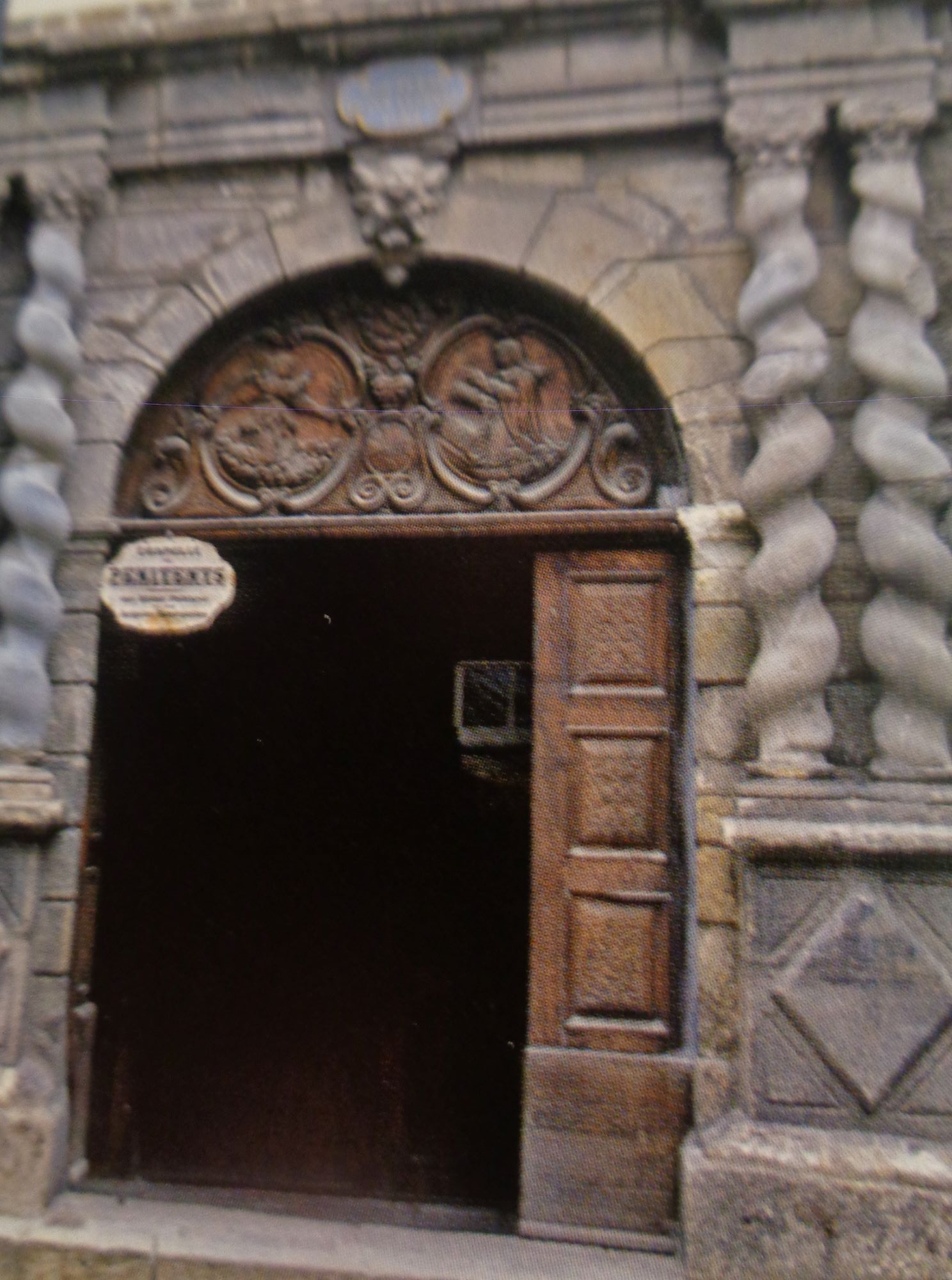
The Chapelle des Pénitents Blancs or Chapel of the White Penitents at 5 rue du Cloître, tell that in 1584, Madame Jacqueline d’Aumont, offers the brotherhood of white penitents a home very close to the cathedral. The brotherhood was installed in 1586 by Bishop Antoine de Séneterre. During the French revolution, the corporation of butchers settled in the chapel and use it as deposit and dryer of leathers to save it from destruction by the revolutionary committee. The brotherhood of the White Penitents of Puy is still active and strong with 45 men and women today, The chapel is home to beautiful remarkable paintings from the 12C, and 13C, and a recumbent in a series of large -format paintings which tell episodes of Saint Mary’s life. You can also admire a ceiling made up of 75 caissons from the 17C and whose central motif is the assumption of the Virgin. Each year, white penitents participate in the procession on Good Friday. On this occasion, they carry the instruments and emblems of the passion that can be seen in the chapel as well as the brotherhood sticks and procession lanterns.
Other things to see here, me think ,are: Puy-en-Velay is classified as a city of art and history, and presents a safeguarded sector extending over 35 hectares the old town allows you to travel several centuries of architecture, The Cathédrale Notre-Dame-de-l’Annonciation (see post) was erected as a minor basilica by a brief apostolic of Pius IX, on February 11, 1856. A black virgin, object of many pilgrimages during the centuries, throne on a Baroque high altar. The current effigy replaces that which would have been offered by Saint Louis on his return from the Crusade of Egypt, and which was burned during the French revolution. The Saint-Jean baptistery hidden behind the cathedral dating from the 10C to the buildings of rue Pannessac whose facades allow to travel the civil architecture from the 18C. Roman sculptures are fattened within the walls of the Cathedral, The Rocher Corneille with the statue of Notre-Dame de France: from the platform we have a beautiful view of the red roofs of the city. The rock is surmounted by a statue of the Virgin Mary, which measures more than 16 meters and weighs 110 tonnes, painted in red. It was erected in 1860 with the cast iron of 213 cannons from the capture of Sébastopol in 1855 during the Crimean War and given by Napoleon III, The Hôtel-Dieu and his hospital pharmacy experienced ten centuries of hospital activities. The City Hall built in 1764, completed in 1766 ; the Saint-Laurent Church, former Dominican church, at boulevard du Docteur-André-Chantemesse. The Saint-Georges Church, former chapel of the Jesuit college of Puy known as the Church of the College, at rue Bessat, the Saint-Pierre-des-Carmes Church, former church of Carmes,at avenue de la Dentelle, The Saint-Georges Chapel, Chapelle du Grand Séminaire, at rue Saint-Georges. The convent of the Visitation, at rue de la Visitation.The municipal theater in the Italian style, built in 1887, inaugurated in 1893 by Raymond Poincaré, The Place du Plot, and Fontaine du Plot, or Fontaine de la Bedoyre, built at 13C, partially destroyed and rebuilt in the 18C, destroyed in part and rebuilt in the 19C, and the Place du Breuil, and its Crozatier fountain, built from 1857 to 1859.
A bit of history tell us that in the 9C, the cult of the Virgin is large enough for the city to change its name ‘Anicium in Le Puy Notre-Dame. From the 10C, the Velay became a county bishopric, for the benefit of the Bishop of Puy. The city became the capital of Velay, seat of the county and the bishopric, The city became more when Saint Louis donated a piece from the Black Virgin. From then on, Puy experienced great prosperity, due to the arrival of thousands of pilgrims. This pilgrimage of the Puy remained, throughout the Middle Ages, the most renowned in France, especially since one of the four major tracks leading to Saint-James of Compostela was there. Bishop Godescalc is cited as the first pilgrim in Compostela in 951. In 1138, King Louis VII the young is with his court at Puy where he celebrated the Festival of the Annunciation of the Virgin , In 1142, Raymond II, count of Tripoli, son of Pons de Saint-Gilles, gives the Bishop of Puy, Humbert d’Albon, all he has in the “county of the Vellaves”. This is the first mention of a county of Velay. The city surrounds itself with ramparts between 1220 and 1240 which will serve as a limit until the 18C, the Pannessac tower is one of its vestiges, The first mention of the Hospitallers of the Order of Saint-Jean de Jerusalem dates from 1153. The Puy always victoriously resisted the attacks of the Huguenots Cévenols who subjected great damage to the city for long months, Puy refused to recognize Henri IV as King of France despite his abjuration. The city was confined to the 1760s with the interior of its surrounding wall and then extends through the opening on the Breuil in 1786. Following the French revolution, the provinces disappear and are replaced by the departments. The Velay becomes the Haute-Loire, with the Le Puy as chief town.
During the Great War or WWI, three regiments started from Puy: the 86th active infantry regiment confined to the Romeuf barracks, the Mouton Duvernet barracks and the Grand Séminaire, the 286th reserve infantry regiment derived from the first and the 101st territorial infantry regiment ; two sites in the agglomeration served as a prison. The first is the former orphanage of La Roche-Arnaud (now disappeared) where German military officers were locked up. The second site is that of the former Charterhouse in Brives-Charensac (today the paradise-la-chartreuse school group) whose buildings were used to imprison up to 600 civil internees (Germans, Austro-Hungarian, Alsatian-Lorraine). During, WWII, the city “adopted” the city of Châtillon-sur-Seine largely destroyed by bombings on May 15 and June 15, 1940, The city was in 1942 the place of an important pilgrimage to the youth of France, organized by Father Paul Donoeœur. The city received many Alsatian Jews whom joined in its population at the end of the WWII, the city is liberated by the Resistance The Liberation of Puy is effective with the arrival of the 1st DB which belongs to the 1st army of General de Lattre in early September 1944.
The Puy en Vélay tourist office on its heritage: https://en.lepuyenvelay-tourisme.fr/explorer/patrimoine/tous-les-sites-de-visites/recherche/commune/le-puy-en-velay/
The Haute Loire dept 43 tourist office on Le Puy en Vélay : https://www.myhauteloire.fr/en/patrimoine/villes-et-villages-de-caracteres/le-puy-en-velay-patrimoine-mondial-de-lunesco/
The official plus beaux detours de France on Le Puy en Vélay: https://www.plusbeauxdetours.com/tous-les-plus-beaux-detours/detour-par-le-puy-en-velay-en-haute-loire/
There you go folks, another spot in my world map or rather France’s map. Glad to have found the old pictures to give credit to Le Puy Velay in my blog; good for the memories of always. Again, hope you enjoy the post on this is Le Puy Velay as I.
And remember, happy travels, good health, and many cheers to all !!!

 Paris1972-Versailles2003
I visited le Puy-en-Velay when I lived in the Rhône-Alpes region; I went around the time their famous Renaissance festival was taking place, but despite the crowds, it’s such a gorgeous little town!
LikeLiked by 2 people
Hard not to like a town in my France. Thanks for stopping by Cheers
LikeLiked by 2 people